

Literature Review vs Systematic Review | Difference Between a Systematic Review and a Literature Review
 By Dr. Robertson Prime, Research Fellow
Updated November 17, 2026
16 min read
About 3,200 words
Students often ask about literature review vs systematic review: are they the same thing, and which one should you write? Both summarize existing research, but they are built in very different ways.
In the literature review vs systematic review comparison, a traditional literature review discusses key studies to build an argument, while a systematic review follows a pre-set protocol to find, appraise and synthesize every eligible study on a specific question.
This guide explains literature review vs systematic review in detail. It defines each one, sets out seven key differences in a side-by-side table, shows where scoping reviews and meta-analyses fit, and gives you a step-by-step way to decide which your program expects.
- The definitions: what a traditional literature review is, what a systematic review is, and why systematic review methods have their roots in evidence-based medicine.
- The differences: seven key similarities and differences, from the research question and search strategy to appraisal, synthesis and reporting.
- The decision: how to choose between them, what the disadvantages of systematic reviews are, and how to describe your choice in your methods.
On this page
Key takeaways
- The core of literature review vs systematic review is method: a systematic review follows a protocol that another researcher could repeat.
- A traditional literature review selects the most relevant studies and organizes them into an argument, usually by themes.
- Systematic review methods include explicit eligibility criteria, a full search, formal appraisal and transparent reporting.
- Most dissertation chapters are traditional literature reviews; some programs, mainly in health, require a systematic review.
Literature Review vs Systematic Review: The Quick Answer
In the debate on literature review vs systematic review, the simplest answer is this: every systematic review is a literature review, but not every literature review is systematic. A systematic review is one specific, highly structured type of review.
- Traditional literature review: it provides an overview of what is known about a particular topic. The author chooses the most relevant sources, groups them by themes and builds an argument that usually leads to a research gap. It is flexible and interpretive, and it is the kind of review most students write for a dissertation chapter.
- Systematic review: it asks a specific question, such as whether a treatment works, and answers it using all the available evidence. It uses a set of pre-specified criteria, searches several databases, screens every record, appraises each included study and reports the whole process so that it is reproducible and defined.
- The key difference: in systematic review vs literature review, the difference is therefore not the topic or the length, but the method. A systematic review describes the review’s methods in enough detail that someone else could repeat it and reach similar results.
What Is a Traditional Literature Review?
A traditional literature review, also called a narrative review, is a critical discussion of the existing literature on a topic. It is a central part of academic research, appearing in theses, dissertations, journal articles and course papers. In literature review vs systematic review comparisons, it is the flexible option.
- Its purpose: a traditional literature review maps the existing research, explains the main debates, evaluates the evidence and identifies gaps in the literature. In a dissertation, it builds the case for your own research question.
- How sources are chosen: the author selects the studies that matter most, based on relevance, quality and influence. A good traditional literature review still explains how sources were found, but it does not have to report every record screened.
- How it is organized: usually by themes, sometimes by time period, method or theory. Each section synthesizes several studies to make a point, rather than describing them one by one.
- What it is good at: broad or complex questions, theory, the history of an idea and topics where the evidence comes from many different kinds of studies. It is also realistic for one researcher working to a deadline.
- Its main weakness: because selection depends on the author’s judgment, a traditional literature review can be biased toward studies the author already knows or agrees with. Literature reviews don’t usually apply formal appraisal tools, so readers rely on the author’s fairness.
To write one well, follow our step-by-step guide on how to write a literature review, and see how to make it evaluative in our guide to the critical literature review.
What Is a Systematic Review?
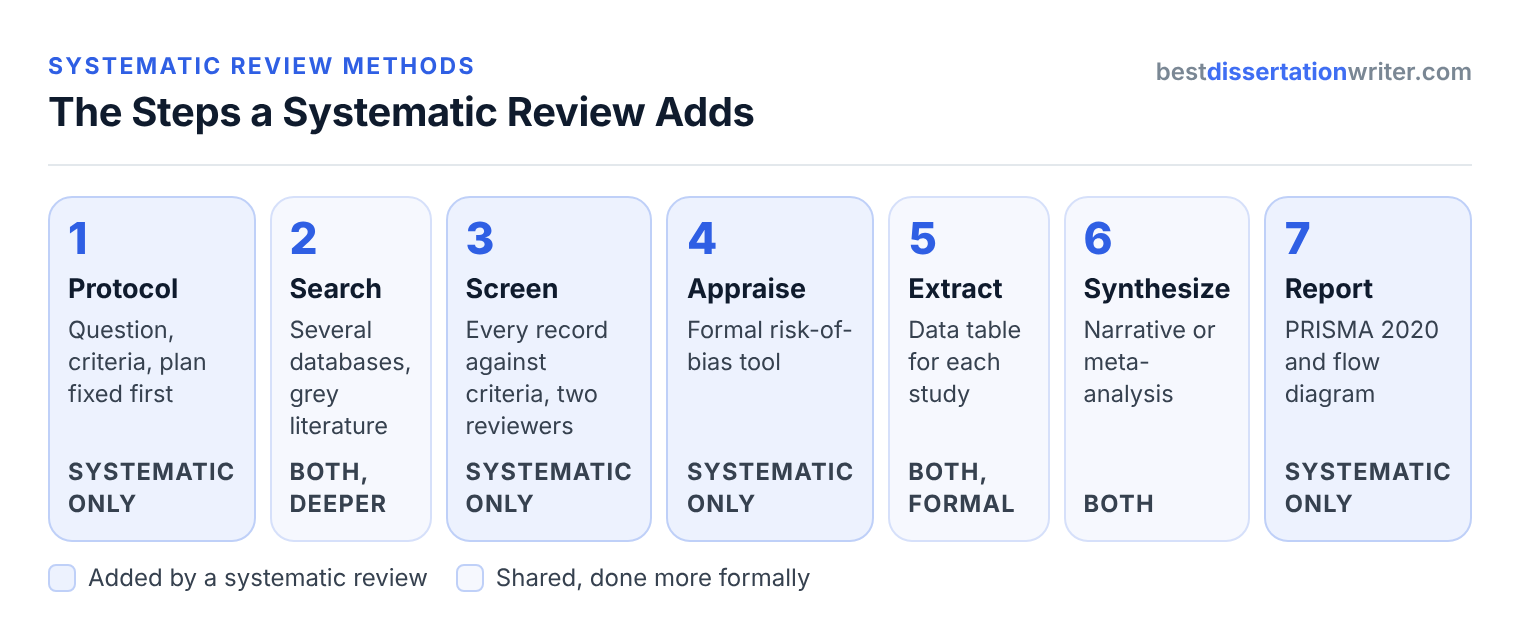
A systematic review is a review that uses explicit, pre-planned systematic review methods to find, select, appraise and synthesize all the studies that answer a specific question. Systematic review methodology has its roots in evidence-based medicine, where clinicians needed reliable summaries of whether treatments work. It is the structured side of literature review vs systematic review.
- A specific question: systematic reviews ask a specific question, often framed with a tool such as PICO (population, intervention, comparison, outcome). A clinical question like “Does exercise reduce depression in older adults?” is typical.
- A protocol: before searching, the review team writes a protocol setting out the question, search strategy, inclusion and exclusion criteria and analysis plan. Many reviews register their protocol publicly so that changes can be seen.
- A comprehensive search: the search covers several databases and often grey literature, such as reports and theses, to reduce the risk of missing studies.
- Screening and appraisal: records are screened against the eligibility criteria, ideally by two reviewers working independently, and the quality or risk of bias of each included study is assessed with a formal tool.
- Synthesis and reporting: findings are combined in a narrative synthesis or, where studies are similar enough, a meta-analysis that produces effect estimates using statistical methods. Reporting usually follows the PRISMA 2020 guidance, the preferred reporting items for systematic reviews and meta-analyses.
The Cochrane Handbook is the standard reference for systematic review methods in health research. Our guide to the systematic literature review structure shows how the finished review is laid out.
Systematic review vs systematic literature review: is there a difference?
You will see both terms in published research, and they usually mean the same thing. “Systematic literature review” is common in education, business and the social sciences, while “systematic review” is the usual term in health research.
- Same methods: both follow a protocol, search comprehensively, apply explicit criteria and appraise the included studies. The methods used, not the name, decide whether a review is systematic.
- Different traditions: health reviews often focus on the effectiveness of a treatment, while a systematic literature review in management or education may synthesize research evidence on practices, policies or experiences.
- Same comparison: in systematic review vs literature review terms, both sit on the systematic side. A traditional literature review or other narrative reviews sit on the other.
Literature Review vs Systematic Review: 7 Key Differences
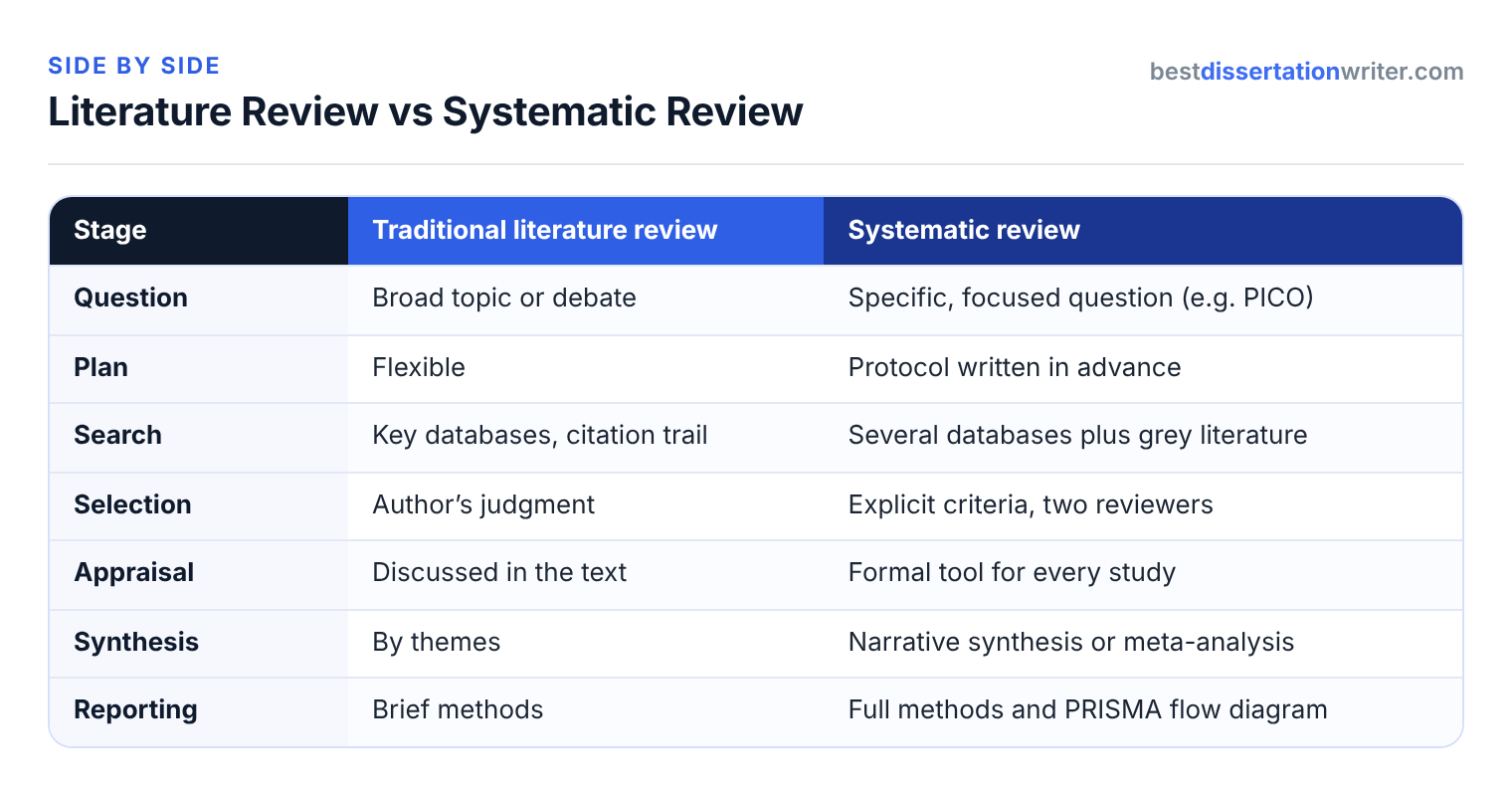
The table sets out the main differences in literature review vs systematic review. Each difference is explained in more detail below it.
| Feature | Traditional literature review | Systematic review |
|---|---|---|
| 1. Question | Broad topic or debate | Specific, focused question |
| 2. Protocol | Not usually written in advance | Written, often registered, before searching |
| 3. Search | Focused, selective | Comprehensive, several databases and grey literature |
| 4. Selection | Author’s judgment | Explicit inclusion and exclusion criteria, screened by two reviewers |
| 5. Appraisal | Informal | Formal quality or risk-of-bias tools |
| 6. Synthesis | Narrative, by themes | Narrative synthesis or meta-analysis |
| 7. Reporting, time and team | Brief methods, weeks, often one author | Full methods and flow diagram, months, a review team |
The difference between a systematic review and a literature review, step by step
The seven differences below explain the table in more depth. Together they show why the systematic review and a literature review take such different amounts of time.
- The research question. A traditional literature review can address a broad research topic, such as how leadership in schools has been studied. A systematic review needs a specific research question, because every later step, from the search terms to the eligibility criteria, depends on it.
- The protocol. Systematic review methods start with a protocol that fixes the plan before any searching happens. This prevents the reviewers from changing the criteria once they see the results, which is one of the main sources of bias that systematic reviews try to remove.
- The search strategy. A traditional literature review searches the databases most likely to hold relevant work and follows citations. A systematic review searches several databases with a documented search strategy, records the date and number of results, and often searches grey literature so that unpublished studies are not missed.
- The selection of included studies. In a traditional literature review, the author decides what to include. In a systematic review, every record is checked against written eligibility criteria, ideally by two people independently, and disagreements are resolved by discussion or a third reviewer.
- The appraisal of quality. Literature reviews often comment on study quality in the text. Systematic reviews apply a formal tool to each included study and report the results, so readers can see how much confidence the findings deserve.
- The synthesis. A traditional literature review synthesizes by discussion, usually theme by theme. A systematic review uses a defined method: a structured narrative synthesis, or a meta-analysis that combines the type of data each study reports into an overall estimate.
- Reporting, time and team. A traditional literature review describes its search briefly and can be written by one person in weeks. A systematic review reports every step, includes a flow diagram of records found and excluded, and usually takes a review team many months.
Where Scoping Reviews, Systematized Reviews and Meta-Analysis Fit
The literature review vs systematic review question is not a strict either/or, and systematic review vs literature review is better seen as a range. Several other review types sit between the two, and it helps to know them.
- Scoping review: a scoping review uses a systematic search to map how much research exists on a broad topic and what kinds of studies have been done. Unlike systematic reviews, it usually does not appraise each study in depth, and it is often used to identify gaps in the literature before a full systematic review.
- Systematized review: Grant and Booth (2009) use this term for reviews that include some elements of systematic review methods, such as a documented search, without meeting all of them. Many student projects that use systematic review methods with a single reviewer fall into this group, and describing them honestly protects you at assessment.
- Rapid review: a rapid review uses systematic methods but simplifies some steps to deliver results quickly, and it states which shortcuts were taken.
- Meta-analysis: a meta-analysis is a statistical step, usually inside a systematic review, that combines effect estimates from similar studies. This is why systematic reviews and meta-analyses are so often published together, but not every systematic review includes a meta-analysis.
For a fuller comparison of these review types, see the typology of reviews by Grant and Booth (2009), which describes 14 review types and their methods.
Literature Review or Systematic Review? How to Decide
Deciding on literature review vs systematic review is mostly practical. Work through these steps in order.
- Read your program’s requirements. Your handbook or supervisor decides first. If the assignment says “systematic review”, you need systematic review methods; if it says “literature review chapter”, a traditional literature review is almost always expected.
- Check the shape of your question. In systematic review vs literature review terms, a specific question about effects, such as whether an intervention works, points to a systematic review. If it is broad, theoretical or about how a topic is understood, a traditional literature review fits better.
- Estimate the evidence. Run a quick search in one or two databases. A handful of studies suggests a traditional literature review or scoping review; many similar studies with comparable outcomes may support a systematic review and even a meta-analysis.
- Be honest about time and people. Systematic review methods ideally need two reviewers and several months. If you are working alone to a short deadline, a well-documented traditional literature review or a clearly labeled systematized review is more realistic.
- Write your choice into your methods. Name the review type and explain why it suits your question. Examiners mark the match between label and method, so describe what you actually did.
Template
This study uses a [traditional literature review / systematic review] because [reason linked to the research question]. Sources were identified through [databases] between [dates] using [search terms]. [Inclusion and exclusion criteria] were applied, and [number] studies were included.
Pros, Cons and Example Wording
In literature review vs systematic review, neither type is better in every case. Each has strengths and disadvantages that matter when you choose.
Strengths and disadvantages of systematic reviews
- Strength, less bias: Pre-set criteria and a full search reduce the chance that the reviewer’s preferences shape the result, which is why systematic reviews are trusted in evidence-based practice.
- Strength, reproducible: Because the methods are reported in full, others can check or update the review.
- Disadvantage, time and resources: A full systematic review usually takes many months and a team, which is hard to fit into a single semester.
- Disadvantage, narrow scope: The specific question that makes a systematic review rigorous also limits it; it may say little about context, theory or why something works.
- Disadvantage, depends on the studies: If the included studies are few or weak, the review can only report that the evidence is limited.
Strengths and disadvantages of a traditional literature review and other narrative reviews
- Strength, flexible and broad: A traditional literature review can cover theory, history and different kinds of evidence in one argument.
- Strength, realistic for one person: It can be completed within a dissertation timeline while still being thorough.
- Disadvantage, risk of bias: Without explicit criteria, the selection of studies may be incomplete or one-sided, so a clear search description matters.
- Disadvantage, harder to repeat: Another researcher might choose different studies and reach different conclusions.
Describing your review honestly
Weak
“A systematic review of the literature was conducted using Google Scholar.”
One database and no criteria do not meet systematic review methods, so the label is misleading.
Strong
“A traditional literature review was conducted. Sources were identified through CINAHL, PubMed and Google Scholar using combinations of ‘nurse’, ‘burnout’ and ‘workload’, limited to peer-reviewed studies published since 2015.”
Names the review type accurately and describes the search clearly.
See an example methods paragraph for a systematic review (about 100 words)
“This systematic review followed a protocol written before the search began. MEDLINE, CINAHL and PsycInfo were searched from 2010 to [date], together with grey literature from trial registers.
Two reviewers independently screened titles, abstracts and full texts against pre-specified inclusion criteria, and assessed the risk of bias of included studies with a standard tool. Findings were combined in a narrative synthesis, and the review is reported following the PRISMA 2020 statement.”
Why literature review vs systematic review matters for your grade
Examiners mark the match between what you call your review and what you actually did. Choosing the right side of literature review vs systematic review, and describing it accurately, protects your marks.
- Accurate labels earn credit: a well-described narrative review that summarizes the available literature clearly is marked as a strong narrative review. Calling the same work a systematic review invites criticism for missing steps.
- Methods must match the label: if you claim systematic review methods, examiners will look for a protocol, criteria, screening and appraisal. If they are missing, the review looks weaker than it is.
- Purpose guides the choice: reviews that evaluate the evidence and provide summary information for practice suit systematic methods; reviews that provide an overview of a field for a dissertation suit a narrative approach, including literature reviews that combine theory and research.
For complete samples of both kinds, browse our literature review examples. For the bigger picture, see our guide on how to write a dissertation.
FAQs on Literature Review vs Systematic Review
Is a literature review a systematic review?
Not necessarily. A systematic review is one type of literature review, but most literature reviews are not systematic. A traditional literature review selects and discusses key studies to build an argument, while a systematic review follows a protocol, searches comprehensively and applies explicit criteria to every study.
So every systematic review is a literature review, but a literature review is only systematic if it uses systematic review methods. Check your assignment wording, because literature review vs systematic review is a choice between very different amounts of time and documentation.
What are the disadvantages of systematic reviews?
Systematic reviews take a lot of time and usually need a team, because they involve a protocol, a comprehensive search, independent screening and formal appraisal. Their focus on a specific question can also make them narrow, saying little about theory or context.
Their conclusions are only as strong as the included studies, so a review of few or weak studies can only report limited evidence. They can also date quickly in fast-moving fields unless they are updated. Weigh these limits carefully when you decide on literature review vs systematic review for your own project.
Is a systematic review qualitative or quantitative?
It can be either, or both. A systematic review of trials may be quantitative and include a meta-analysis that combines effect estimates statistically. A systematic review of interview studies is qualitative and may use methods such as thematic synthesis.
Mixed methods systematic reviews bring both kinds of evidence together. What makes a review systematic is its method, the protocol, search, criteria and appraisal, not whether the included studies are qualitative or quantitative. That is also the real dividing line in literature review vs systematic review: the method, not the type of data.
Can a student do a systematic review alone?
A student can carry out a review that uses systematic methods alone, but a full systematic review normally involves at least two reviewers, especially for screening and appraisal. Many programs accept a single-author review if its limits are stated honestly.
Such work is often described as a systematized review or a review using systematic methods. Ask your supervisor what your program accepts, and in your methods, state clearly which steps you did alone and how you checked your decisions. Being transparent matters more than the label, so describe exactly what you did.
Best Dissertation Writers
Need help with your literature review?
Get a critical, well-structured review with current sources and a clear research gap.