The Use of Cognitive Behavioural Therapy Techniques in Mental Health Nursing Practice: A Narrative Review
 By Dr. Robertson Prime, Research Fellow
Updated October 12, 2026
16 min read
About 3,100 words
In this review
Abstract
Background: Cognitive behavioural therapy is the most widely researched psychological treatment, helping people to understand the links between thoughts, feelings and behaviour. Demand for psychological therapy has long outstripped supply, and mental health nurses, as the largest professional group in most services, both train as therapists and use CBT techniques in everyday care.
Aim: This narrative review aimed to examine the effectiveness of CBT and related techniques, and whether they can be delivered effectively by mental health nurses and other non-specialist practitioners.
Methods: Evidence was identified through targeted searches of openly accessible bibliographic records, publisher websites and the reference lists of key reviews. Six sources published between 2002 and 2018 were included: one review of meta-analyses, one systematic review with meta-analysis, two randomised controlled trials, one national quality standard and one analysis of routine national outcome data, appraised with CASP checklists and synthesised narratively.
Findings: A review of 106 meta-analyses found a strong evidence base, particularly for anxiety disorders, and national guidance recommends at least 16 sessions of CBT for psychosis. Community psychiatric nurses delivered brief CBT for schizophrenia safely, with modest improvements in overall symptoms, insight and depression, and behavioural activation delivered by junior mental health workers was non-inferior to CBT delivered by therapists. In routine national services, the mean reliable recovery rate was 44.4%, and shorter waits, more sessions and fewer missed appointments predicted better outcomes.
Conclusion: Nurses can extend access to psychological interventions by using structured cognitive and behavioural techniques with specific training and regular supervision, while recognising the limits of brief interventions and referring people for a full course of therapy where guidance recommends it.
Keywords: cognitive behavioural therapy, CBT, psychological interventions
Introduction
This narrative review critically examines recent evidence on cognitive behavioural therapy and its implications for mental health nursing practice.
Depression, anxiety and psychosis are among the most common reasons people come into contact with mental health services. Medication helps many people, but a large proportion want, need or respond better to talking treatments. Demand for psychological therapy has long outstripped supply, and waiting lists for specialist therapists can be long. People with severe mental illness, in particular, have historically had poor access to evidence-based psychological interventions, even where guidelines recommend them.
Cognitive behavioural therapy is the most widely researched psychological treatment. It helps people to understand the links between thoughts, feelings and behaviour and to test out new ways of thinking and acting. Mental health nurses are the largest professional group in most mental health services and spend more time with service users than any other clinician. Many nurses train as CBT therapists, and many more use cognitive and behavioural techniques within everyday care, from activity scheduling on an inpatient ward to coping strategies for voices in the community.
A narrative review design was chosen because the relevant evidence is diverse, ranging from reviews of meta-analyses and national guidance to pragmatic trials and routine service data, and because the question concerns how evidence translates into practice rather than a single pooled effect. A narrative approach allows these different types of evidence on cognitive behavioural therapy to be brought together and interpreted critically.
Review question
What does the evidence say about the effectiveness of cognitive behavioural therapy and related techniques, and can they be delivered effectively by mental health nurses and other non-specialist practitioners?
Background to Cognitive Behavioural Therapy
Cognitive behavioural therapy developed from the cognitive therapy of Aaron Beck and from behaviour therapy. It is structured, time-limited and collaborative. The therapist and client agree a shared formulation of the problem, set goals and use techniques such as thought records, behavioural experiments, graded exposure and activity scheduling. Homework between sessions is used to practise new skills, and progress is monitored with standardised measures. The approach has been adapted for many conditions, including depression, anxiety disorders, eating disorders and psychosis.
Behavioural activation is a simpler, behaviourally focused approach. It aims to help people with depression re-engage with activities that bring pleasure, achievement or meaning, and to reduce avoidance and withdrawal. Because it requires less training in cognitive techniques, behavioural activation has been proposed as a way of extending psychological treatment beyond specialist therapists, including to nurses and junior mental health workers.
Cognitive behavioural therapy for psychosis (CBTp) applies the same principles to distressing beliefs and experiences such as hearing voices and paranoia. Rather than challenging delusions directly, the therapist helps the person to understand their experiences, reduce distress and develop alternative ways of coping. In England, the expansion of psychological therapies has been led by the Improving Access to Psychological Therapies (IAPT) programme, now NHS Talking Therapies, which trains large numbers of therapists, many of them from nursing backgrounds.
For mental health nurses, CBT can be understood at two levels. Some nurses complete postgraduate training and deliver formal therapy, while most use CBT-informed techniques, such as problem solving, activity planning and coping strategy enhancement, as part of their wider role. Both levels raise questions about training, supervision, fidelity and how much of the benefit of the full therapy is retained when it is simplified.
Search Strategy and Methods
Evidence for this example was identified through targeted searches of openly accessible bibliographic records, publisher websites and the reference lists of key reviews. Search terms combined keywords for the intervention (“cognitive behavioural therapy”, “CBT”, “behavioural activation”, “cognitive therapy”, “psychological interventions”) with terms for delivery and population (“nurse*”, “non-specialist”, “depression”, “psychosis”, “schizophrenia”, “anxiety”), joined with the Boolean operators AND and OR. A full narrative review for assessment would run the same strategy in CINAHL, PubMed/MEDLINE, the Cochrane Library and Embase and report the number of records screened in a PRISMA flow diagram.
Sources were eligible if they evaluated cognitive behavioural therapy or closely related techniques for adults with depression, anxiety or psychosis, or examined delivery by nurses or other non-specialist staff, or reported national guidance or service outcomes relevant to practice. Reviews of meta-analyses, systematic reviews, large randomised controlled trials, national guidance and analyses of routine outcome data were prioritised. Studies of children and adolescents, and of CBT for physical health conditions alone, were excluded.
Six sources on cognitive behavioural therapy published between 2002 and 2018 were included: one review of meta-analyses, one systematic review with meta-analysis, two randomised controlled trials, one national quality standard and one analysis of routine national outcome data (Table 1). The quality of each source was appraised using the Critical Appraisal Skills Programme (CASP) checklist appropriate to its design, and findings were synthesised narratively and grouped into themes.
Key Findings on Cognitive Behavioural Therapy
Three themes were identified: the overall evidence base for cognitive behavioural therapy, the delivery of CBT and behavioural activation by nurses and non-specialist workers, and the translation of CBT into routine services. Table 1 summarises the included sources, and Figure 1 presents the pooled effects of behavioural activation for depression.
| Author, year | Design | Setting and sample | Key finding |
|---|---|---|---|
| Turkington et al. (2002) | Pragmatic randomised controlled trial | 422 patients with schizophrenia and carers; brief CBT by community psychiatric nurses | Greater improvement in overall symptoms, insight and depression; psychotic symptoms not significantly improved. |
| Hofmann et al. (2012) | Review of meta-analyses | 106 of 269 meta-analyses of CBT across many conditions | Strongest support for anxiety disorders, somatoform disorders, bulimia, anger and stress; higher response rates in 7 of 11 reviews. |
| Ekers et al. (2014) | Systematic review and meta-analysis | 26 RCTs, 1,524 adults with depression | Behavioural activation superior to controls (SMD −0.74) and medication (SMD −0.42); non-specialists effective. |
| NICE (2015) | National quality standard (QS80) | Adults with psychosis or schizophrenia; England | Offer CBTp over at least 16 planned sessions, following a treatment manual. |
| Richards et al. (2016) | Non-inferiority randomised controlled trial (COBRA) | 440 adults with depression; England | Behavioural activation by junior workers non-inferior to CBT by therapists (PHQ-9 8.4 vs 8.4 at 12 months). |
| Clark et al. (2018) | Analysis of routine national outcome data | IAPT services in England, 2014–15 and 2015–16 | Mean reliable recovery 44.4% in 2015–16; five organisational features predicted better outcomes. |
Theme 1: The Evidence Base for Cognitive Behavioural Therapy
Hofmann et al. (2012) identified 269 meta-analyses of CBT and reviewed a representative sample of 106, covering problems from depression and anxiety to psychosis, substance use, insomnia, chronic pain and anger. The strongest support was found for anxiety disorders, somatoform disorders, bulimia, anger control problems and general stress. Of 11 reviews that compared response rates between CBT and other treatments or control conditions, seven found higher response rates for CBT and only one found lower rates. The authors concluded that, in general, the evidence base of CBT is very strong.
This breadth is a strength, but the review also has limitations. It summarised meta-analyses rather than primary trials, so it inherited their biases, and the included meta-analyses differed in the rigour of their comparison conditions. The authors noted that, apart from children and older adults, no meta-analyses had examined CBT in specific groups such as ethnic minorities or people on low incomes. Strong efficacy evidence from specialist research settings does not guarantee similar results when the therapy is delivered by busy clinicians in routine services.
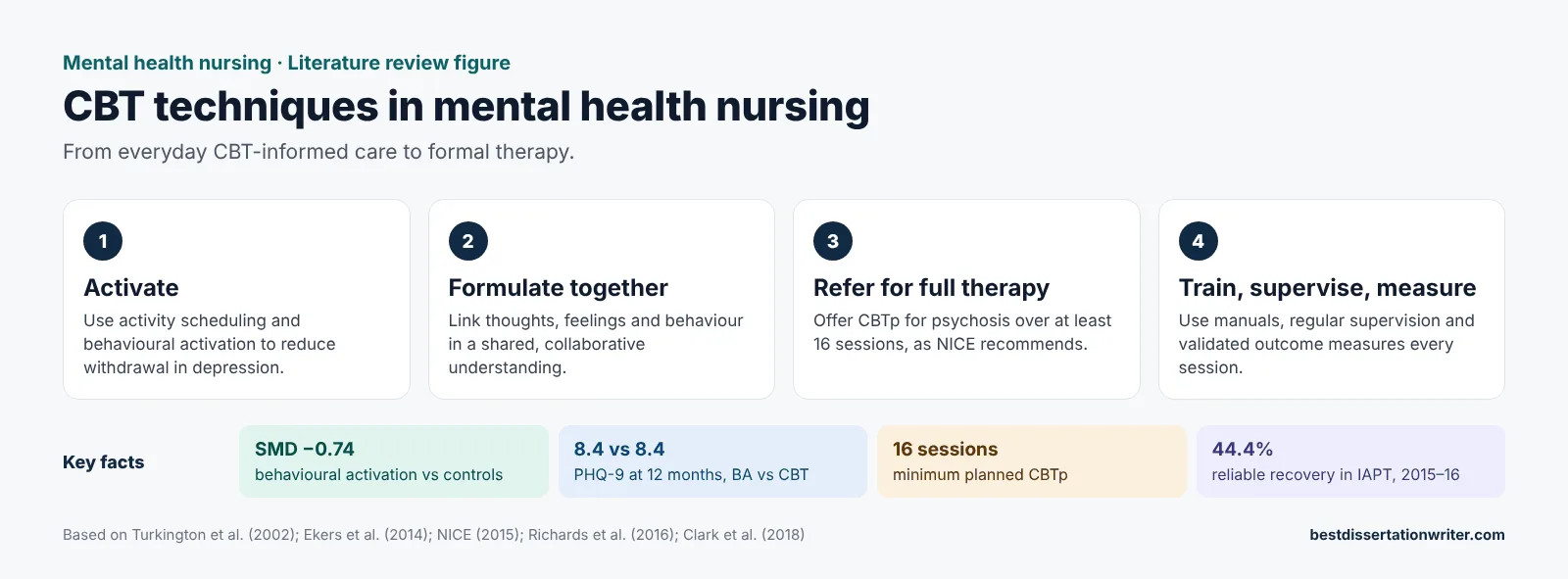
National guidance reflects this evidence. The NICE quality standard for psychosis and schizophrenia states that adults with psychosis or schizophrenia should be offered CBTp, delivered over at least 16 planned sessions and following a treatment manual (National Institute for Health and Care Excellence [NICE], 2015). The standard states that CBTp can improve outcomes such as psychotic symptoms when given with antipsychotic medication, or alone if medication is declined. It also requires the therapy to include components such as self-monitoring, alternative ways of coping or reducing distress, setting a clear benchmark for services and for nurses delivering the therapy.
Theme 2: Cognitive Behavioural Therapy Delivered by Nurses and Non-Specialists
An early test of whether nurses could deliver cognitive behavioural therapy in routine care was a pragmatic trial by Turkington et al. (2002). Community psychiatric nurses received ten days of intensive training and then delivered up to six sessions of brief CBT to people with schizophrenia, with sessions for carers. Compared with 165 people receiving usual care, the 257 people in the CBT group showed greater improvement in overall symptoms, insight and depression, and suicidal ideation did not increase. The authors concluded that community psychiatric nurses could deliver brief CBT safely and effectively.
The trial was large and conducted in ordinary services, which strengthens its relevance to nursing. However, the improvement in psychotic symptoms themselves was not significant, the intervention was much briefer than the 16 sessions later recommended by NICE (2015), and the numbers needed to treat, between nine and 13, indicate modest benefit. The trial was funded by a pharmaceutical company and did not report longer-term outcomes such as rehospitalisation in the same paper.
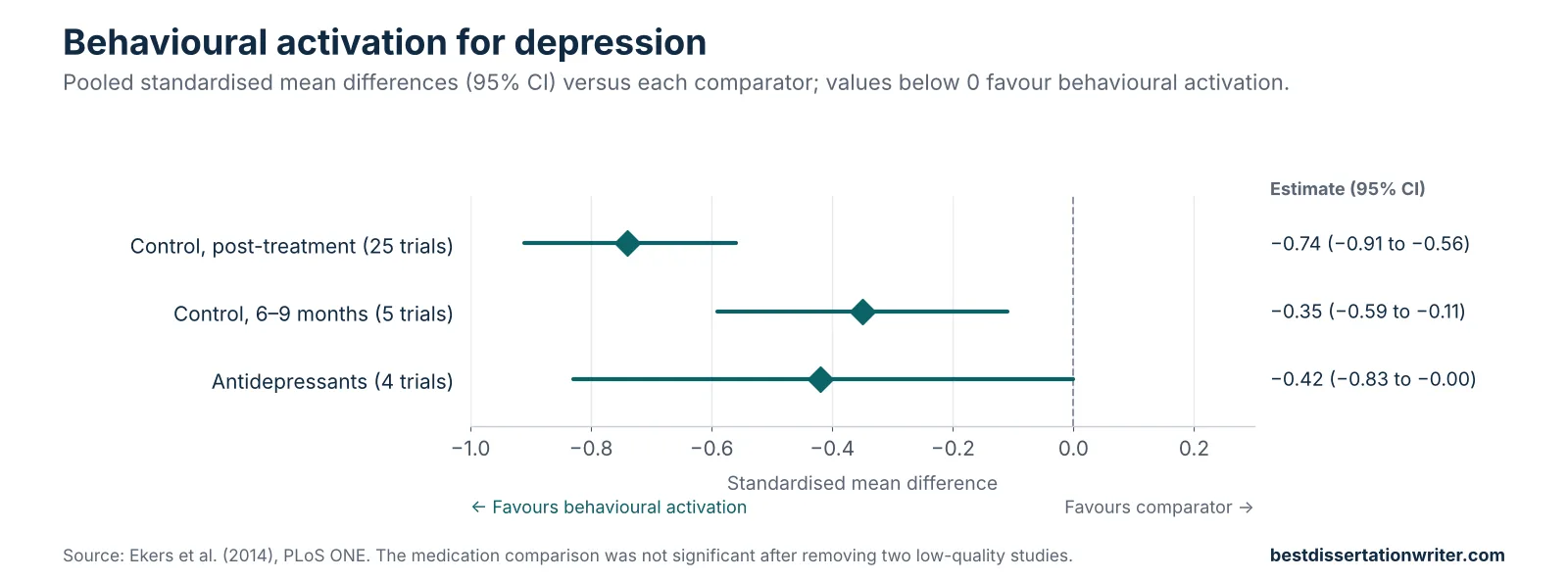
Behavioural activation offers a simpler route. In a meta-analysis of 26 randomised trials with 1,524 participants, Ekers et al. (2014) found that behavioural activation was more effective than control conditions for depression (standardised mean difference −0.74) and slightly more effective than antidepressant medication (−0.42), although the medication comparison included only four trials and lost significance when two low-quality studies were removed. Benefits over controls persisted, though smaller, at six to nine months. Three included studies used non-specialist therapists, and their effects were large and similar to those of specialists.
The COBRA trial tested this directly. Richards et al. (2016) randomised 440 adults with depression to behavioural activation delivered by junior mental health workers or to CBT delivered by psychological therapists. At 12 months, mean scores on the Patient Health Questionnaire (PHQ-9) were 8.4 in both groups, a mean difference of 0.1 points, and behavioural activation was non-inferior to CBT. Follow-up was incomplete, with outcome data for 79% of the behavioural activation group and 86% of the CBT group, but the findings were the same in both the modified intention-to-treat and per-protocol analyses.
Together these studies suggest that the therapeutic benefits of cognitive and behavioural approaches do not depend entirely on highly trained specialist therapists. Structured, manualised interventions with clear training and supervision appear to transfer well to nurses and junior workers. However, these were well-supported research programmes, and staff in routine services may not receive the same level of training or supervision.
Theme 3: From Trials to Routine Services
The IAPT programme, now NHS Talking Therapies, provides an unusual opportunity to examine CBT-based treatment at national scale. Clark et al. (2018) analysed publicly available outcome data for services in England, where symptom scores before and after treatment were available for 98% of patients. In 2015–16, the mean reliable recovery rate across clinical commissioning group areas was 44.4% and the reliable improvement rate was 62.5%, both slightly higher than in the previous year.
Outcomes varied widely between services, and five features of service organisation predicted better results: recording a problem descriptor, providing more treatment sessions, treating a higher percentage of referrals, shorter waits and fewer missed appointments. Together, organisational factors explained about a third of the variation in reliable improvement (Clark et al., 2018). This suggests that how therapy is organised and delivered matters as much as the therapy itself.
The analysis was observational, so the organisational features may be markers of better-resourced services rather than causes of better outcomes. The data also cover only people who completed treatment, not those who were referred but never started or who dropped out after one session. Nonetheless, the commitment to collecting outcomes for almost every patient offers a model that nurse-led services could follow.
Discussion
This review suggests that cognitive behavioural therapy has a broad and strong evidence base and that its techniques can be delivered effectively by mental health nurses and other non-specialists when training, structure and supervision are in place. Behavioural activation, in particular, appears to offer similar outcomes to full CBT for depression at lower training intensity, while brief nurse-delivered CBT produced modest benefits for people with schizophrenia.
There is, however, a tension between brief, accessible versions of cognitive behavioural therapy and the intensity recommended in guidance. NICE (2015) recommends at least 16 sessions of CBTp, yet the nurse-delivered intervention tested by Turkington et al. (2002) involved up to six sessions and did not significantly reduce psychotic symptoms. Brief interventions may be valuable as a first step or where specialist therapy is unavailable, but nurses should be clear about what such interventions can and cannot achieve and should not present them as equivalent to a full course of therapy.
The evidence also highlights the importance of the comparison used. Effects of psychological interventions tend to look largest against waiting lists or usual care, and smaller against credible alternatives. Ekers et al. (2014) found smaller effects in placebo-controlled comparisons, and only 11 of the meta-analyses reviewed by Hofmann et al. (2012) compared response rates between CBT and other treatments or controls. COBRA is valuable precisely because it compared two active treatments and found no meaningful difference, which supports wider use of the simpler one.
Routine service data add a further perspective on cognitive behavioural therapy. Even in a well-organised national programme, fewer than half of those completing treatment met the criteria for reliable recovery in 2015–16 (Clark et al., 2018). Missed appointments, long waits and too few sessions were linked to poorer outcomes, all of which nurses can influence through engagement, care coordination and follow-up. Improving access is therefore not only about training more therapists, but also about how services are organised.
The evidence base has limitations. Several sources are more than a decade old, most trials took place in high-income countries and few examined people from ethnic minority groups or with complex needs. Psychotherapy trials cannot blind participants, and outcomes were mostly self-reported. This review relied on openly accessible, English-language sources and did not involve independent double screening or formal meta-analysis. Future research should evaluate CBT techniques delivered by nurses in inpatient and community settings, including the training and supervision required to maintain fidelity, and should report long-term and cost outcomes.
Implications of Cognitive Behavioural Therapy Evidence for Practice
For mental health nurses, the evidence supports using structured cognitive and behavioural techniques, such as activity scheduling, problem solving and coping strategy enhancement, as part of everyday care, and referring people for a full course of cognitive behavioural therapy where guidance recommends it. Nurses who deliver CBT-informed interventions should receive specific training and regular clinical supervision, use treatment manuals where available and monitor outcomes with validated measures. Services should reduce waits and missed appointments and ensure that people with psychosis are offered CBTp in line with NICE guidance.
Behavioural activation is particularly relevant to nursing work with adults with depression, and brief CBT approaches can complement medication and psychosocial care for people with schizophrenia. Psychological approaches are central to early intervention services for young people with emerging psychosis, and adapted cognitive behavioural techniques also have a role in supporting perinatal mental health.
Conclusion
This narrative review examined the use of cognitive behavioural therapy techniques in mental health nursing practice. CBT has a strong and broad evidence base, behavioural activation delivered by junior workers was non-inferior to CBT delivered by therapists, and community psychiatric nurses delivered brief CBT for schizophrenia with modest benefits, although guidance recommends more intensive therapy for psychosis.
Mental health nurses are well placed to extend access to cognitive behavioural therapy and other psychological interventions, both as trained therapists and through CBT-informed everyday care. Realising this potential requires adequate training, supervision and service organisation, together with honest recognition of the limits of brief interventions and continued evaluation in routine practice.
References
Clark, D. M., Canvin, L., Green, J., Layard, R., Pilling, S., & Janecka, M. (2018). Transparency about the outcomes of mental health services (IAPT approach): An analysis of public data. The Lancet, 391(10121), 679–686. https://doi.org/10.1016/S0140-6736(17)32133-5
Ekers, D., Webster, L., Van Straten, A., Cuijpers, P., Richards, D., & Gilbody, S. (2014). Behavioural activation for depression; an update of meta-analysis of effectiveness and sub group analysis. PLoS ONE, 9(6), e100100. https://doi.org/10.1371/journal.pone.0100100
Hofmann, S. G., Asnaani, A., Vonk, I. J. J., Sawyer, A. T., & Fang, A. (2012). The efficacy of cognitive behavioral therapy: A review of meta-analyses. Cognitive Therapy and Research, 36(5), 427–440. https://doi.org/10.1007/s10608-012-9476-1
National Institute for Health and Care Excellence. (2015). Psychosis and schizophrenia in adults (Quality Standard QS80). https://www.nice.org.uk/guidance/qs80
Richards, D. A., Ekers, D., McMillan, D., Taylor, R. S., Byford, S., Warren, F. C., Barrett, B., Farrand, P. A., Gilbody, S., Kuyken, W., O’Mahen, H., Watkins, E. R., Wright, K. A., Hollon, S. D., Reed, N., Rhodes, S., Fletcher, E., & Finning, K. (2016). Cost and Outcome of Behavioural Activation versus Cognitive Behavioural Therapy for Depression (COBRA): A randomised, controlled, non-inferiority trial. The Lancet, 388(10047), 871–880. https://doi.org/10.1016/S0140-6736(16)31140-0
Turkington, D., Kingdon, D., & Turner, T. (2002). Effectiveness of a brief cognitive–behavioural therapy intervention in the treatment of schizophrenia. British Journal of Psychiatry, 180(6), 523–527. https://doi.org/10.1192/bjp.180.6.523
Cite this example
Best Dissertation Writers (2026) The Use of Cognitive Behavioural Therapy Techniques in Mental Health Nursing Practice: A Narrative Review. Available at: https://bestdissertationwriter.com/cognitive-behavioural-therapy-review/
Best Dissertation Writers
Get expert help with your nursing literature review
Share your topic and deadline with Best Dissertation Writers and get support tailored to your module brief.