Moral Distress Among Intensive Care Nurses: A Systematic Review of Causes and Consequences
 By Dr. Robertson Prime, Research Fellow
Updated October 17, 2026
14 min read
About 2,800 words
In this review
Abstract
Background: Moral distress arises when nurses believe they know the ethically right action but feel unable to take it because of constraints. ICU nurses are particularly exposed because they care for dying patients, deliver treatments they may consider futile and often have limited influence over decisions.
Aim: This systematic review aimed to examine the evidence on the causes, correlates and consequences of moral distress among intensive care nurses.
Methods: Evidence was identified through targeted searches of openly accessible bibliographic records, publisher websites and the reference lists of key reviews. Five sources published between 2007 and 2022 were included: two cross-sectional surveys, a multi-society statement and two systematic reviews, synthesised narratively.
Findings: Nurses reported higher distress, poorer collaboration and a worse ethical climate than physicians caring for the same dying patients. In 13 Canadian units, 18% of nurses were considering leaving their job because of this distress, compared with 7% of physicians, with end-of-life care and cost constraints the leading causes. Reviews linked distress to poor ethical climate, poor collaboration and low autonomy, and to burnout and intention to leave.
Conclusion: Units should address the causes through better teamwork, earlier and clearer end-of-life decision-making and ethics support, while recognising distress as an organisational rather than individual problem.
Keywords: moral distress, ICU nurses, ethical dilemmas
Introduction
This systematic review critically examines recent evidence on moral distress and its implications for critical care nursing practice.
Intensive care nurses face ethical dilemmas every day. They may continue aggressive treatment for a patient they believe will not survive, carry out decisions they disagree with, watch families struggle with choices, or work in conditions that prevent them from giving the care they think patients need. When nurses know what they believe is right but feel unable to act on it, they may experience moral distress: a painful mix of frustration, anger, guilt and powerlessness.
This experience is not new, but it has gained attention as concerns about the wellbeing and retention of critical care nurses have grown. The COVID-19 pandemic exposed many ICU nurses to extreme situations, including rationing of care, restricted visiting and deaths without families present, which intensified ethical strain. Understanding what causes this distress, and what it leads to, can help leaders and nurses to respond.
Ethical strain of this kind matters for patients as well as staff. Nurses who are distressed may withdraw emotionally, avoid families or leave their jobs, taking valuable experience with them. Units with high turnover and burnout may provide less safe care, which links nurses’ ethical experiences directly to quality and safety.
A systematic review approach was chosen to bring together surveys, systematic reviews and a multi-society statement and to identify consistent patterns in the evidence.
Families and patients may also notice when staff are under ethical strain. Nurses who feel unable to influence decisions may find it harder to answer families’ questions honestly or to offer the reassurance families seek, which can affect trust and communication at the bedside.
Review question
What does the evidence show about the causes, correlates and consequences of moral distress among intensive care nurses?
Background to Moral Distress
The concept was first described in nursing ethics in the 1980s, as distinct from moral dilemmas in which the right course of action is unclear. In this situation, the person believes they know the right action but is prevented from taking it by internal or external constraints, such as hierarchy, policies, lack of resources or fear of conflict. Later definitions have broadened the concept to include distress arising from uncertainty and from being implicated in actions one considers wrong.
Moral distress is often measured using the Moral Distress Scale developed by Corley and its revised versions, which ask how often specific situations occur and how distressing they are. Common situations include continuing life support that is not in the patient’s best interest, following family wishes that conflict with the patient’s welfare, working with colleagues perceived as incompetent and providing care with inadequate staffing.
A related idea is moral residue, the lingering distress that remains after a situation has passed. Repeated episodes may build up over time, producing a crescendo effect in which each new situation provokes a stronger reaction. This may help to explain why distress can increase with experience in some groups.
This experience is closely connected with burnout, which involves emotional exhaustion, depersonalisation and a reduced sense of accomplishment. While burnout has many causes, ethical conflict, end-of-life care and lack of control are among the most important in intensive care.
ICU nurses also encounter ethical dilemmas that arise from wider pressures. Shortages of beds may force decisions about which patients are admitted or discharged, staffing gaps may prevent nurses from giving the care they believe patients need, and organisational policies may limit family presence or end-of-life rituals. These situations place nurses between their professional values and the constraints of the system in which they work.
Search Strategy and Methods
Evidence for this example was identified through targeted searches of openly accessible bibliographic records, publisher websites and the reference lists of key reviews. Search terms combined keywords for the concept (“moral distress”, “ethical conflict”, “ethical climate”, “burnout”) with terms for the population and setting (“nurses”, “intensive care”, “critical care”, “end-of-life care”, “intention to leave”), joined with the Boolean operators AND and OR. A full systematic review for assessment would run the same strategy in CINAHL, PubMed/MEDLINE, the Cochrane Library and Embase and report the number of records screened in a PRISMA flow diagram.
Sources were eligible if they measured or reviewed this phenomenon, its causes or its consequences among intensive care nurses or multidisciplinary intensive care staff. Systematic reviews and multicentre surveys were prioritised, and a multi-society statement was included because it summarises evidence on consequences such as burnout and turnover. Studies limited to students or to non-clinical staff were excluded.
Five sources published between 2007 and 2022 were included: two cross-sectional surveys, a multi-society statement and two systematic reviews (Table 1). The quality of each source was considered using the Critical Appraisal Skills Programme (CASP) checklists where appropriate, and findings were synthesised narratively.
Key Findings on Moral Distress
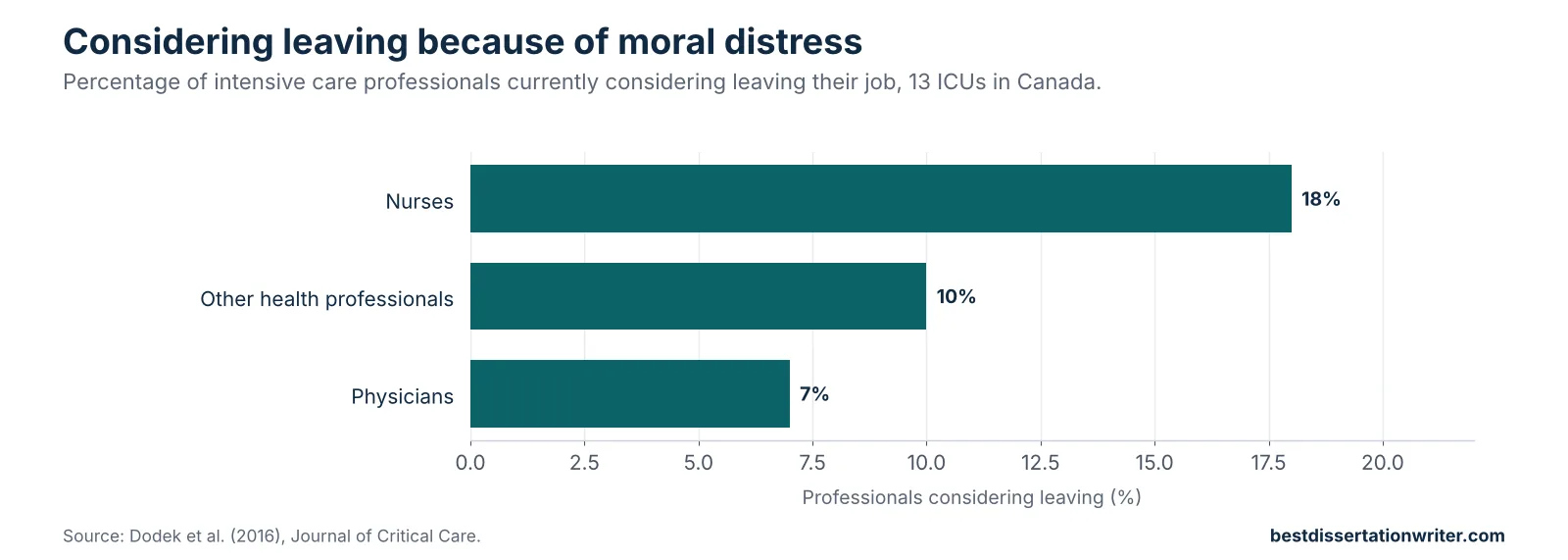
Three themes were identified: differences between professions, causes and correlates, and consequences for nurses and organisations. Table 1 summarises the included sources, and Figure 1 shows the proportion of intensive care professionals considering leaving because of moral distress.
| Author, year | Design | Setting and sample | Key finding |
|---|---|---|---|
| Hamric and Blackhall (2007) | Cross-sectional survey | 196 nurses and 29 physicians, US ICUs | Nurses reported higher moral distress, lower collaboration and a worse ethical climate than physicians. |
| Dodek et al. (2016) | Cross-sectional survey | Over 650 professionals, 13 ICUs, Canada | Nurses more distressed than physicians; 18% of nurses considering leaving; end-of-life care and cost constraints key causes. |
| Moss et al. (2016) | Multi-society statement | Critical Care Societies Collaborative | 25–33% of critical care nurses with severe burnout; moral distress and end-of-life care key causes; linked to turnover and errors. |
| Lamiani et al. (2017) | Systematic review | 17 empirical studies, mostly nurses | Moral distress linked to poor ethical climate, poor collaboration, low satisfaction and low autonomy. |
| Giannetta et al. (2022) | Systematic review | Studies of adult ICU nurses using Corley’s scale | Moderate distress overall; linked to intention to leave; supportive head nurses associated with lower scores. |
Theme 1: Nurses Experience More Moral Distress Than Physicians
A survey of 196 registered nurses and 29 physicians in intensive care units in the United States compared their perspectives on the care of dying patients (Hamric and Blackhall, 2007). Nurses reported significantly higher distress, lower nurse-physician collaboration, a more negative ethical climate and lower satisfaction with the quality of care than attending physicians. The findings suggest that professionals caring for the same patients can experience the same situations very differently.
A survey of more than 650 nurses, physicians and other professionals in 13 intensive care units in Canada confirmed that nurses and other health professionals reported higher moral distress than physicians (Dodek et al., 2016). Among nurses, more years of experience were associated with higher distress, while among other professionals younger age was associated with higher distress. Cost constraints and end-of-life care were the situations associated with the greatest distress.
These differences may reflect the different roles of nurses and physicians. Physicians usually make treatment decisions, while nurses carry them out, spend more time at the bedside and witness the suffering of patients and families most directly. Nurses may have little influence over decisions yet feel responsible for their consequences, which is a classic setting for ethical strain.
Differences in perspective can also create conflict within teams. If nurses feel that their concerns about a patient’s suffering are not heard, or that decisions are made without their input, trust between professions may erode. Regular interdisciplinary discussions about goals of care, in which nurses’ observations are valued, may help to close this gap and reduce the sense of powerlessness that ICU nurses describe.
Theme 2: Causes and Correlates
A systematic review of 17 empirical studies examined correlates of moral distress among healthcare professionals, most of them nurses (Lamiani et al., 2017). Higher this distress was associated with a poor ethical climate and poor collaboration, low work satisfaction and engagement, and low psychological empowerment and autonomy. The authors noted that distress negatively affected clinicians’ wellbeing and job retention and called for research on protective factors.
A systematic review of studies of adult ICU nurses using Corley’s Moral Distress Scale found that overall moral distress was moderate (Giannetta et al., 2022). Triggers were identified at patient, team and system levels. Higher scores were associated with less work experience, younger age, female gender and intention to leave, while nurses who felt supported by their head nurses reported lower distress. These findings highlight the protective role of supportive leadership.
The two reviews and the Canadian survey differ on the role of experience, with one finding more distress among experienced nurses and another among less experienced nurses. This may reflect differences in populations, measures and settings, or the crescendo effect, in which experienced nurses accumulate moral residue while newer nurses lack the confidence or skills to manage ethical dilemmas. Both groups may therefore need support, in different forms.
For nurse leaders, these findings suggest practical targets. Building trusting relationships with physicians, giving nurses a voice in decisions and making ethics support easy to access are all within the reach of unit leadership. Supportive head nurses, who recognise ethical dilemmas and respond to concerns, appear to make a real difference to how nurses experience difficult situations.
Theme 3: Consequences for Nurses and Organisations
In the Canadian survey, 18% of nurses said they were considering leaving their current job because of ethical strain, compared with 10% of other health professionals and 7% of physicians (Dodek et al., 2016). Around three times as many had considered leaving in the past. The investigators described the causes as largely preventable and recommended teamwork and communication training and more explicit approaches to end-of-life decision-making.
A statement from the Critical Care Societies Collaborative summarised evidence on burnout in critical care (Moss et al., 2016). About a quarter to a third of critical care nurses showed symptoms of severe burnout, and up to 86% had at least one classic symptom. Moral distress, end-of-life care and decisions to withdraw treatment were identified as important causes. Burnout was linked to post-traumatic stress symptoms, turnover, medical errors, infections and lower patient satisfaction.
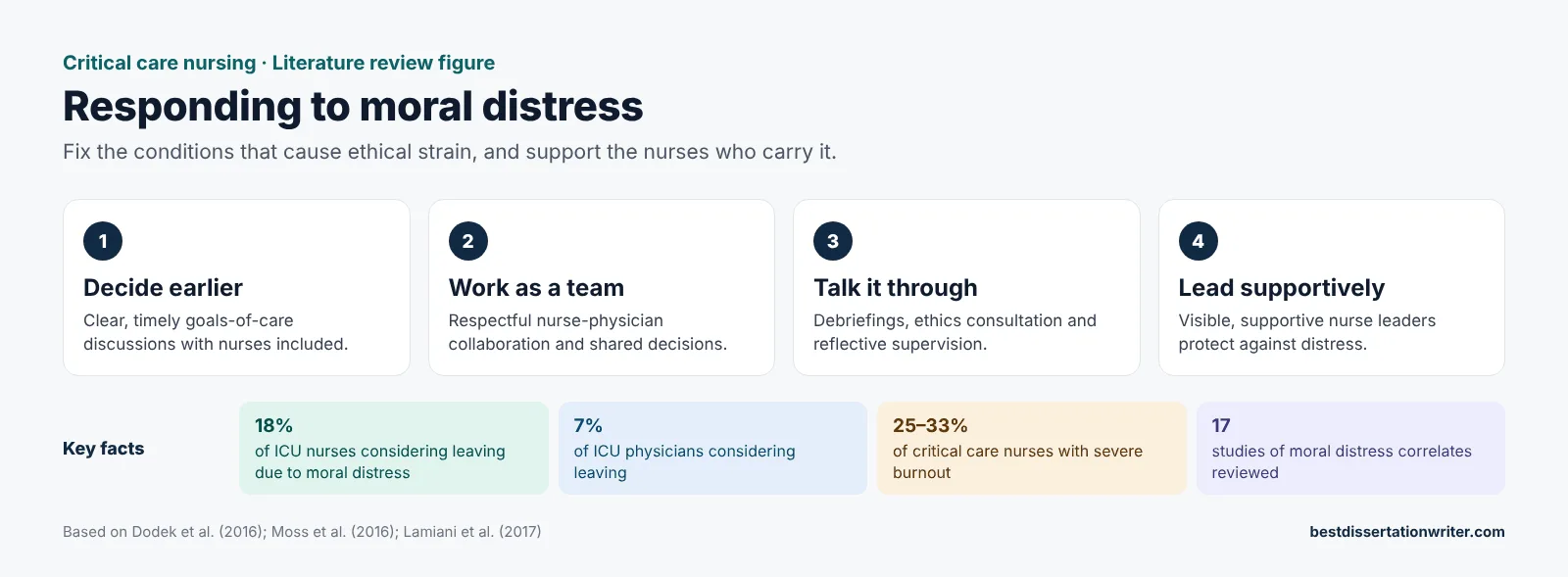
The statement recommended organisational measures, including healthy work environments, team debriefings, structured communication, ethics and palliative care consultation and early family conferences, alongside individual strategies such as mindfulness and resilience training. Its emphasis on organisational causes is important, because such distress is primarily a response to the conditions in which nurses work rather than a personal weakness.
The consequences extend beyond individual nurses. When experienced ICU nurses leave, units lose expertise that takes years to develop, and remaining staff may face heavier workloads and more frequent ethical dilemmas, which can create a cycle of strain and turnover. Breaking this cycle requires attention to the root causes rather than only to recruitment.
Taken together, these sources describe a consistent picture across settings and decades: the conditions of intensive care work, rather than individual weakness, generate ethical strain that affects nurses most.
Discussion
This review found that ICU nurses experience more moral distress than physicians, that distress is linked to poor collaboration, poor ethical climate and lack of autonomy, and that it contributes to burnout and intention to leave. End-of-life care and resource constraints are among the most important causes. These findings are consistent across countries and over time, suggesting that this distress is a persistent feature of intensive care work.
The evidence points to organisational solutions. Better collaboration between nurses and physicians, earlier and more explicit discussions about goals of care, involvement of nurses in decisions and family meetings, access to ethics consultation and supportive leadership all address the conditions that give rise to distress. Interventions aimed only at individual resilience risk placing responsibility on nurses for problems they cannot control.
Ethical strain also has implications for patient care and for the workforce. Nurses who leave intensive care take specialist skills with them, and high turnover increases pressure on those who remain. Recognising and addressing ethical strain is therefore part of workforce planning and patient safety, not only staff wellbeing.
Opportunities to talk about difficult cases matter. Structured debriefings after deaths or ethically challenging situations, moral case deliberation and clinical supervision can help nurses to process their experiences, learn from them and feel heard. These approaches also build shared understanding within teams, which may reduce conflict in future situations.
This review has limitations. It included a small number of sources, most cross-sectional, and measures of distress varied. Several sources included professionals other than nurses. This review relied on openly accessible, English-language sources and did not involve independent double screening. Future research should evaluate organisational interventions to reduce this distress among ICU nurses and track effects on retention and patient outcomes.
Education also has a role. Teaching nurses about ethical principles, communication and the recognition of ethical strain can help them to name what they are experiencing and to raise concerns constructively. Simulation and case-based discussion can prepare newer nurses for ethical dilemmas they are likely to meet, while giving experienced nurses opportunities to share their knowledge.
Implications of Moral Distress Evidence for Practice
Unit leaders should foster collaboration and a positive ethical climate, include nurses in family meetings and treatment decisions, and provide access to ethics consultation, debriefing and supervision. Early, clear communication about end-of-life care can prevent the prolonged, unwanted treatment that often causes distress. Measures to address burnout and staff wellbeing should target organisational causes as well as individual coping.
Everyday practice can also be a source of ethical strain, for example when workload prevents nurses from delivering care such as enteral feeding or measures to prevent bloodstream infections as they believe they should. Adequate staffing and resources help nurses to provide care consistent with their values.
Nurses themselves can support one another through peer support and informal debriefing, and by speaking up when they feel unable to provide appropriate care. Professional bodies and unions can also advocate for working conditions that allow ICU nurses to practise ethically.
Conclusion
This systematic review examined the evidence on moral distress among intensive care nurses. Nurses experience more distress than physicians, especially around end-of-life care and resource constraints, and distress is linked to poor collaboration, poor ethical climate, low autonomy, burnout and intention to leave.
Moral distress is an organisational problem with personal consequences. Addressing it requires teamwork, nurse involvement in decisions, ethics support and supportive leadership, so that ICU nurses can practise in line with their values and remain in the workforce.
References
Dodek, P. M., Wong, H., Norena, M., et al. (2016). Moral distress in intensive care unit professionals is associated with profession, age, and years of experience. Journal of Critical Care, 31(1), 178–182. https://doi.org/10.1016/j.jcrc.2015.10.011
Giannetta, N., Villa, G., Bonetti, L., Dionisi, S., Pozza, A., Rolandi, S., Rosa, D., & Manara, D. F. (2022). Moral distress scores of nurses working in intensive care units for adults using Corley’s scale: A systematic review. International Journal of Environmental Research and Public Health, 19(17), 10640. https://doi.org/10.3390/ijerph191710640
Hamric, A. B., & Blackhall, L. J. (2007). Nurse-physician perspectives on the care of dying patients in intensive care units: Collaboration, moral distress, and ethical climate. Critical Care Medicine, 35(2), 422–429. https://doi.org/10.1097/01.CCM.0000254722.50608.2D
Lamiani, G., Borghi, L., & Argentero, P. (2017). When healthcare professionals cannot do the right thing: A systematic review of moral distress and its correlates. Journal of Health Psychology, 22(1), 51–67. https://doi.org/10.1177/1359105315595120
Moss, M., Good, V. S., Gozal, D., Kleinpell, R., & Sessler, C. N. (2016). An official Critical Care Societies Collaborative statement: Burnout syndrome in critical care health-care professionals: A call for action. American Journal of Respiratory and Critical Care Medicine, 194(1), 106–113. https://doi.org/10.1164/rccm.201604-0708ST
Cite this example
Best Dissertation Writers (2026) Moral Distress Among Intensive Care Nurses: A Systematic Review of Causes and Consequences. Available at: https://bestdissertationwriter.com/moral-distress-literature-review/
Best Dissertation Writers
Get expert help with your nursing literature review
Share your topic and deadline with Best Dissertation Writers and get support tailored to your module brief.