Emergency Department Overcrowding and Patient Flow: Nursing Strategies and Outcomes: A Systematic Review
 By Dr. Robertson Prime, Research Fellow
Updated November 2, 2026
15 min read
About 2,900 words
In this review
Abstract
Background: Emergency department overcrowding occurs when the demand for care exceeds the resources available, so that patients wait long periods for assessment, treatment or an inpatient bed. It is a worldwide problem and a recognised threat to patient safety, staff wellbeing and the quality of emergency nursing care.
Aim: This systematic review aimed to examine the evidence on the causes and consequences of emergency department overcrowding, the effectiveness of interventions to reduce it and the experiences of nurses and patients.
Methods: Evidence was identified through targeted searches of openly accessible bibliographic records, publisher websites and repositories. Five sources published between 2018 and 2025 were included: three systematic or scoping reviews, a rapid review of experiences and a national observational study. The sources were appraised using CASP checklists and synthesised narratively.
Findings: A systematic review of 102 studies found that the negative consequences of overcrowding are well established, with a mismatch between identified causes and reported solutions. A scoping review of 77 reviews identified 38 interventions, 27 of which changed practices and processes and nine of which changed team composition. A review of 16 studies of older adults found that rapid assessment and streaming in a dedicated unit shortened length of stay but that heterogeneity and poor quality limited conclusions. A study of more than five million patients in England found that admission delays beyond five hours were associated with higher 30-day mortality, with one extra death for every 82 patients delayed beyond six to eight hours. A rapid review found that nurses and patients described stress, frustration and dissatisfaction.
Conclusion: Emergency department overcrowding harms patients and staff, and solutions that focus only on flow within the department are unlikely to be sufficient. Nurses contribute through assessment, streaming and advanced roles, but whole-system action is needed.
Keywords: emergency department overcrowding, patient flow, boarding
Introduction
This systematic review critically examines recent evidence on emergency department overcrowding and its implications for emergency nursing practice.
Emergency departments are designed to assess and treat people with urgent needs, but in many countries they are now routinely overwhelmed. Corridors fill with trolleys, patients wait many hours to be seen and others stay in the department for a long time after the decision to admit them because no inpatient bed is available. Emergency department overcrowding has become a feature of the daily working lives of emergency nurses.
The effects are felt by patients and staff alike. Patients wait in uncomfortable conditions, may deteriorate while waiting and may leave without being seen. Nurses must care for more patients than the department is designed for, often in places that lack privacy, oxygen or monitoring. Staff describe stress and moral distress when they cannot give the standard of care they would wish.
Overcrowding is not caused only by what happens inside the emergency department. It reflects pressures across the health and social care system, including access to primary care, the availability of inpatient beds and delays in discharging patients to community care.
Review question
What does the evidence show about the causes and consequences of emergency department overcrowding, which interventions have been tried and what does it mean for emergency nursing practice?
Background to Emergency Department Overcrowding
Overcrowding is often described in terms of input, throughput and output. Input refers to the number and type of patients who arrive, throughput to the processes within the department and output to the movement of patients out of it, whether to a ward or home. A delay at any stage affects the others. For example, patients who are waiting for a bed occupy space that would otherwise be used for new arrivals.
The terms used in the literature vary. Crowding, overcrowding, boarding, access block and corridor care are all used, and they overlap. Boarding refers to patients who remain in the department after a decision to admit them, and corridor care to the practice of caring for patients in spaces not intended for treatment. These terms matter for nurses because they refer to different problems that need different responses.
The consequences of overcrowding are relevant to other parts of emergency nursing. Triage decisions are made in a crowded waiting area, as discussed in the review of triage tools, and staff under pressure may be more likely to experience aggression, which is explored in the review of workplace violence. Delays in assessment may also affect the recognition of time-critical illness such as sepsis in the emergency department.
The nursing perspective on emergency department overcrowding is distinctive. Nurses are present for the whole of a patient’s stay, so they see the effects of a long wait on comfort, dignity and clinical condition. They are also the staff who must decide, minute by minute, which patient to reassess and which task to delay. This continuous contact means that nurses are well placed to identify risk early, and that their working conditions are directly affected when the department is full.
Emergency department overcrowding also has consequences for the wider workforce. Staff who work repeatedly in crowded conditions report fatigue and frustration, and some leave the profession or the specialty. Services that lose experienced emergency nurses become less able to manage demand, which can deepen emergency department overcrowding. Retention is therefore part of the response, as well as a consequence of the problem.
Search Strategy and Methods
Evidence for this example was identified through targeted searches of openly accessible bibliographic records, publisher websites and repositories. Search terms combined keywords for the problem (“emergency department crowding”, “overcrowding”, “boarding”, “access block”, “corridor care”) with terms for the outcomes and interventions (“causes”, “consequences”, “interventions”, “patient flow”, “nurses”, “length of stay”), joined with the Boolean operators AND and OR. A full systematic review for assessment would run the same strategy in CINAHL, PubMed/MEDLINE, Embase and the Cochrane Library and report the records screened in a PRISMA flow diagram.
Sources were eligible if they were systematic, scoping or rapid reviews of the causes, consequences, solutions or experiences of emergency department crowding, or large studies of its effect on patient outcomes. Single-site studies and studies of prehospital delays were excluded.
Five sources published between 2018 and 2025 were included (Table 1). The quality of each source was considered using the Critical Appraisal Skills Programme (CASP) checklists, with the national observational study considered for the adequacy of its adjustment for confounding, and findings were synthesised narratively under themes.
The studies reviewed here use different words for related problems, and their definitions of emergency department overcrowding are not identical. Some count patients in the department against its capacity, whereas others measure the time patients wait for assessment or an inpatient bed. Where a definition is important to interpreting a finding, it is given, and differences between definitions are noted as a limitation of the evidence.
Key Findings on Emergency Department Overcrowding
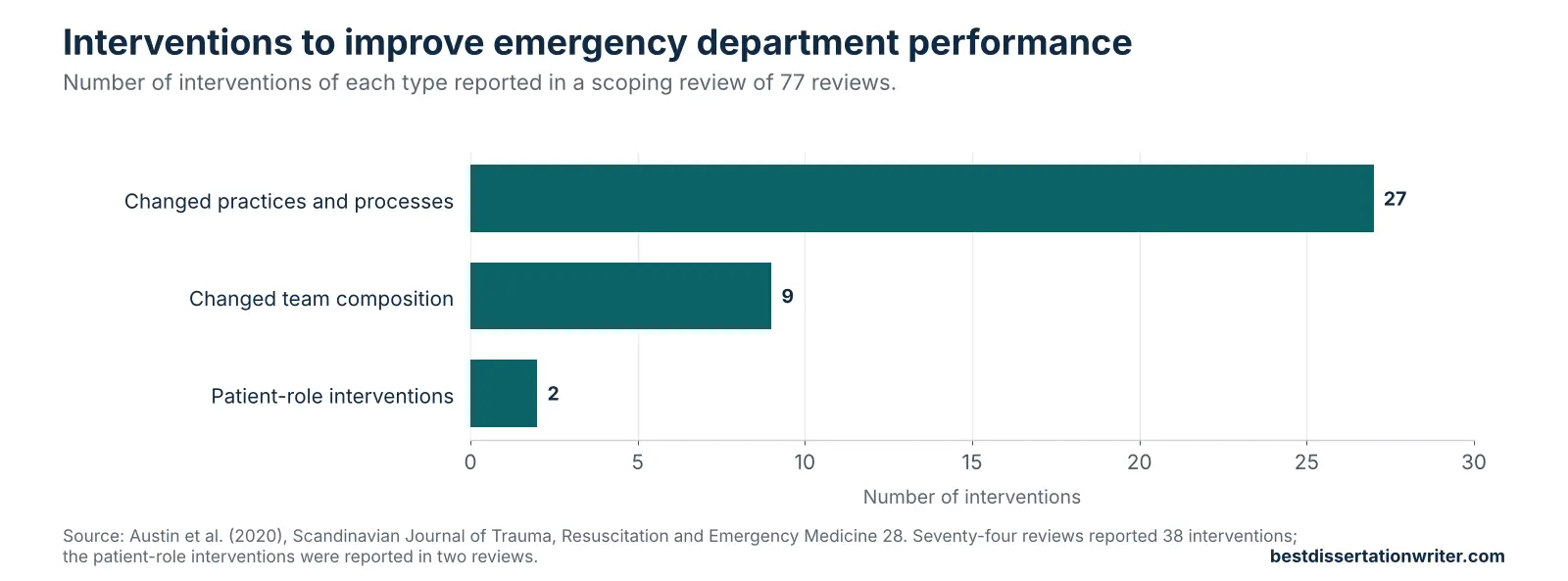
Three themes were identified: causes and consequences, interventions to reduce overcrowding, and the experiences of nurses and patients. Table 1 summarises the included sources, and Figure 1 shows the types of intervention identified in a scoping review of reviews.
| Author, year | Design | Setting and sample | Key finding |
|---|---|---|---|
| Austin et al. (2020) | Scoping review of reviews | 77 reviews; 38 interventions | 27 interventions changed practices and processes; nine changed team composition. |
| Hesselink et al. (2019) | Systematic review | 16 studies of older adults | Rapid assessment and streaming reduced length of stay; poor quality limited conclusions. |
| Jones et al. (2022) | National observational study | 5,249,891 patients in England | Admission delays beyond five hours linked to higher 30-day mortality. |
| Morley et al. (2018) | Systematic review | 102 studies | Consequences well established; mismatch between causes and solutions. |
| Robertson et al. (2025) | Rapid review | Staff and patient experiences | Themes of stress, dissatisfaction and safety; nurse autonomy and communication may help. |
Theme 1: Causes and Consequences
Morley et al. (2018) carried out a systematic review of the causes, consequences and solutions of emergency department crowding, following PRISMA guidelines and searching four databases for studies published between January 2000 and June 2018. Of 4,131 studies identified, 102 met the inclusion criteria. Most were retrospective cohort studies, and the largest group, 51%, trialled or modelled potential solutions. Fourteen studies examined causes and 40 examined consequences.
The authors concluded that the negative consequences of emergency department overcrowding are well established, including poorer patient outcomes. They found a mismatch between the causes identified, mainly patient volume and type and timely discharge, and the solutions reported, which focused on patient flow within the department. Whole-of-system initiatives and extended primary care hours showed promise. An increase in presentations by older people with complex chronic conditions emerged as a widespread driver.
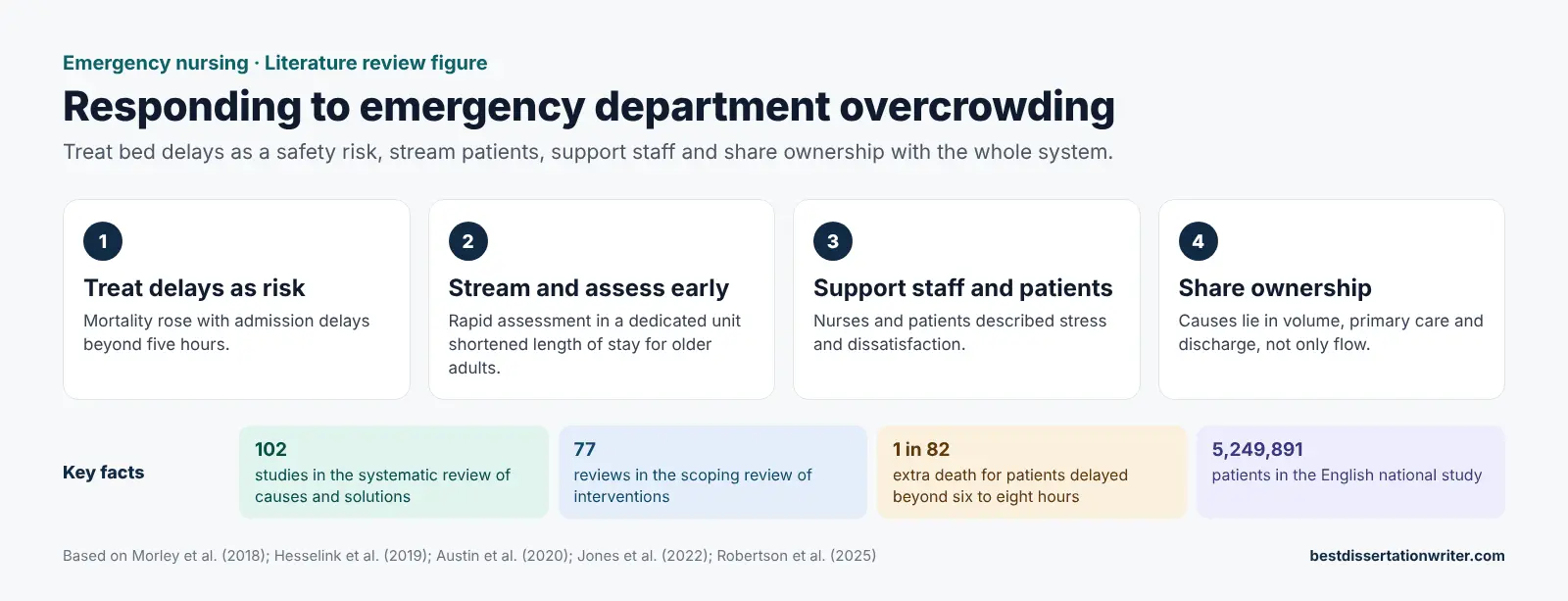
Jones et al. (2022) provide a measure of how serious the consequences can be. They analysed national data from every major emergency department in England over two years, covering 7,472,480 admissions and 5,249,891 patients. Crude 30-day mortality was 8.71%. Mortality rose in a statistically significant linear fashion from five hours after arrival until 12 hours, when accurate data collection stopped, and the largest change in the standardised mortality ratio was an 8% increase in patients who waited more than six to eight hours.
The authors estimated that for every 82 admitted patients whose transfer to an inpatient bed was delayed beyond six to eight hours from arrival, there was one extra death. This was an observational study, so it cannot prove that the delay itself caused the deaths, but the authors adjusted for age, sex, deprivation, comorbidity, time of day and crowding, and the dose-response pattern strengthens the case for a real effect. For nurses, it shows why the time patients spend waiting for a bed is a patient safety issue and not only a matter of comfort.
Theme 2: Interventions to Reduce Overcrowding
Austin et al. (2020) carried out a scoping review of reviews to map the strategies used to measure and improve emergency department performance. They searched five databases from inception to July 2019 and included 77 reviews. Seventy-four reviews reported 38 interventions: 27 changed practices and processes, such as triage, care transitions and technology, and nine changed team composition, for example through advanced nursing roles, scribes and pharmacy staff. Two reviews reported interventions that supported patients’ decisions or gave education.
Outcomes fell into five domains: time, proportion, process, cost and clinical outcomes, and few interventions reported outcomes across all five. The authors concluded that improvement interventions cover a wide range of processes and disciplines. This breadth is a reminder that emergency department overcrowding has no single solution, and that nurses are involved in many of the interventions, from triage and streaming to advanced practice and discharge planning.
Hesselink et al. (2019) systematically reviewed interventions to alleviate emergency department crowding caused by older adults. They searched six databases for experimental and quasi-experimental studies published between 1990 and March 2017 and included 16 studies: eight randomised controlled trials, two non-randomised trials and six controlled before-after studies. Thirteen studies (81%) measured effects on revisits and four (25%) on throughput time, and 13 evaluated multicomponent interventions.
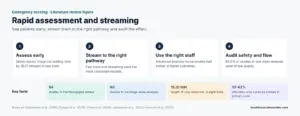
Rapid assessment and streaming of care for older adults in a dedicated unit significantly decreased length of stay, and an emergency department-based consultant geriatrician reduced the time from admission to geriatric review compared with an in-reaching geriatrician. However, the authors concluded that heterogeneity and poor methodological quality prevented firm conclusions. The approach of rapid assessment and streaming is considered further in the review of rapid assessment and streaming.
Theme 3: Experiences of Nurses and Patients
Robertson et al. (2025) carried out a rapid review of staff and patient experiences of crowding, corridor care and boarding. It identified three main themes: stress and frustration, dissatisfaction with care, and safety and coping mechanisms. The authors suggested that enhancing nurse autonomy and improving communication with patients could ease these experiences, improve staff retention, reduce conflict between staff and patients and lower the likelihood that patients leave without being seen.
These findings add the human dimension to the quantitative evidence. Nurses working in an overcrowded department are not simply managing numbers but are caring for people in conditions they may consider unsafe. Giving nurses a say in how the department responds, and keeping patients informed about delays, are low-cost actions that may reduce the harm of waiting even when the underlying delays cannot be removed.
As a rapid review, this source used streamlined methods and the abstract did not report the number of included studies, so the strength of the evidence should be treated with caution. It nevertheless matches the wider literature in describing the emotional and safety consequences of overcrowding, and it points to practical steps that nurse leaders can take.
The sources agree that emergency department overcrowding is both common and harmful, but they differ in how they see the solution. Reviews of interventions emphasise improvements to processes and staffing models, whereas studies of consequences point to delays in admission as a major cause of harm. Both views are compatible. They suggest that a combination of better flow in the department and better flow out of it is required.
Discussion
This systematic review shows that emergency department overcrowding is associated with worse outcomes for patients and a more stressful environment for staff, and that no single intervention has been shown to resolve it. The evidence supports the view that overcrowding is a system problem, with causes in patient volume, access to primary care and the movement of patients out of the department.
A key finding is the mismatch between causes and solutions. Studies have often tested ways of improving patient flow inside the department, whereas the main drivers lie outside it, including bed availability and discharge. Nurses can improve processes within their control, such as streaming and advanced roles, but they cannot by themselves relieve emergency department overcrowding if inpatient capacity is short. Hospital managers and system leaders therefore need to share responsibility.
Limitations of this review should be noted. Reviews of overcrowding vary in definitions and measures, and many of the primary studies are retrospective or of poor quality. Much of the evidence comes from the United States, Australia and Canada, and the English study used national data that do not capture nursing activity directly. The reviews overlap in the studies they include, and only five sources were reviewed. This review relied on openly accessible, English-language sources.
The sources also suggest what is missing. There is little evidence on the effects of overcrowding on nurses’ health, retention and missed care, on the experience of patients who wait in corridors and on the cost-effectiveness of nurse-led solutions. Studies that include these outcomes, and that test interventions outside the department as well as inside it, would be especially valuable for emergency nursing.
Implications of Emergency Department Overcrowding Evidence for Practice
For practice, the evidence supports recognising prolonged waits for an inpatient bed as a safety risk, supporting streaming and rapid assessment models, using advanced nursing roles within a wider improvement plan, keeping waiting patients informed and involving nurses in decisions about how the department responds. Guidance is available from the Royal College of Nursing and the Royal College of Emergency Medicine.
Managers should monitor the time that patients wait for a bed, escalate delays early and support staff who work in crowded areas. Because emergency department overcrowding is a system problem, services should work with inpatient, community and primary care colleagues to address the causes outside the department.
Practical steps within the nurse’s reach include regular reassessment of patients who are waiting, clear communication about expected delays, attention to comfort, hydration and pain relief for those in corridors, and escalation when a patient’s condition changes. Recording the number of patients waiting for a bed at set times of the day can help to make the scale of emergency department overcrowding visible to managers, and may support requests for resources.
Future research should test interventions that target admission and discharge, evaluate nurse-led approaches in terms of outcomes and cost, and examine how overcrowding affects nurses and patients. Studies from United Kingdom emergency departments, and studies that include patients’ views, would be particularly informative.
Overall, the evidence on emergency department overcrowding supports a modest but practical role for nursing: to recognise the risk, to act on the processes that nurses control and to speak up about the delays that they do not. Organisations that listen to this view are better placed to protect patients and to keep their emergency nurses.
Conclusion
This systematic review found that emergency department overcrowding harms patients and staff, that delays in admission are associated with higher mortality and that solutions confined to the emergency department are unlikely to be enough.
Emergency nurses can contribute through assessment, streaming, communication and advanced roles, but lasting improvement requires action across the whole health and care system.
References
Austin, E. E., Blakely, B., Tufanaru, C., Selwood, A., Braithwaite, J., & Clay-Williams, R. (2020). Strategies to measure and improve emergency department performance: A scoping review. Scandinavian Journal of Trauma, Resuscitation and Emergency Medicine, 28, Article 55. https://doi.org/10.1186/s13049-020-00749-2
Hesselink, G., Sir, Ö., & Schoon, Y. (2019). Effectiveness of interventions to alleviate emergency department crowding by older adults: A systematic review. BMC Emergency Medicine, 19, Article 69. https://doi.org/10.1186/s12873-019-0288-4
Jones, S., Moulton, C., Swift, S., Molyneux, P., Black, S., Mason, N., Oakley, R., & Mann, C. (2022). Association between delays to patient admission from the emergency department and all-cause 30-day mortality. Emergency Medicine Journal, 39(3), 168–173. https://doi.org/10.1136/emermed-2021-211572
Morley, C., Unwin, M., Peterson, G. M., Stankovich, J., & Kinsman, L. (2018). Emergency department crowding: A systematic review of causes, consequences and solutions. PLOS ONE, 13(8), Article e0203316. https://doi.org/10.1371/journal.pone.0203316
Robertson, S., Ryan, T., & Talpur, A. (2025). Staff and patient experiences of crowding, corridor care and boarding: A rapid review. Emergency Nurse, 33(5), 15–21. https://doi.org/10.7748/en.2024.e2215
Cite this example
Best Dissertation Writers (2026) Emergency Department Overcrowding and Patient Flow: Nursing Strategies and Outcomes: A Systematic Review. Available at: https://bestdissertationwriter.com/emergency-department-overcrowding/
Best Dissertation Writers
Get expert help with your nursing literature review
Share your topic and deadline with Best Dissertation Writers and get support tailored to your module brief.