
Trauma Assessment and the Primary Survey: Adherence to Protocols by Emergency Nurses: An Integrative Review
 By Dr. Robertson Prime, Research Fellow
Updated November 2, 2026
14 min read
About 2,900 words
In this review
Abstract
Background: The primary survey is the rapid, structured assessment of a seriously ill or injured patient, usually following the Airway, Breathing, Circulation, Disability and Exposure (ABCDE) sequence. It allows emergency nurses to find and treat life-threatening problems in order of priority, but its use in practice is not always consistent.
Aim: This integrative review aimed to examine the evidence on the primary survey in emergency care, including how it is taught, how consistently it is used and what is known about its effect on patient outcomes.
Methods: Evidence was identified through targeted searches of openly accessible bibliographic records, publisher websites and professional guidance. Five sources published between 2017 and 2024 were included: a scoping review, an observational pilot study, a simulation training study, a nursing practice article and a national guideline. The sources were appraised using CASP checklists and integrated narratively.
Findings: A scoping review of 57 studies found 39 different assessment tools and adherence ranging from 18% to 84% in clinical practice and from 65% to 97% in simulation after training, but very little patient outcome data. An observational pilot study found the approach was used in 33% of 206 possibly unstable medical patients, usually completed within 10 minutes. A simulation study of 30 volunteers found significant improvement after a two-day course, which was partly retained after three to four months. A nursing article and the Resuscitation Council UK guidance describe the approach as a way of treating life-threatening problems before moving to the next step, with early help and structured communication.
Conclusion: The primary survey is widely recommended and can be taught, but adherence varies and evidence on patient outcomes is scarce. Nurses should use it consistently, escalate early and take part in simulation training.
Keywords: primary survey, ATLS, ABCDE assessment
Introduction
This integrative review critically examines recent evidence on primary survey and its implications for emergency nursing practice.
When a seriously ill or injured patient arrives in the emergency department, there is little time to decide what to do first. The primary survey provides an answer. It is a structured, rapid assessment that deals with the most immediately life-threatening problems in order of priority: airway, breathing, circulation, disability and exposure. The sequence is often called the ABCDE approach and is used for medical emergencies and for trauma alike.
The principle behind the primary survey is that problems are treated as they are found. A blocked airway is dealt with before breathing is assessed, and a breathing problem before circulation. This prevents a nurse from being distracted by a dramatic but less dangerous finding while a more urgent problem goes unnoticed. The survey is repeated regularly, because a patient’s condition can change quickly.
Emergency nurses are central to this process. They often start the primary survey at triage or at the bedside, attach monitors, obtain access, give oxygen and fluids and communicate findings to the team. Yet the way the primary survey is taught, used and measured varies. An integrative review was chosen because the sources include a scoping review, observational and simulation studies and guidance.
Review question
What does the evidence show about the use of the primary survey in emergency care, how consistently is it applied and what is known about teaching it and about its effect on patient outcomes?
Background to the Primary Survey
The ABCDE approach is widely recommended in resuscitation and trauma guidelines, and they are taught on many life support and advanced life support courses. The approach is valued because it is simple, universal and easy to remember, and because it creates a common language for the team. A nurse who calls out that the airway is clear and breathing is laboured gives colleagues a clear picture in a few seconds.
The ABCDE sequence is not limited to major trauma. Patients with sepsis, heart failure, overdose or a seizure may also be assessed using the same sequence. The review of sepsis in the emergency department describes a condition in which a systematic assessment helps to identify the signs of deterioration, and the review of cardiac arrest covers the situation in which an assessment of airway, breathing and circulation is the first step of resuscitation.
Nurses also meet patients whose presentation is unclear. A confused or agitated patient may have a physical cause such as hypoxia, low blood sugar or sepsis, and not only a psychiatric one. Using the ABCDE sequence to check physical causes before attributing behaviour to a mental health crisis is one way that the approach supports safe care.
Teamwork is a further strength of the approach. In a resuscitation or a busy bay, several people may work at once: one nurse manages the airway, another attaches monitors, a third obtains intravenous access and the team leader keeps track of the findings. Because everyone follows the same order, tasks can be shared without confusion, and the nurse in charge can see at a glance which step has been reached. This is a particular advantage in departments where staff do not always work together.
Search Strategy and Methods
Evidence for this example was identified through targeted searches of openly accessible bibliographic records, publisher websites and professional guidance. Search terms combined keywords for the intervention (“primary survey”, “ABCDE approach”, “primary assessment”, “systematic assessment”) with terms for the setting and outcomes (“emergency department”, “nurses”, “adherence”, “simulation”, “deteriorating patient”), joined with the Boolean operators AND and OR. A full integrative review for assessment would run the same strategy in CINAHL, PubMed/MEDLINE, Embase and the Cochrane Library and report the records screened in a PRISMA flow diagram.
Sources were eligible if they examined how the primary survey or ABCDE approach is used, taught or evaluated in emergency or acute care, or if they were professional guidance on its use. Studies concerned only with a single component, such as airway management, were excluded.
Five sources published between 2017 and 2024 were included (Table 1). The quality of each research source was considered using the Critical Appraisal Skills Programme (CASP) checklists, and findings were integrated narratively under themes.
Most of the research on this topic measures process, such as whether steps were completed and how long they took, because outcomes such as survival depend on many other factors. The findings below should be read with that in mind. A high level of adherence shows that a method is being used, but it does not, on its own, show that patients benefit, and the sources are open about this gap.
Key Findings on the Primary Survey
Three themes were identified: how consistently the primary survey is used, how it can be taught, and what the guidance and evidence say about its value. Table 1 summarises the included sources, and Figure 1 shows the range of adherence reported in a scoping review.
| Author, year | Design | Setting and sample | Key finding |
|---|---|---|---|
| Bruinink et al. (2024) | Scoping review | 57 studies; 39 assessment tools | Adherence 18–84% in clinical practice; 65–97% in simulation after training; outcome data scarce. |
| Drost-de Klerck et al. (2020) | Observational simulation study | 30 volunteers; follow-up at 3–4 months | Performance improved after a two-day course and was partly retained. |
| Olgers et al. (2017) | Observational pilot study | 270 medical patients; 206 possibly unstable | ABCDE used in 33% of possibly unstable patients; usually completed within 10 minutes. |
| Resuscitation Council UK (2024) | National guidance | The ABCDE approach | Treat life-threatening problems before moving on; ask for help early; structured communication. |
| Smith & Bowden (2017) | Clinical practice article | Assessment of the deteriorating patient | ABCDE with vital signs, track and trigger tool and structured reporting. |
Theme 1: How Consistently the Primary Survey Is Used
Bruinink et al. (2024) carried out a scoping review of the ABCDE approach in critically ill patients, covering assessment tools, adherence and reported outcomes. They followed Joanna Briggs Institute guidance and searched four databases in March 2024. Of 8,165 records, 57 studies were included: 27 reported clinical care data and 30 reported simulation data.
Forty-two studies described 39 different assessment tools, containing between 5 and 36 items. Forty-three studies reported adherence. In clinical practice, adherence ranged from 18% to 84%. In simulation, it ranged from 29% to 35% before an intervention and from 65% to 97% after it. Team leader presence and attendance at simulation training improved adherence, but patient outcome data were very scarce.
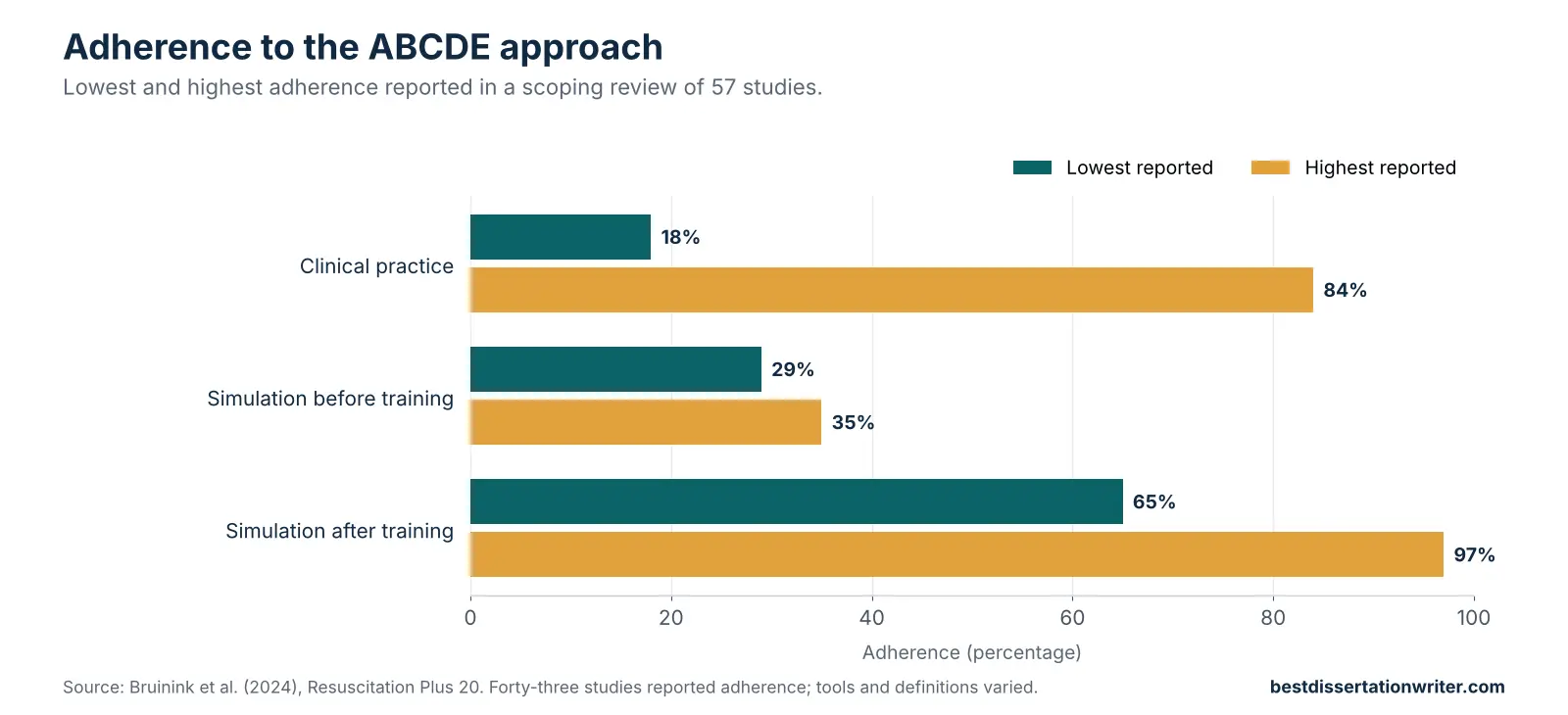
The authors concluded that many tools with variable content exist, that adherence was the most common outcome and varied widely, and that the link between the ABCDE approach and patient outcomes has yet to be investigated. For nursing practice, these findings suggest that a primary survey is likely to be applied unevenly unless it is taught, practised and supported by team leaders.
Olgers et al. (2017) gave an example from clinical practice. In an observational pilot study in a Dutch emergency department, they looked at how often staff used the ABCDE approach with medical patients who might be unstable. Of 270 medical patients, 206 were classed as possibly unstable by triage code, and the approach was used in 33% of them. When used, it was completed quickly, generally within 10 minutes, and covered more than 80% of the required items.
Staff often skipped the approach on the basis of a first clinical impression or triage vital signs, and higher triage codes were associated with more frequent use. The authors noted that it is unclear whether vital signs and first impressions are enough to identify who needs the approach. This is a pilot study from a single centre, so it cannot be generalised, but it suggests that the primary survey may be used selectively and that some patients who might benefit do not receive it.
Theme 2: Teaching the Primary Survey
Drost-de Klerck et al. (2020) assessed the short- and long-term effectiveness of simulation training for learning a structured ABCDE approach in an observational study with three to four months of follow-up. Thirty volunteers took a two-day course that included 24 simulations of primary assessments of acutely ill patients. Performance was recorded on video before the course, immediately afterwards and three to four months later, and scored by two blinded observers.
Performance improved significantly after the course and, although it fell slightly by follow-up, remained higher than before. The study was small, used volunteers rather than a representative group of clinicians and had no control group, so its findings are indicative only. It adds to the evidence from the scoping review that simulation can improve adherence, and it suggests that some of the benefit is retained for several months.
Simulation has several advantages as a way of teaching assessment. It allows learners to practise rare and frightening scenarios safely, to repeat them and to receive feedback from observers. It also makes errors visible without harm to patients. A limitation is that the scenarios are designed by teachers, so the behaviour seen in simulation may not match behaviour in a real, noisy and interrupted department, which may explain why adherence in simulation after training was higher than in clinical studies.
Together, these sources imply that learning the primary survey is not a one-off event. Skills fade, and a nurse who has not used the sequence for some time is likely to be less fluent. Regular refresher sessions, in situ simulation and feedback on real cases can help to maintain performance. Nurses with the confidence to take the lead in assessing a deteriorating patient are also more likely to ask for help early, which the guidance emphasises.
Theme 3: Guidance and the Value of the Approach
Smith and Bowden (2017) described the ABCDE approach for nurses in an article in Nursing Standard. They note that patients who deteriorate without recognition or timely intervention are at risk of critical care admission, illness and death. They present the approach as a systematic way to assess patients and address life-threatening problems in order of priority, recommend that vital signs are measured as part of the assessment and recorded with a track and trigger tool, and advise that findings are reported using a structured communication tool.
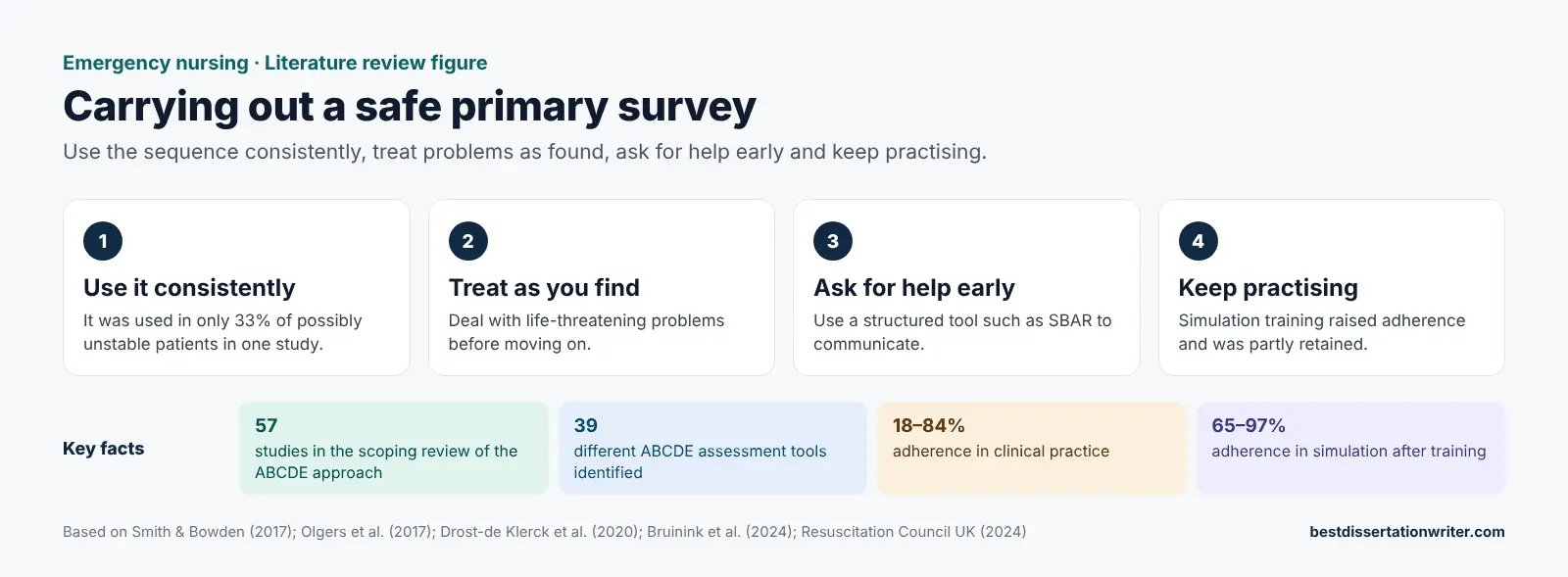
The Resuscitation Council UK (2024) guidance, first published in 2015 and updated in 2024, describes the ABCDE approach as a structured method for assessing and treating critically ill patients. The steps stay the same whatever the condition. Clinicians complete an initial assessment and reassess regularly, team members can carry out tasks at the same time, help should be requested early and communication should follow a structured format such as SBAR. It states that life-threatening problems should be treated before moving to the next part of the assessment.
These two sources are expert guidance, not research evidence, and they do not show that the approach improves outcomes. They nevertheless represent the standard that nurses in the United Kingdom are expected to follow, and they emphasise the practical features that appear in the research: treating problems as they are found, repeating the assessment, asking for help and communicating clearly. The research suggests that these features are not always applied, which is why training and audit are important.
Discussion
This integrative review shows that the primary survey is widely recommended, can be taught effectively through simulation and is often applied unevenly in clinical practice. Adherence ranges widely, from under a fifth to over four fifths of patients in clinical studies, and assessment tools vary in content. Evidence that the approach improves patient outcomes is very limited.
The lack of outcome evidence does not mean that the approach is ineffective. A structured assessment is logical and has a long record of use, and it would be difficult to design a trial that withheld it. However, it does mean that claims about its benefits rest on principle and on process measures such as adherence and completeness. Researchers should therefore explore links with outcomes such as time to treatment, deterioration and mortality, and nurses should be careful about overstating what the approach can do.
There are other limitations. The five sources include a scoping review, a small pilot, a small simulation study and two guidance documents, so the evidence is varied and mostly indirect. The participants in two studies were doctors or volunteers and not nurses. The studies come from the Netherlands and the review is international, so findings should be applied to United Kingdom practice with care. This review relied on openly accessible, English-language sources.
Nevertheless, the findings suggest practical steps. Nurses should use the primary survey for all patients who might be unstable, not only for those who look obviously unwell, because first impressions and vital signs may not be enough. Departments can reduce variation by agreeing on one assessment tool, by practising in simulation and by giving feedback on real cases.
Implications of Primary Survey Evidence for Practice
For practice, the evidence supports using the primary survey for every patient who may be unstable, treating life-threatening problems as they are found, reassessing regularly, calling for help early and handing over with a structured tool. Guidance is available from the Resuscitation Council UK and the Royal College of Nursing.
Managers and educators should provide regular simulation-based training, agree a single local assessment tool, audit use of the primary survey and give feedback to staff. Team leaders should be present in resuscitations, since leadership was linked with better adherence. Pain relief is also part of early care for injured and acutely ill patients, a topic considered in the review of delays in analgesia.
Future research should link the primary survey to patient outcomes, compare assessment tools, test refresher training and in situ simulation and include nurses specifically in studies. Evidence from United Kingdom emergency departments, and from trauma as well as medical presentations, would be particularly welcome.
A practical test of any approach to emergency assessment is whether nurses will use it when they are tired, busy and under pressure. The evidence reviewed here suggests that a simple, rehearsed sequence is most likely to survive such conditions, and that teams should keep their methods consistent so that they become habit.
Conclusion
This integrative review found that the primary survey is a recommended and teachable approach but that adherence varies and evidence on patient outcomes is scarce.
Emergency nurses can use the primary survey consistently, practise it in simulation and support colleagues to escalate early, while researchers and services work to show how it affects outcomes.
References
Bruinink, L. J., Linders, M., de Boode, W. P., Fluit, C. R. M. G., & Hogeveen, M. (2024). The ABCDE approach in critically ill patients: A scoping review of assessment tools, adherence and reported outcomes. Resuscitation Plus, 20, Article 100763. https://doi.org/10.1016/j.resplu.2024.100763
Drost-de Klerck, A. M., Olgers, T. J., van de Meeberg, E. K., Schonrock-Adema, J., & Ter Maaten, J. C. (2020). Use of simulation training to teach the ABCDE primary assessment: An observational study in a Dutch university hospital with a 3–4 months follow-up. BMJ Open, 10(7), Article e032023. https://doi.org/10.1136/bmjopen-2019-032023
Olgers, T. J., Dijkstra, R. S., Drost-de Klerck, A. M., & Ter Maaten, J. C. (2017). The ABCDE primary assessment in the emergency department in medically ill patients: An observational pilot study. Netherlands Journal of Medicine, 75(3), 106–111.
Resuscitation Council UK. (2024). The ABCDE approach. https://resus.org.uk/node/123
Smith, D., & Bowden, T. (2017). Using the ABCDE approach to assess the deteriorating patient. Nursing Standard, 32(14), 51–63. https://doi.org/10.7748/ns.2017.e11030
Cite this example
Best Dissertation Writers (2026) Trauma Assessment and the Primary Survey: Adherence to Protocols by Emergency Nurses: An Integrative Review. Available at: https://bestdissertationwriter.com/primary-survey-literature-review/
Best Dissertation Writers
Get expert help with your nursing literature review
Share your topic and deadline with Best Dissertation Writers and get support tailored to your module brief.