Telehealth Consultations Delivered by Nurse Practitioners: A Scoping Review
 By Dr. Robertson Prime, Research Fellow
Updated November 2, 2026
14 min read
About 2,800 words
In this review
Abstract
Background: Telehealth consultations by telephone or video expanded rapidly during the COVID-19 pandemic, and nurse practitioners and other advanced practitioners now deliver a substantial share of them. Their use raises questions about access, safety, the limits of remote assessment and the education that practitioners need.
Aim: This scoping review aimed to map the evidence on telehealth consultations delivered by nurse practitioners and advanced practice nurses, including access, patient and provider experience, outcomes and education.
Methods: Evidence was identified through targeted searches of openly accessible bibliographic records, publisher websites and repositories. Five sources published between 2021 and 2025 were included: two systematic reviews, a scoping review, a survey study and a qualitative study. Findings were charted and summarised descriptively under themes.
Findings: A scoping review of 42 studies found that nurse practitioner-led telehealth improved access, that satisfaction was high and fell when patients felt they needed a physical assessment, and that 14 studies addressed education. A systematic review of 15 studies of advanced practice nurses found positive effects in 12. A systematic review of nine studies of telepsychiatry found feasible delivery but low-quality evidence. A survey of 308 patients found lower telehealth use and attitude scores in rural and frontier areas. A qualitative study of 25 nurses found that telehealth maintained services but did not support complex assessment.
Conclusion: Telehealth consultations by advanced practitioners appear to improve access and to be acceptable to patients, but remote assessment has limits and rural patients may be disadvantaged. Evidence quality is low, and practitioners need education, funding and guidance on when to see patients in person.
Keywords: telehealth consultations, telemedicine, remote consultation
Introduction
This scoping review critically examines recent evidence on telehealth consultations and its implications for advanced clinical practice.
Before 2020, telehealth was used mainly in specific services, such as remote monitoring or consultations in sparsely populated areas. The COVID-19 pandemic changed this almost overnight. Practices and clinics that had seen patients face to face began to use the telephone and video, often with little preparation, and many have continued to do so. Advanced practitioners were among those who adapted, offering assessment, advice and follow-up remotely.
A remote consultation offers clear benefits. Patients can avoid travel, time off work and exposure to infection, and services can reach people who find it hard to attend. It also has limits. A practitioner cannot examine the patient directly, may miss non-verbal cues and depends on the patient’s access to technology, privacy and confidence. For advanced practitioners, whose role relies on physical assessment and clinical reasoning, these limits are especially relevant.
Telehealth consultations are also a matter of equity. Patients in remote areas may gain most from remote care but may have the poorest connections, while those with limited digital skills or a language barrier may be left behind. A scoping review is suited to a field that is developing quickly and is described by studies of many designs.
Review question
What is known about telehealth consultations delivered by nurse practitioners and advanced practice nurses, including access, experience, outcomes and education?
Background to Telehealth Consultations in Advanced Clinical Practice
The term telehealth covers a range of activities. A telephone call, a video consultation, a text-based exchange and remote monitoring of observations are all examples, and the choice affects what can be assessed. Synchronous consultations take place in real time, while asynchronous ones, such as sending a photograph, do not. Studies often use the term loosely, so it is important to note which form of telehealth is being described.
Telehealth consultations link to many themes in advanced practice. The quality of remote assessment depends on the practitioner’s skills in questioning and reasoning, as discussed in the review of clinical reasoning skills. Patients’ views on telehealth consultations are part of the broader subject of patient satisfaction. Remote consultations are also used in prescribing decisions, such as those considered in the review of antimicrobial stewardship, and need governance, as discussed in the review of clinical governance.
Concerns about safety are central to telehealth consultations. Practitioners must decide when a remote consultation is adequate and when the patient should be seen in person, and they must document that decision. Because the evidence on these decisions is still emerging, this review pays particular attention to the limits of telehealth as well as its benefits.
Search Strategy and Methods
Evidence for this example was identified through targeted searches of openly accessible bibliographic records, publisher websites and repositories. Search terms combined keywords for the intervention (“telehealth”, “telemedicine”, “telepsychiatry”, “remote consultation”, “video consultation”) with terms for the practitioners and outcomes (“nurse practitioner”, “advanced practice nurse”, “access”, “satisfaction”, “education”), joined with the Boolean operators AND and OR. A full scoping review would run the same strategy in CINAHL, PubMed/MEDLINE, Embase and Scopus and report how records were screened.
Sources were eligible if they reported telehealth consultations or services delivered by nurse practitioners, advanced practice nurses or nurses in primary care, and described access, outcomes, experience or education. Studies of remote monitoring without clinician consultation and opinion pieces were excluded. In keeping with scoping review methods, studies were not excluded on the basis of design.
Five sources published between 2021 and 2025 were included (Table 1). Findings were charted and summarised descriptively under themes. As is usual in a scoping review, the quality of the sources was noted but not used to exclude them.
The findings are presented from the general to the specific. First the evidence on access and outcomes is considered, then the experience of patients and nurses, and finally the evidence on education and the limits of remote assessment. Because the sources use different designs, the results are described in each source’s own terms and are not combined statistically.
Key Findings on Telehealth Consultations
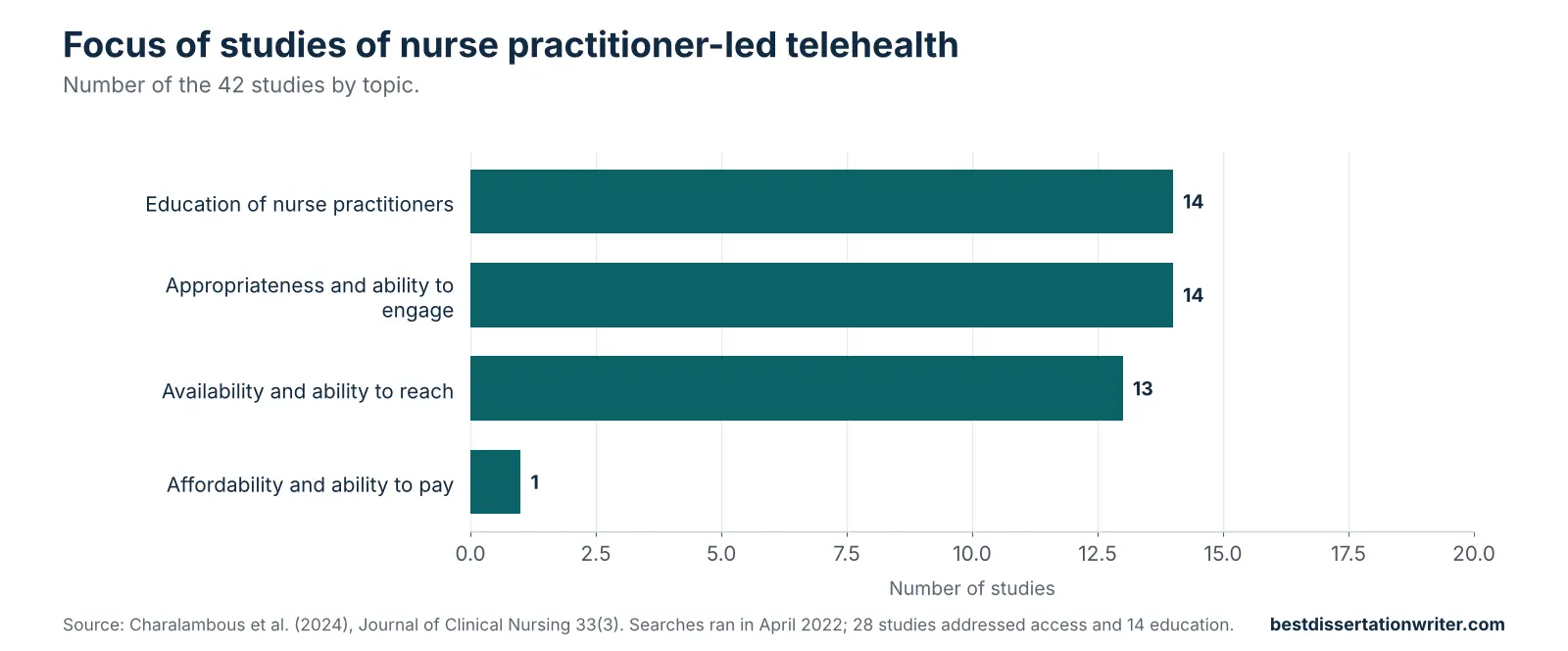
Three themes were identified: access and outcomes, patient and nurse experience, and education and the limits of remote assessment. Table 1 summarises the included sources, and Figure 1 shows the focus of the 42 studies in a scoping review of nurse practitioner-led telehealth.
| Author, year | Design | Setting and sample | Key finding |
|---|---|---|---|
| Barton et al. (2023) | Survey study | 308 patients in three nurse-led models in Colorado | Rural and frontier patients had lower telehealth use and attitude scores. |
| Charalambous et al. (2024) | Scoping review | 42 studies of nurse practitioner-led telehealth | Improved access; high satisfaction; 14 studies on education. |
| Costa et al. (2025) | Systematic review | 15 studies of advanced practice nurse telehealth | Positive effects on primary outcomes in 12 studies. |
| Finley et al. (2021) | Integrative systematic review | 9 studies of telepsychiatry by advanced practice nurses | Feasible delivery; evidence low quality and high risk of bias. |
| James et al. (2021) | Qualitative study | 25 Australian primary healthcare nurses | Telehealth maintained services but did not support complex assessment. |
Theme 1: Access and Outcomes
Charalambous et al. (2024) carried out a scoping review of nurse practitioner-led telehealth services. They searched four databases in April 2022 and included 42 studies published between 2010 and 2022, from Australia, New Zealand, the United States, Canada, the United Kingdom and Ireland. Twenty-eight studies addressed access to care: 14 on appropriateness and the ability to engage, one on affordability and 13 on availability and the ability to reach services. Fourteen addressed the education of nurse practitioners.
Patients reported high satisfaction, citing reduced travel time and costs and more flexible appointments. Providers reported fewer emergency presentations, fewer missed appointments and better engagement by consumers. The authors concluded that nurse practitioner-led telehealth appears to improve access to care and that high satisfaction suggests patients accept it. They noted that telehealth is likely to remain a core part of care delivery.
Costa et al. (2025) carried out a systematic review of telehealth in patient care by advanced practice nurses. They searched seven databases in August 2023 and included 15 intervention studies of moderate or high quality, in adults, older adults and family members of children with chronic diseases. Interventions included telephone calls and combinations of devices or programmes for education, monitoring or counselling. A meta-analysis was not possible.
Positive effects on primary outcomes were found in 12 of the 15 studies. These outcomes included costs, self-management, caregiver satisfaction, quality of life, comfort, treatment adaptation, functional recovery, clinical indicators and vital signs. The authors concluded that telehealth was effective for obtaining clinical data and managing care and that its safe use was supported. Since the studies were drawn from selected, higher-quality designs, the findings may be more favourable than those of routine practice.
Finley et al. (2021) carried out an integrative systematic review of psychiatric mental health advanced practice registered nurses using synchronous telepsychiatry. They searched eight databases and screened 342 articles, of which nine were included. The risk of bias was high in all nine, three studies were rated of very low quality, five low and one medium. Even so, the authors concluded that such nurses can feasibly and successfully deliver telepsychiatry to diverse patients in varied locations.
Taken together, these sources suggest that telehealth consultations by advanced practitioners improve access and are generally acceptable to patients. They also show that the evidence is limited by low quality, short follow-up and a focus on feasibility, so claims about clinical effectiveness and safety should be made with care.
Theme 2: Patient and Nurse Experience
Barton et al. (2023) surveyed patients and providers in three nurse-led care models in Colorado during the sudden adoption of telehealth: federally qualified health centres, nurse midwifery practices and the Nurse-Family Partnership programme. There were 308 patient respondents, mostly living in rural or frontier communities. Urban patients used telehealth more often than rural or frontier patients (P < .001), and rural and frontier patients had significantly lower attitude scores in all five domains assessed.
Telehealth modality also varied by location. Urban providers used video calls more often, whereas rural and frontier providers relied more on telephone calls. The authors suggested that the findings could inform policy and help to address barriers to access and delivery. This is a single study in one region, and survey responses may not represent all patients, but it highlights the risk that remote care may not reach those who might benefit most.
James et al. (2021) carried out a qualitative study of 25 Australian primary healthcare nurses who used telehealth during COVID-19, using semistructured telephone interviews from June to August 2020. Four themes emerged: preparedness, accessibility of telehealth, care experience and impacts on the nursing role. Some nurses were experienced with telehealth, while others lacked preparation and suitable technology.
Telehealth improved access to care but did not support complex clinical assessment. Patient engagement depended on access to and confidence with technology, perceived safety of attending in person and how much patients valued telehealth. Many nurses were frustrated by funding arrangements that limited their ability to practise to their full scope. The authors concluded that telehealth allowed primary healthcare services to continue during the pandemic and that lessons should inform future implementation.
The experience of telehealth consultations differs between those who deliver them and those who receive them. Practitioners may find that they can complete some tasks, such as reviewing results, discussing treatment and giving advice, efficiently by telephone, while patients may value the convenience but still wish for a face-to-face meeting when the problem is worrying. Understanding both perspectives helps services to design telehealth consultations that suit the purpose of the contact.
Equity again appears in this theme. The Colorado survey, the Australian interviews and the scoping review together suggest that access to and confidence with technology, and concerns about privacy, affect whether telehealth consultations work for a given patient. Practitioners can ask about these factors at the start of a consultation and offer an alternative if telehealth consultations are not suitable, which helps to prevent patients from being excluded.
Theme 3: Education and the Limits of Remote Assessment
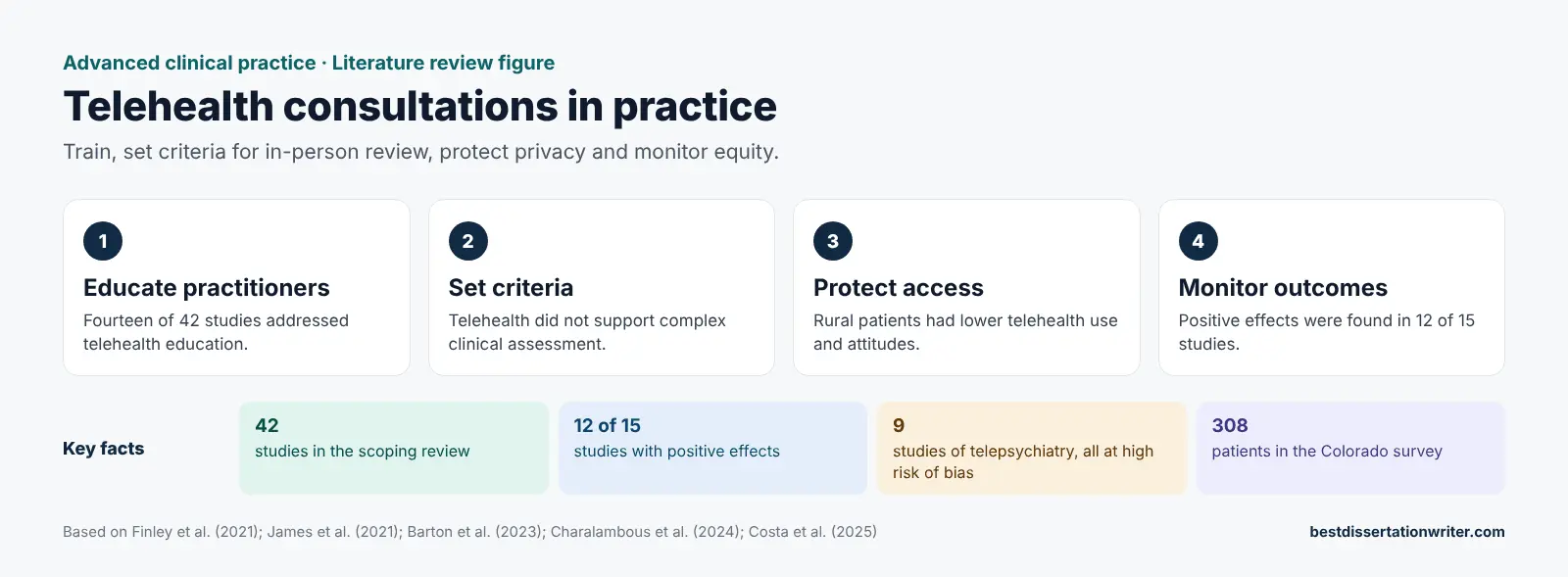
Charalambous et al. (2024) found that 14 of the 42 studies addressed the education of nurse practitioners for telehealth, using didactic modules, simulations and clinical experiences, and that all were published in the previous three years. The authors argued that, because telehealth is likely to remain a core part of care, nurse practitioners need formal telehealth education, and they noted that the recent rise in education studies reflects how quickly telehealth has become mainstream.
The limits of remote assessment are a recurring theme. In the review by Charalambous et al., satisfaction fell when patients felt that they needed a physical assessment or had concerns about privacy. In the study by James et al., telehealth did not support complex clinical assessment. These findings suggest that practitioners need criteria for when a remote consultation is sufficient and when to arrange an in-person assessment, and that services should support them in making that choice.
Preparedness and funding were also raised. Nurses who lacked suitable technology or training felt less able to deliver good telehealth, and funding models that limited their scope restricted their contribution. For advanced practitioners, this implies that implementation should include access to equipment, education, clear policies and appropriate funding, not just an instruction to use the telephone or video.
Discussion
This scoping review suggests that telehealth consultations by nurse practitioners and advanced practice nurses improve access, are acceptable to patients and can be delivered effectively across a range of conditions, but that remote assessment has limits and that rural and disadvantaged patients may face barriers.
The evidence base has limits. The systematic reviews include small numbers of studies, and the telepsychiatry review found high risk of bias in every study. The survey and qualitative studies are limited to specific regions and to the early pandemic period. Few studies measure safety, missed diagnoses or the appropriateness of the decision to consult remotely, and the sources say little about video compared with telephone consultations.
Other limitations should be noted. The review of nurse practitioner-led telehealth is from English-speaking, high-income countries. The sources on education are mostly descriptions of programmes and not evaluations. This review relied on openly accessible, English-language sources, and the speed of change in telehealth means that newer studies may alter the picture.
Even so, the sources point in a consistent direction. Telehealth consultations work best when practitioners have education and technology, when patients have access and confidence and when there are clear rules about when to see patients in person. For advanced clinical practitioners, a structured approach to remote assessment, with safety-netting advice, is a practical way of reducing risk.
A practical lesson concerns documentation and safety-netting. A practitioner who holds telehealth consultations should record what was assessed, what could not be assessed, why a remote approach was judged adequate and what advice was given about when to seek urgent help. Clear records support continuity and accountability, and they are consistent with the concern in the included sources that remote assessment has limits.
Implications of Telehealth Consultations Evidence for Practice
For practice, the evidence supports education in remote consultation, a clear policy on when to arrange face-to-face assessment, attention to privacy, access and language, and the offer of both telephone and video options. Guidance is available from NHS England, the Nursing and Midwifery Council and the Royal College of Nursing.
Managers should provide equipment and training, make sure that funding and scheduling support extended remote consultations, monitor who is and is not using telehealth and audit decisions to convert a remote consultation to an in-person one. They should also check that rural and disadvantaged patients are not left behind.
Future research should evaluate the safety and clinical effectiveness of nurse-led telehealth in controlled designs, compare video with telephone consultations, evaluate education programmes and include the experience of patients with limited access to technology. Studies in United Kingdom services would be particularly valuable.
Conclusion
This scoping review found that telehealth consultations by advanced practitioners improve access and are acceptable to patients, but that the evidence is of low quality, remote assessment has limits and rural patients may be disadvantaged.
Advanced clinical practitioners can use telehealth effectively with education, clear criteria for in-person review and attention to equity of access.
References
Barton, A. J., Amura, C. R., Willems, E. L., Medina, R., Centi, S., Hernandez, T., Reed, S. M., & Cook, P. F. (2023). Patient and provider perceptions of COVID-19-driven telehealth use from nurse-led care models in rural, frontier, and urban Colorado communities. Journal of Patient Experience, 10. https://doi.org/10.1177/23743735231151546
Charalambous, J., Hollingdrake, O., & Currie, J. (2024). Nurse practitioner led telehealth services: A scoping review. Journal of Clinical Nursing, 33(3), 839–858. https://doi.org/10.1111/jocn.16898
Costa, I. C. P., Costa, A. S., Garbuio, D. C., Zamarioli, C. M., Eduardo, A. H. A., de Carvalho, E. C., & Chaves, E. de C. L. (2025). Telehealth in patient care by advanced practice nurses: A systematic review. Acta Paulista de Enfermagem, 38, Article eAPE0003141. https://doi.org/10.37689/acta-ape/2025AR0003141i
Finley, B. A., Shea, K. D., Maixner, R., & Slebodnik, M. (2021). Advanced practice registered nurses using synchronous telepsychiatry: An integrative systematic review. Journal of the American Psychiatric Nurses Association, 27(4), 271–282. https://doi.org/10.1177/1078390320939159
James, S., Ashley, C., Williams, A., Desborough, J., McInnes, S., Calma, K., Mursa, R., Stephen, C., & Halcomb, E. J. (2021). Experiences of Australian primary healthcare nurses in using telehealth during COVID-19: A qualitative study. BMJ Open, 11(8), Article e049095. https://doi.org/10.1136/bmjopen-2021-049095
Cite this example
Best Dissertation Writers (2026) Telehealth Consultations Delivered by Nurse Practitioners: A Scoping Review. Available at: https://bestdissertationwriter.com/telehealth-consultations-review-review/
Best Dissertation Writers
Get expert help with your nursing literature review
Share your topic and deadline with Best Dissertation Writers and get support tailored to your module brief.