Suicide Risk Assessment and Prevention by Mental Health Nurses: An Integrative Review
 By Dr. Robertson Prime, Research Fellow
Updated October 12, 2026
15 min read
About 3,000 words
In this review
Abstract
Background: Suicide risk assessment has long been organised around checklists, scales and categories of low, medium or high risk that shape decisions about admission, observation and follow-up. Mental health nurses carry out much of this work, but suicide is statistically rare even among high-risk groups and risk factors are common, which limits the predictive value of any tool.
Aim: This integrative review aimed to examine how accurately risk assessment can predict suicide and suicidal behaviour, and which approaches to assessment and suicide prevention are supported by evidence for mental health nursing.
Methods: Evidence was identified through targeted searches of openly accessible bibliographic records, publisher websites and the reference lists of key reviews. Six sources published between 2016 and 2022 were included: four meta-analyses or systematic reviews, a cohort comparison study and a national guideline, appraised with CASP checklists and synthesised narratively.
Findings: Patients classified as high risk had higher pooled odds of suicide, but almost half of those who died had been classified as lower risk, and the pooled positive predictive value of risk scales for suicide was only 5.5%. The 2022 NICE guideline advises against using risk tools or global risk categories to predict suicide or allocate care, recommending individual risk formulation within psychosocial assessment instead. Safety planning-type interventions reduced suicidal behaviour (relative risk 0.57) but had no significant effect on suicidal ideation.
Conclusion: Mental health nurses should replace reliance on risk scores with compassionate, person-centred assessment, a clear formulation and collaborative safety planning, supported by follow-up contact after discharge.
Keywords: suicide risk assessment, safety planning, suicide prevention
Introduction
This integrative review critically examines recent evidence on suicide risk assessment and its implications for mental health nursing practice.
Suicide is a leading cause of avoidable death, and people in contact with mental health services, including those who have recently self-harmed or been discharged from hospital, are at markedly higher risk than the general population. Each death has a devastating effect on families, friends and staff. Services are under strong pressure to identify people who are most likely to die by suicide and to intervene before harm occurs.
Mental health nurses carry out much of this work. They assess people in emergency departments, crisis teams and inpatient wards, decide on levels of observation, plan leave and discharge, and are often the professionals to whom people disclose suicidal thoughts. For many years suicide risk assessment has been organised around checklists, scales and categories of low, medium or high risk, which shape decisions about admission, observation and follow-up and are often documented as a routine part of nursing care.
An integrative design was chosen because the relevant evidence includes meta-analyses of predictive accuracy, a cohort comparison study, a meta-analysis of intervention studies and national guidance. Combining these different types of evidence allows the review to consider both the limits of suicide risk assessment and the alternatives that services are now adopting.
Review question
How accurately can suicide risk assessment predict suicide and suicidal behaviour, and which approaches to assessment and suicide prevention are supported by evidence for mental health nursing?
Background to Suicide Risk Assessment
Traditional suicide risk assessment rests on the idea that known risk factors, such as previous self-harm, hopelessness, suicidal intent, male sex, substance misuse and physical illness, can be combined to estimate an individual’s likelihood of suicide. Many scales have been developed for this purpose, and local services have often devised their own risk forms. Category labels are then used to allocate scarce resources, such as inpatient beds, close observation or rapid follow-up, to those judged to be at highest risk.
However, suicide is statistically rare even among high-risk groups, and risk factors are common. A factor that is present in many people who never die by suicide cannot reliably pick out the few who do. This is a problem of base rates rather than of clinical skill, and it limits the predictive value of any tool, however carefully designed. A person classified as low risk may still die by suicide, while many people labelled high risk will not.
These concerns have led to a shift in thinking about suicide risk assessment. Rather than predicting who will die, newer approaches emphasise understanding each person’s situation, building a therapeutic relationship, formulating risk in a narrative way and working collaboratively on safety planning. In England, the 2022 NICE guideline on self-harm advises against using risk tools and scales or global risk categories to predict suicide or to decide who should receive treatment (National Institute for Health and Care Excellence [NICE], 2022).
Search Strategy and Methods
Evidence for this example was identified through targeted searches of openly accessible bibliographic records, publisher websites and the reference lists of key reviews. Search terms combined keywords for assessment (“suicide risk assessment”, “risk scale”, “risk stratification”, “prediction”, “positive predictive value”) and intervention (“safety planning”, “safety plan”, “suicide prevention”, “brief contact”) with terms for population and setting (“mental health”, “psychiatric patients”, “self-harm”, “emergency department”), joined with the Boolean operators AND and OR. A full integrative review for assessment would run the same strategy in CINAHL, PubMed/MEDLINE, the Cochrane Library and Embase and report the number of records screened in a PRISMA flow diagram.
Sources were eligible if they examined the accuracy of suicide risk assessment, risk factors or risk scales in predicting suicide or suicidal behaviour among people using mental health services or after self-harm, or evaluated safety planning interventions for adults at risk of suicide. Systematic reviews, meta-analyses, large comparative studies and national guidelines published in English from 2010 onward were included. Single small studies, opinion pieces and studies limited to children or the general population were excluded.
Six sources on suicide risk assessment and safety planning published between 2016 and 2022 were included: four meta-analyses or systematic reviews, one cohort comparison study and one national guideline (Table 1). The quality of each source was appraised using the relevant Critical Appraisal Skills Programme (CASP) checklist, and findings were synthesised narratively and grouped into themes.
Key Findings on Suicide Risk Assessment
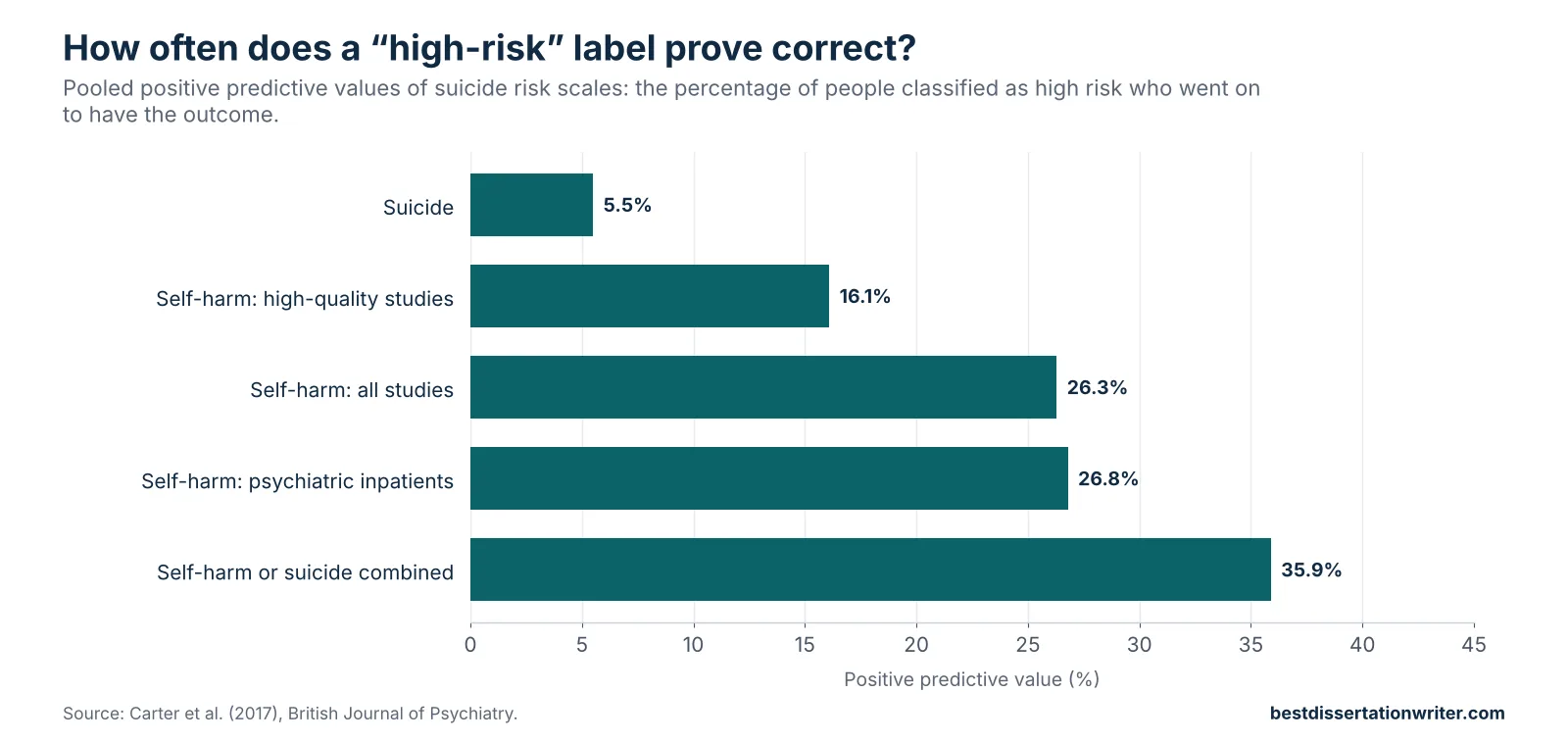
Three themes were identified: the limited predictive accuracy of suicide risk assessment tools and categories, the move in guidance from prediction towards individual formulation, and evidence for safety planning as an intervention. Table 1 summarises the included sources, and Figure 1 presents the pooled positive predictive values of risk scales reported by Carter et al. (2017).
| Author, year | Design | Setting and sample | Key finding |
|---|---|---|---|
| Chan et al. (2016) | Systematic review and meta-analysis | 12 risk factor and 7 risk scale studies of people after self-harm | Four risk factors robustly associated with suicide but too common to predict; scale PPVs 1.3–16.7%. |
| Large et al. (2016) | Meta-analysis of cohort studies | 53 samples from 37 studies of psychiatric patients | High-risk category OR 4.84; sensitivity 56%, specificity 79%; suicide in 5.5% of high-risk patients. |
| Carter et al. (2017) | Systematic review and meta-analysis | Studies of risk scales predicting suicide and self-harm | Pooled PPV 5.5% for suicide and 26.3% for self-harm; no high-risk classification clinically useful. |
| Stanley et al. (2018) | Cohort comparison study | 1,640 patients, nine US Veterans Health Administration emergency departments | Safety planning with telephone follow-up: suicidal behaviour 3.03% vs 5.29% (OR 0.56). |
| Nuij et al. (2021) | Meta-analysis | 6 studies, 3,536 participants | Safety planning-type interventions reduced suicidal behaviour (RR 0.57); no effect on ideation. |
| NICE (2022) | National clinical guideline | People who have self-harmed, all settings, England | Do not use risk tools or low/medium/high categories to predict suicide or allocate care; use formulation and safety plans. |
Theme 1: The Limited Predictive Accuracy of Suicide Risk Assessment
Large et al. (2016) pooled 53 samples from 37 longitudinal cohort studies in which psychiatric patients or people who had attempted suicide were classified as high or lower risk. The pooled odds of suicide among high-risk patients were 4.84 times those of lower-risk patients (95% CI 3.79–6.20), but heterogeneity was very high (I² = 93.3%). Over an average follow-up of 63 months, 5.5% of high-risk and 0.9% of lower-risk patients died by suicide, and sensitivity and specificity were 56% and 79% respectively.
These figures show that suicide risk assessment based on categorisation identifies a group with raised risk but misses almost half of those who go on to die, while the great majority of people labelled high risk do not die by suicide. Large et al. (2016) also found no improvement in the strength of prediction in more recent studies and evidence of publication bias that inflated the pooled odds, which suggests that the true accuracy of such categories may be lower still.
Carter et al. (2017) addressed the same question from the clinician’s perspective by calculating positive predictive values (PPVs), the proportion of people classified as high risk who go on to have the outcome. For suicide, the pooled PPV of risk scales was 5.5% (95% CI 3.9–7.9%). For self-harm the PPV was higher at 26.3%, but in high-quality studies it fell to 16.1%. The authors concluded that no high-risk classification was clinically useful and noted that prevalence imposes a ceiling on PPV.
Chan et al. (2016), in a review undertaken to inform NICE guidance, examined prospective studies of people who had self-harmed. Previous self-harm, suicidal intent, physical health problems and male gender were robustly associated with later suicide, with hazard ratios between 1.68 and 2.7, but these factors were too common to be useful for prediction. Only three scales had been evaluated, PPVs ranged from 1.3% to 16.7%, and the authors warned that scales might give false reassurance.
Theme 2: From Prediction to Formulation
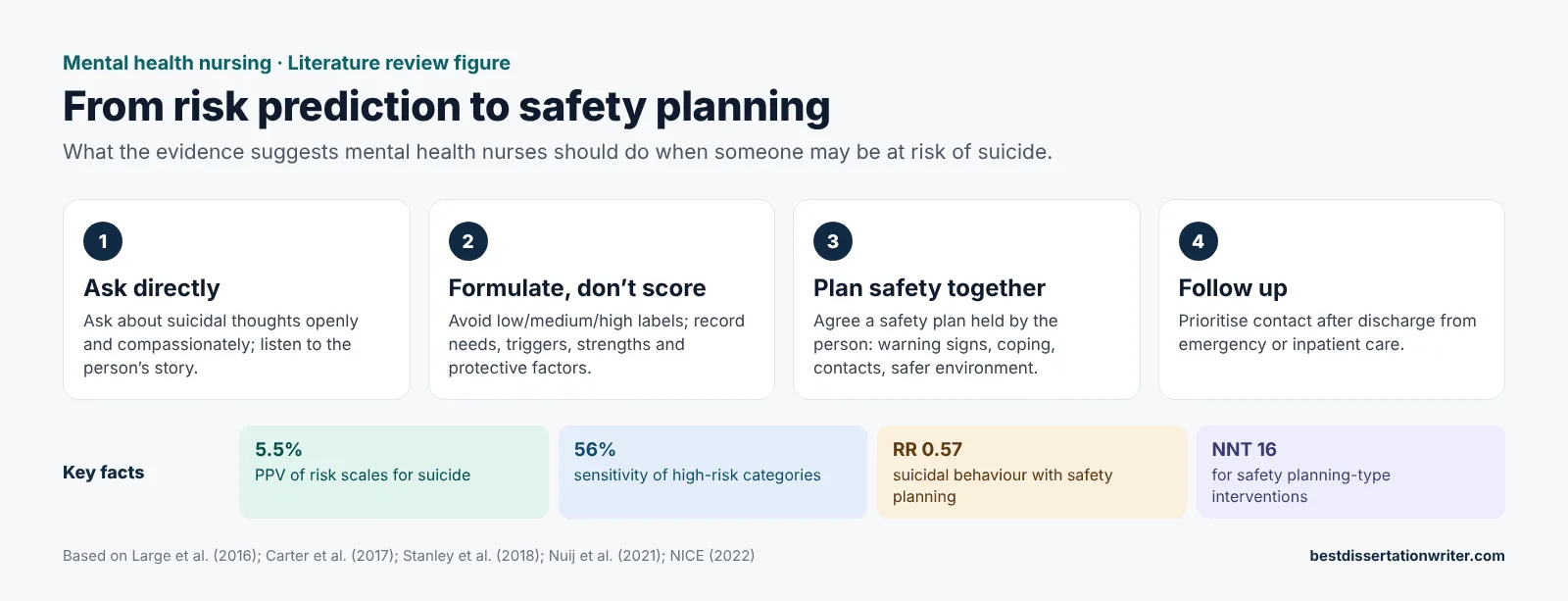
The 2022 NICE guideline on self-harm translated this evidence into practice recommendations. It states that risk assessment tools and scales, and global stratification into low, medium or high risk, should not be used to predict future suicide or repetition of self-harm, or to determine who should be offered treatment or discharged (NICE, 2022). Instead, mental health professionals should carry out a risk formulation as part of every psychosocial assessment.
The guideline describes psychosocial assessment as an opportunity to build a therapeutic relationship, to develop a shared understanding of why self-harm occurred and to identify strengths, needs, and historic, current and future factors, including protective factors. This approach treats risk as dynamic and individual rather than as a fixed score. For nurses, it means that the quality of the conversation and the plan agreed with the person matter more than the completion of a risk form.
This change is not without challenges. Risk categories are embedded in many local policies, electronic records and audit processes, and staff may feel exposed if they cannot point to a completed tool after a death. Moving to formulation-based suicide risk assessment requires training, supervision and organisational support so that clinicians can document their reasoning clearly and share decisions with service users, families and colleagues.
Theme 3: Safety Planning as Suicide Prevention
If prediction is unreliable, the focus shifts to interventions that can be offered to everyone who is at risk. Stanley et al. (2018) compared the Safety Planning Intervention with structured telephone follow-up against usual care for 1,640 patients presenting to nine Veterans Health Administration emergency departments with suicide-related concerns. Over six months, suicidal behaviour occurred in 3.03% of the intervention group and 5.29% of the comparison group (odds ratio 0.56, 95% CI 0.33–0.95), and the odds of attending outpatient mental health care were about twice as high (odds ratio 2.06).
Because sites rather than individuals were allocated and the groups were of unequal size, the study is vulnerable to confounding by differences between hospitals. Nuij et al. (2021) therefore pooled six studies with 3,536 participants comparing safety planning-type interventions with control conditions. The relative risk of suicidal behaviour was 0.57 (95% CI 0.41–0.80), with a number needed to treat of 16, although there was no significant effect on suicidal ideation.
Safety planning is well suited to nursing practice. NICE (2022) suggests developing a safety plan with the person that identifies triggers and warning signs, coping strategies, supportive contacts, crisis contacts and ways to make the environment safer, and recommends that plans are developed collaboratively, held by the person and accessible during a crisis. These steps can be completed by nurses in emergency, community and inpatient settings.
Discussion
The evidence reviewed here points consistently in one direction. Meta-analyses spanning decades of research show that risk factors, scales and categories are associated with suicide at a group level but cannot predict which individuals will die. Most people classified as high risk do not die by suicide, and more than two in five of those who do were classified as lower risk. Suicide risk assessment used as prediction therefore offers limited protection and may divert attention from care.
This does not mean that suicide risk assessment has no value. Asking about suicidal thoughts, understanding the person’s circumstances and identifying modifiable factors such as hopelessness, access to means, substance use or social crisis remain essential. The change advocated by NICE (2022) is in the purpose of assessment: from assigning a level of risk to understanding needs and planning care. Assessment thus becomes the starting point for suicide prevention rather than a gatekeeping exercise.
Safety planning offers a practical way of linking assessment with intervention, and the meta-analytic evidence suggests a meaningful reduction in suicidal behaviour. However, the number of studies is small, several were not randomised, and safety planning was often combined with follow-up contacts, making it difficult to know which component is effective. The lack of effect on suicidal ideation suggests that safety plans support people through crises but do not on their own address underlying distress.
There are also tensions for nursing practice. Nurses often work within systems that still expect suicide risk assessment to produce ratings for observation levels and leave, and fear of blame after a death may encourage defensive practice. Moving towards formulation and collaborative safety planning requires organisational change, including revised documentation, supervision, and a culture that accepts that suicide cannot always be predicted or prevented.
The perspectives of service users and families also deserve attention. People who have self-harmed or felt suicidal may experience checklist-driven assessment as impersonal, and being labelled low risk can feel dismissive when they are in distress. Involving the person, and with consent their family or carers, in developing a shared understanding and a safety plan respects their expertise in their own lives. It also gives those closest to the person clear information about warning signs and how to get help in a crisis.
This review has limitations. It included a small number of sources, some of which overlapped in the studies they pooled, and the safety planning evidence came largely from the United States. This review relied on openly accessible, English-language sources and did not involve independent double screening. Future research should evaluate formulation-based approaches in practice, test safety planning in randomised trials across different settings, including inpatient wards, and examine the experiences of service users and nurses.
Implications of Suicide Risk Assessment Evidence for Practice
For mental health nurses, the evidence supports replacing reliance on risk scores with compassionate, person-centred assessment. Nurses should ask directly about suicidal thoughts, explore the person’s circumstances, strengths and reasons for living, and record a clear formulation and plan rather than a single risk category. Every person at risk should be offered collaborative safety planning, with copies held by the person and shared with carers where they agree, and follow-up contact after discharge from emergency or inpatient care should be prioritised.
Assessment depends on trust, so skills in building the therapeutic relationship are central to honest disclosure. Nurses should be alert to suicidal thinking when supporting adults with depression and people with schizophrenia, and should recognise that people who self-harm need psychosocial assessment and follow-up rather than judgement. Services should support nurses with training, supervision and policies that reflect current guidance on suicide prevention.
Conclusion
This integrative review found that suicide risk assessment based on scales, risk factors and categories cannot accurately predict suicide in individuals, with low positive predictive values and poor sensitivity. National guidance now advises against using such tools for prediction or to decide who receives care, and supports individual formulation and collaborative safety planning.
For mental health nursing, the priority is to use suicide risk assessment as a means of understanding and helping people rather than labelling them. Combining therapeutic conversations, clear formulation, safety planning and timely follow-up offers the best available evidence-based approach to suicide prevention, while organisations must support nurses to work in this way.
References
Carter, G., Milner, A., McGill, K., Pirkis, J., Kapur, N., & Spittal, M. J. (2017). Predicting suicidal behaviours using clinical instruments: Systematic review and meta-analysis of positive predictive values for risk scales. British Journal of Psychiatry, 210(6), 387–395. https://doi.org/10.1192/bjp.bp.116.182717
Chan, M. K. Y., Bhatti, H., Meader, N., Stockton, S., Evans, J., O’Connor, R. C., Kapur, N., & Kendall, T. (2016). Predicting suicide following self-harm: Systematic review of risk factors and risk scales. British Journal of Psychiatry, 209(4), 277–283. https://doi.org/10.1192/bjp.bp.115.170050
Large, M., Kaneson, M., Myles, N., Myles, H., Gunaratne, P., & Ryan, C. (2016). Meta-analysis of longitudinal cohort studies of suicide risk assessment among psychiatric patients: Heterogeneity in results and lack of improvement over time. PLoS ONE, 11(6), e0156322. https://doi.org/10.1371/journal.pone.0156322
National Institute for Health and Care Excellence. (2022). Self-harm: Assessment, management and preventing recurrence (NICE Guideline NG225). https://www.nice.org.uk/guidance/ng225
Nuij, C., van Ballegooijen, W., de Beurs, D., Juniar, D., Erlangsen, A., Portzky, G., O’Connor, R. C., Smit, J. H., Kerkhof, A., & Riper, H. (2021). Safety planning-type interventions for suicide prevention: Meta-analysis. British Journal of Psychiatry, 219(2), 419–426. https://doi.org/10.1192/bjp.2021.50
Stanley, B., Brown, G. K., Brenner, L. A., Galfalvy, H. C., Currier, G. W., Knox, K. L., Chaudhury, S. R., Bush, A. L., & Green, K. L. (2018). Comparison of the safety planning intervention with follow-up vs usual care of suicidal patients treated in the emergency department. JAMA Psychiatry, 75(9), 894–900. https://doi.org/10.1001/jamapsychiatry.2018.1776
Cite this example
Best Dissertation Writers (2026) Suicide Risk Assessment and Prevention by Mental Health Nurses: An Integrative Review. Available at: https://bestdissertationwriter.com/suicide-risk-assessment-review-review/
Best Dissertation Writers
Get expert help with your nursing literature review
Share your topic and deadline with Best Dissertation Writers and get support tailored to your module brief.