Medication Adherence in People with Schizophrenia and the Role of the Mental Health Nurse: A Literature Review
 By Dr. Robertson Prime, Research Fellow
Updated October 12, 2026
15 min read
About 3,000 words
In this review
Abstract
Background: For people with schizophrenia, antipsychotic medication is central to reducing symptoms and lowering the risk of relapse, yet partial or complete nonadherence is common. Mental health nurses administer long-acting injections, monitor side effects and support people through discharge, so their approach to medication, whether compliance-focused or based on concordance and shared decision-making, may influence whether treatment continues.
Aim: This narrative review aimed to examine the importance of antipsychotic adherence, the factors that influence it and the interventions that mental health nurses can use to support it.
Methods: Evidence was identified through targeted searches of openly accessible bibliographic records, publisher websites and the reference lists of key reviews. Seven sources published between 2002 and 2026 were included: a Cochrane review, three further reviews, a multicentre randomised trial, a national guideline and an international fact sheet, appraised with CASP checklists and synthesised narratively.
Findings: Between seven and twelve months, 27% of people who continued antipsychotic medication relapsed compared with 64% of those switched to placebo, but movement disorders, sedation and weight gain were more common. Nonadherence was frequent, with a mean rate of 41.2% in one review, and was linked to poor insight, negative attitudes to medication, substance misuse, inadequate discharge planning and a poorer therapeutic alliance. Adherence therapy produced mixed results, reducing symptoms without measurably changing adherence, whereas combined, individually tailored approaches based on shared decision-making appeared more promising.
Conclusion: Nurses should discuss medication openly and without judgement at every contact, support joint decisions about treatment, manage side effects and physical health, and prioritise discharge planning and continuity of care.
Keywords: people with schizophrenia, antipsychotic, concordance
Introduction
This narrative review critically examines recent evidence on people with schizophrenia and its implications for mental health nursing practice.
Schizophrenia is a serious mental illness that affects perception, thinking, emotion and behaviour. It often begins in early adulthood and can follow a relapsing course, with periods of acute psychosis separated by times of relative stability. For many people with schizophrenia, antipsychotic medication is a central part of treatment, both to reduce symptoms during an acute episode and to lower the risk of relapse afterwards. Yet taking medication consistently over months and years is difficult, and partial or complete nonadherence is common.
Mental health nurses are closely involved in this area of care. They administer long-acting injections, monitor side effects and physical health, support people through discharge and work with families and carers. Nurses are also well placed to explore how people feel about their medication, because they often have more frequent contact with service users than other professionals. The way in which nurses approach medication, whether through compliance-focused instruction or through concordance and shared decision-making, may influence whether people with schizophrenia continue treatment.
A narrative approach was chosen because the relevant evidence is diverse, ranging from Cochrane reviews of medication effects to observational reviews of adherence, randomised trials of adherence therapy and national guidance, and these sources need to be interpreted together rather than pooled statistically.
Review question
What does the evidence say about the importance of antipsychotic adherence for people with schizophrenia, the factors that influence it and the interventions that mental health nurses can use to support it?
Background to People with Schizophrenia
The World Health Organization (2026) estimates that around 1 in 300 people worldwide, or 27 million people, live with schizophrenia. The condition is associated with substantial disability, stigma and premature death, and the World Health Organization reports that people with schizophrenia die nine years earlier than the general population. Access to care remains limited, with only 29% of people with psychosis receiving specialist mental health care.
Antipsychotic medication remains the main pharmacological treatment. In England, NICE guidance on psychosis and schizophrenia in adults (NICE, 2014) asks services to work in partnership with people with schizophrenia and their carers and to offer care in an atmosphere of hope and optimism. Guidance based on CG178 also states that the choice of antipsychotic should be made jointly by the prescriber and the service user, that the side effects each person is most willing to tolerate should be discussed and that long-acting injectable preparations can be considered where a person prefers them.
Adherence is the extent to which a person’s medication-taking matches the agreed treatment plan. Older terms such as compliance imply that the person should simply follow instructions, whereas concordance describes an agreement reached through open discussion between the person and the clinician, in which the person’s beliefs and preferences are respected. The shift towards concordance reflects wider moves towards recovery-oriented and person-centred mental health care.
Nonadherence can be intentional, for example when someone decides to stop medication because of side effects or because they do not believe they are unwell, or unintentional, for example when someone forgets doses or finds the regimen confusing (Haddad et al., 2014). These different forms require different nursing responses, which is why understanding the reasons behind nonadherence matters as much as measuring its frequency.
Search Strategy and Methods
Evidence on people with schizophrenia for this example was identified through targeted searches of openly accessible bibliographic records, publisher websites and the reference lists of key reviews. Search terms combined keywords for the population (“schizophrenia”, “psychosis”), the treatment (“antipsychotic”, “maintenance treatment”) and the outcome or intervention (“adherence”, “nonadherence”, “concordance”, “adherence therapy”, “relapse”), joined with the Boolean operators AND and OR. A full narrative review for assessment would run the same strategy in CINAHL, PubMed/MEDLINE, the Cochrane Library and Embase and report the number of records screened in a PRISMA flow diagram.
Sources were eligible if they addressed people with schizophrenia or related psychotic disorders aged 18 years or over and reported on antipsychotic maintenance treatment, the prevalence or causes of nonadherence, or interventions to support adherence that could be delivered or coordinated by nurses. Cochrane and other systematic reviews, randomised controlled trials, national guidance and international data were prioritised. Studies focused only on first-episode psychosis in adolescents, or on specific drug comparisons without adherence outcomes, were excluded.
Seven sources about people with schizophrenia published between 2002 and 2026 were included: a Cochrane review, three further reviews, a multicentre randomised trial, a national guideline and an international fact sheet (Table 1). One older review was retained because it remains the most widely cited synthesis of nonadherence rates. The quality of each source was appraised using the Critical Appraisal Skills Programme (CASP) checklist appropriate to its design, and findings were synthesised narratively and grouped into themes.
Key Findings on People with Schizophrenia
Three themes were identified: the benefits and burdens of antipsychotic maintenance treatment, the extent and causes of nonadherence, and the effectiveness of adherence interventions and concordance-based nursing. Table 1 summarises the included sources, and Figure 1 shows the main outcomes of antipsychotic maintenance treatment compared with placebo.
| Author, year | Design | Setting and sample | Key finding |
|---|---|---|---|
| Lacro et al. (2002) | Comprehensive literature review | 39 articles on medication nonadherence in schizophrenia | Mean nonadherence 41.2% (49.5% in most rigorous studies); poor insight, negative attitudes and weak alliance key predictors. |
| Gray et al. (2006) | Multicentre randomised controlled trial | 409 people with schizophrenia and recent instability; European mental health services | Eight sessions of adherence therapy were no more effective than health education for quality of life at 52 weeks. |
| Leucht et al. (2012) | Cochrane systematic review | 65 RCTs, 6,493 participants | Relapse at 7–12 months 27% with antipsychotics vs 64% with placebo; more movement disorders and weight gain. |
| NICE (2014) | National clinical guideline (CG178) | Adults with psychosis and schizophrenia in England | Partnership working; joint choice of antipsychotic; discussion of side effects; long-acting injections considered. |
| Haddad et al. (2014) | Narrative review | Literature on antipsychotic nonadherence | Nonadherence affects over a third each year; tailored, combined psychosocial approaches and shared decisions recommended. |
| Gray et al. (2016) | Systematic review and meta-analysis | 6 RCTs, 725 participants | Adherence therapy reduced symptoms (SMD −0.56) but did not significantly change adherence or attitudes. |
| World Health Organization (2026) | International fact sheet | Global data | Around 1 in 300 people live with schizophrenia; only 29% of people with psychosis receive specialist care. |
Theme 1: Why Antipsychotic Maintenance Matters for People with Schizophrenia
The strongest evidence on the value of continued treatment comes from a Cochrane review by Leucht et al. (2012), which included 65 randomised trials with 6,493 participants. Between seven and twelve months, 27% of people who continued antipsychotic medication relapsed, compared with 64% of those switched to placebo (risk ratio 0.40), giving a number needed to treat of three. Fewer people taking antipsychotics were readmitted to hospital (10% compared with 26%), and quality of life was better in the small number of trials that measured it.
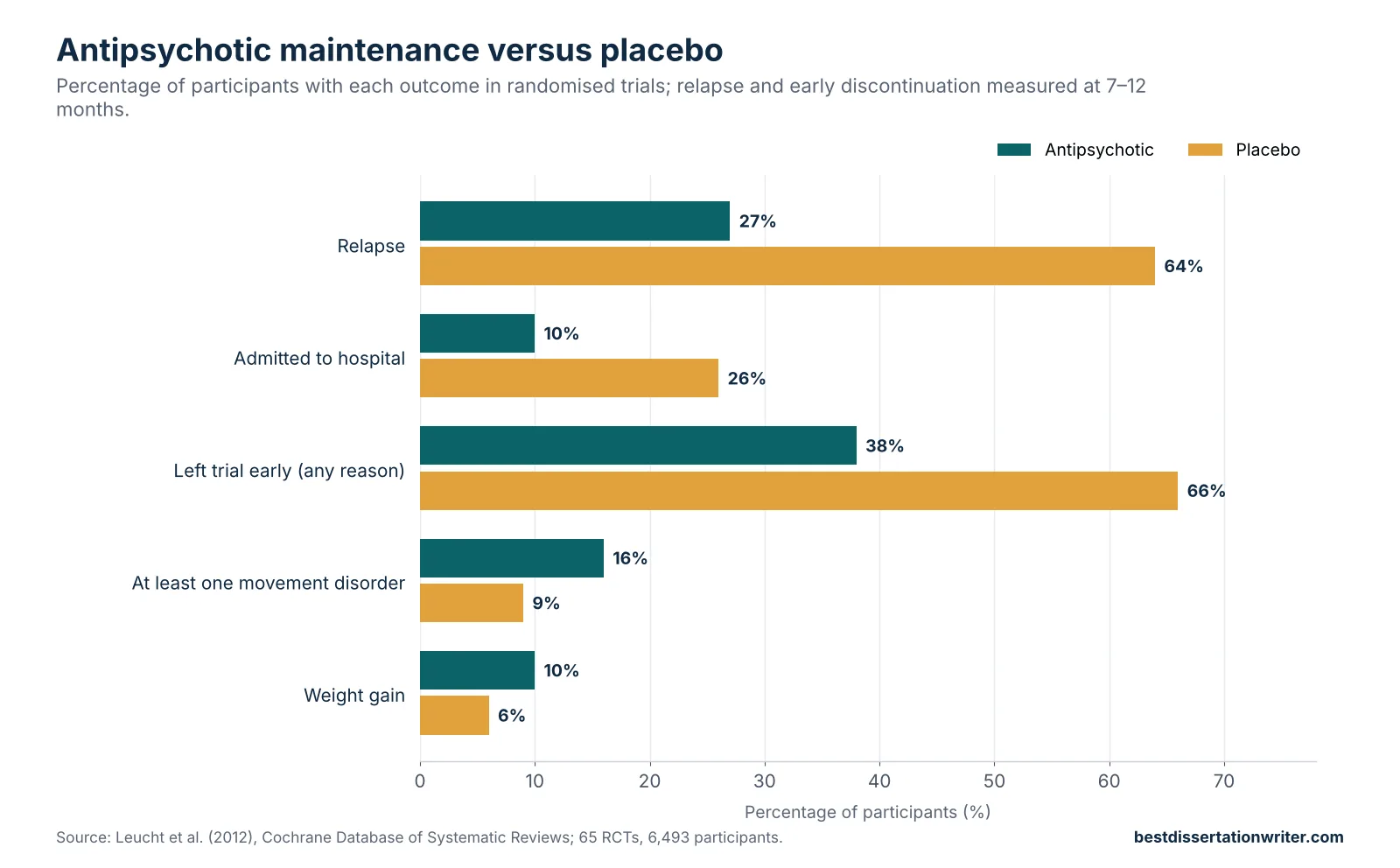
The same review also shows the costs of treatment. Movement disorders were more common with antipsychotic medication (16% compared with 9%), as were sedation (13% compared with 9%) and weight gain (10% compared with 6%). These side effects are not trivial. They affect appearance, physical health and self-esteem, and they are among the reasons people give for stopping medication. Nurses therefore need to hold two messages at once: maintenance treatment substantially reduces relapse, but it has burdens that must be acknowledged and actively managed.
There are limits to how far these findings can be generalised. Most trials compared continuing medication with abrupt withdrawal to placebo, which may exaggerate relapse in the placebo group, and few trials lasted beyond a year. The review cannot show which individuals might safely reduce or stop medication. This uncertainty supports open, shared discussion rather than a single message that everyone must remain on medication indefinitely.
Theme 2: The Extent and Causes of Nonadherence
In a comprehensive review of 39 articles, Lacro et al. (2002) found a mean nonadherence rate of 41.2% in studies meeting strict criteria, rising to 49.5% in the most rigorous studies. The factors most consistently associated with nonadherence were poor insight, negative attitudes towards medication, previous nonadherence, substance misuse, shorter illness duration, inadequate discharge planning or aftercare and a poorer therapeutic alliance. Notably, side-effect severity and route of administration were not consistent predictors.
Haddad et al. (2014) reached similar conclusions more than a decade later, reporting that nonadherence affects more than one third of people with schizophrenia each year and is often hidden and underestimated by clinicians. They described contributing factors linked to the person, the illness, the medication, the clinician and the service, including stigma, social isolation, depression and cognitive impairment. Nonadherence increased the risk of relapse, readmission and self-harm and reduced quality of life. They also noted that there is no gold-standard way to measure adherence.
Two points stand out for nursing. First, several of the strongest predictors, such as the therapeutic alliance and the quality of discharge planning, are modifiable features of care rather than fixed characteristics of the person. Second, the finding that clinicians underestimate nonadherence suggests that routine, non-judgemental conversations about medication are needed, rather than assumptions based on how well someone appears to be. Asking directly, and accepting honest answers without criticism, may reveal more than relying on clinical impression.
Theme 3: Adherence Therapy, Concordance and Nursing Interventions
Adherence therapy is a brief, structured intervention, usually of around eight sessions, that uses motivational interviewing and cognitive behavioural techniques to explore a person’s beliefs about medication. In a European multicentre randomised trial, Gray et al. (2006) randomised 409 people and compared eight sessions of adherence therapy with eight sessions of health education for people with schizophrenia who had recently been clinically unstable. After 52 weeks, adherence therapy was no more effective than health education in improving quality of life.
A later meta-analysis by Gray et al. (2016) pooled six randomised trials involving 725 participants. Adherence therapy reduced psychiatric symptoms compared with usual treatment (standardised mean difference −0.56) over follow-up of less than one year, but it had no significant effect on adherence behaviour or on attitudes to medication. Heterogeneity was very high (I² 86%), and the trials were few and varied in quality. The finding that symptoms improved without measurable change in adherence is puzzling and suggests that general therapeutic engagement may account for some of the benefit.
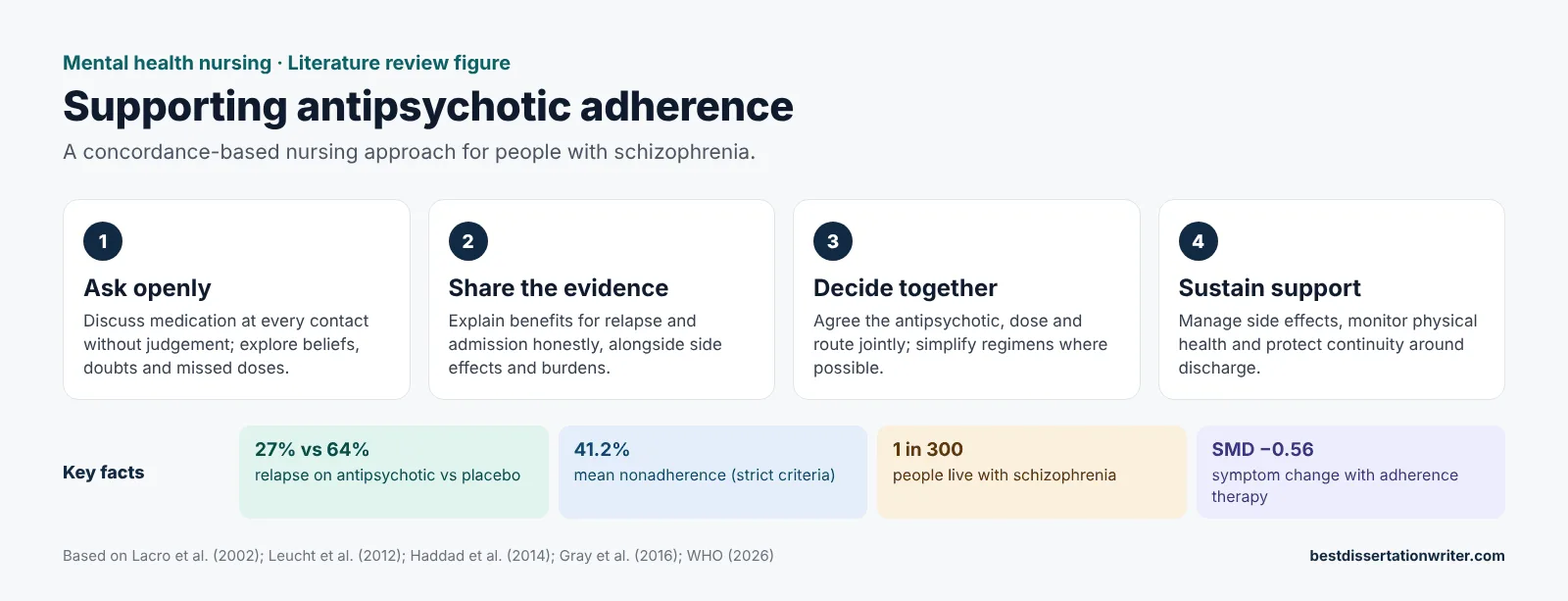
Haddad et al. (2014) concluded that combined psychosocial approaches appear more effective than single-component interventions and that support should be tailored to the individual. Practical strategies included shared decision-making, regular checks on adherence, simplifying regimens, managing side effects and building a strong therapeutic alliance. Long-acting injectable antipsychotic medication and electronic reminders, such as text messages and smart pill containers, may help some people, while financial incentives raise ethical concerns and their role remains unclear. These recommendations are consistent with the concordance-based approach set out in NICE guidance.
Discussion
This review shows that antipsychotic maintenance treatment substantially reduces relapse and readmission for people with schizophrenia, that nonadherence is common and multi-causal, and that specific adherence interventions have produced mixed results. The evidence on the benefits of maintenance treatment is strong, but the evidence on how best to support adherence is weaker and more uncertain.
A central tension lies between the strength of the case for continued medication and the respect owed to individual choice. Leucht et al. (2012) provides compelling population-level evidence, yet side effects are real, and some people decide that the burdens outweigh the benefits for them. A concordance approach does not abandon the evidence; it shares it honestly, explores the person’s priorities and seeks an agreement that the person can sustain. This is more consistent with recovery-oriented care than persuasion alone.
The disappointing results for adherence therapy also deserve reflection. Gray et al. (2006) found no effect in routine settings, and Gray et al. (2016) found improvements in symptoms but not in adherence itself. One explanation is that adherence is shaped by many factors, including insight, substance use, stigma and service continuity, that a short course of sessions cannot address alone. Another is that the measurement of adherence is unreliable, as Haddad et al. (2014) noted, making true effects hard to detect.
These findings have implications for the role of mental health nurses. Rather than relying on a single packaged intervention, nurses may be most effective when concordance-based conversations are woven into every contact, alongside practical help with side effects, regimens, physical health and social needs. Continuity of care for people with schizophrenia, particularly around discharge, appears important, given that inadequate discharge planning and a weak therapeutic alliance were consistently linked to nonadherence.
The role of long-acting injectable medication illustrates these tensions. For some people with schizophrenia, an injection every few weeks removes the burden of daily tablets and makes missed doses visible, allowing nurses to follow up promptly. NICE (2014) supports considering long-acting preparations where a person prefers them. However, injections can feel coercive when they are linked to community treatment orders or offered without genuine choice, and they do not remove side effects. Nurses who administer injections are therefore in a key position to keep the conversation about treatment open, to review side effects and physical health at each visit and to ensure that consent remains meaningful.
This review has limitations. It relied on openly accessible, English-language sources, did not involve independent double screening and included one older review alongside more recent evidence. Many included studies came from high-income countries, and few captured service users’ own accounts of medication decisions. Future research should test multi-component, nurse-delivered concordance interventions with reliable adherence measures, include longer follow-up and involve service users in defining meaningful outcomes.
Implications of People with Schizophrenia Evidence for Practice
For mental health nurses, the evidence supports routine, non-judgemental discussion of medication at every contact, using open questions to explore beliefs, side effects and practical barriers. Nurses should share balanced information about the benefits of maintenance treatment and its burdens, support joint decisions about the choice of antipsychotic and route of administration, monitor and act on side effects and physical health, and pay close attention to discharge planning and continuity of care. Families and carers should be involved where the person agrees.
Concordance depends on a trusting therapeutic relationship, and many service users have experienced coercive treatment or earlier adversity, so the principles of trauma-informed care are directly relevant to medication discussions. Nurses should also recognise that substance misuse is a strong predictor of nonadherence and may require integrated care for dual diagnosis, and that relapse and nonadherence increase the risk of self-harm, which should be assessed and addressed.
Conclusion
This narrative review found that antipsychotic maintenance treatment markedly reduces relapse and readmission for people with schizophrenia, but that nonadherence affects a large proportion and arises from personal, clinical and service factors. Single adherence interventions have produced mixed results, whereas combined, individually tailored approaches based on shared decision-making appear more promising.
Mental health nurses can best support people with schizophrenia by building trusting relationships, discussing medication openly and honestly, managing side effects and ensuring continuity of care. Treating medication as a shared decision rather than an instruction is likely to be both more ethical and more effective.
References
Gray, R., Bressington, D., Ivanecka, A., Hardy, S., Jones, M., Schulz, M., von Bormann, S., White, J., Anderson, K. H., & Chien, W. T. (2016). Is adherence therapy an effective adjunct treatment for patients with schizophrenia spectrum disorders? A systematic review and meta-analysis. BMC Psychiatry, 16, 90. https://doi.org/10.1186/s12888-016-0801-1
Gray, R., Leese, M., Bindman, J., Becker, T., Burti, L., David, A., Gournay, K., Kikkert, M., Koeter, M., Puschner, B., Schene, A., Thornicroft, G., & Tansella, M. (2006). Adherence therapy for people with schizophrenia: European multicentre randomised controlled trial. British Journal of Psychiatry, 189(6), 508–514. https://doi.org/10.1192/bjp.bp.105.019489
Haddad, P. M., Brain, C., & Scott, J. (2014). Nonadherence with antipsychotic medication in schizophrenia: Challenges and management strategies. Patient Related Outcome Measures, 5, 43–62. https://doi.org/10.2147/PROM.S42735
Lacro, J. P., Dunn, L. B., Dolder, C. R., Leckband, S. G., & Jeste, D. V. (2002). Prevalence of and risk factors for medication nonadherence in patients with schizophrenia: A comprehensive review of recent literature. Journal of Clinical Psychiatry, 63(10), 892–909. https://doi.org/10.4088/JCP.v63n1007
Leucht, S., Tardy, M., Komossa, K., Heres, S., Kissling, W., & Davis, J. M. (2012). Maintenance treatment with antipsychotic drugs for schizophrenia. Cochrane Database of Systematic Reviews, (5), CD008016. https://doi.org/10.1002/14651858.CD008016.pub2
National Institute for Health and Care Excellence. (2014). Psychosis and schizophrenia in adults: Prevention and management (Clinical guideline CG178). https://www.nice.org.uk/guidance/cg178
World Health Organization. (2026). Schizophrenia [Fact sheet]. https://www.who.int/news-room/fact-sheets/detail/schizophrenia
Cite this example
Best Dissertation Writers (2026) Medication Adherence in People with Schizophrenia and the Role of the Mental Health Nurse: A Literature Review. Available at: https://bestdissertationwriter.com/people-with-schizophrenia-review-review/
Best Dissertation Writers
Get expert help with your nursing literature review
Share your topic and deadline with Best Dissertation Writers and get support tailored to your module brief.