Prevention and Management of Postpartum Haemorrhage by Midwives: A Systematic Review of the Evidence
 By Dr. Robertson Prime, Research Fellow
Updated October 12, 2026
15 min read
About 3,000 words
In this review
Abstract
Background: Postpartum haemorrhage is a leading cause of maternal death worldwide, and haemorrhage accounted for 27.1% of maternal deaths in a WHO systematic analysis. Midwives are usually the first professionals present when bleeding begins, so their skills in prevention, early detection and first-line treatment are central to safe care.
Aim: This systematic review aimed to examine the evidence on the prevention and management of excessive bleeding after birth and what this means for midwifery practice.
Methods: Evidence was identified through targeted searches of openly accessible bibliographic records, publisher websites and the reference lists of key reviews. Six sources published between 2014 and 2025 were included: a WHO systematic analysis, two Cochrane reviews and three large randomised trials, appraised with CASP checklists and synthesised thematically.
Findings: Active management of the third stage of labour reduced severe blood loss over 1000 mL (risk ratio 0.34), although the certainty was very low. A network meta-analysis of 122 trials found that ergometrine plus oxytocin and misoprostol plus oxytocin reduced bleeding of 500 mL or more compared with oxytocin alone, while heat-stable carbetocin was non-inferior to oxytocin in a trial of 29,645 women. Tranexamic acid given within three hours reduced death from bleeding (risk ratio 0.69), and in the E-MOTIVE trial early detection with a calibrated drape and a treatment bundle cut the composite of severe bleeding, laparotomy or death from 4.3% to 1.6%.
Conclusion: Midwives should offer prophylactic uterotonics to all women, measure blood loss objectively and start bundled first-response treatment, including early tranexamic acid, without delay.
Keywords: postpartum haemorrhage, uterotonics, active management
Introduction
This systematic review critically examines recent evidence on postpartum haemorrhage and its implications for midwifery practice.
Most births end safely, but bleeding after birth can become life-threatening within minutes. Excessive blood loss may follow a vaginal or caesarean birth, often in women with no identified risk factors, and delays in recognising it or starting treatment are a common feature of severe outcomes. For this reason, postpartum haemorrhage is treated as an obstetric emergency in which every member of the maternity team must know their role.
Midwives are usually the professionals present at the moment of birth and in the hours that follow. They give prophylactic uterotonics, manage the third stage of labour, estimate blood loss, monitor vital signs and call for help. In many settings, particularly in low- and middle-income countries, midwives may be the only skilled birth attendant available. Their practice therefore has a direct influence on whether postpartum haemorrhage is prevented, detected early and treated effectively.
A systematic approach was chosen so that Cochrane reviews and large randomised trials could be identified and appraised alongside global data on maternal mortality. The question matters because practice has changed in recent years, with new uterotonic options, wider use of tranexamic acid and growing interest in treatment bundles.
Review question
What is the evidence for interventions to prevent and manage postpartum haemorrhage, and what are the implications for midwives?
Background to Postpartum Haemorrhage
Postpartum haemorrhage is conventionally defined as blood loss of 500 mL or more within 24 hours of birth, with loss of 1000 mL or more often described as severe. The most common cause is uterine atony, in which the uterus fails to contract effectively after the placenta separates. Other causes include genital tract trauma, retained placental tissue and coagulation disorders, often summarised as tone, trauma, tissue and thrombin.
The global burden is considerable. In a WHO systematic analysis of 60,799 maternal deaths in 417 datasets from 115 countries, haemorrhage accounted for 27.1% of maternal deaths between 2003 and 2009, more than any other single cause (Say et al., 2014). Together with hypertensive disorders (14.0%) and sepsis (10.7%), it accounted for more than half of maternal deaths worldwide. Most of these deaths occurred in low- and middle-income countries, where access to blood transfusion and surgery may be limited.
Prevention focuses on the third stage of labour. Active management traditionally combines a prophylactic uterotonic drug, controlled cord traction and uterine massage, whereas expectant management allows the placenta to deliver spontaneously. Oxytocin is the standard uterotonic in many countries, but it requires refrigeration, and alternatives such as carbetocin, misoprostol and ergometrine differ in stability, cost and side effects.
Treatment of established bleeding involves uterine massage, further uterotonics, intravenous fluids, examination to identify the cause and escalation to surgical care where needed. Tranexamic acid, an antifibrinolytic drug, has been added to this response. A recurring problem is that visual estimation of blood loss is inaccurate and often underestimates bleeding, so treatment may start late.
Although factors such as prolonged labour, multiple pregnancy, a large baby and previous postpartum haemorrhage increase risk, many women who bleed heavily have no identifiable risk factor. Every birth therefore requires preparation: a prophylactic uterotonic ready, equipment for measuring blood loss, intravenous access available and a clear plan for calling help. Women who are known to be at higher risk benefit from antenatal discussion and an individual plan for the third stage, while women at low risk need the same vigilant observation in the first hours after birth, whether they give birth in hospital, a midwifery unit or at home.
Search Strategy and Methods
Evidence for this example was identified through targeted searches of openly accessible bibliographic records, publisher websites and the reference lists of key reviews. Search terms combined keywords for the condition (“postpartum haemorrhage”, “postpartum hemorrhage”, “PPH”, “blood loss”) with terms for interventions (“uterotonics”, “oxytocin”, “carbetocin”, “active management”, “third stage of labour”, “tranexamic acid”, “bundle”), joined with the Boolean operators AND and OR. A full systematic review for assessment would run the same strategy in CINAHL, MIDIRS, PubMed/MEDLINE, the Cochrane Library and Embase and report the number of records screened in a PRISMA flow diagram.
Sources were eligible if they evaluated interventions to prevent or treat postpartum haemorrhage after vaginal or caesarean birth and reported blood loss, morbidity or mortality, or if they described the global burden of maternal death from haemorrhage. Cochrane reviews and large randomised trials were prioritised. Outcomes of interest included blood loss above 500 mL and 1000 mL, the need for additional uterotonics, blood transfusion, surgery and death from postpartum haemorrhage. Studies of antenatal haemorrhage, and small single-centre trials already captured by systematic reviews, were excluded.
Six sources published between 2014 and 2025 were included: one WHO systematic analysis of maternal deaths, two Cochrane systematic reviews (one a network meta-analysis) and three large international randomised trials (Table 1). The quality of each source was appraised using the Critical Appraisal Skills Programme (CASP) checklist appropriate to its design, and findings were synthesised narratively and grouped into themes. Certainty ratings reported in the Cochrane reviews were noted for each outcome.
Key Findings on Postpartum Haemorrhage
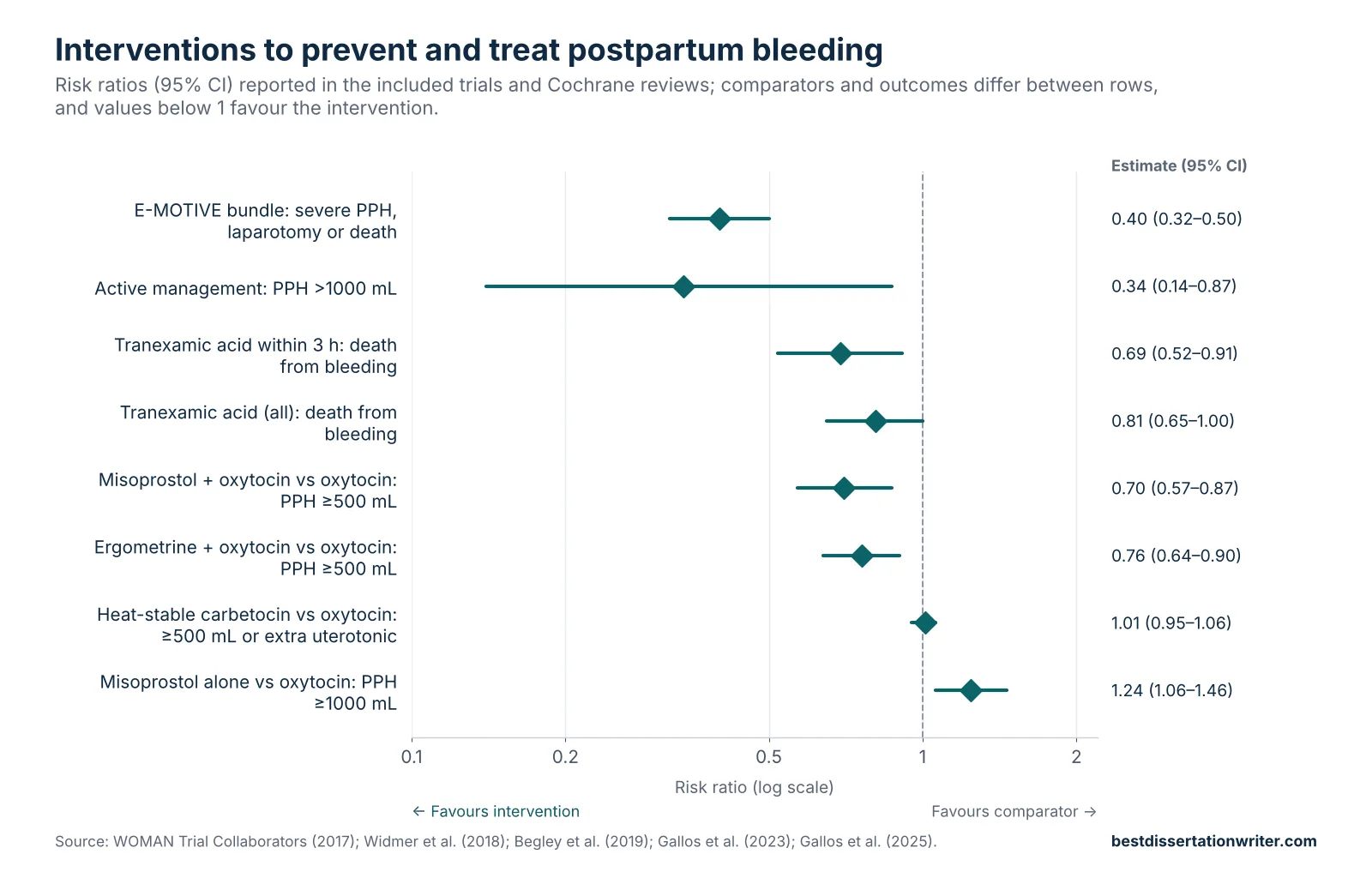
Three themes were identified: prevention through active management of the third stage of labour, the choice of prophylactic uterotonics, and early detection and treatment of postpartum haemorrhage, including tranexamic acid and bundled care. Table 1 summarises the included sources, and Figure 1 presents the main risk ratios reported for each intervention.
| Author, year | Design | Setting and sample | Key finding |
|---|---|---|---|
| Say et al. (2014) | WHO systematic analysis | 60,799 maternal deaths; 417 datasets, 115 countries | Haemorrhage caused 27.1% of maternal deaths in 2003–2009, the largest single cause. |
| WOMAN Trial Collaborators (2017) | International randomised placebo-controlled trial | 20,060 women with postpartum bleeding | Tranexamic acid reduced death from bleeding (RR 0.81); within 3 hours RR 0.69. |
| Widmer et al. (2018) | Randomised non-inferiority trial (CHAMPION) | 29,645 women, 23 sites in 10 countries; vaginal birth | Heat-stable carbetocin was non-inferior to oxytocin (14.5% vs 14.4%) for blood loss ≥500 mL. |
| Begley et al. (2019) | Cochrane systematic review | 8 studies, 8,892 women; third stage of labour | Active management reduced severe blood loss >1000 mL (RR 0.34); very low certainty. |
| Gallos et al. (2023) | Cluster randomised trial (E-MOTIVE) | 80 hospitals, 210,132 vaginal births; Kenya, Nigeria, South Africa, Tanzania | Calibrated drape and treatment bundle cut severe bleeding, laparotomy or death (1.6% vs 4.3%). |
| Gallos et al. (2025) | Cochrane network meta-analysis | 122 trials, 121,931 women, 48 countries | Ergometrine or misoprostol plus oxytocin reduced bleeding ≥500 mL versus oxytocin; more side effects. |
Theme 1: Active Management of the Third Stage of Labour
Begley et al. (2019) compared active with expectant or mixed management of the third stage in a Cochrane review of eight studies involving 8,892 women. In women at mixed risk of bleeding, active management reduced severe postpartum haemorrhage over 1000 mL at birth (risk ratio [RR] 0.34, 95% confidence interval [CI] 0.14 to 0.87) and reduced maternal haemoglobin below 9 g/dL after birth (RR 0.50, 0.30 to 0.83). It probably reduced blood loss over 500 mL and may have reduced the need for blood transfusion.
The certainty of this evidence was low or very low, and the reviewers found that active management may increase diastolic blood pressure, vomiting, afterpains and return to hospital with bleeding. In women at low risk of excessive bleeding, the effect on severe postpartum haemorrhage was uncertain (RR 0.31, 0.05 to 2.17). Seven of the eight studies were conducted in higher-income countries, and most predate current practice. These findings support offering active management but also justify discussing the options with women at low risk who prefer a physiological third stage.
Theme 2: Choosing Prophylactic Uterotonics
The uterotonic drug is the most important component of active management. In a Cochrane network meta-analysis of 122 trials with 121,931 women in 48 countries, Gallos et al. (2025) compared uterotonics with oxytocin. Ergometrine plus oxytocin (RR 0.76, 0.64 to 0.90; high certainty) and misoprostol plus oxytocin (RR 0.70, 0.57 to 0.87; moderate certainty) reduced blood loss of 500 mL or more. Carbetocin had a similar effect to oxytocin with few or no additional side effects, whereas misoprostol alone probably increased blood loss of 1000 mL or more (RR 1.24, 1.06 to 1.46).
Side effects shape the choice of drug. Combinations including ergometrine may increase nausea, vomiting and diarrhoea and, because ergometrine may raise blood pressure, they are unsuitable for women with hypertensive disorders. Misoprostol combinations probably increase nausea, vomiting, diarrhoea and fever (Gallos et al., 2025). Midwives therefore need to consider each woman’s medical history, as the most effective uterotonics on paper are not always the most appropriate.
Drug stability is a practical concern. In the CHAMPION trial, Widmer et al. (2018) randomised 29,645 women at 23 sites in 10 countries to heat-stable carbetocin or oxytocin after vaginal birth. Blood loss of 500 mL or more or use of additional uterotonics occurred in 14.5% and 14.4% respectively (RR 1.01, 0.95 to 1.06), meeting the criterion for non-inferiority. For blood loss of 1000 mL or more, non-inferiority could not be shown because events were rare (1.51% versus 1.45%). Heat-stable carbetocin may therefore be valuable where reliable refrigeration of oxytocin cannot be guaranteed.
Theme 3: Early Detection and Treatment of Postpartum Haemorrhage
Prevention cannot eliminate bleeding, so rapid treatment is essential. In the WOMAN trial, 20,060 women with postpartum haemorrhage were randomised to tranexamic acid or placebo (WOMAN Trial Collaborators, 2017). Death due to bleeding was reduced from 1.9% to 1.5% (RR 0.81, 0.65 to 1.00). The benefit depended on timing: when treatment was given within three hours of birth, death from bleeding fell (RR 0.69, 0.52 to 0.91), whereas later treatment showed no benefit (RR 1.07). The composite of death or hysterectomy did not differ, and no increase in thromboembolic events was found.
The E-MOTIVE trial tested a whole-system approach. Gallos et al. (2023) randomised 80 secondary-level hospitals in Kenya, Nigeria, South Africa and Tanzania, including 210,132 women who had vaginal births. Intervention hospitals used a calibrated blood collection drape to detect bleeding early and a bundle of first-response treatments: uterine massage, uterotonic drugs, tranexamic acid, intravenous fluids, and examination with escalation of care. The composite of severe postpartum haemorrhage, laparotomy for bleeding or death from bleeding fell from 4.3% to 1.6% (RR 0.40, 0.32 to 0.50).
The mechanism behind this result is instructive. Detection of postpartum haemorrhage rose from 51.1% to 93.1%, and use of the treatment bundle rose from 19.4% to 91.2% (Gallos et al., 2023). The interventions themselves were already familiar, so the gain came from measuring blood loss objectively and giving treatments together rather than one after another. Because the trial was conducted in African hospitals with high baseline rates, the size of benefit in well-resourced settings may be smaller.
Discussion
This review shows that postpartum haemorrhage can be reduced at several points: by active management and effective uterotonics during the third stage, by early tranexamic acid when bleeding occurs and by systems that detect bleeding promptly and trigger bundled treatment. The evidence for uterotonics and for tranexamic acid is drawn from very large trials and network meta-analysis, which gives considerable confidence in their direction and size of effect.
The E-MOTIVE results suggest that implementation, not knowledge of effective drugs, is often the weakest link. In usual care, nearly half of haemorrhages went undetected, and fewer than one in five women received the full bundle. This echoes the long-standing finding that visual estimation underestimates blood loss. For midwives, objective measurement and clear thresholds for action may be as important as the choice of drug.
There are tensions in the evidence. Active management reduces severe bleeding, yet the certainty is very low and some women at low risk prefer a physiological third stage. The most effective uterotonic combinations carry more side effects, and ergometrine is unsuitable for women with hypertension. Balancing effectiveness against side effects and women’s preferences requires individualised assessment and informed discussion antenatally, rather than a single approach for all women.
Context also matters. Say et al. (2014) showed that most deaths from postpartum haemorrhage occur in low- and middle-income countries, where heat-stable drugs, simple measurement tools and task-sharing with midwives may have the greatest impact. In high-income settings, the absolute risk of death is low, but severe morbidity, transfusion and admission to intensive care remain important outcomes that services should audit.
Timing is a further thread running through the evidence. The benefit of tranexamic acid was confined to women treated within three hours of birth, and the E-MOTIVE bundle worked by detecting bleeding earlier and treating it at once. Both findings suggest that the outcome of postpartum haemorrhage is often decided in the first minutes and hours. Midwives who recognise bleeding promptly, start treatment without waiting for a doctor and escalate early are therefore likely to have more influence on outcomes than any single drug choice. Clear local protocols that authorise midwives to act within agreed thresholds support this rapid response.
Women’s experiences should not be overlooked. A severe postpartum haemorrhage can be frightening for the woman and her birth partner, particularly when the room fills with staff and the baby is separated from the mother. None of the included trials focused on psychological outcomes, yet midwives are well placed to explain what is happening during the emergency, to keep the birth partner informed and to revisit the experience afterwards. Including women’s views in future trials and audits would give a fuller picture of the impact of different approaches to care.
The evidence base has limitations. The active management trials are older and mostly from higher-income countries, and outcome definitions vary between studies. The E-MOTIVE trial was limited to vaginal births in four African countries. This review relied on openly accessible, English-language sources and did not involve independent double screening, so relevant evidence may have been missed. Future research should evaluate early detection bundles in high-income settings, after caesarean birth and in midwife-led units.
Implications of Postpartum Haemorrhage Evidence for Practice
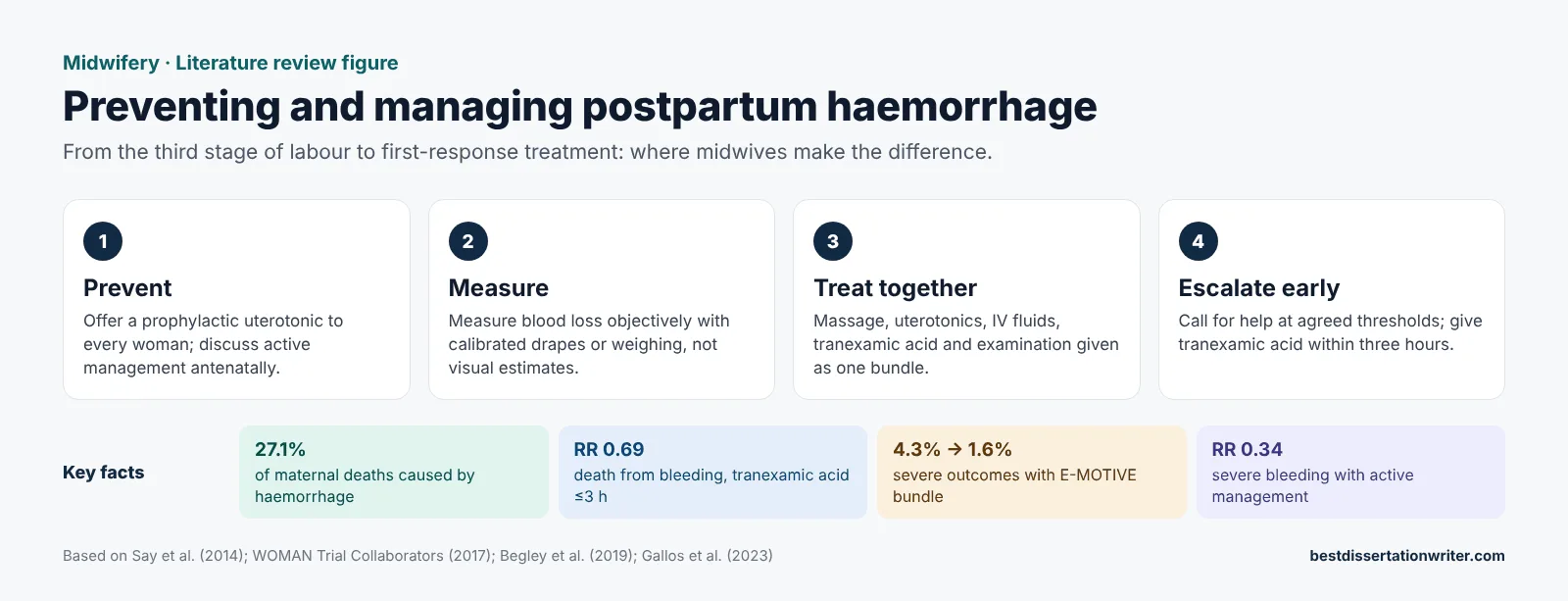
For midwives, the evidence supports offering prophylactic uterotonics to all women and discussing active management of the third stage antenatally, including its benefits and side effects. Blood loss should be measured objectively, for example by weighing or using calibrated drapes, rather than estimated visually. When bleeding exceeds agreed thresholds, midwives should call for help and start first-response treatment together: uterine massage, further uterotonics, intravenous fluids, tranexamic acid within three hours and examination to identify the cause. Regular multidisciplinary skills drills help teams respond quickly.
Women who experience severe bleeding may later develop perinatal anxiety and depression, so midwives should offer debriefing and emotional support. Haemorrhage and its treatment can also delay breastfeeding initiation, requiring extra postnatal support. A known midwife under continuity of carer models can help women understand what happened, and local learning from severe haemorrhage contributes to wider efforts to reduce maternal mortality.
Conclusion
This systematic review examined evidence on the prevention and management of postpartum haemorrhage. Active management reduces severe bleeding, uterotonic combinations and heat-stable carbetocin offer alternatives to oxytocin, tranexamic acid reduces death from bleeding when given early, and calibrated drapes with bundled first-response treatment substantially reduce severe outcomes.
Midwives are central to each of these steps. Preventing postpartum haemorrhage, measuring blood loss accurately and acting quickly with a coordinated bundle of treatments can save lives, and maternity services should support midwives with training, equipment and clear escalation pathways.
References
Begley, C. M., Gyte, G. M. L., Devane, D., McGuire, W., Weeks, A., & Biesty, L. M. (2019). Active versus expectant management for women in the third stage of labour. Cochrane Database of Systematic Reviews, (2), CD007412. https://doi.org/10.1002/14651858.CD007412.pub5
Gallos, I. D., Devall, A. J., Martin, J., Middleton, L. J., Beeson, L. E., Galadanci, H., Al-Beity, F., Qureshi, Z., Hofmeyr, G. J., Moran, N. F., Fawcus, S., Sheikh, L., Gwako, G., Osoti, A., Aswat, A., Mammoliti, K. M., Sindhu, K. N., Podesek, M., Horne, I., … Coomarasamy, A. (2023). Randomized trial of early detection and treatment of postpartum hemorrhage. New England Journal of Medicine, 389(1), 11–21. https://doi.org/10.1056/NEJMoa2303966
Gallos, I. D., Yunas, I., Devall, A. J., Podesek, M., Tobias, A., Price, M. J., Oladapo, O. T., & Coomarasamy, A. (2025). Uterotonic agents for preventing postpartum haemorrhage: A network meta-analysis. Cochrane Database of Systematic Reviews, (4), CD011689. https://doi.org/10.1002/14651858.CD011689.pub4
Say, L., Chou, D., Gemmill, A., Tunçalp, Ö., Moller, A.-B., Daniels, J., Gülmezoglu, A. M., Temmerman, M., & Alkema, L. (2014). Global causes of maternal death: A WHO systematic analysis. The Lancet Global Health, 2(6), e323–e333. https://doi.org/10.1016/S2214-109X(14)70227-X
Widmer, M., Piaggio, G., Nguyen, T., Osoti, A., Owa, O., Misra, S., Coomarasamy, A., Abdel-Aleem, H., Mallapur, A., Qureshi, Z., Lumbiganon, P., Patel, A., & WHO CHAMPION Trial Group. (2018). Heat-stable carbetocin versus oxytocin to prevent hemorrhage after vaginal birth. New England Journal of Medicine, 379(8), 743–752. https://doi.org/10.1056/NEJMoa1805489
WOMAN Trial Collaborators. (2017). Effect of early tranexamic acid administration on mortality, hysterectomy, and other morbidities in women with post-partum haemorrhage (WOMAN): An international, randomised, double-blind, placebo-controlled trial. The Lancet, 389(10084), 2105–2116. https://doi.org/10.1016/S0140-6736(17)30638-4
Cite this example
Best Dissertation Writers (2026) Prevention and Management of Postpartum Haemorrhage by Midwives: A Systematic Review of the Evidence. Available at: https://bestdissertationwriter.com/postpartum-haemorrhage-review-review/
Best Dissertation Writers
Get expert help with your nursing literature review
Share your topic and deadline with Best Dissertation Writers and get support tailored to your module brief.