Perinatal Anxiety and Depression: The Role of the Midwife in Identification and Support: An Integrative Review
 By Dr. Robertson Prime, Research Fellow
Updated October 12, 2026
14 min read
About 2,900 words
In this review
Abstract
Background: Perinatal anxiety and depression are among the most common complications of pregnancy and the first postnatal year, affecting women’s wellbeing, relationships and their babies’ development. Midwives see almost every woman repeatedly during this period and are therefore well placed to identify mental health problems early and offer support.
Aim: This integrative review aimed to examine the evidence on the prevalence and identification of anxiety and depression in the perinatal period and the role of the midwife in identification and support.
Methods: Evidence was identified through targeted searches of openly accessible bibliographic records, publisher websites and the reference lists of key reviews. Six sources published between 2016 and 2019 were included: two prevalence meta-analyses, a diagnostic accuracy study, an integrative review of midwives’ experiences, a systematic review of preventive interventions and a national quality standard, appraised with CASP checklists and synthesised thematically.
Findings: Self-reported anxiety symptoms affected 18.2% to 24.6% of women across the three trimesters, and the pooled prevalence of perinatal depression was 11.9%. In a south-east London cohort, 27% of women had a mental disorder at booking, and the two Whooley questions asked by midwives identified any disorder about as accurately as the Edinburgh Postnatal Depression Scale. Midwives reported gaps in knowledge, skills and referral pathways, while counselling interventions reduced the risk of perinatal depression (risk ratio 0.61).
Conclusion: Midwives should ask about emotional wellbeing at every contact, use brief validated questions and refer to clear pathways, supported by training and services that can respond.
Keywords: perinatal anxiety and depression, perinatal depression, antenatal anxiety, mental health
Introduction
This integrative review critically examines recent evidence on perinatal anxiety and depression and its implications for midwifery practice.
Pregnancy and the first year after birth bring physical, emotional and social changes that can affect any woman’s mental health. For many, low mood or worry is short-lived, but a substantial minority develop anxiety or depressive disorders that persist, impair daily functioning and affect relationships with partners and babies. Untreated problems can influence attendance at antenatal care, sleep, nutrition, bonding and infant development, and in the most serious cases they contribute to maternal suicide.
Midwives have regular contact with women from booking to the end of the postnatal period, often in women’s own homes. This gives them a unique opportunity to notice changes, ask about emotional wellbeing and help women access treatment. Yet midwives have reported feeling underprepared for this role, and many women are reluctant to disclose symptoms for fear of being judged or of their baby being taken into care. The way midwives ask, listen and respond therefore matters as much as the tools they use.
Recognising perinatal anxiety and depression is also a matter of equity. Women who face social disadvantage, language barriers or discrimination may be less likely to have their distress recognised and less able to access support. Midwives who take a consistent, non-judgemental approach to every woman can help to reduce these gaps, provided that interpreters, culturally appropriate information and accessible services are available.
An integrative design was chosen because the relevant evidence includes prevalence meta-analyses, diagnostic accuracy research, qualitative and survey studies of midwives, intervention reviews and guidance, which cannot be combined in a single meta-analysis but can be synthesised to inform practice.
Review question
How common are perinatal anxiety and depression, how well can midwives identify them, and what is the midwife’s role in identification and support?
Background to Perinatal Anxiety and Depression
The perinatal period is usually defined as pregnancy and the first year after birth. Perinatal depression includes depressive episodes that begin during pregnancy or after birth, and it ranges from mild to severe. Anxiety disorders, including generalised anxiety disorder, panic disorder, obsessive-compulsive disorder and post-traumatic stress disorder, are equally important but have historically received less attention than postnatal depression. The two frequently occur together.
Antenatal anxiety deserves particular attention. Worry about the pregnancy, the birth and the baby is normal, which can make it difficult for women and professionals to recognise when anxiety becomes disabling. Fear of childbirth, previous loss or traumatic birth experiences and social stressors such as poverty, domestic abuse and migration can all increase vulnerability. Women with pre-existing mental illness are at higher risk of relapse during pregnancy and after birth.
The consequences of perinatal anxiety and depression extend beyond the woman herself. Persistent symptoms can affect the developing relationship between mother and baby, the wellbeing of partners and the functioning of the wider family. Many women also experience shame, believing that they should feel happy at this time, which can delay help-seeking. Recognising perinatal anxiety and depression as common, treatable conditions rather than personal failings is therefore an important part of the midwife’s message to women.
In the United Kingdom, the National Institute for Health and Care Excellence quality standard on antenatal and postnatal mental health states that women should be asked about their emotional wellbeing at each routine antenatal and postnatal contact (NICE, 2016). Professionals are advised to consider asking two depression identification questions, often called the Whooley questions, and the two-item Generalized Anxiety Disorder scale (GAD-2) at booking and at regular contacts. Midwives are responsible for most of these contacts, which places them at the centre of identification.
Identification is only worthwhile if it leads to appropriate support. Women who screen positive may need further assessment, psychological therapy, medication review or referral to specialist perinatal mental health services, depending on severity. Effective identification therefore relies on midwives’ skills, on time within appointments and on accessible referral pathways.
Search Strategy and Methods
Evidence for this example was identified through targeted searches of openly accessible bibliographic records, publisher websites and the reference lists of key reviews. Search terms combined keywords for the condition (“perinatal anxiety and depression”, “perinatal depression”, “antenatal anxiety”, “postnatal depression”, “perinatal mental health”) with terms for the midwife’s role (“midwi*”, “identification”, “screening”, “Whooley”, “support”, “prevention”), joined with the Boolean operators AND and OR. A full integrative review for assessment would run the same strategy in CINAHL, MIDIRS, PubMed/MEDLINE, PsycINFO and the Cochrane Library and report the number of records screened in a PRISMA flow diagram.
Sources were eligible if they reported the prevalence of anxiety or depression in pregnancy or the first postnatal year, evaluated tools or approaches that midwives could use to identify these conditions, explored midwives’ experiences of perinatal mental health care, or evaluated interventions to prevent perinatal depression. Systematic reviews, large studies and national guidance were prioritised. Studies focused solely on severe mental illness, such as postpartum psychosis, were excluded. Because perinatal anxiety and depression are studied using very different designs, an integrative approach allowed quantitative, qualitative and guidance sources to be considered together.
Six sources published between 2016 and 2019 were included: two systematic reviews with meta-analysis of prevalence, one diagnostic accuracy study, one integrative review of midwives’ experiences, one systematic review of preventive interventions and one national quality standard (Table 1). The quality of each source was appraised using the Critical Appraisal Skills Programme (CASP) checklist appropriate to its design, and findings were synthesised narratively and grouped into themes.
Key Findings on Perinatal Anxiety and Depression
Three themes were identified: the prevalence of perinatal anxiety and depression, the identification of women with mental health problems in maternity care, and midwives’ preparedness and the effectiveness of support. Table 1 summarises the included sources, and Figure 1 presents pooled prevalence estimates for anxiety and depression in pregnancy and after birth.
| Author, year | Design | Setting and sample | Key finding |
|---|---|---|---|
| NICE (2016) | National quality standard (QS115) | Antenatal and postnatal care in England | Ask about emotional wellbeing at every routine contact; consider depression identification questions and GAD-2. |
| Dennis et al. (2017) | Systematic review and meta-analysis | 102 studies, 221,974 women, 34 countries | Anxiety symptoms 18.2–24.6% across trimesters and 15.0% postnatally. |
| Noonan et al. (2017) | Integrative review | 22 papers on midwives’ perceptions and experiences | Gaps in knowledge, skills and confidence; training needs referral pathways and support. |
| Woody et al. (2017) | Systematic review and meta-regression | 96 studies of perinatal depression | Pooled prevalence 11.9%; higher in low- and middle-income countries. |
| Howard et al. (2018) | Diagnostic accuracy cohort study | 545 women at booking; inner-city London | 27% had a mental disorder; midwife-asked Whooley questions as accurate as EPDS. |
| O’Connor et al. (2019) | Systematic review for USPSTF | 50 studies, 22,385 participants | Counselling interventions reduced perinatal depression (RR 0.61). |
Theme 1: How Common Are Perinatal Anxiety and Depression?
Dennis et al. (2017) pooled 102 studies involving 221,974 women from 34 countries. The prevalence of self-reported anxiety symptoms was 18.2% in the first trimester, 19.1% in the second and 24.6% in the third, and 15.0% between one and 24 weeks after birth. When clinical diagnosis was used, 15.2% of women had any anxiety disorder in pregnancy and 9.9% in the postnatal period. Antenatal anxiety symptoms were more common in low- and middle-income countries (34.4%) than in high-income countries (19.4%).
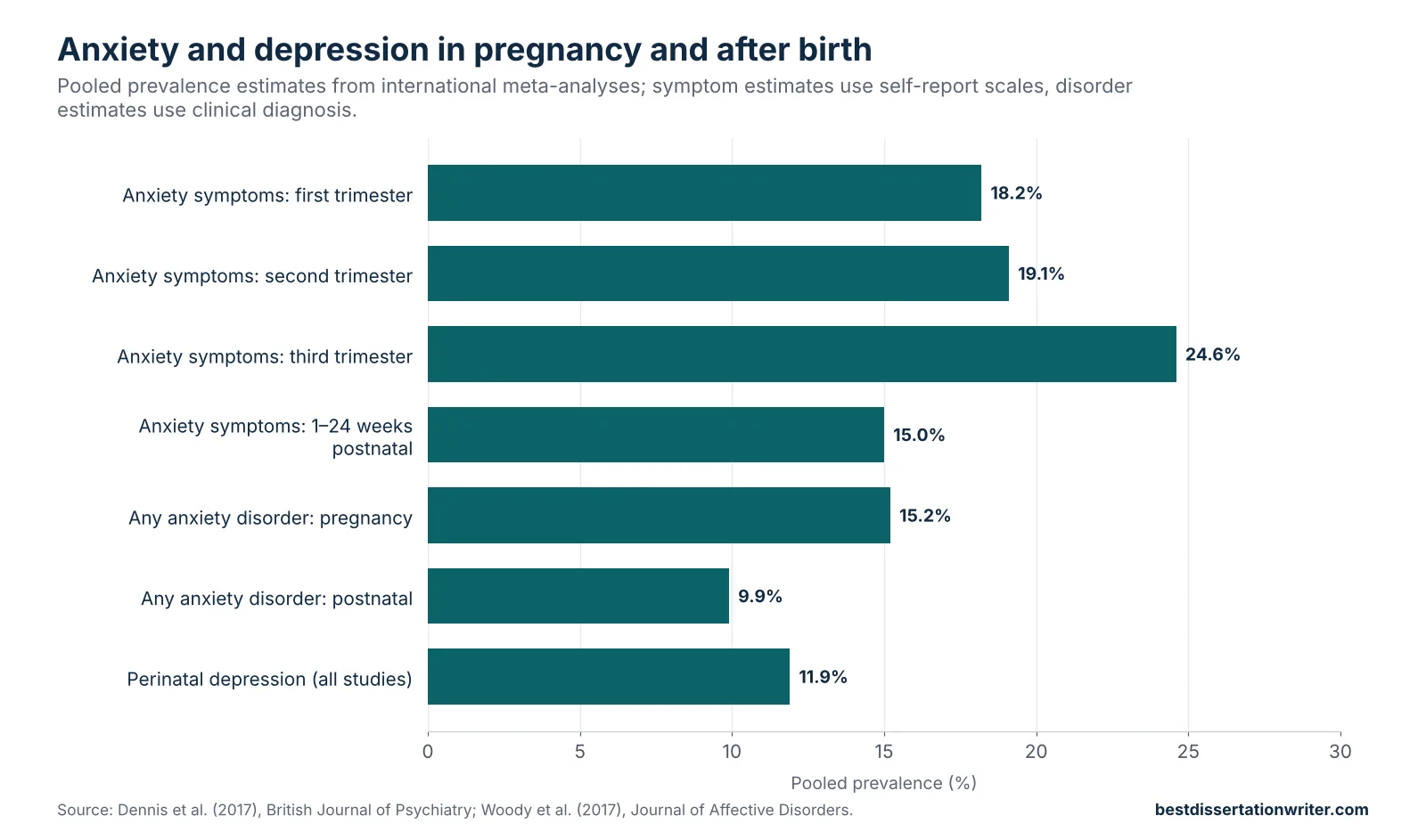
For depression, Woody et al. (2017) analysed 96 studies and found a pooled prevalence of perinatal depression of 11.9%. In high-income countries, adjusted prevalence was 9.2% antenatally and 9.5% postnatally, compared with 19.2% and 18.7% in low- and middle-income countries. Symptom scales produced significantly higher estimates than diagnostic interviews, which helps to explain variation between studies. Only three included studies came from low-income countries, so estimates for these settings remain uncertain.
Taken together, these reviews show that perinatal anxiety and depression are common, that anxiety is at least as prevalent as depression and that antenatal anxiety rises towards the end of pregnancy. The difference between symptom-based and diagnostic estimates is important for practice: a positive screen indicates the need for further assessment rather than a diagnosis.
Theme 2: Identifying Mental Health Problems in Maternity Care
Howard et al. (2018) recruited 545 women at their antenatal booking appointment in an inner-city maternity service in south-east London, where midwives asked the two Whooley questions. A diagnostic interview found that 27% of women had a mental disorder, including depression in 11% and anxiety disorders in 15%, with smaller proportions having obsessive-compulsive disorder, eating disorders or post-traumatic stress disorder. This suggests that perinatal anxiety and depression are often accompanied by other conditions that a depression-focused screen may miss.
The two Whooley questions performed well: their likelihood ratios for depression (8.2) and for any disorder (5.8) were similar to those of the ten-item Edinburgh Postnatal Depression Scale (9.8 and 6.0). The authors concluded that brief questions could be used at booking if maternity professionals were trained to ask them sensitively (Howard et al., 2018). The study was conducted in a single, diverse urban service, and depression was harder to identify in older women, so performance may differ elsewhere.
The NICE (2016) quality standard extends this approach across pregnancy and the postnatal period by recommending that emotional wellbeing is discussed at every routine contact, not only at booking. Repeated enquiry recognises that symptoms can emerge or worsen later, as the rising third-trimester anxiety prevalence reported by Dennis et al. (2017) illustrates. However, the standard does not, by itself, ensure that midwives have time, privacy or confidence to have these conversations.
Theme 3: Midwives’ Preparedness and Effective Support
Noonan et al. (2017) conducted an integrative review of 22 papers on midwives’ perceptions and experiences of caring for women with perinatal mental health problems. Two overarching themes emerged. Personal engagement covered midwives’ knowledge, skills, decision-making and attitudes, while professional engagement covered continuing professional development, organisation of care, referral and support. Midwives recognised the importance of mental health but often reported limited knowledge and confidence, and the authors cautioned that training would have little benefit without appropriate referral pathways and support systems.
Support can also prevent illness. O’Connor et al. (2019) reviewed 50 studies involving 22,385 participants for the US Preventive Services Task Force. Counselling interventions reduced the likelihood of developing perinatal depression (risk ratio 0.61, 95% confidence interval 0.47 to 0.78; 17 trials). Health system interventions did not show a statistically significant effect. This supports identifying women with risk factors early in pregnancy, so that preventive support can be offered before symptoms become established.
Discussion
This review confirms that perinatal anxiety and depression affect a large proportion of women and that anxiety, which has received less attention than postnatal depression, is at least as common. The prevalence meta-analyses are large and international, which strengthens confidence in these estimates, although heterogeneity was considerable and estimates depended on whether self-report scales or diagnostic interviews were used.
The evidence on identification is encouraging. Brief questions that midwives can ask in a few minutes identified women with mental disorders about as accurately as a longer questionnaire. The key condition is that midwives ask sensitively and respond appropriately. Noonan et al. (2017) show that many midwives lack the knowledge and confidence to do so, which suggests that recommending enquiry at every contact is not sufficient without investment in education and supervision.
A tension exists between identification and capacity. Asking about mental health raises expectations of help, yet waiting lists for psychological therapy and specialist services vary widely. If women disclose symptoms and receive no response, trust may be damaged and future disclosure discouraged. The preventive benefit of counselling interventions reported by O’Connor et al. (2019) supports a stepped model in which midwives identify risk, offer listening support and refer to therapies that services must make available.
Relational factors also matter. Women are more likely to disclose distress to a professional they know and trust, and fear of stigma or of child protection involvement can inhibit honesty. Continuity of the midwife, private space and normalising language may therefore improve the effectiveness of screening questions, although these factors were not directly tested in the included studies.
The findings also raise questions about where responsibility lies. Midwives can identify perinatal anxiety and depression, but they cannot treat moderate or severe illness alone. Effective care depends on collaboration with general practitioners, health visitors, psychological therapy services and specialist perinatal mental health teams. Shared documentation, joint care plans and clear handover at the end of midwifery care help to ensure that women do not fall through gaps between services, particularly when symptoms persist beyond the early postnatal weeks. Without this collaboration, even accurate identification of perinatal anxiety and depression may not change outcomes for women and babies.
The evidence base has limitations. Most studies were from high-income countries, the diagnostic accuracy study came from a single London service and the preventive interventions were evaluated mainly outside the United Kingdom. This review relied on openly accessible, English-language sources and did not involve independent double screening, so relevant studies may have been missed. Future research should evaluate midwife-delivered identification and support in diverse settings, including the experiences of women from minority ethnic groups and fathers or partners.
Implications of Perinatal Anxiety and Depression Evidence for Practice
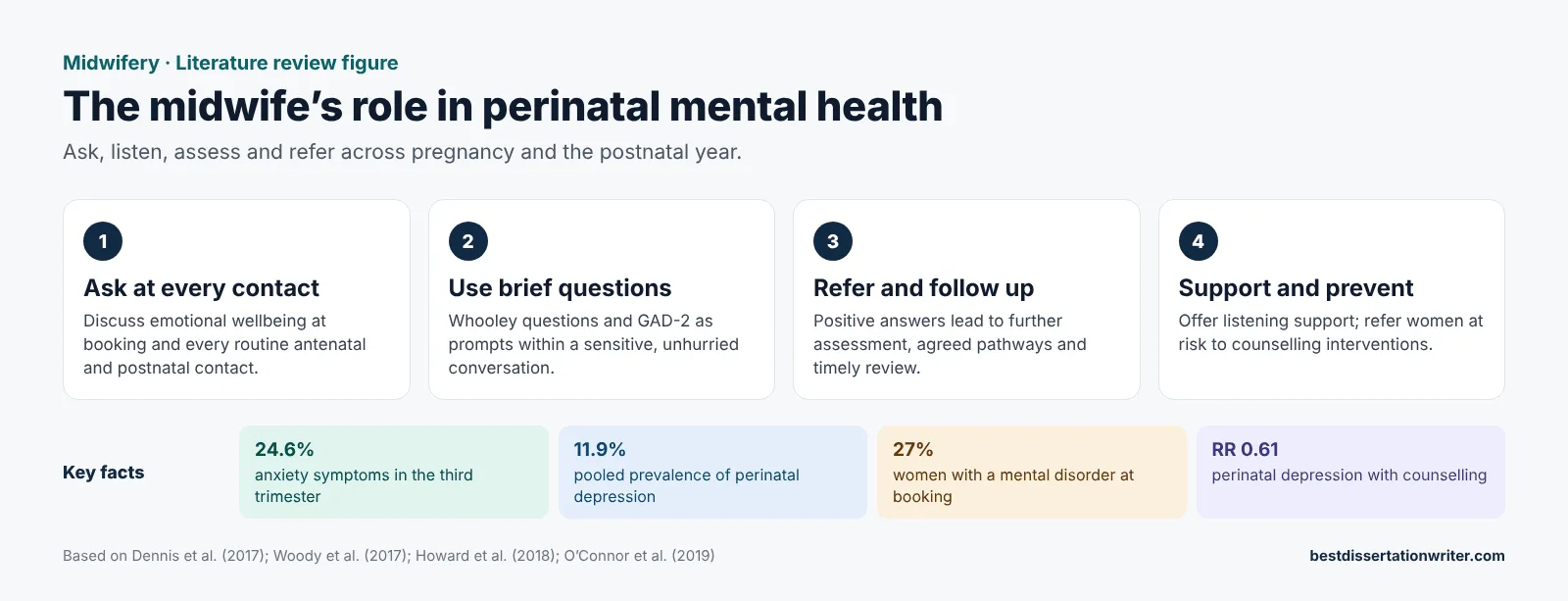
For midwives, the evidence supports asking every woman about her emotional wellbeing at booking and at each subsequent contact, using the Whooley questions and GAD-2 as prompts within a supportive conversation. Midwives should explain why they ask, reassure women that disclosure is common and helpful, and follow agreed pathways for further assessment and referral. Services should provide training in perinatal mental health, protected time in appointments and clear access to psychological therapies and specialist teams, so that identification leads to timely support.
This work links closely with wider perinatal mental health services and with the trusting relationships fostered by continuity of carer. Midwives should also recognise that anxiety and low mood can affect breastfeeding initiation, and that antenatal discussion of options for pain relief in labour can reduce fear and help women feel more in control of the birth.
Conclusion
This integrative review examined the evidence on perinatal anxiety and depression and the role of the midwife in identification and support. Anxiety and depression are common across pregnancy and the postnatal year, brief questions asked by midwives can identify women who need further assessment and counselling interventions can prevent perinatal depression in women at risk.
Midwives are ideally placed to identify perinatal anxiety and depression early, but they need training, time and responsive services behind them. Asking about mental health at every contact, listening without judgement and acting on what women say can make a lasting difference to women, babies and families.
References
Dennis, C.-L., Falah-Hassani, K., & Shiri, R. (2017). Prevalence of antenatal and postnatal anxiety: Systematic review and meta-analysis. The British Journal of Psychiatry, 210(5), 315–323. https://doi.org/10.1192/bjp.bp.116.187179
Howard, L. M., Ryan, E. G., Trevillion, K., Anderson, F., Bick, D., Bye, A., Byford, S., O’Connor, S., Sands, P., Demilew, J., Milgrom, J., & Pickles, A. (2018). Accuracy of the Whooley questions and the Edinburgh Postnatal Depression Scale in identifying depression and other mental disorders in early pregnancy. The British Journal of Psychiatry, 212(1), 50–56. https://doi.org/10.1192/bjp.2017.9
National Institute for Health and Care Excellence. (2016). Antenatal and postnatal mental health (Quality standard QS115). https://www.nice.org.uk/guidance/qs115
Noonan, M., Doody, O., Jomeen, J., & Galvin, R. (2017). Midwives’ perceptions and experiences of caring for women who experience perinatal mental health problems: An integrative review. Midwifery, 45, 56–71. https://doi.org/10.1016/j.midw.2016.12.010
O’Connor, E., Senger, C. A., Henninger, M. L., Coppola, E., & Gaynes, B. N. (2019). Interventions to prevent perinatal depression: Evidence report and systematic review for the US Preventive Services Task Force. JAMA, 321(6), 588–601. https://doi.org/10.1001/jama.2018.20865
Woody, C., Ferrari, A., Siskind, D., Whiteford, H., & Harris, M. (2017). A systematic review and meta-regression of the prevalence and incidence of perinatal depression. Journal of Affective Disorders, 219, 86–92. https://doi.org/10.1016/j.jad.2017.05.003
Cite this example
Best Dissertation Writers (2026) Perinatal Anxiety and Depression: The Role of the Midwife in Identification and Support: An Integrative Review. Available at: https://bestdissertationwriter.com/perinatal-anxiety-and-depression-review/
Best Dissertation Writers
Get expert help with your nursing literature review
Share your topic and deadline with Best Dissertation Writers and get support tailored to your module brief.