Fear of Childbirth (Tokophobia) and Midwifery Approaches to Support: A Scoping Review
 By Dr. Robertson Prime, Research Fellow
Updated October 12, 2026
14 min read
About 2,900 words
In this review
Abstract
Background: Fear of childbirth ranges from common worries to tokophobia, a severe fear of pregnancy and childbirth that may affect women and babies in the short and long term. It has been linked to more obstetric interventions, difficulties during birth and poorer postnatal psychological adjustment.
Aim: This scoping review aimed to map evidence on how common severe childbirth fear is, how it is measured, which interventions reduce it and how women experience support, and what this means for midwifery practice.
Methods: Evidence was identified through targeted searches of openly accessible bibliographic records, publisher websites and the reference lists of key reviews. Six sources published between 2014 and 2021 were included: a randomised controlled trial, a meta-analysis of prevalence, a systematic review of definitions and measures, a Cochrane review, a further systematic review with meta-analysis and a qualitative meta-synthesis, appraised with CASP checklists and synthesised thematically.
Findings: Pooled prevalence of tokophobia was 14% across 853,988 pregnant women, but definitions and cut-off scores varied widely. A midwife-led psycho-education trial and a meta-analysis of 48 studies found that most interventions reduced fear, and a Cochrane review of seven trials found that interventions probably reduced caesarean births (risk ratio 0.70), although the reduction in fear scores may not be clinically meaningful. Qualitative evidence described a journey from facing fear to ownership of childbirth, supported by security and empowerment.
Conclusion: Midwives should ask about childbirth fear routinely, use consistent screening measures and offer relational antenatal support, with referral for women with severe fear.
Keywords: fear of childbirth, tokophobia, antenatal support
Introduction
This scoping review critically examines recent evidence on fear of childbirth and its implications for midwifery practice.
Many women feel some anxiety about giving birth, and a degree of worry is a normal part of pregnancy. For some women, however, fear becomes intense enough to dominate pregnancy, affect relationships and daily life and shape decisions about how and where to give birth. At its most severe, this is described as tokophobia, a severe fear of pregnancy and childbirth that may have short- and long-term effects on both mother and baby.
Childbirth fear matters clinically because it has been associated with more obstetric interventions and poorer emotional and psychological health in women. Women with severe fear may request a planned caesarean birth, find labour more difficult or have a distressing birth experience that affects their recovery and future pregnancies. Because midwives see women repeatedly during pregnancy, they are well placed to recognise fear of childbirth early and to provide or arrange antenatal support.
A scoping design was chosen because the evidence is broad and diverse, including prevalence studies, measurement reviews, trials and qualitative research. Mapping this evidence helps to show what is known, where definitions conflict and where gaps remain for midwifery practice.
Review question
How common is fear of childbirth, how is it defined and measured, which interventions reduce it, and how do women experience support?
Background to Fear of Childbirth
Fear of childbirth is usually understood as a continuum. At one end are the common concerns that most pregnant women experience, such as worries about pain, the health of the baby or loss of control. At the other end is severe fear, sometimes called tokophobia or tocophobia, which may lead a woman to avoid pregnancy or to seek a caesarean birth. Where on this continuum fear becomes a clinical problem is not agreed, and this uncertainty affects both research and practice.
Fear may arise before a first pregnancy or develop after a previous birth experienced as frightening or traumatic. It can also overlap with general anxiety and depression, which makes it difficult to separate childbirth-specific fear from wider perinatal mental health problems. Webb et al. (2021) noted that between 5% and 14% of women have fear of childbirth and that it is associated with difficulties during birth and with postnatal psychological adjustment.
A range of tools has been developed to identify childbirth fear. The most widely used is the Wijma Delivery Expectancy Questionnaire (W-DEQ), a self-report measure with a score range of 0 to 165, on which higher scores indicate more fear. Other measures include single questions, short rating scales and visual analogue scales. The choice of tool and cut-off score strongly affects how many women are classed as having severe fear.
Interventions for women with severe fear vary from psycho-education and counselling by midwives to cognitive behavioural therapy, group discussion, art therapy and specialist perinatal mental health care. Some services offer dedicated clinics or specialist teams, whereas in other settings support depends on individual midwives and obstetricians. This variety makes it important to understand which forms of antenatal support are effective and acceptable to women.
Search Strategy and Methods
Evidence for this example was identified through targeted searches of openly accessible bibliographic records, publisher websites and the reference lists of key reviews. Search terms combined keywords for the concept (“fear of childbirth”, “tokophobia”, “tocophobia”, “childbirth fear”) with terms for population, measures and interventions (“pregnan*”, “prevalence”, “W-DEQ”, “psycho-education”, “counselling”, “midwi*”), joined with the Boolean operators AND and OR. A full scoping review for assessment would run the same strategy in CINAHL, MIDIRS, PubMed/MEDLINE, PsycINFO, the Cochrane Library and Embase and report the number of records screened in a PRISMA flow diagram.
Sources were eligible if they examined the prevalence, definition or measurement of fear of childbirth in pregnant women, evaluated interventions to reduce it, or explored women’s experiences of those interventions. Consistent with a scoping approach, quantitative, qualitative and review designs were included. Studies focused only on fear after birth or on general anxiety without a childbirth-specific measure were excluded.
Six sources published between 2014 and 2021 were included: a randomised controlled trial, a systematic review and meta-analysis of prevalence, a systematic review of definitions and measures, a Cochrane systematic review, a systematic review and meta-analysis of interventions and a qualitative meta-synthesis (Table 1). The quality of each source was appraised using the Critical Appraisal Skills Programme (CASP) checklist appropriate to its design, and findings were charted and grouped into themes.
Key Findings on Fear of Childbirth
Three themes were identified: the prevalence and measurement of childbirth fear, the effectiveness of interventions to reduce fear, and women’s experiences of support. Table 1 summarises the included sources, and Figure 1 presents pooled effects of these interventions on caesarean birth, preference for caesarean birth and epidural use.
| Author, year | Design | Setting and sample | Key finding |
|---|---|---|---|
| Toohill et al. (2014) | Randomised controlled trial (BELIEF) | 339 women with high fear, three hospitals in Queensland, Australia | Midwife telephone psycho-education reduced fear and increased childbirth self-efficacy. |
| O’Connell et al. (2017) | Systematic review and meta-analysis | 33 studies, 18 countries; 853,988 women in meta-analysis | Pooled prevalence of tokophobia 14% (95% CI 12% to 16%); very high heterogeneity. |
| Nilsson et al. (2018) | Systematic review | 24 papers from nine countries | Definitions and measures varied; W-DEQ ≥85 gave rates of 6.3% to 14.8% between countries. |
| O’Connell, Khashan, Leahy-Warren, Stewart, et al. (2021) | Cochrane systematic review | 7 RCTs, 1,357 women with high to severe fear | Fear may fall (MD −7.08 W-DEQ); caesarean births probably reduced (RR 0.70). |
| O’Connell, Khashan and Leahy-Warren (2021) | Qualitative meta-synthesis | 7 qualitative studies, all from Scandinavia | Overarching theme of ownership of childbirth: facing the fear, feeling empowered, sense of security. |
| Webb et al. (2021) | Systematic review and meta-analysis | 66 papers from 48 studies | Most interventions reduced fear (mean effect size −1.27); study quality limited. |
Theme 1: How Common Is Fear of Childbirth and How Is It Measured?
O’Connell et al. (2017) conducted the first worldwide meta-analysis of the prevalence of tokophobia. They included 33 studies from 18 countries in the systematic review and 29 studies with 853,988 pregnant women in the meta-analysis. Reported prevalence ranged from 3.7% to 43%, and the pooled prevalence was 14% (95% CI 12% to 16%). Prevalence appeared to have risen since 2000. However, heterogeneity was extremely high (I² = 99.25%) and was not explained by definition, trimester of screening or parity, so the pooled figure must be interpreted cautiously.
The authors attributed much of this heterogeneity to the lack of a consensus definition. Nilsson et al. (2018) examined this problem directly in a systematic review of 24 papers from nine countries in Europe, Australia, Canada and the United States. Definitions and measures varied widely. The W-DEQ was the most commonly used tool, with cut-offs for moderate, severe and extreme fear, alongside three- to six-point scales and visual analogue scales.
Even when the same tool and cut-off were used, prevalence differed between countries. In seven studies using a W-DEQ cut-off of 85 or more, rates ranged from 6.3% to 14.8%, a statistically significant difference. Nilsson et al. (2018) recommended that future studies use the W-DEQ with this cut-off, a better-tested version of the Fear of Birth Scale or a simple three-point question such as “Are you afraid about the birth?”, and called for a shorter clinical tool. For midwives, this means that fear of childbirth should be asked about directly, while recognising that screening scores are only a starting point for conversation.
Theme 2: Interventions to Reduce Fear of Childbirth
The BELIEF trial tested a midwife-led psycho-education intervention in three hospitals in South East Queensland, Australia (Toohill et al., 2014). Of 1,410 women recruited, those reporting high fear were randomised to the intervention (n = 170) or usual care (n = 169). All women received a decision-aid booklet, and the intervention group also received telephone counselling from midwives at 24 and 34 weeks of pregnancy. Fear scores and childbirth self-efficacy improved significantly more in the intervention group, while decisional conflict and depressive symptoms fell but not significantly.
Webb et al. (2021) brought together 66 papers from 48 studies of interventions for fear of childbirth in pregnancy, grouped into cognitive behavioural therapy, other talking therapies, antenatal education, enhanced midwifery care, alternative interventions and interventions during labour. The mean effect size across studies was −1.27, and the authors concluded that most interventions reduced fear regardless of approach. However, 30 of the 48 studies had a medium risk of bias, and the authors called for high-quality randomised trials.
The Cochrane review by O’Connell, Khashan, Leahy-Warren, Stewart, et al. (2021) took a stricter approach, including only seven randomised trials with 1,357 women with high to severe fear of childbirth, including tokophobia. Compared with standard care, interventions such as psycho-education, cognitive behavioural therapy, group discussion, peer education and art therapy may reduce fear scores (mean difference −7.08 points on the W-DEQ, 95% CI −12.19 to −1.97; low certainty), but the reviewers were not certain that this reduction was clinically meaningful.
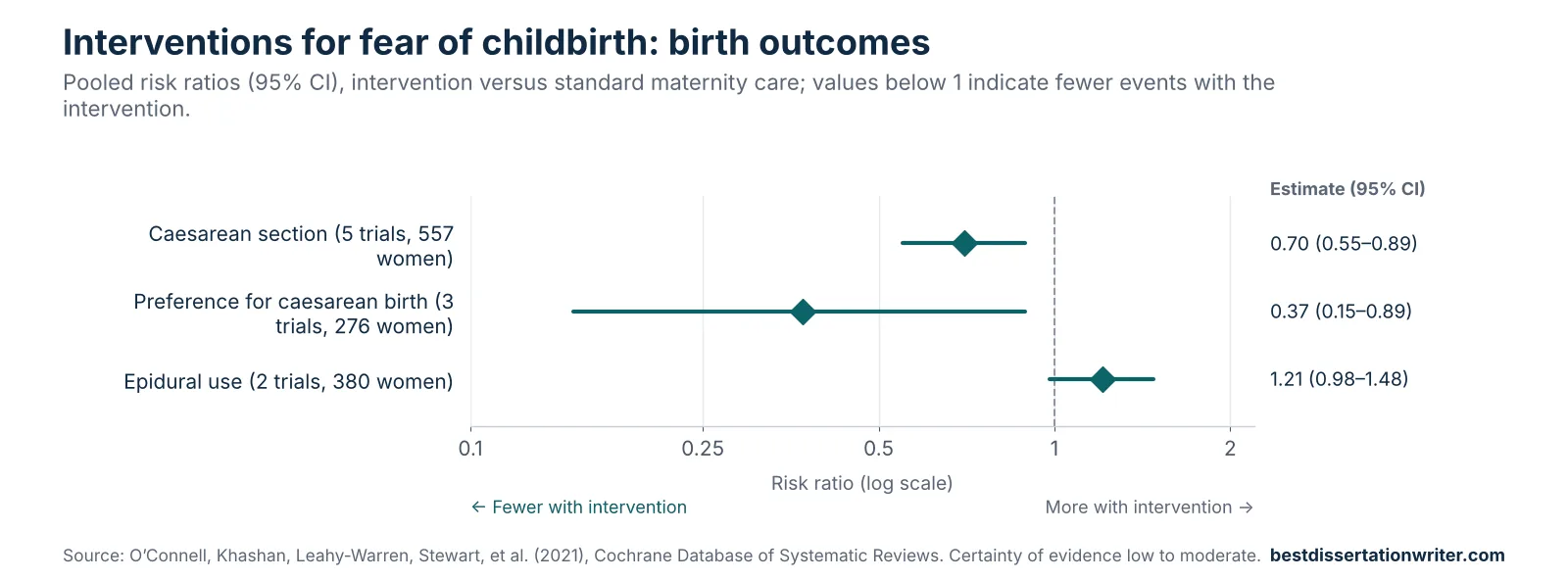
The same review found that interventions probably reduced caesarean births (five trials, 557 women; risk ratio 0.70, 95% CI 0.55 to 0.89; moderate certainty) and the preference for caesarean birth (three trials, 276 women; risk ratio 0.37, 95% CI 0.15 to 0.89). There was little or no difference in depression scores, and epidural use was not clearly different. None of the trials reported anxiety. These findings suggest that structured antenatal support may help women feel able to plan a vaginal birth, even if fear scores fall only modestly.
Theme 3: Women’s Experiences of Antenatal Support
Qualitative evidence helps to explain how interventions work from women’s perspective. In a meta-synthesis of seven qualitative studies, O’Connell, Khashan and Leahy-Warren (2021) identified an overarching theme of “ownership of childbirth” and three analytical themes: facing the fear, feeling empowered and managing the fear with a sense of security. Women described a process that began with acknowledging and identifying their fears and moved towards owning their birth experience.
The synthesis showed that women can be empowered to manage their fear themselves, but that partners and staff can influence this process positively or negatively. A sense of security, often provided by a trusted professional, appeared to be central. However, no eligible studies came from outside Scandinavia, so it is unclear whether these experiences apply in countries such as the United Kingdom, where maternity systems, cultural expectations of birth and the organisation of antenatal support may differ.
Discussion
This scoping review shows that fear of childbirth is common, that its measured prevalence depends heavily on definitions and tools, and that a range of interventions, including midwife-led psycho-education, appear to reduce fear and the preference for caesarean birth. Qualitative evidence suggests that support works when it helps women face their fears, feel secure and regain a sense of ownership over birth.
There is, however, a tension between the review findings. Webb et al. (2021) concluded that most interventions reduced fear, whereas the Cochrane review was uncertain whether the reduction was clinically meaningful. The difference partly reflects inclusion criteria: Webb et al. (2021) included many non-randomised and lower-quality studies, while the Cochrane review included only seven trials. This suggests that the benefits of interventions are promising but less certain than individual studies may imply.
Measurement problems run through the whole evidence base. Without an agreed definition or cut-off, prevalence estimates range widely, intervention trials recruit different populations and results are hard to compare. Screening tools such as the W-DEQ are long for routine use, while single questions may miss women who find it difficult to express fear. Midwives need to combine brief screening with open, unhurried conversation.
The evidence also raises questions about outcomes. Caesarean birth is often used as a marker of success, yet a planned caesarean may be the right choice for some women with tokophobia. Interventions should aim to support informed decisions and a positive birth experience rather than simply reduce caesarean rates. The absence of anxiety outcomes in the Cochrane trials and the limited data on postnatal wellbeing are important gaps.
The findings also highlight the central place of the midwife. The BELIEF trial showed that a relatively brief intervention, delivered by midwives over the telephone, could reduce fear and increase confidence, and the qualitative evidence emphasised the value of a trusted professional who provides a sense of security. Both point towards relational care rather than one-off information giving. Yet midwives may have limited time in antenatal appointments, may change from visit to visit and may not feel trained to explore fear of childbirth in depth.
Training in psycho-education and listening skills, together with models that allow the same midwife to see a woman across pregnancy, may therefore be as important as any specific intervention. Clear referral pathways are also needed, so that midwives know when and where to seek specialist help.
This review has limitations. It relied on openly accessible, English-language sources, did not involve independent double screening and included a small number of sources, some of which overlapped. Much of the evidence came from Scandinavia and Australia. Future research should agree core definitions and measures of fear of childbirth, test midwife-led antenatal support in other settings, including the United Kingdom, and report women’s birth experiences and postnatal mental health.
Implications of Fear of Childbirth Evidence for Practice
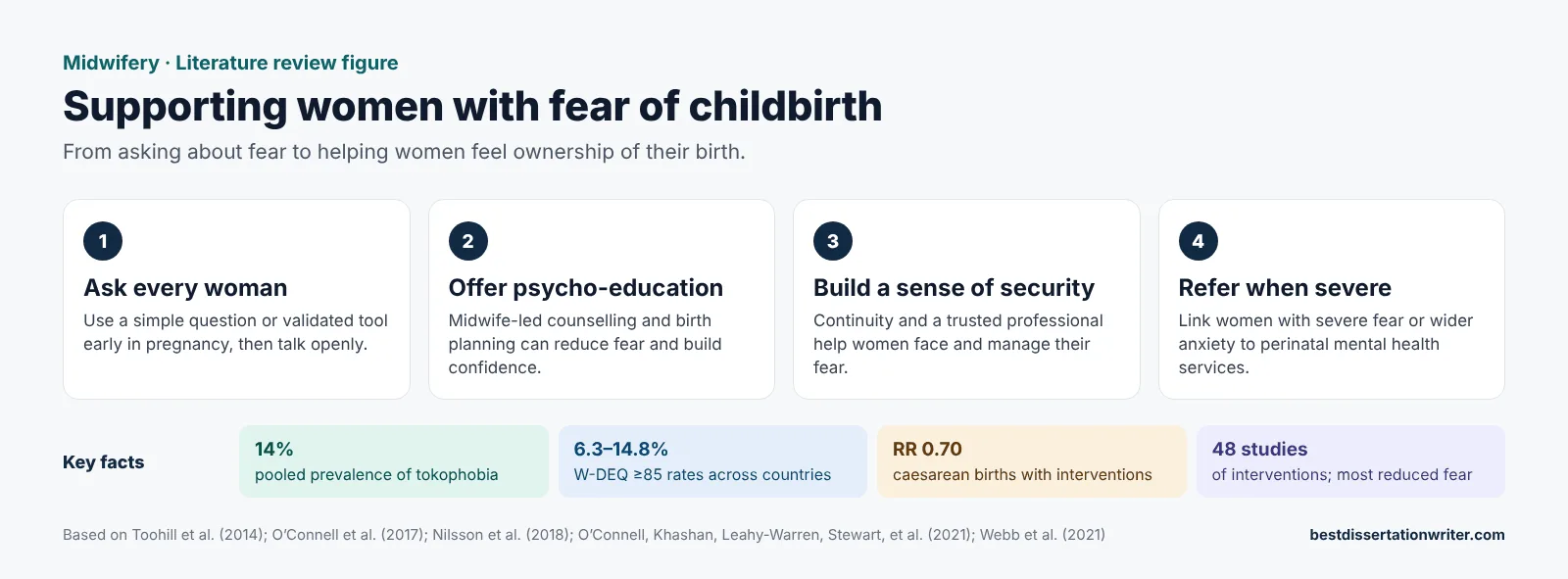
For midwives, the evidence supports asking every woman about fear of birth early in pregnancy and again later, using a simple question or validated tool followed by an open conversation. Women with significant fear should be offered relational antenatal support, such as psycho-education, birth planning and continuity of care, with referral to perinatal mental health services where fear is severe or overlaps with perinatal anxiety and depression. Clear information about pain relief in labour can address one common source of worry, and care should follow the principles of respectful maternity care so that women feel listened to and in control.
Fear should also be considered in women whose pregnancies involve extra monitoring, for example those with gestational diabetes, since additional appointments offer further opportunities to ask about worries and plan support. After birth, midwives should review how women experienced labour, because a frightening birth may affect future pregnancies.
Conclusion
This scoping review mapped evidence on fear of childbirth. Severe fear affects around one in seven pregnant women, although estimates depend on how fear is defined and measured, and interventions including midwife-led psycho-education appear to reduce fear and caesarean births, with low to moderate certainty.
Midwives can make a difference by asking about fear of childbirth routinely, offering relational antenatal support and helping women move from facing their fear to a sense of ownership of their birth.
References
Nilsson, C., Hessman, E., Sjöblom, H., Dencker, A., Jangsten, E., Mollberg, M., Patel, H., Sparud-Lundin, C., Wigert, H., & Begley, C. (2018). Definitions, measurements and prevalence of fear of childbirth: A systematic review. BMC Pregnancy and Childbirth, 18, 28. https://doi.org/10.1186/s12884-018-1659-7
O’Connell, M. A., Khashan, A. S., & Leahy-Warren, P. (2021). Women’s experiences of interventions for fear of childbirth in the perinatal period: A meta-synthesis of qualitative research evidence. Women and Birth, 34(3), e309–e321. https://doi.org/10.1016/j.wombi.2020.05.008
O’Connell, M. A., Khashan, A. S., Leahy-Warren, P., Stewart, F., & O’Neill, S. M. (2021). Interventions for fear of childbirth including tocophobia. Cochrane Database of Systematic Reviews, (7), CD013321. https://doi.org/10.1002/14651858.CD013321.pub2
O’Connell, M. A., Leahy-Warren, P., Khashan, A. S., Kenny, L. C., & O’Neill, S. M. (2017). Worldwide prevalence of tocophobia in pregnant women: Systematic review and meta-analysis. Acta Obstetricia et Gynecologica Scandinavica, 96(8), 907–920. https://doi.org/10.1111/aogs.13138
Toohill, J., Fenwick, J., Gamble, J., Creedy, D. K., Buist, A., Turkstra, E., & Ryding, E. L. (2014). A randomized controlled trial of a psycho-education intervention by midwives in reducing childbirth fear in pregnant women. Birth, 41(4), 384–394. https://doi.org/10.1111/birt.12136
Webb, R., Bond, R., Romero-Gonzalez, B., Mycroft, R., & Ayers, S. (2021). Interventions to treat fear of childbirth in pregnancy: A systematic review and meta-analysis. Psychological Medicine, 51(12), 1964–1977. https://doi.org/10.1017/S0033291721002324
Cite this example
Best Dissertation Writers (2026) Fear of Childbirth (Tokophobia) and Midwifery Approaches to Support: A Scoping Review. Available at: https://bestdissertationwriter.com/fear-of-childbirth-literature-review/
Best Dissertation Writers
Get expert help with your nursing literature review
Share your topic and deadline with Best Dissertation Writers and get support tailored to your module brief.