The Effectiveness of Antenatal Education in Preparing Women and Partners for Birth and Parenthood: A Systematic Review
 By Dr. Robertson Prime, Research Fellow
Updated October 12, 2026
15 min read
About 3,000 words
In this review
Abstract
Background: Antenatal education is offered to many expectant parents to prepare them for labour, birth and the early weeks of parenthood, yet classes vary widely in content, format and length. Midwives deliver much of this preparation, so it matters whether it changes birth outcomes, confidence and the transition to parenthood.
Aim: This systematic review aimed to examine how effective antenatal education is in preparing women and partners for birth and parenthood, and what this means for midwifery practice.
Methods: Evidence was identified through targeted searches of openly accessible bibliographic records, publisher websites and the reference lists of key reviews. Seven sources published between 2007 and 2021 were included: a Cochrane review, two systematic reviews with or without meta-analysis, a qualitative meta-synthesis and three reports from randomised trials, appraised with CASP checklists and synthesised narratively.
Findings: A Cochrane review of nine trials with 2,284 women found no consistent effects of general antenatal classes, whereas a later meta-analysis of 23 studies reported slightly lower rates of caesarean birth (RR 0.90) and epidural use (RR 0.84), together with lower stress and higher self-efficacy. In a Danish trial of 1,766 women, small-class education did not change epidural use compared with auditorium lectures. Midwife-led psycho-education reduced high childbirth fear and increased confidence, and first-time parents wanted partners included and more preparation for life after birth.
Conclusion: Midwives should offer interactive, partner-inclusive childbirth preparation that gives equal weight to parenthood, targets women with high fear and is evaluated with consistent outcomes.
Keywords: antenatal education, childbirth preparation, parenting classes
Introduction
This systematic review critically examines recent evidence on antenatal education and its implications for midwifery practice.
Pregnancy is a time of rapid learning. Expectant parents must make decisions about where and how to give birth, understand what happens in labour, consider options for pain relief and prepare for feeding and caring for a newborn baby. Many seek this information from family, friends and the internet, but structured childbirth preparation, usually delivered by midwives in group classes, remains a familiar part of maternity care in many countries. Classes are often valued as a way to meet other parents as well as to learn.
Despite its familiarity, the purpose of antenatal education is not always clear. Some programmes aim to reduce fear and increase confidence for birth, others to reduce interventions such as epidural analgesia or caesarean birth, and others to prepare parents for the emotional and practical changes of parenthood. Content, length, group size and teaching style vary widely, and partners may or may not be included. This variation makes it difficult to say whether antenatal education works, and for whom.
Midwives are the main providers of childbirth preparation and parenting classes in the United Kingdom, so evidence on what makes education effective is directly relevant to how they spend their time. A systematic approach was chosen so that Cochrane and other systematic reviews, randomised trials and qualitative syntheses could be identified, appraised and compared.
Review question
How effective is antenatal education in preparing women and their partners for birth and parenthood, and what are the implications for midwifery practice?
Background to Antenatal Education
Antenatal education is a broad term for planned learning activities offered during pregnancy. It may be delivered in groups or individually, face to face or online, and by midwives, health visitors, physiotherapists or trained educators. Typical topics include the signs of labour, coping strategies and pain relief, interventions during birth, infant feeding, care of the newborn and the transition to parenthood. Some programmes add specific techniques, such as breathing, relaxation or mindfulness.
Childbirth preparation has a long history. Early approaches focused on reducing fear and pain through information and relaxation, based on the idea that fear increases tension and pain. Later programmes broadened to include parenting skills, relationship changes and emotional wellbeing. Today, parenting classes and childbirth preparation are often combined into a single course, although the balance between birth and parenthood varies.
Antenatal education may influence outcomes in several ways. Accurate information may reduce anxiety and fear of the unknown, practising coping strategies may increase confidence, known as childbirth self-efficacy, and understanding labour may help women stay at home in early labour and make informed decisions about interventions. Classes also provide social support, which may protect against stress and isolation after birth. Each of these pathways suggests different outcomes that research should measure.
However, attendance is not equal. Women who are younger, have lower incomes, have limited English or have had a previous baby are often less likely to attend. Because those who attend classes may differ from those who do not, observational comparisons can overstate its benefits. Randomised trials and systematic reviews of trials therefore provide the most reliable evidence of effect.
Search Strategy and Methods
Evidence for this example was identified through targeted searches of openly accessible bibliographic records, publisher websites and the reference lists of key reviews. Search terms combined keywords for the intervention (“antenatal education”, “prenatal education”, “childbirth preparation”, “parenting classes”, “antenatal classes”, “psycho-education”) with terms for outcomes (“caesarean”, “epidural”, “fear”, “self-efficacy”, “stress”, “parenthood”), joined with the Boolean operators AND and OR. A full systematic review for assessment would run the same strategy in CINAHL, PubMed/MEDLINE, the Cochrane Library and Embase and report the number of records screened in a PRISMA flow diagram. MIDIRS would also be searched for midwifery literature.
Sources were eligible if they evaluated antenatal education for childbirth, parenthood or both, delivered to pregnant women with or without partners, and reported birth outcomes, psychological outcomes or adjustment to parenthood, or explored parents’ views of antenatal education. Cochrane and other systematic reviews, randomised trials and qualitative syntheses were prioritised. Studies of education limited to a single clinical condition, such as diabetes, were excluded.
Seven sources published between 2007 and 2021 were included: a Cochrane systematic review, a systematic review of small-class antenatal teaching, a systematic review and meta-analysis, a qualitative meta-synthesis and three reports from two randomised trials (Table 1). The quality of each source was appraised using the Critical Appraisal Skills Programme (CASP) checklist appropriate to its design, and findings were synthesised narratively and grouped into themes.
Key Findings on Antenatal Education
Three themes were identified: the effects of education on birth outcomes and interventions, its effects on fear, confidence and stress, and preparation for parenthood and the needs of partners. Table 1 summarises the included sources, and Figure 1 presents the pooled and trial effect estimates for caesarean birth and epidural use.
| Author, year | Design | Setting and sample | Key finding |
|---|---|---|---|
| Gagnon and Sandall (2007) | Cochrane systematic review | 9 randomised trials, 2,284 women | No consistent results; effects of general antenatal education largely unknown. |
| Toohill et al. (2014) | Randomised controlled trial (BELIEF) | 339 women with high fear of birth, Queensland, Australia | Midwife telephone psycho-education reduced fear (p < 0.001) and increased self-efficacy (p = 0.002). |
| Brixval et al. (2015) | Systematic review | 17 randomised or quasi-randomised trials of small-class education | Insufficient evidence of effect; each outcome reported in only one or a few trials. |
| Brixval et al. (2016) | Randomised controlled trial (NEWBORN) | 1,766 pregnant women, Hvidovre Hospital, Denmark | Small classes vs lectures: epidural 30.9% vs 29.1% (aOR 1.10); no difference in interventions. |
| Entsieh and Kristensson Hallström (2016) | Qualitative meta-synthesis | 12 qualitative studies of first-time parents | Parents wanted partners included, realistic parenting information and equal emphasis on the postnatal period. |
| Koushede et al. (2017) | Randomised trial, secondary analysis (NEWBORN) | 1,766 pregnant women, Denmark | Small beneficial effect on global stress at six months; no significant difference in parenting stress. |
| Hong et al. (2021) | Systematic review and meta-analysis | 23 studies (14 controlled trials, 9 observational) | Lower caesarean birth (RR 0.90) and epidural use (RR 0.84); lower stress and higher self-efficacy. |
Theme 1: Antenatal Education and Birth Outcomes
The Cochrane review by Gagnon and Sandall (2007) included nine randomised trials involving 2,284 women. Eight trials focused on educational interventions, and sample sizes in the smaller trials ranged from 10 to 318. No consistent results were found, and the authors concluded that the effects of general education for childbirth or parenthood remained largely unknown. No data were reported on anxiety, breastfeeding success or general social support, and the largest trial evaluated education and support for vaginal birth after caesarean rather than general classes.
A later meta-analysis presents a more positive picture. Hong et al. (2021) included 23 studies, 14 controlled trials and nine observational studies, evaluating structured antenatal programmes against comparison groups. Overall maternal physical outcomes did not differ, but caesarean birth was less common in the education groups (relative risk 0.90, 95% CI 0.82 to 0.99), as was epidural anaesthesia (relative risk 0.84, 95% CI 0.74 to 0.96). Birth weight and gestational age did not differ.
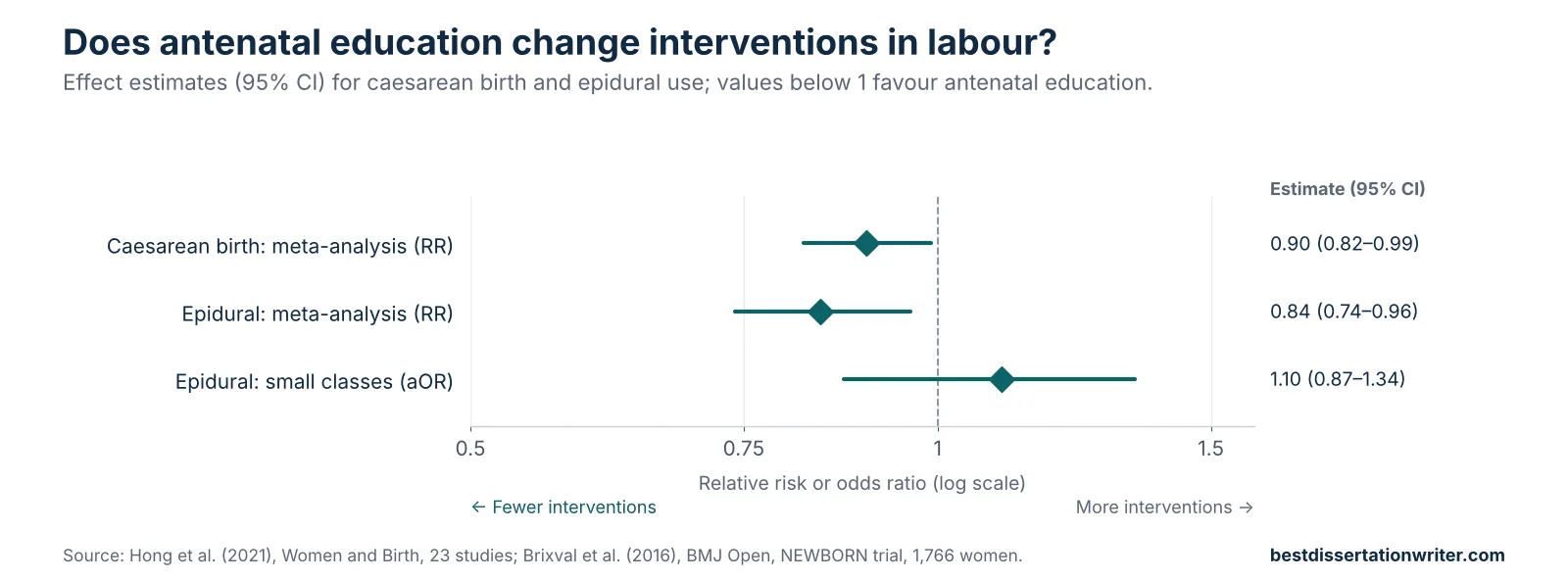
The reductions reported by Hong et al. (2021) were small, and the inclusion of observational studies raises the possibility that women who chose to attend classes differed from those who did not. The authors themselves noted that evidence on physical outcomes was limited and called for programmes to be standardised. The difference between this review and the Cochrane review may reflect the newer studies included, but it may also reflect weaker study designs.
A large trial helps to test whether the format of classes matters. In the NEWBORN trial in Denmark, Brixval et al. (2016) randomised 1,766 pregnant women to three 2.5-hour sessions in small classes of six to eight women or to two 2-hour auditorium lectures for about 250 people. Epidural use was 30.9% in the small-class group and 29.1% in the lecture group (adjusted odds ratio 1.10, 95% CI 0.87 to 1.34), and there were no significant differences in other pain relief or obstetric interventions.
An earlier systematic review by Brixval et al. (2015) had already found 17 randomised or quasi-randomised trials of education in small classes, but each outcome was reported in only one or a few trials, and the authors concluded that there was insufficient evidence of effectiveness. Taken together, these sources suggest that antenatal education may have at most a small effect on interventions in labour, and that simply changing the format of classes does not reliably change birth outcomes.
Theme 2: Fear, Confidence and Stress
Psychological outcomes may be a more realistic goal for classes than clinical ones. In the meta-analysis by Hong et al. (2021), stress and self-efficacy improved significantly in the education groups, although anxiety and depression did not differ. Self-efficacy, a woman’s confidence in her ability to cope with labour, is linked to how women approach birth, so improvements may matter even when rates of intervention change little.
Women with high fear of birth may need more targeted childbirth preparation than general classes provide. In the BELIEF trial in Queensland, Australia, Toohill et al. (2014) screened 1,410 pregnant women and randomised 339 with high fear to midwife-led telephone psycho-education at 24 and 34 weeks or to usual care. All women received a decision-aid booklet about childbirth choices. Fear of birth (p < 0.001) and childbirth self-efficacy (p = 0.002) differed significantly in favour of the intervention, while decisional conflict and depressive symptoms fell but not significantly.
The BELIEF trial shows that brief, individual childbirth preparation delivered by midwives can reduce fear and build confidence in a high-fear group. Its strengths include randomisation and a validated fear measure, but the intervention was delivered by telephone to women already identified as fearful, so the results cannot be generalised to group classes for all women. It nevertheless suggests that tailoring education to need may be more effective than a single approach for everyone.
Theme 3: Antenatal Education for Parenthood and Partners
Many parents report that classes focus on birth and leave them unprepared for life with a baby. Entsieh and Kristensson Hallström (2016) synthesised 12 qualitative studies of first-time parents’ needs for parenthood preparation. Parents wanted antenatal education to include male partners actively before and after birth, to give early and realistic information about parenting skills, to provide access to professional support in the early postnatal period and to prepare them for changes in their relationship. Learning from peers and new parents was valued.
The authors concluded that antenatal classes should give equal emphasis to the prenatal and postnatal periods and use participatory, experiential adult learning methods. These findings challenge the traditional structure of antenatal education, in which parenting classes are often brief and placed at the end of a course focused on labour. The synthesis was limited to qualitative studies, which describe what parents want rather than what works.
Trial evidence on parenthood outcomes is limited. In an exploratory analysis of the NEWBORN trial, Koushede et al. (2017) found that small-class education, which included a session after birth, had a small beneficial effect on global stress six months after birth compared with auditorium lectures. Differences in parenting stress and parenting alliance were not statistically significant. Because these were secondary outcomes, the findings should be interpreted cautiously, but they suggest that interactive parenting classes may support parents’ wellbeing in the months after birth.
Discussion
This review suggests that antenatal education has modest and inconsistent effects on birth outcomes. A meta-analysis found small reductions in caesarean birth and epidural use, but the Cochrane review found no consistent effects, and a large randomised trial found that small-class education did not change epidural use compared with lectures. The most consistent benefits of classes appear to be psychological, including lower stress and higher self-efficacy.
The mixed findings partly reflect the diversity of the programmes evaluated. Programmes differ in content, intensity, timing, group size and whether partners attend, and many studies did not describe the intervention fully. Outcome measures also vary, making pooling difficult. When interventions are this varied, it is unsurprising that pooled effects are small, and an average effect may hide programmes that work well alongside others that do not.
There is a tension between expecting antenatal education to reduce interventions and recognising its wider value. Birth outcomes depend heavily on clinical factors and on the practices of maternity services, which classes cannot change. Judging antenatal education mainly by caesarean or epidural rates may therefore underestimate its contribution to confidence, informed decision-making, social support and preparation for parenthood, which parents themselves value.
The evidence also points to the value of targeting. Women with high fear benefited from individual psycho-education in the BELIEF trial, while first-time parents wanted more preparation for life after birth. A combination of universal childbirth preparation and targeted support for women with additional needs may make better use of midwives’ time than a single model for everyone. Attention to access is also important, since women who might benefit most are often least likely to attend.
This review has limitations. It relied on openly accessible, English-language sources, used a targeted rather than exhaustive search and did not involve independent double screening. The Cochrane review is now dated, and several trials came from a single country. Future research should evaluate clearly described programmes in randomised trials with consistent outcomes, including fear, self-efficacy, postnatal wellbeing and parenting, and should test online and partner-inclusive antenatal education in diverse populations.
Implications of Antenatal Education Evidence for Practice
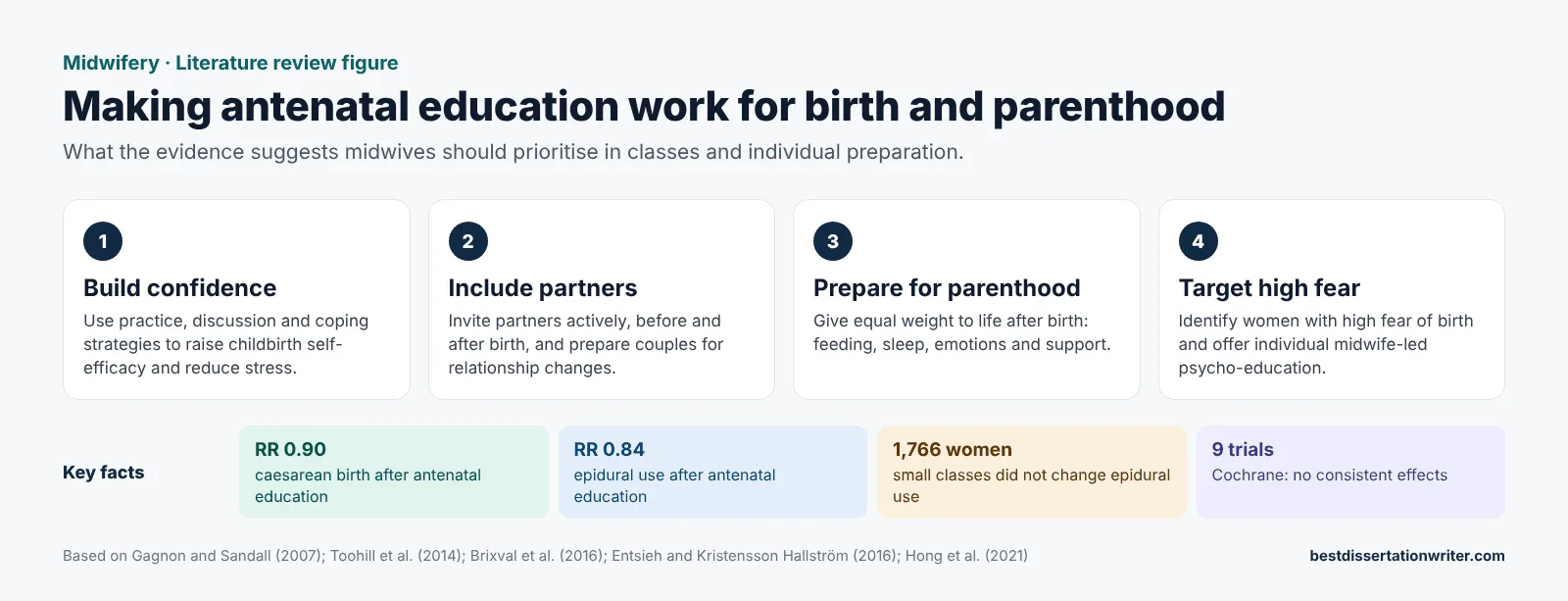
For midwives, the evidence supports interactive, small-group childbirth preparation that builds confidence, includes partners and gives as much weight to the postnatal period as to labour. Classes should use participatory methods, invite new parents to share experiences and give realistic information about feeding, sleep, relationships and emotional changes. Midwives should identify women with high fear of birth and offer individual psycho-education or referral, and should adapt materials and timing so that younger women, women with limited English and those on low incomes can attend.
Antenatal classes also provide an opportunity to discuss topics that matter for safety and wellbeing. Women with fear of childbirth may need additional support beyond group classes, and education can explain warning signs of pre-eclampsia and when to seek help. Practical preparation for breastfeeding initiation supports early feeding, and sensitive, inclusive teaching should recognise that some parents attending classes may have experienced loss and benefited from bereavement care following stillbirth in a previous pregnancy.
Conclusion
This systematic review examined the effectiveness of antenatal education in preparing women and partners for birth and parenthood. Effects on caesarean birth and epidural use are small and inconsistent, but it appears to reduce stress and increase confidence, and midwife-led psycho-education can reduce high fear of birth.
Midwives can strengthen childbirth preparation and parenting classes by making them interactive, partner-inclusive and balanced between birth and parenthood, and by offering targeted support to women with high fear or other needs. Clearer descriptions of programmes and consistent outcome measures in future research will help services to understand which forms of antenatal education work best.
References
Brixval, C. S., Axelsen, S. F., Lauemøller, S. G., Andersen, S. K., Due, P., & Koushede, V. (2015). The effect of antenatal education in small classes on obstetric and psycho-social outcomes – a systematic review. Systematic Reviews, 4, 20. https://doi.org/10.1186/s13643-015-0010-x
Brixval, C. S., Thygesen, L. C., Axelsen, S. F., Gluud, C., Winkel, P., Lindschou, J., Weber, T., Due, P., & Koushede, V. (2016). Effect of antenatal education in small classes versus standard auditorium-based lectures on use of pain relief during labour and of obstetric interventions: Results from the randomised NEWBORN trial. BMJ Open, 6(6), e010761. https://doi.org/10.1136/bmjopen-2015-010761
Entsieh, A. A., & Kristensson Hallström, I. (2016). First-time parents’ prenatal needs for early parenthood preparation – A systematic review and meta-synthesis of qualitative literature. Midwifery, 39, 1–11. https://doi.org/10.1016/j.midw.2016.04.006
Gagnon, A. J., & Sandall, J. (2007). Individual or group antenatal education for childbirth or parenthood, or both. Cochrane Database of Systematic Reviews, (3), CD002869. https://doi.org/10.1002/14651858.CD002869.pub2
Hong, K., Hwang, H., Han, H., Chae, J., Choi, J., Jeong, Y., Lee, J., & Lee, K. J. (2021). Perspectives on antenatal education associated with pregnancy outcomes: Systematic review and meta-analysis. Women and Birth, 34(3), 219–230. https://doi.org/10.1016/j.wombi.2020.04.002
Koushede, V., Brixval, C. S., Thygesen, L. C., Axelsen, S. F., Winkel, P., Lindschou, J., Gluud, C., & Due, P. (2017). Antenatal small-class education versus auditorium-based lectures to promote positive transitioning to parenthood – A randomised trial. PLOS ONE, 12(5), e0176819. https://doi.org/10.1371/journal.pone.0176819
Toohill, J., Fenwick, J., Gamble, J., Creedy, D. K., Buist, A., Turkstra, E., & Ryding, E. L. (2014). A randomized controlled trial of a psycho-education intervention by midwives in reducing childbirth fear in pregnant women. Birth, 41(4), 384–394. https://doi.org/10.1111/birt.12136
Cite this example
Best Dissertation Writers (2026) The Effectiveness of Antenatal Education in Preparing Women and Partners for Birth and Parenthood: A Systematic Review. Available at: https://bestdissertationwriter.com/antenatal-education-literature-review/
Best Dissertation Writers
Get expert help with your nursing literature review
Share your topic and deadline with Best Dissertation Writers and get support tailored to your module brief.