Midwifery Bereavement Care Following Stillbirth: A Systematic Review of Parents’ and Midwives’ Experiences
 By Dr. Robertson Prime, Research Fellow
Updated October 12, 2026
16 min read
About 3,200 words
By Dr. Robertson Prime, Research Fellow
Updated October 12, 2026
16 min read
About 3,200 words
In this review
Abstract
Background: Bereavement care following stillbirth shapes how parents remember the birth and death of their baby, and how they cope in the months and years that follow. Midwives are usually the professionals closest to parents at this time, yet many report feeling unprepared and unsupported in providing this care.
Aim: This systematic review aimed to examine parents’ and midwives’ experiences of care after stillbirth, and what these experiences mean for midwifery practice.
Methods: Evidence was identified through targeted searches of openly accessible bibliographic records, publisher websites and the reference lists of key reviews. Seven sources published between 2013 and 2025 were included: a Cochrane review, three systematic reviews, a scoping review, a qualitative interview study and a national survey, appraised with CASP checklists and synthesised thematically.
Findings: Parents described one chance to get it right, and a review of 52 studies found that staff behaviour had a memorable impact on parents in 53% of studies, while support with memory-making was the most frequent parental theme. Evidence on seeing and holding the baby was mixed: in a national survey 84% of mothers held their baby, but those who did had higher odds of anxiety at nine months, and a systematic review judged the evidence sparse and of poor quality. A Cochrane review found no randomised trials of psychosocial support after perinatal death. Professionals described emotional, knowledge and system barriers, unmet needs for training and limited institutional support.
Conclusion: Midwives should offer choices about contact and memory-making without pressure, give parents time and privacy, and receive training, continuity and emotional support so that they can provide compassionate care.
Keywords: bereavement care following stillbirth, perinatal loss, perinatal bereavement
Introduction
This systematic review critically examines recent evidence on bereavement care following stillbirth and its implications for midwifery practice.
The death of a baby before or during birth is one of the most devastating events that parents can experience. Ellis et al. (2016) note that an estimated 2.7 million babies were stillborn worldwide in 2015, and that stillbirth has been described as a shamefully neglected public health issue. Behind each statistic is a family who must give birth to a baby who has died, make decisions about seeing, holding and naming that baby, consider a post-mortem examination and then return home without their child. Perinatal loss of this kind can have lasting psychological, social and relationship consequences.
Midwives are usually the professionals closest to parents throughout this time. They care for women during labour and birth, help parents to spend time with their baby, prepare them for what to expect, provide information and arrange follow-up. The quality of bereavement care following stillbirth is remembered for many years, and it can either ease or deepen the grief that follows. Yet stillbirth is relatively uncommon in any single unit, and many midwives care for bereaved parents only occasionally, which can leave them feeling unprepared.
A systematic approach was chosen so that Cochrane evidence, systematic and scoping reviews, qualitative research and survey data could be identified and appraised together. Combining the views of parents and professionals is important, because good care depends both on understanding what parents need and on recognising the barriers that staff face in providing it.
Review question
What are parents’ and midwives’ experiences of bereavement care following stillbirth, and what are the implications for midwifery practice?
Background to Bereavement Care Following Stillbirth
Stillbirth refers to the death of a baby before or during birth after the threshold of viability, which in the United Kingdom is 24 completed weeks of pregnancy. The death may be diagnosed before labour, when parents learn at a scan or appointment that their baby’s heart has stopped, or less commonly during labour itself. In either case, parents usually face a vaginal birth, followed by a series of decisions that they have often never imagined having to make.
Bereavement care following stillbirth covers the support offered from diagnosis through labour and birth, the time parents spend with their baby, discussions about investigations and post-mortem examination, the transfer home and follow-up. It includes practical elements such as a private room and information about registration and funeral arrangements, as well as relational elements such as compassionate communication and continuity of staff. Memory-making, including photographs, handprints and footprints, has become a common part of care in many high-income countries.
Practice in this area has changed considerably over recent decades. In the past, babies were often removed quickly and parents were discouraged from seeing them, in the belief that this would reduce grief. More recently, care has moved towards offering parents the opportunity to see, hold and spend time with their baby. However, the evidence for different approaches to bereavement care following stillbirth has been debated, and perinatal bereavement care has developed largely from professional consensus and parents’ accounts rather than from trials.
Professionals are also affected by perinatal loss. Midwives, obstetricians and nurses may experience grief, guilt and distress, particularly when a death was unexpected or when they feel that something could have been done differently. How staff cope, and the support they receive, influences the care they are able to give. Understanding both perspectives is therefore essential for improving perinatal bereavement care.
Search Strategy and Methods
Evidence for this example was identified through targeted searches of openly accessible bibliographic records, publisher websites and the reference lists of key reviews. Search terms combined keywords for the event (“stillbirth”, “stillborn”, “perinatal death”, “perinatal loss”) with terms for care and experience (“bereavement care”, “support”, “memory-making”, “holding the baby”, “experience*”, “midwi*”, “health professional*”), joined with the Boolean operators AND and OR. A full systematic review for assessment would run the same strategy in CINAHL, MIDIRS, PubMed/MEDLINE and the Cochrane Library and report the number of records screened in a PRISMA flow diagram.
Sources were eligible if they reported parents’ or health professionals’ experiences of bereavement care following stillbirth or wider perinatal death, or evaluated aspects of care such as contact with the baby or psychosocial support. Systematic reviews, Cochrane reviews and primary studies from any country were considered, with priority given to reviews and to studies conducted in the United Kingdom. Studies limited to miscarriage or to termination of pregnancy for fetal anomaly were excluded.
Seven sources published between 2013 and 2025 were included: one Cochrane review, three systematic reviews, one scoping review, one qualitative interview study and one national survey (Table 1). The quality of each source was appraised using the Critical Appraisal Skills Programme (CASP) checklist appropriate to its design, and the findings on bereavement care following stillbirth were synthesised thematically.
Key Findings on Bereavement Care Following Stillbirth
Three themes were identified: parents’ experiences of care and the lasting impact of staff behaviour, seeing and holding the baby and memory-making, and the experiences and support needs of midwives and other professionals. Table 1 summarises the included sources, and Figure 1 shows how frequently the main themes of bereavement care following stillbirth were reported across studies in a large systematic review.
| Author, year | Design | Setting and sample | Key finding |
|---|---|---|---|
| Downe et al. (2013) | Qualitative interview study | 25 parents from 22 families; all NHS regions in the UK | Staff interactions strongly affected coping; meta-theme “one chance to get it right”. |
| Koopmans et al. (2013) | Cochrane systematic review | Randomised trials of support after perinatal death | No trials met inclusion criteria; benefits of support and harms of holding the baby unclear. |
| Hennegan et al. (2015) | Systematic review | 11 studies (18 papers) comparing contact with the baby versus no contact | Mixed findings on holding and mental health; mothers satisfied with their decisions; poor-quality evidence. |
| Ellis et al. (2016) | Systematic review (meta-summary) | 52 studies of parents and professionals; high-income countries | Memory-making support (53%) and impact of staff behaviour (53%) most frequent; staff barriers in 100%. |
| Redshaw et al. (2016) | National postal survey (secondary analysis) | 468 women after stillbirth in England, 2012 | 84% held their baby; holding associated with higher odds of anxiety at nine months (OR 2.12). |
| Shorey et al. (2017) | Scoping review | 30 papers on maternity professionals facing perinatal death | Psychological and physical impact; unmet needs for social support, training and education. |
| Cates et al. (2025) | Systematic review and meta-synthesis | 13 qualitative studies, 127 obstetricians, nine countries | Emotional burden, self-blame and guilt; inadequate bereavement training and support in every setting. |
Theme 1: Parents’ Experiences of Bereavement Care Following Stillbirth
In a qualitative interview study, Downe et al. (2013) explored how bereaved parents in the United Kingdom viewed their interactions with hospital staff when their baby died shortly before or during labour. Twenty-five parents from 22 families took part, recruited from respondents to a national survey and representing every NHS region. Interactions with staff had a profound effect on parents’ ability to cope, both at the time and in the long term. The overarching theme, “one chance to get it right”, captured the sense that each encounter could never be repeated.
Three further themes described enduring and multiple loss, making irretrievable moments precious, and care that ranged from the best possible to the worst imaginable. Downe et al. (2013) concluded that positive memories depend as much on caring staff attitudes and behaviours as on high-quality clinical procedures. The study used maximum variation sampling and continued until data saturation, which strengthens its credibility, although births occurred between 2002 and 2010 and some accounts were recalled several years later.
A systematic review of 52 qualitative, quantitative and mixed-method studies from high-income countries extended these findings (Ellis et al., 2016). Using meta-summary, the authors calculated how often each theme appeared across studies. Support with memory-making was reported in 53% of studies of parents, privacy without abandonment and postnatal information each in 30%, and preparation for vaginal birth in 23%. Parents also wanted options and time, discussion of their concerns, tailored post-mortem discussions and recognition that fathers have different needs.
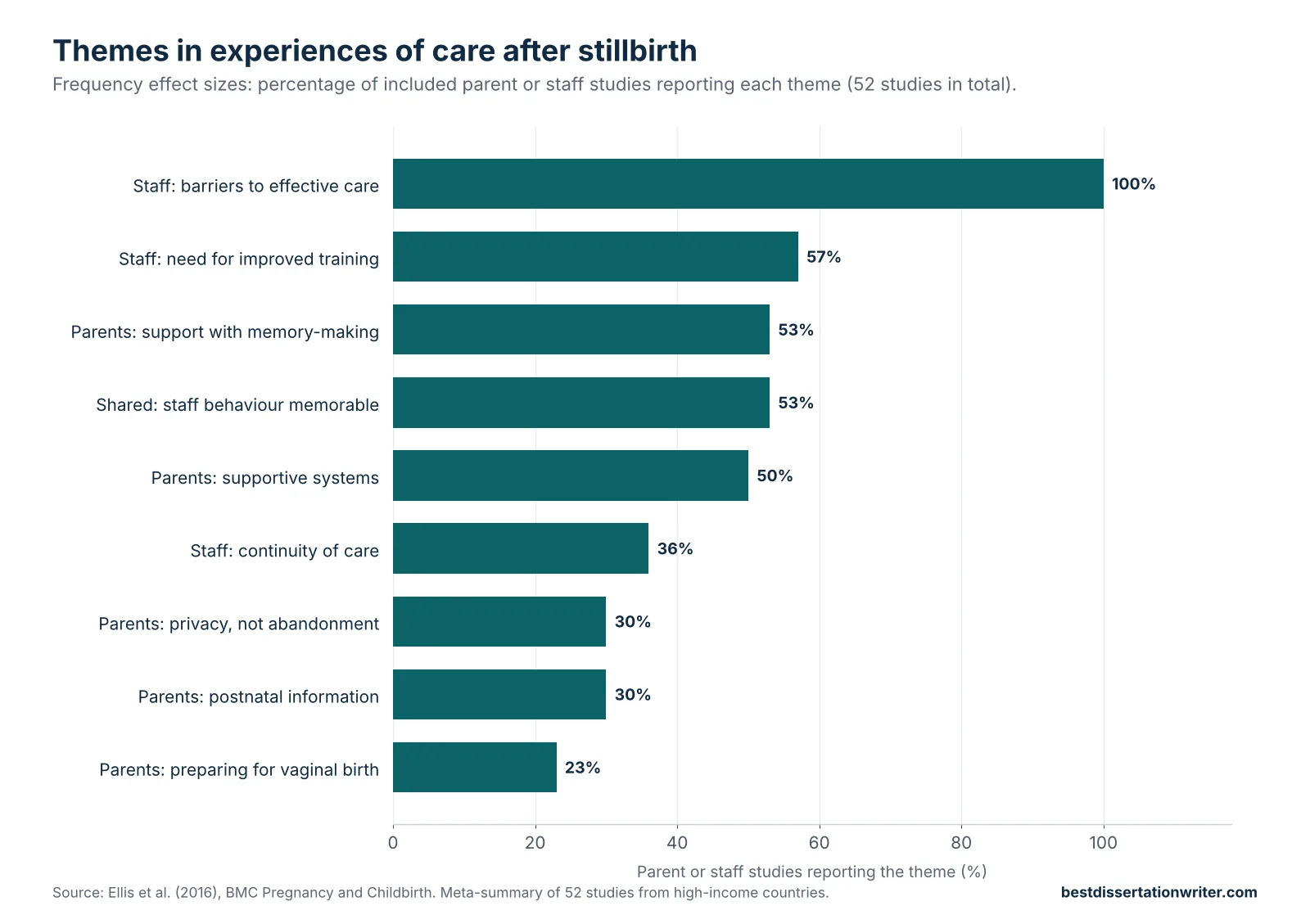
A finding shared by parents and staff was that staff behaviour had a memorable impact on parents, reported in 53% of studies. Parents described distress when midwives appeared to hide behind tasks and ritualised guidelines. Frequency effect sizes show how often a theme was reported, not how important it was, and the authors acknowledged that researchers’ interests may influence which findings are published. Nevertheless, the convergence with Downe et al. (2013) suggests that compassionate, individualised care is central to good bereavement care following stillbirth.
Theme 2: Seeing, Holding and Memory-Making
Whether parents should see and hold their stillborn baby has been one of the most debated questions in perinatal bereavement care. In a systematic review, Hennegan et al. (2015) identified 11 studies, reported in 18 papers, that quantitatively compared parents who did or did not hold their baby or take part in other memory-making activities. Findings on holding and mental health were mixed, with conflicting results for anxiety and post-traumatic stress, while other memory-making activities showed no significant association with mental health. Mothers were consistently satisfied with their decision to hold their baby or create memories.
Most studies in this review had a high risk of bias, particularly in sample representativeness and adjustment for confounders, and the authors described the evidence as sparse and of poor quality. A later national survey of women with a registered stillbirth in England in 2012 illustrates the difficulty (Redshaw et al., 2016). Of 468 respondents, 97% saw their baby and 84% held them. After adjustment, women who held their baby had higher odds of anxiety at nine months (odds ratio 2.12, 95% CI 1.11 to 4.04) and of family relationship difficulties.
These findings should be interpreted cautiously. The survey had a response rate of 30.2%, it was observational, and the authors could not adjust for anxiety before the loss, so women who were more distressed may have been more likely to hold their baby. A Cochrane review of support for parents after perinatal death found no randomised trials that met its criteria (Koopmans et al., 2013). The authors concluded that evidence on potential harms of seeing and holding the baby was inconclusive, while descriptive studies suggested that these experiences were often positive when guided by sensitive, experienced staff.
Theme 3: Midwives’ and Professionals’ Experiences and Support Needs
Professionals’ experiences form the other side of bereavement care following stillbirth. In the review by Ellis et al. (2016), every study of staff (100%) reported emotional, knowledge-based or system-based barriers to effective care, 57% described a need for improved training and 36% a need for continuity of care. Some staff coped by distancing themselves from parents and focusing on tasks, which mirrors the parents’ accounts of staff hiding behind procedures and suggests that the two experiences are closely linked.
A scoping review of 30 papers on maternity professionals facing perinatal death reached similar conclusions (Shorey et al., 2017). Perinatal death had considerable psychological and physical effects on healthcare professionals, who used personal and external resources to manage stress but reported unmet needs for social support, training and education. The authors called for institutional support that acknowledges staff stress and for culturally sensitive education. They also noted that studies of physicians were scarce, and most of the evidence concerned midwives and nurses.
A more recent meta-synthesis of 13 qualitative studies involving 127 obstetricians in nine countries found a heavy emotional burden, including self-blame and guilt, difficulties in interactions with parents after adverse outcomes and a lack of support and resources (Cates et al., 2025). Inadequate training and support for bereavement care were reported in every setting studied. Although this review focused on obstetricians rather than midwives, it shows that the needs identified in earlier research persist and extend across the whole maternity team.
Discussion
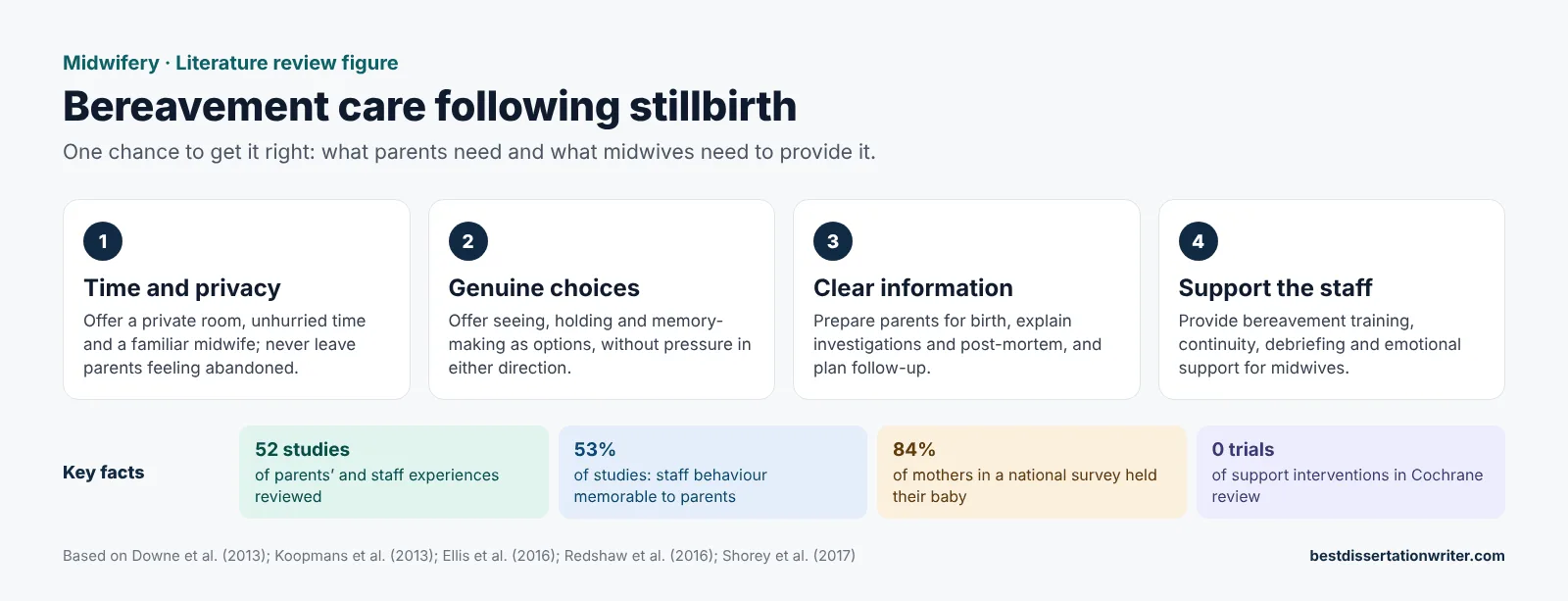
This review found a consistent message across very different types of evidence: the way professionals behave after a stillbirth has a lasting effect on parents. Parents described one chance to get it right and remembered both kindness and its absence for many years. A large systematic review confirmed that support with memory-making, privacy, information and time were among the most frequently reported needs. These findings support a model of bereavement care following stillbirth that is relational and individualised rather than driven by checklists alone.
The evidence on seeing and holding the baby is more uncertain. Parents in qualitative studies often valued this time, and mothers in the systematic review were satisfied with their decisions, yet one national survey found higher odds of anxiety among mothers who held their baby. The tension is partly methodological, since no randomised trials exist and observational studies cannot separate the effect of holding from the characteristics of women who choose to hold. For bereavement care following stillbirth, the balance of evidence supports offering contact as a genuine choice, without pressure in either direction.
Guidelines and checklists can help to ensure that important steps are not missed, but the evidence suggests that they can also become a barrier when followed mechanically. Parents described distress when staff appeared to hide behind tasks, while staff described task focus as a way of coping. This suggests that improving perinatal bereavement care requires attention to the emotional needs of staff as well as to procedures, so that midwives feel able to stay present with parents rather than retreating into routine.
The professional evidence points to systemic gaps. Training, continuity and institutional support were repeatedly identified as unmet needs, from the 2016 review of staff experiences to the 2025 meta-synthesis of obstetricians’ experiences. Where these needs are not met, professionals may experience burnout or leave practice, which in turn reduces the experience available to support bereaved families. Investment in bereavement care following stillbirth is therefore both a quality issue for parents and a workforce issue for maternity services.
The evidence base has limitations. Most studies were qualitative or observational, many came from high-income countries, and samples were often self-selected, which may over-represent parents with strong views. The Cochrane review found no trials, so the effects of specific interventions remain unknown. This review relied on openly accessible, English-language sources and did not involve independent double screening. Future research should evaluate structured bereavement care pathways, staff training and support programmes, and the experiences after perinatal loss of fathers and of families from minority ethnic and migrant backgrounds.
Implications of Bereavement Care Following Stillbirth Evidence for Practice
Midwives should give parents time, privacy and clear information, prepare them gently for a vaginal birth and offer the opportunity to see, hold and make memories with their baby as a choice rather than an expectation. Care should be continuous where possible, and continuity of carer models can help parents to be supported by a familiar midwife. Parents should be told who to contact after discharge, and midwives should watch for signs of perinatal anxiety and depression in the months that follow and in any later pregnancy.
Some stillbirths follow complications such as pre-eclampsia or fetal growth restriction, so explanations of investigations and post-mortem findings should be planned with obstetric colleagues. Units that promote skin-to-skin contact for live-born babies should also consider how warmth, closeness and time with the baby can be offered sensitively to bereaved parents. Finally, maternity services should provide bereavement training for all staff, protected time for debriefing and access to emotional support, so that midwives can sustain compassionate care.
Conclusion
This systematic review examined parents’ and midwives’ experiences of bereavement care following stillbirth. Parents value compassionate, individualised care, time with their baby, privacy and information, and remember staff behaviour for many years. Evidence on the effects of holding the baby is mixed and of low quality, and no randomised trials of support interventions were found.
Professionals experience significant emotional burden and report unmet needs for training and support. Improving bereavement care following stillbirth therefore depends on offering parents genuine choices with sensitivity and on supporting the midwives and other professionals who care for them.
References
Cates, F., Wetzler, S., Wishlade, T., Patel, M., & Aiken, C. E. (2025). How obstetricians experience stillbirth and perinatal loss: A systematic review and meta-synthesis. AJOG Global Reports, 5(2), 100465. https://doi.org/10.1016/j.xagr.2025.100465
Downe, S., Schmidt, E., Kingdon, C., & Heazell, A. E. P. (2013). Bereaved parents’ experience of stillbirth in UK hospitals: A qualitative interview study. BMJ Open, 3(2), e002237. https://doi.org/10.1136/bmjopen-2012-002237
Ellis, A., Chebsey, C., Storey, C., Bradley, S., Jackson, S., Flenady, V., Heazell, A., & Siassakos, D. (2016). Systematic review to understand and improve care after stillbirth: A review of parents’ and healthcare professionals’ experiences. BMC Pregnancy and Childbirth, 16, 16. https://doi.org/10.1186/s12884-016-0806-2
Hennegan, J. M., Henderson, J., & Redshaw, M. (2015). Contact with the baby following stillbirth and parental mental health and well-being: A systematic review. BMJ Open, 5(11), e008616. https://doi.org/10.1136/bmjopen-2015-008616
Koopmans, L., Wilson, T., Cacciatore, J., & Flenady, V. (2013). Support for mothers, fathers and families after perinatal death. Cochrane Database of Systematic Reviews, (6), CD000452. https://doi.org/10.1002/14651858.CD000452.pub3
Redshaw, M., Hennegan, J. M., & Henderson, J. (2016). Impact of holding the baby following stillbirth on maternal mental health and well-being: Findings from a national survey. BMJ Open, 6(8), e010996. https://doi.org/10.1136/bmjopen-2015-010996
Shorey, S., André, B., & Lopez, V. (2017). The experiences and needs of healthcare professionals facing perinatal death: A scoping review. International Journal of Nursing Studies, 68, 25–39. https://doi.org/10.1016/j.ijnurstu.2016.12.007
Cite this example
Best Dissertation Writers (2026) Midwifery Bereavement Care Following Stillbirth: A Systematic Review of Parents’ and Midwives’ Experiences. Available at: https://bestdissertationwriter.com/bereavement-care-following-stillbirth/
Best Dissertation Writers
Get expert help with your nursing literature review
Share your topic and deadline with Best Dissertation Writers and get support tailored to your module brief.