
Accuracy and Reliability of Triage Tools Used by Emergency Nurses: A Systematic Review
 By Dr. Robertson Prime, Research Fellow
Updated November 2, 2026
14 min read
About 2,800 words
In this review
Abstract
Background: Triage is the process by which emergency nurses decide who needs care first, and the triage tools they use shape waiting times, safety and the use of resources. Five-level scales such as the Manchester Triage System and the Emergency Severity Index are widely used, but questions remain about how reliable and valid they are.
Aim: This systematic review aimed to examine the evidence on the reliability and validity of triage tools used in emergency departments, including paediatric triage, and the implications for emergency nursing practice.
Methods: Evidence was identified through targeted searches of openly accessible bibliographic records, publisher websites and repositories. Five sources published between 2014 and 2019 were included: four systematic reviews or meta-analyses and an integrative review of triage education. The sources were appraised using CASP checklists and synthesised narratively.
Findings: A meta-analysis of 19 studies found a pooled reliability coefficient of 0.791 for the Emergency Severity Index, with higher agreement among expert raters. A review of 12 studies found that the Manchester Triage System had mostly good to very good agreement but low safety because of undertriage. A review of 25 paediatric studies found that over half were of low quality and that systems performed better in their home countries. A review of 50 comparative studies found that sensitivity for severe sepsis ranged from 36% to 74% and that only 11 of 42 reliability evaluations reported a kappa above 0.8. Educational interventions generally improved triage accuracy.
Conclusion: Triage tools show acceptable reliability but undertriage of critically ill patients remains a concern. Nurses need consistent training, awareness of the limits of the tool they use and clinical judgement to supplement it.
Keywords: triage tools, Manchester Triage System, ESI
Introduction
This systematic review critically examines recent evidence on triage tools and its implications for emergency nursing practice.
Triage is the first clinical decision in the emergency department. A nurse assesses each patient who arrives, judges how urgent their need is and assigns a priority, which determines how soon the patient is seen. In many departments this role belongs to an experienced emergency nurse, who must decide quickly and with limited information while a queue builds.
Most departments now use structured triage tools to support this decision. These are typically five-level scales, such as the Manchester Triage System, the Emergency Severity Index, the Canadian Triage and Acuity Scale and the Australasian Triage Scale. Each scale defines categories by clinical features, vital signs or the resources that a patient is expected to need, and each is intended to make triage consistent between nurses and between hospitals.
Good triage tools should be reliable, so that different nurses reach the same decision for the same patient, and valid, so that the priority they give matches the patient’s real need. Triage that is too low, called undertriage, may delay care for someone who is seriously ill. Triage that is too high, called overtriage, uses scarce resources and lengthens waits for others.
Review question
What does the evidence show about the reliability and validity of triage tools used in emergency departments, and what does it mean for nursing practice?
Background to Triage Tools
Triage has a long history in military and disaster medicine, where it was used to sort casualties when resources were short. In everyday emergency care, triage serves a similar purpose on a smaller scale. The pressure of demand, which is considered in the review of emergency department overcrowding, makes it more important to identify quickly those who cannot wait.
Triage tools differ in design. Some, such as the Manchester Triage System, use flowcharts based on presenting complaints and discriminators. Others, such as the Emergency Severity Index, combine an assessment of acuity with an estimate of the resources a patient will need. Paediatric versions exist for several of these tools because children’s physiology and presentations differ from adults. Local adaptations are common, which makes comparison between studies harder.
Nurses are the main users of these tools, and their skill, experience and training influence the result. The review of workplace violence shows that triage is also a point at which nurses meet distressed and sometimes aggressive patients and relatives, a reminder that the triage nurse’s decisions are made in a demanding environment.
The role of the nurse in triage has also changed. In many services, triage is no longer a single step at the front door but part of a wider process that includes streaming to different areas, early investigations and treatment started by nurses. The triage tool is therefore used at the start of a pathway that may continue for hours, and the accuracy of the first decision affects every step that follows. This makes the quality of triage tools a matter for patient safety as well as for flow.
Search Strategy and Methods
Evidence for this example was identified through targeted searches of openly accessible bibliographic records, publisher websites and repositories. Search terms combined keywords for the intervention (“triage”, “triage scale”, “Manchester Triage System”, “Emergency Severity Index”) with terms for the outcomes and setting (“reliability”, “validity”, “undertriage”, “emergency department”, “nurses”), joined with the Boolean operators AND and OR. A full systematic review for assessment would run the same strategy in CINAHL, PubMed/MEDLINE, Embase and the Cochrane Library, and report the records screened in a PRISMA flow diagram.
Sources were eligible if they were systematic reviews or meta-analyses of the reliability or validity of emergency triage scales, or reviews of education for triage nurses. Single studies, studies of prehospital triage and reviews of triage in disaster settings were excluded.
Five sources published between 2014 and 2019 were included (Table 1). The quality of each source was considered using the Critical Appraisal Skills Programme (CASP) checklist for systematic reviews, and findings were synthesised narratively under themes.
The reviews differ in the questions they ask. Some focus on reliability, which concerns agreement between raters, and others on validity, which concerns whether the priority given matches outcomes such as admission, intensive care or death. Both matter for triage tools, and the findings are therefore presented separately before the evidence on education is considered. Where a review combined several scales, results are described for the group unless a particular scale is named.
Key Findings on Triage Tools
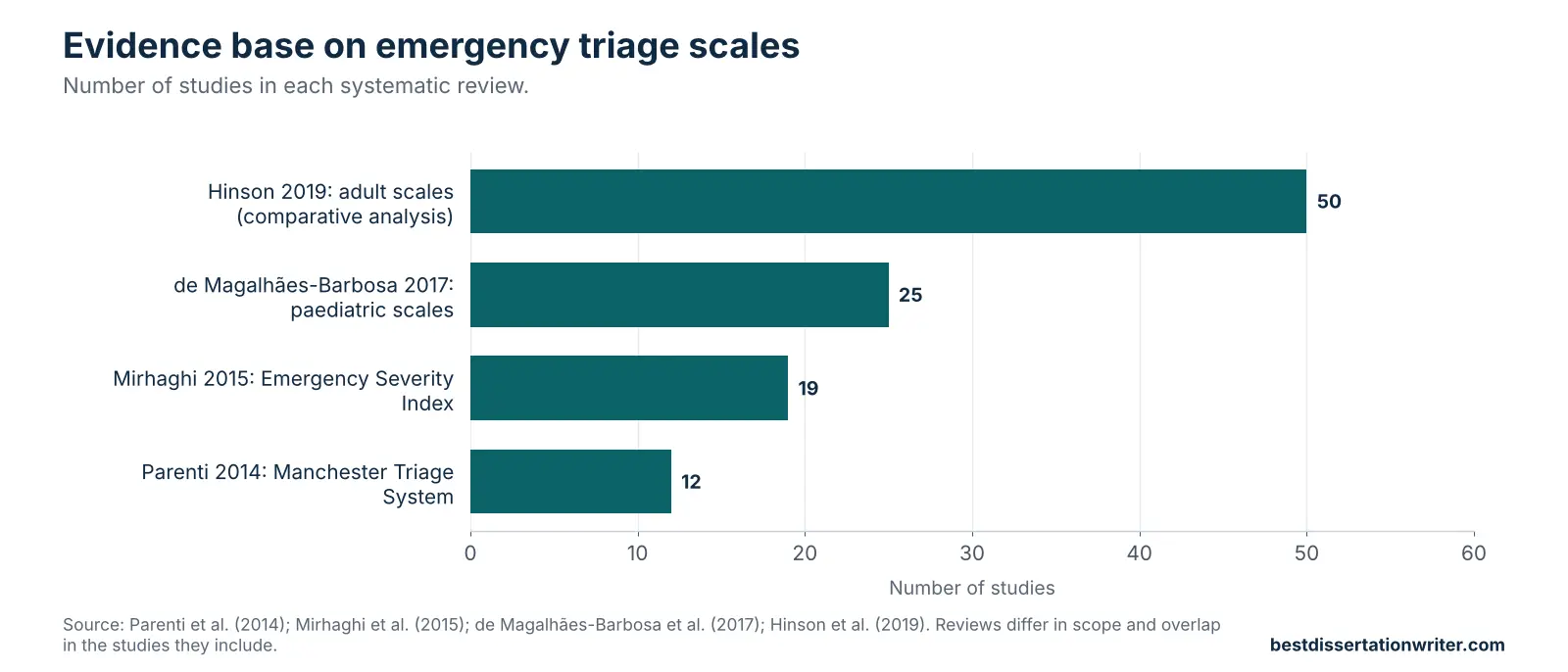
Three themes were identified: the reliability of triage tools, their validity and safety, and education for triage. Table 1 summarises the included sources, and Figure 1 shows the number of studies in the four reviews of triage scales.
| Author, year | Design | Setting and sample | Key finding |
|---|---|---|---|
| de Magalhães-Barbosa et al. (2017) | Systematic review | 25 studies; seven paediatric triage systems | Some support for validity in home countries; over half of studies low quality; undertriage. |
| Hinson et al. (2019) | Systematic review | 50 studies in comparative analysis | Five scales performed similarly; sensitivity for severe sepsis 36–74%; only 11 of 42 kappas above 0.8. |
| Mirhaghi et al. (2015) | Systematic review and meta-analysis | 19 studies; six countries | Pooled reliability 0.791 for the Emergency Severity Index. |
| Parenti et al. (2014) | Systematic review | 12 studies of the Manchester Triage System | Mostly good agreement; low safety because of undertriage. |
| Recznik & Simko (2018) | Integrative literature review | Studies of paediatric triage education | Simulation and standardised curricula common; accuracy generally improved. |
Theme 1: Reliability
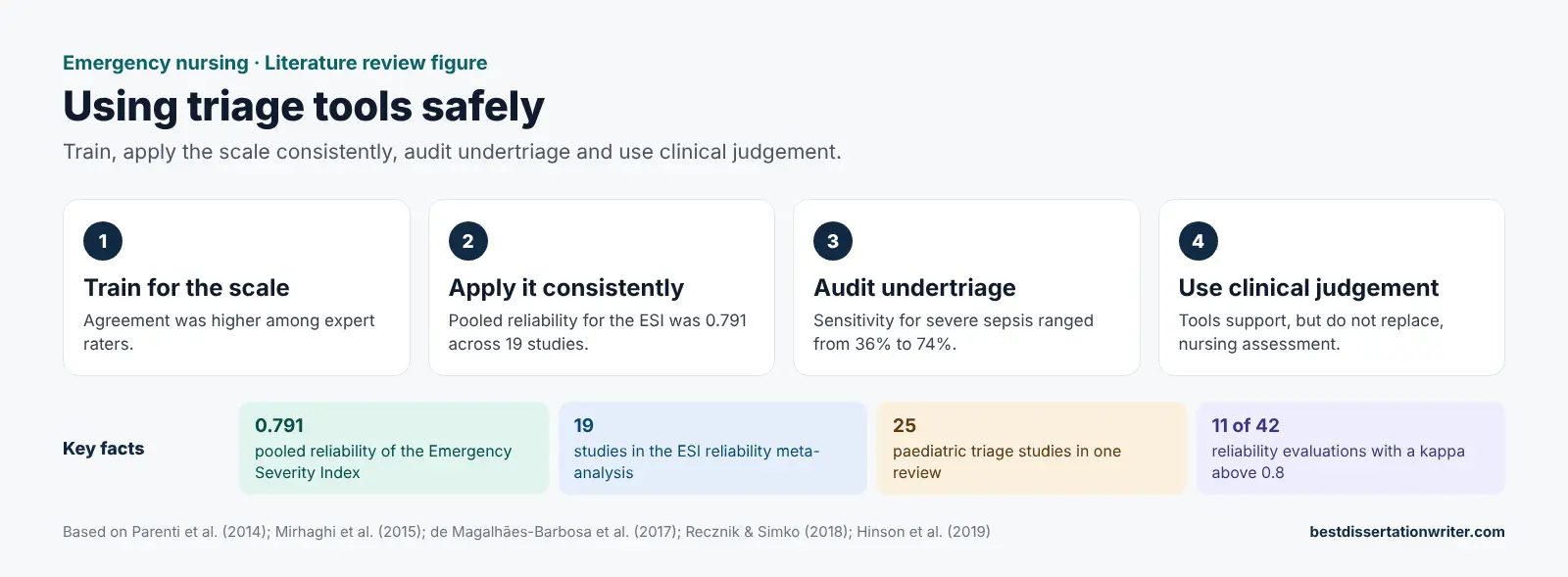
Mirhaghi et al. (2015) carried out a meta-analysis of the reliability of the Emergency Severity Index, searching databases in March 2014. They included 19 studies from six countries and pooled reliability coefficients using random-effects models. The pooled reliability coefficient was 0.791 (95% confidence interval 0.787 to 0.795), which the authors considered substantial.
Agreement was higher for the latest version of the scale, for adult versions and among expert raters than for older versions, paediatric versions and other rater groups. The authors concluded that the Emergency Severity Index has acceptable overall reliability, but that the scales require more development to achieve full agreement among all rater groups. For nursing practice, this suggests that experience and training influence the consistency of decisions.
Parenti et al. (2014) reviewed the validity and reliability of the Manchester Triage System, searching six databases for literature published from 1997 to November 2012. They included 12 studies and assessed quality with the STARD guidelines. The Manchester Triage System showed a wide range of inter-rater agreement, mostly good to very good. The authors judged that the reporting quality of the included studies was good.
Theme 2: Validity and Safety
Parenti et al. (2014) also reported that safety of the Manchester Triage System was low, because of high undertriage and low sensitivity for higher urgency levels, while high overtriage could lead to unnecessary use of emergency department resources. This finding suggests that a tool can be reliable, in the sense that nurses agree with each other, without necessarily being accurate in identifying the sickest patients.
Hinson et al. (2019) synthesised the adult triage literature to compare triage systems on clinical outcomes and reliability. They searched four databases through 2016 and identified 6,160 publications, of which 182 met the eligibility criteria and 50 were included in the comparative analysis. They compared five widely used scales: the Australian Triage Scale, the Canadian Triage and Acuity Scale, the Emergency Severity Index, the Manchester Triage Scale and the South African Triage Scale, and found that they performed similarly.
Six of eight studies reported high sensitivity (above 90%) for identifying patients who died in the emergency department. However, sensitivity was below 80% for critical illness and for deaths within days of the visit or during the hospital stay. Sensitivity for severe sepsis ranged from 36% to 74%, for non-ST elevation myocardial infarction from 44% to 85% and for ST elevation myocardial infarction from 56% to 92%. Between 3% and 45% of hospitalised patients had been triaged to low acuity.
Inter-rater reliability varied, and only 11 of 42 evaluations reported a kappa above 0.8. The authors concluded that a substantial share of patients who die or are critically ill are not triaged as high acuity and that there is room to improve both reliability and performance. These are important messages for emergency nurses: the tool supports judgement but does not replace it, and conditions such as sepsis, which is discussed in the review of sepsis in the emergency department, may be missed.
de Magalhães-Barbosa et al. (2017) reviewed the validity of five-level triage systems for children aged 0 to 18 in paediatric emergency care. They searched six databases without a time limit and identified 25 studies covering seven triage systems. Only studies of the Manchester Triage System used a reference standard for urgency, and the other systems were evaluated using proxy outcomes such as hospital admission. Over half of the studies were of low quality.
The Manchester Triage System, the paediatric Canadian Triage and Acuity Scale and the Emergency Severity Index version 4 had the most moderate- and high-quality studies. These three performed better in their home countries or nearby, with consistent links to hospitalisation and resource use, but in all three, patients at the lowest urgency levels were hospitalised, indicating undertriage. The authors concluded that cross-cultural adaptation is needed before adopting these systems elsewhere.
Theme 3: Education for Triage
Recznik and Simko (2018) carried out an integrative literature review of paediatric triage education. They found that many educational methods exist, that the highest-rated studies most often used simulation programmes or standardised curricula, and that triage accuracy generally improved after educational interventions. Outcomes varied widely, and the authors called for direct comparisons of teaching methods and noted that retention of skills depends on the method and timing of training.
Taken with the other sources, this suggests that training is a practical response to the limits of triage tools. If agreement is higher among expert raters, as Mirhaghi et al. found, then supporting less experienced nurses with structured education and supervised practice may improve consistency. Because triage is a high-risk task, services may also wish to audit undertriage regularly and feed the results back to nurses.
The sources have implications for how nurses use a triage tool each day. Nurses should be familiar with the version of the scale in use and its local adaptations, should apply it consistently, and should be prepared to escalate when clinical concern is greater than the score suggests. Sepsis, chest pain and the deteriorating child are examples in which the tool’s sensitivity may be limited, and the nurse’s overall impression is an important safeguard.
One lesson from the sources is that reliability and safety should be examined together. A scale that nurses apply consistently could still systematically underestimate the urgency of certain patients, and the reviews show that this can happen. Audit that looks only at agreement between nurses would miss this, so services should look at outcomes such as unplanned admissions and deaths among patients who were triaged to lower categories.
The sources also suggest that triage tools cannot be considered in isolation from their users. The training of nurses, the culture of the department and the pressure of demand all influence how a tool is applied. A department that expects nurses to triage large numbers of patients in a short time may see lower reliability than the studies report, and one that supports nurses to ask for a second opinion may see better safety.
Discussion
This systematic review shows that triage tools used in emergency departments have acceptable reliability, particularly among experienced raters, but that validity and safety are less certain. Undertriage of critically ill patients was found in several reviews, and sensitivity for conditions such as severe sepsis was low. Reliability does not guarantee accuracy.
The strength of the evidence is mixed. Reviews of the Emergency Severity Index and the Manchester Triage System include many studies, but over half of the paediatric studies were low quality, outcomes used to judge validity were often proxies such as admission, and reporting of agreement varied. There was heterogeneity in settings, versions of the scales and rater groups, and the sources overlap in the primary studies that they include.
Limitations of this review should also be noted. It included only five sources, all of which were published between 2014 and 2019, so more recent studies of newer tools or of technology-supported triage are not captured. No source is a United Kingdom review of nurse-led triage in particular, and the effect of triage tools on patient outcomes was not examined directly. This review relied on openly accessible, English-language sources.
Even so, the sources are consistent in their main message. Triage tools are helpful and acceptably reliable, but they have limits that nurses should understand. Education, audit and clinical judgement are needed to make them safe. Departments should also consider whether their local adaptations of a scale have been checked, since the evidence suggests that performance may change when a system is moved to a new setting.
Implications of Triage Tools Evidence for Practice
For practice, the evidence supports training triage nurses in the scale in use, supporting less experienced nurses with supervised practice, auditing undertriage and overtriage, encouraging nurses to override the score when clinical concern is high and checking local adaptations of the tool. Guidance is available from the Royal College of Nursing and the NHS.
Managers should provide time and support for triage education and for audit, and should consider how streaming and rapid assessment arrangements, described in the review of rapid assessment and streaming, affect the triage nurse’s role.
Future research should compare triage tools and teaching methods directly, use reference standards for urgency instead of proxy outcomes, test tools in United Kingdom emergency departments and examine how triage tools perform for sepsis and other time-critical conditions. Studies should also measure patient outcomes and nurses’ experiences.
Conclusion
This systematic review found that triage tools are acceptably reliable but are limited by undertriage, particularly for critically ill patients and for children outside the settings where scales were developed.
Emergency nurses can use these findings to apply triage tools consistently, to recognise their limits and to support one another through education and audit.
References
de Magalhães-Barbosa, M. C., Robaina, J. R., Prata-Barbosa, A., & de Souza Lopes, C. (2017). Validity of triage systems for paediatric emergency care: A systematic review. Emergency Medicine Journal, 34(11), 711–719. https://doi.org/10.1136/emermed-2016-206058
Hinson, J. S., Martinez, D. A., Cabral, S., George, K., Whalen, M., Hansoti, B., & Levin, S. (2019). Triage performance in emergency medicine: A systematic review. Annals of Emergency Medicine, 74(1), 140–152. https://doi.org/10.1016/j.annemergmed.2018.09.022
Mirhaghi, A., Heydari, A., Mazlom, R., & Hasanzadeh, F. (2015). Reliability of the Emergency Severity Index: Meta-analysis. Sultan Qaboos University Medical Journal, 15(1). https://doi.org/10.18295/2075-0528.1656
Parenti, N., Reggiani, M. L. B., Iannone, P., Percudani, D., & Dowding, D. (2014). A systematic review on the validity and reliability of an emergency department triage scale, the Manchester Triage System. International Journal of Nursing Studies, 51(7), 1062–1069. https://doi.org/10.1016/j.ijnurstu.2014.01.013
Recznik, C. T., & Simko, L. M. (2018). Pediatric triage education: An integrative literature review. Journal of Emergency Nursing, 44(6), 605–613.e9. https://doi.org/10.1016/j.jen.2018.01.003
Cite this example
Best Dissertation Writers (2026) Accuracy and Reliability of Triage Tools Used by Emergency Nurses: A Systematic Review. Available at: https://bestdissertationwriter.com/triage-tools-literature-review/
Best Dissertation Writers
Get expert help with your nursing literature review
Share your topic and deadline with Best Dissertation Writers and get support tailored to your module brief.