Recognition and Management of Delirium in Hospitalised Older Adults: A Systematic Review of Nursing Interventions
 By Dr. Robertson Prime, Research Fellow
Updated October 26, 2026
14 min read
About 2,800 words
In this review
Abstract
Background: Delirium in hospitalised older adults is common, frequently missed and associated with death, institutional care and dementia. Because it often develops after admission and fluctuates, nurses are well placed to recognise it early and to deliver the everyday measures that prevent it.
Aim: This systematic review aimed to examine the frequency and consequences of delirium in hospitalised older adults, the accuracy of brief screening tools and the effectiveness of nurse-deliverable, non-pharmacological interventions for delirium prevention.
Methods: Evidence was identified through targeted searches of openly accessible bibliographic records, publisher websites and the reference lists of key reviews. Five sources published between 1999 and 2021 were included: two meta-analyses, a diagnostic accuracy study, a controlled intervention study and a Cochrane review, appraised using CASP checklists and synthesised narratively.
Findings: Delirium affected 23% of medical inpatients across 33 studies, with no change over four decades. It was associated with higher post-discharge mortality (hazard ratio 1.95), institutionalisation (odds ratio 2.41) and dementia. The 4AT detected delirium with 76% sensitivity and 94% specificity, compared with 40% sensitivity for the Confusion Assessment Method as used in routine practice. Multicomponent interventions reduced delirium incidence from 18.4% to 10.5% (risk ratio 0.57) and shortened hospital stay.
Conclusion: Hospital delirium is common, serious and largely preventable. Nurses should screen routinely with a brief tool and deliver multicomponent delirium prevention that addresses orientation, sleep, mobility, hydration, vision and hearing.
Keywords: delirium in hospitalised older adults, delirium prevention, hospital delirium
Introduction
This systematic review critically examines recent evidence on delirium in hospitalised older adults and its implications for older adult nursing practice.
Delirium is an acute and fluctuating disturbance of attention and awareness, usually triggered by illness, surgery, medication or a change of environment. Older people admitted to hospital are particularly vulnerable, especially if they have dementia, frailty, sensory impairment or several medical conditions. Delirium may present as agitation and restlessness, but it often takes a quiet, hypoactive form in which the person becomes withdrawn and drowsy, and this form is especially easy to miss.
Delirium is distressing for patients and families, and it is associated with falls, pressure injuries, longer hospital stays, loss of independence and death. Yet a substantial proportion of cases are thought to be preventable, and early recognition allows the causes to be identified and treated. Because nurses spend the most time with patients and observe changes in behaviour across the day, they play a central role in both recognising and preventing delirium in hospitalised older adults.
A systematic review approach was chosen to draw on meta-analyses, a large diagnostic accuracy study, a landmark intervention study and a Cochrane review.
The question matters because delirium remains under-recognised in routine care, and because the most effective preventive measures are everyday aspects of good nursing care that can be delivered on any ward. Understanding the evidence helps nurses to prioritise screening and prevention for older patients.
Review question
How common is delirium in hospitalised older adults, what are its consequences, how accurately can it be detected using brief tools, and how effective are non-pharmacological interventions for delirium prevention?
Background to Delirium in Hospitalised Older Adults
Delirium has three main subtypes. Hyperactive delirium involves agitation, restlessness and sometimes hallucinations; hypoactive delirium involves reduced activity, drowsiness and withdrawal; and mixed delirium involves features of both. Hypoactive delirium is common in older adults and is associated with poor outcomes, partly because it is less likely to be noticed and treated.
Delirium results from an interaction between predisposing factors, such as older age, dementia, frailty, sensory impairment and severe illness, and precipitating factors, such as infection, dehydration, constipation, pain, urinary retention, surgery, new medications and the hospital environment. A person with many predisposing factors may develop delirium after a relatively minor trigger, while a robust person may need a major insult.
Prevention focuses on reducing precipitating factors. Multicomponent interventions typically include orientation and cognitive stimulation, promotion of sleep, early mobilisation, ensuring adequate hydration and nutrition, use of glasses and hearing aids, pain management, review of medication and prevention of constipation and infection. Many of these elements are delivered by nurses, sometimes supported by trained volunteers or family members.
Detection relies on recognising a change from the person’s usual mental state. Brief screening tools, such as the 4AT and the Confusion Assessment Method, help staff to identify possible delirium quickly. In the United Kingdom, national guidance recommends assessing older people for delirium risk on admission and monitoring for changes during their stay.
The experience of delirium in hospitalised older adults is often frightening. Patients may later recall vivid hallucinations, a sense of threat or confusion about where they were, and families may be shocked to see a sudden change in someone they know well. Recognising this distress, explaining what is happening and providing reassurance are important parts of nursing care alongside the search for causes.
Search Strategy and Methods
Evidence for this example was identified through targeted searches of openly accessible bibliographic records, publisher websites and the reference lists of key reviews. Search terms combined keywords for the condition (“delirium in hospitalised older adults”, “hospital delirium”, “acute confusion”) with terms for detection, prevention and outcomes (“delirium prevention”, “multicomponent intervention”, “4AT”, “screening”, “mortality”, “institutionalisation”), joined with the Boolean operators AND and OR. A full systematic review for assessment would run the same strategy in CINAHL, PubMed/MEDLINE, the Cochrane Library and Embase and report the number of records screened in a PRISMA flow diagram.
Sources were eligible if they examined the occurrence, consequences, detection or non-pharmacological prevention of delirium in older adults in hospital, excluding intensive care. Meta-analyses, diagnostic accuracy studies and controlled intervention studies were included. Studies of drug treatment for delirium were excluded.
Five sources published between 1999 and 2021 were included: a meta-analysis of delirium occurrence in medical inpatients, a meta-analysis of outcomes after delirium, a multicentre diagnostic accuracy study of brief screening tools, a controlled study of a multicomponent prevention programme and a Cochrane review of non-pharmacological prevention (Table 1). Each source was appraised using the Critical Appraisal Skills Programme (CASP) checklist appropriate to its design, and findings were synthesised narratively and grouped into themes.
Key Findings on Delirium in Hospitalised Older Adults
Three themes were identified in relation to delirium in hospitalised older adults: the frequency and consequences of hospital delirium, detection using brief screening tools, and the effectiveness of multicomponent delirium prevention. Table 1 summarises the included sources, and Figure 1 compares outcomes after discharge for patients with and without delirium.
| Author, year | Design | Setting and sample | Key finding |
|---|---|---|---|
| Inouye et al. (1999) | Controlled intervention study (matched) | 852 patients aged 70+ | Multicomponent programme reduced delirium (9.9% vs 15.0%; OR 0.60). |
| Witlox et al. (2010) | Meta-analysis of observational studies | High-quality adjusted cohorts | Delirium linked to death (HR 1.95), institutionalisation (OR 2.41) and dementia. |
| Shenkin et al. (2019) | Diagnostic accuracy study | 785 patients aged 70+ | 4AT sensitivity 76%, specificity 94%; CAM sensitivity 40%. |
| Gibb et al. (2020) | Systematic review and meta-analysis | 33 studies of medical inpatients | Pooled delirium occurrence 23%, unchanged since 1980. |
| Burton et al. (2021) | Cochrane systematic review | 22 trials; 5,718 participants | Multicomponent interventions reduced incidence (RR 0.57). |
Theme 1: Frequency and Consequences of Delirium in Hospitalised Older Adults
Gibb et al. (2020) updated a meta-analysis of delirium occurrence in adult medical inpatients, including 33 studies that used formal diagnostic criteria. The pooled occurrence was 23% (95% CI 19% to 26%), and rates did not change between 1980 and 2019, despite increasing awareness and the growing complexity of hospital patients. The authors concluded that delirium remains a priority for clinical diagnosis and care pathways.
Witlox et al. (2010) pooled high-quality observational studies of older patients with delirium, adjusting for age, sex, comorbidity or illness severity and baseline dementia. Over an average of 22.7 months, 38.0% of patients with delirium died compared with 27.5% of controls (adjusted hazard ratio 1.95). Over 14.6 months, 33.4% were institutionalised compared with 10.7% (odds ratio 2.41). In two studies with 4.1 years of follow-up, 62.5% of patients with delirium developed dementia compared with 8.1% of controls (odds ratio 12.52).
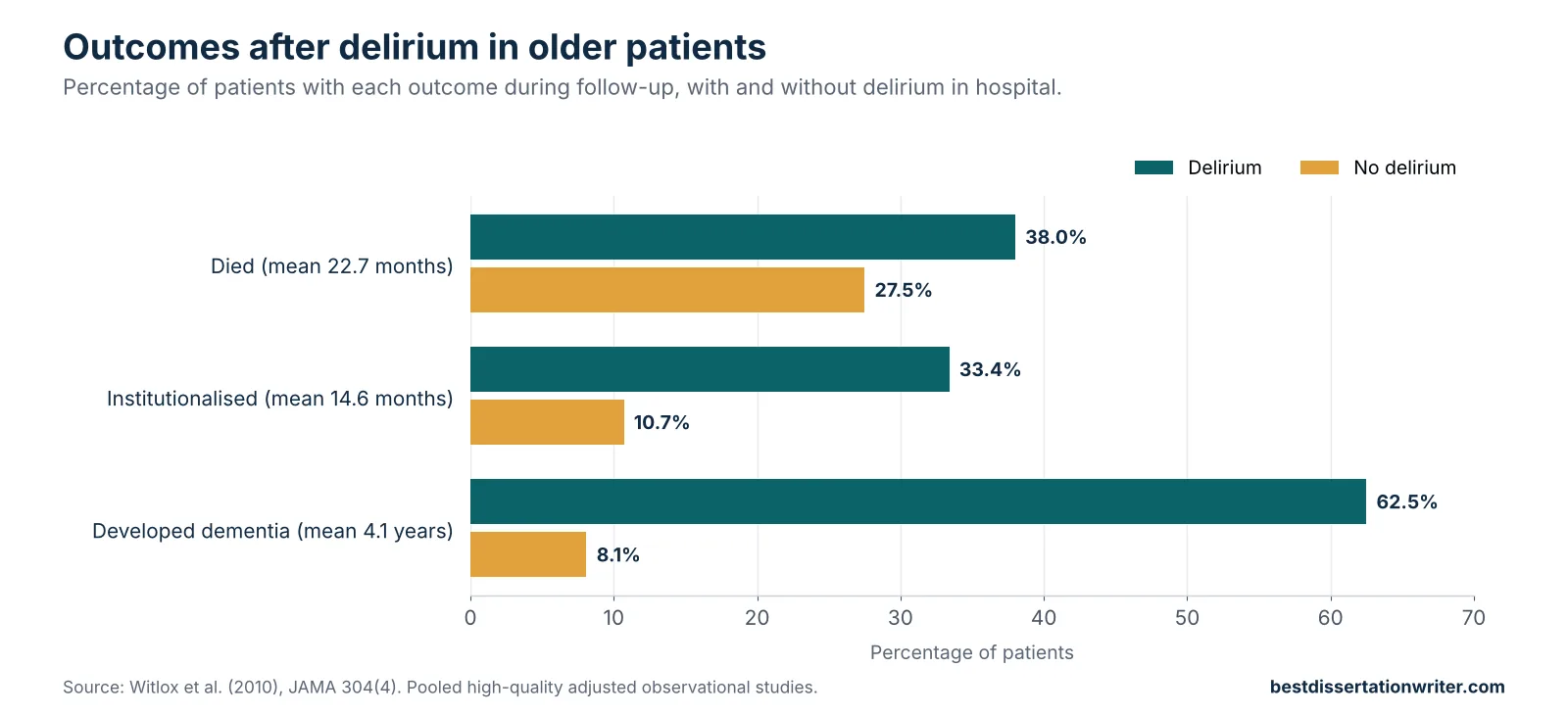
These findings show that delirium in hospitalised older adults is both common and serious. Around one in four medical inpatients is affected, and delirium is independently associated with death, loss of independence and later dementia. Because rates have not fallen over four decades, current practice has not yet succeeded in reducing the burden.
Theme 2: Detecting Hospital Delirium
Shenkin et al. (2019) compared the 4AT with the Confusion Assessment Method in 785 patients aged 70 or older in emergency departments and acute medical wards, against a reference standard diagnosis. Delirium was present in 12.1% of patients. The 4AT had a sensitivity of 76% and specificity of 94%, with an area under the curve of 0.90. The Confusion Assessment Method, as administered in the study, had a sensitivity of only 40% and specificity of 100%.
These findings suggest that the 4AT is a practical tool for routine use. According to its developers, it takes about two minutes and requires no special training, which makes it suitable for busy wards and emergency departments. Its higher sensitivity means that fewer cases of hospital delirium are missed, although positive screens still need clinical assessment to confirm the diagnosis and identify causes.
Theme 3: Multicomponent Delirium Prevention
Inouye et al. (1999) evaluated a multicomponent intervention, later known as the Hospital Elder Life Program, in 852 patients aged 70 or older on general medical wards. Standardised protocols targeted six risk factors: cognitive impairment, sleep deprivation, immobility, visual impairment, hearing impairment and dehydration. Delirium developed in 9.9% of intervention patients compared with 15.0% of matched controls (odds ratio 0.60, 95% CI 0.39 to 0.92). The total number of days with delirium and the number of episodes were also reduced, although severity and recurrence were not.
Burton et al. (2021) reviewed 22 randomised trials of non-pharmacological interventions for delirium prevention in non-intensive care hospital patients. In 14 trials with 3,693 participants, multicomponent interventions reduced delirium incidence from 18.4% to 10.5% (risk ratio 0.57, 95% CI 0.46 to 0.71; moderate certainty), a relative reduction of 43%. Hospital stay may have been shortened by about 1.3 days, while there was little or no effect on inpatient mortality.
Discussion
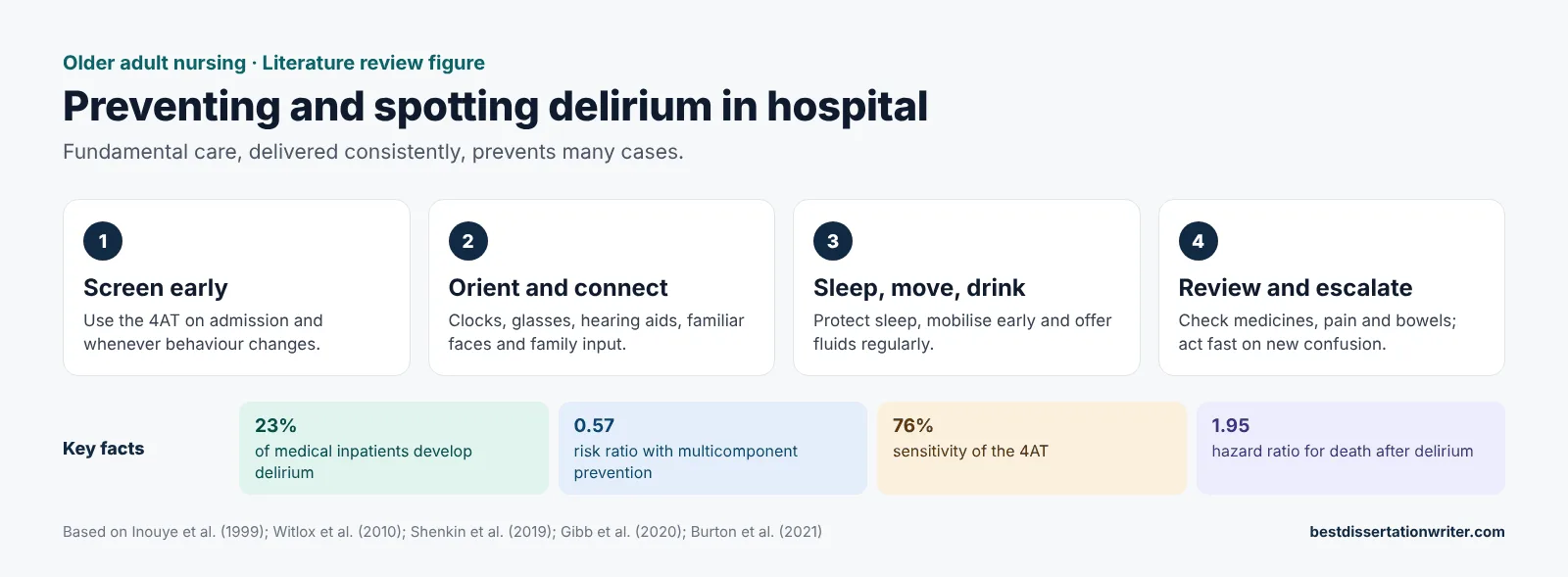
This review shows that delirium in hospitalised older adults affects around a quarter of medical inpatients, is associated with death, institutionalisation and dementia and has not become less common over time. The 4AT offers an accurate and practical way to detect it, and multicomponent delirium prevention reduces incidence by more than 40%. These findings place delirium firmly within the scope of everyday nursing practice.
The components of effective delirium prevention are largely fundamental nursing care: helping patients to stay oriented, encouraging sleep at night, supporting mobility, offering drinks regularly, making sure glasses and hearing aids are used, managing pain and preventing constipation. The challenge is not knowing what to do but ensuring that it is done consistently for every at-risk patient, every day, on busy wards with competing demands.
Routine screening is the starting point. Using the 4AT on admission and whenever a change in behaviour is noticed can help nurses to identify delirium early, including the hypoactive form. Family members are valuable partners because they can tell staff whether the person’s current state is different from normal. Information from families about the person’s usual abilities, routines and preferences also supports person-centred care, linking delirium care to person-centred dementia care.
Documentation and handover support continuity. Recording the 4AT score, the person’s baseline mental state and the elements of the prevention plan allows staff on each shift to notice changes and to continue the same approach. Without this, a patient’s gradual withdrawal may be attributed to tiredness, or preventive measures may lapse when staff change. Simple prompts in care plans and handover tools can help to keep delirium prevention visible.
Medication is a common precipitating factor. Sedatives, anticholinergic drugs and opioids can all contribute to delirium, and reviewing medications on admission and during the stay is an important part of prevention. Nurses can contribute by noticing changes after new drugs are started and by supporting polypharmacy and deprescribing reviews.
Education for staff remains essential. Many nurses and doctors are more familiar with the agitated form of delirium than the quiet, withdrawn form, and some may assume that confusion is a normal part of ageing. Training that covers the subtypes, the use of the 4AT and the components of prevention can change these assumptions and give staff the confidence to act.
Identifying patients at greatest risk allows prevention to be targeted. Frailty, dementia and sensory impairment are strong predisposing factors, and using frailty assessment on admission can help nurses to recognise patients who need a full delirium prevention plan. However, because delirium is common, universal measures such as orientation and hydration benefit all older patients.
Older people with dementia deserve particular attention. Dementia is one of the strongest risk factors for delirium in hospitalised older adults, yet delirium superimposed on dementia is easily attributed to the dementia itself. Asking families whether the person’s confusion is new or worse than usual, and documenting baseline cognition on admission, can help nurses to recognise this combination and respond appropriately.
Recovery from delirium can be slow, and some patients leave hospital with ongoing confusion. Nurses can support recovery by continuing preventive measures after the acute episode, communicating clearly with community teams and care homes at discharge and ensuring that families know what to expect. Follow-up after an episode of delirium in hospitalised older adults is also an opportunity to assess cognition and plan future care.
Organisational factors influence success. Ward moves, especially at night, disrupt orientation and sleep, while noise, poor lighting and a lack of clocks and calendars make it harder for patients to stay oriented. Adequate staffing, trained volunteers and dementia-friendly environments support delivery of preventive care. The Hospital Elder Life Program used trained volunteers to deliver some components, which may be a useful model where staff time is limited.
The evidence base has limitations. The occurrence meta-analysis found possible publication bias, and the outcome meta-analysis drew on observational studies, so associations may be partly explained by unmeasured factors. The Hospital Elder Life Program study was a matched, non-randomised design in one hospital, and the Cochrane review found that certainty for some outcomes was low. This review relied on openly accessible, English-language sources and did not involve formal systematic screening. Future research should examine how to implement delirium prevention reliably on busy wards and how to support recovery after delirium.
Implications of Delirium in Hospitalised Older Adults Evidence for Practice
For nurses, the evidence supports screening older patients with the 4AT on admission and when changes occur, involving families in recognising changes, delivering multicomponent delirium prevention for at-risk patients, avoiding unnecessary ward moves, reviewing medications and escalating concerns promptly so that underlying causes can be treated. The 4AT website provides the tool and guidance on its use.
Managers should ensure that delirium screening and prevention are built into admission documentation and care plans, that staff receive training in recognising hypoactive delirium, that environments support orientation and sleep and that delirium rates are audited. Supporting patients and families after an episode of hospital delirium, including explaining what happened and what to expect, is also an important part of care.
Conclusion
This systematic review examined the frequency, consequences, detection and prevention of delirium in hospitalised older adults. Delirium affects around a quarter of medical inpatients, is associated with death, institutionalisation and dementia and has not declined over time. The 4AT detects delirium accurately, and multicomponent interventions reduce its incidence substantially.
Delirium in hospitalised older adults is common, serious and largely preventable. Through routine screening, consistent delivery of fundamental care and close partnership with families, nurses can reduce its burden and protect older people from its lasting consequences.
References
Burton, J. K., Craig, L., Yong, S. Q., Siddiqi, N., Teale, E. A., Woodhouse, R., Barugh, A. J., Shepherd, A. M., Brunton, A., Freeman, S. C., Sutton, A. J., & Quinn, T. J. (2021). Non-pharmacological interventions for preventing delirium in hospitalised non-ICU patients. Cochrane Database of Systematic Reviews, (11), CD013307. https://doi.org/10.1002/14651858.CD013307.pub3
Gibb, K., Seeley, A., Quinn, T., Siddiqi, N., Shenkin, S., Rockwood, K., & Davis, D. (2020). The consistent burden in published estimates of delirium occurrence in medical inpatients over four decades: A systematic review and meta-analysis study. Age and Ageing, 49(3), 352–360. https://doi.org/10.1093/ageing/afaa040
Inouye, S. K., Bogardus, S. T., Charpentier, P. A., Leo-Summers, L., Acampora, D., Holford, T. R., & Cooney, L. M. (1999). A multicomponent intervention to prevent delirium in hospitalized older patients. New England Journal of Medicine, 340(9), 669–676. https://doi.org/10.1056/NEJM199903043400901
Shenkin, S. D., Fox, C., Godfrey, M., Siddiqi, N., Goodacre, S., Young, J., Anand, A., Gray, A., Hanley, J., MacRaild, A., Steven, J., Black, P. L., Tieges, Z., Boyd, J., Stephen, J., Weir, C. J., & MacLullich, A. M. J. (2019). Delirium detection in older acute medical inpatients: A multicentre prospective comparative diagnostic test accuracy study of the 4AT and the confusion assessment method. BMC Medicine, 17, 138. https://doi.org/10.1186/s12916-019-1367-9
Witlox, J., Eurelings, L. S. M., de Jonghe, J. F. M., Kalisvaart, K. J., Eikelenboom, P., & van Gool, W. A. (2010). Delirium in elderly patients and the risk of postdischarge mortality, institutionalization, and dementia: A meta-analysis. JAMA, 304(4), 443–451. https://doi.org/10.1001/jama.2010.1013
Cite this example
Best Dissertation Writers (2026) Recognition and Management of Delirium in Hospitalised Older Adults: A Systematic Review of Nursing Interventions. Available at: https://bestdissertationwriter.com/delirium-in-hospitalised-older-adults/
Best Dissertation Writers
Get expert help with your nursing literature review
Share your topic and deadline with Best Dissertation Writers and get support tailored to your module brief.