The Effectiveness of Early Warning Scores in Detecting and Responding to Clinical Deterioration in Hospitalised Adult Patients: A Systematic Review
 By Dr. Robertson Prime, Research Fellow
Updated October 12, 2026
17 min read
About 3,400 words
By Dr. Robertson Prime, Research Fellow
Updated October 12, 2026
17 min read
About 3,400 words
In this review
Abstract
Background: Early warning scores convert routine bedside observations into a single value linked to an escalation protocol, and they are now embedded in NHS policy, electronic observation systems and sepsis pathways. Unrecognised clinical deterioration remains one of the most persistent safety problems in acute hospitals, and nurses take most bedside observations.
Aim: This systematic review aimed to examine how effective track and trigger systems such as NEWS and NEWS2 are in detecting clinical deterioration and prompting a timely response in hospitalised adults, and what factors shape their use in nursing practice.
Methods: Evidence was identified through targeted searches of openly accessible bibliographic records, publisher websites and the reference lists of key reviews. Eleven sources published between 2013 and 2023 were included: five systematic or integrative reviews, two large hospital database studies, two qualitative studies, one scoping review and the NEWS2 national guidance, appraised with CASP checklists and synthesised thematically.
Findings: In 35,585 acute medical admissions, NEWS discriminated well between patients who did and did not die within 24 hours (AUROC 0.894), although all 95 development and validation studies appraised in one review were judged at high risk of bias. Randomised evidence from a Cochrane review of 11 studies suggests that early warning and rapid response systems may make little or no difference to hospital mortality or unplanned intensive care admission, with low-certainty evidence. The value of a score depends on the people using it: busy wards, reluctance to escalate moderate scores and anxiety about calling emergency teams weaken the link between detection and treatment.
Conclusion: Nurses should complete full sets of observations, escalate according to NEWS2 thresholds and act on their own concern even when a score is low. Ward managers should protect staffing for observations and build a culture in which escalation is welcomed rather than criticised.
Keywords: early warning scores, NEWS, clinical deterioration, track and trigger
Introduction
This systematic review critically examines recent evidence on early warning scores and its implications for adult nursing practice.
Unrecognised clinical deterioration remains one of the most persistent safety problems in acute hospitals. Patients who suffer cardiac arrest, unplanned admission to intensive care or unexpected death on general wards often show abnormal vital signs in the hours beforehand, yet these changes are not always noticed, recorded or acted on. Nurses are central to closing this gap because they take most bedside observations and are usually the first professionals to see a patient’s condition change.
Early warning scores were introduced to make that recognition more systematic. By converting routine observations into a single value linked to an escalation protocol, they give ward teams a shared language for urgency. Despite their near-universal use in the UK and growing adoption internationally, questions remain about how accurately they predict deterioration, whether they change patient outcomes and how nurses actually use them on busy wards.
The question follows the PICO structure, with hospitalised adults as the population, track and trigger systems as the intervention, usual observation practice as the comparison, and the accuracy of detection, patient outcomes and escalation behaviour as the outcomes.
Review question
In hospitalised adult patients, how effective are early warning scores in detecting clinical deterioration and prompting a timely response, and what factors shape their use in nursing practice?
Background to Early Warning Scores
Track and trigger systems assign a weighted score to each physiological measurement according to how far it departs from a normal range. The individual scores are added together, and predefined thresholds trigger actions such as increasing the frequency of observations, informing a doctor or calling a rapid response team. Early versions varied widely between hospitals, which made audit and staff training difficult and meant that the same patient could be scored differently after moving between organisations.
To address this inconsistency, the Royal College of Physicians (RCP) introduced the National Early Warning Score (NEWS) in 2012 and updated it as NEWS2 in 2017. NEWS2 scores six parameters: respiratory rate, oxygen saturation, systolic blood pressure, pulse rate, level of consciousness or new confusion, and temperature, with two extra points for patients receiving supplemental oxygen (RCP, 2017). A score of 3 in any single parameter prompts urgent review by a ward-based doctor, an aggregate score of 5 or 6 requires an urgent response from a clinician competent in acute illness, and a score of 7 or more calls for an emergency response, usually from a critical care outreach team.
NEWS2 also introduced a second oxygen saturation scale for patients with hypercapnic respiratory failure, whose target saturations are lower, and gave new confusion the same weight as other signs of reduced consciousness. Today, early warning scores are embedded in NHS policy, electronic observation systems and sepsis pathways, so understanding their strengths and limitations is a core competence for every adult nurse.
Search Strategy and Methods
Evidence for this example was identified through targeted searches of openly accessible bibliographic records, publisher websites and the reference lists of key reviews. Search terms combined keywords for the scores (“early warning score*”, “NEWS”, “NEWS2”, “track and trigger”) with terms for deterioration (“clinical deterioration”, “patient deterioration”, “failure to rescue”) and for the ward setting, joined with the Boolean operators AND and OR. A full systematic review for assessment would run the same strategy in CINAHL, PubMed/MEDLINE, the Cochrane Library and Embase and report the number of records screened in a PRISMA flow diagram.
Studies were eligible if they examined early warning scores in adults aged 18 or over admitted to general hospital wards and reported predictive accuracy, patient outcomes, or nurses’ use of and response to the scores. Systematic reviews, cohort studies, trials and qualitative studies were included. Studies conducted only in emergency departments, paediatric or maternity settings, or pre-hospital care were excluded, as were conference abstracts and opinion pieces. National guidance was included to describe the standard against which practice is measured.
Eleven sources published between 2013 and 2023 were included in the final synthesis: five systematic or integrative reviews, two large hospital database studies, two qualitative studies, one scoping review and the NEWS2 national guidance (Table 1). Priority was given to systematic reviews and large studies, so that the synthesis reflects the strongest available evidence rather than isolated small studies.
Each source was appraised with a tool matched to its design, using the Critical Appraisal Skills Programme (CASP) checklists for systematic reviews, cohort studies and qualitative research. Data on design, setting, sample and main findings were extracted into a summary table. Findings were then synthesised thematically by comparing how the studies addressed the accuracy of early warning scores, their effect on outcomes and their use by nurses. Because the included studies used different designs and outcome measures, statistical pooling was not appropriate.
The aim of this approach was to judge not only whether early warning scores work in principle, but whether they work as they are actually used on real hospital wards.
Key Findings on Early Warning Scores
Three themes emerged from the synthesis: the predictive accuracy of the scores, their effect on patient outcomes, and the human and organisational factors that decide whether a high score leads to timely action. Table 1 summarises the included sources.
| Author, year | Design | Setting and sample | Key finding |
|---|---|---|---|
| Smith et al. (2013) | Retrospective database study | 35,585 acute medical admissions; 198,755 observation sets; UK | NEWS discriminated death within 24 hours well (AUROC 0.894) and outperformed 33 other scores for the combined outcome. |
| Pimentel et al. (2019) | Multi-centre database study | 251,266 admissions; five UK hospitals | NEWS2’s second oxygen saturation scale did not improve discrimination and increased alerts when misapplied. |
| Gerry et al. (2020) | Systematic review | 95 development and validation studies | All studies at high risk of bias; missing data and calibration poorly handled. |
| Alam et al. (2014) | Systematic review | 7 controlled studies | Mixed effects on mortality; heterogeneity prevented meta-analysis. |
| McGaughey et al. (2021) | Cochrane systematic review | 11 studies; 282 hospitals | Low-certainty evidence of little or no difference in mortality, ICU admission or adverse events. |
| Downey et al. (2017) | Systematic review and narrative synthesis | 232 studies | Scores give a common language but depend on engagement, timely response and clinical judgement. |
| Massey et al. (2017) | Integrative review | 17 studies | Recognition and response shaped by knowing the patient, education, non-technical skills and support. |
| Wood et al. (2019) | Scoping review | 23 studies | Overreliance on scores and inconsistent escalation were key barriers. |
| Petersen et al. (2017) | Qualitative focus groups | 18 nurses; two acute wards; Denmark | Under-monitoring when busy and reluctance to escalate moderate scores or call the emergency team. |
| Langkjaer et al. (2023) | Qualitative fieldwork | 32 nurses; 15 wards; six hospitals; Denmark | Scores supported risk assessment, but observations were sometimes delegated to less experienced staff. |
| RCP (2017) | National guidance | NHS, UK | Defines NEWS2 parameters, thresholds and clinical responses. |
Theme 1: Predictive Accuracy of Early Warning Scores
The strongest evidence in favour of early warning scores concerns their ability to identify patients at higher risk. In a retrospective study of 35,585 acute medical admissions and 198,755 sets of observations, Smith et al. (2013) found that NEWS discriminated well between patients who did and did not die within 24 hours, with an area under the receiver operating characteristic curve (AUROC) of 0.894. NEWS also outperformed 33 other scores for the combined outcome of cardiac arrest, unanticipated intensive care admission or death. Its ability to predict cardiac arrest alone was more modest (AUROC 0.722), suggesting that some arrests are preceded by little measurable change in vital signs.
Refinements to the score have not always improved its performance. Pimentel et al. (2019) compared NEWS and NEWS2 across 251,266 admissions in five UK hospitals and found that the separate oxygen saturation scale introduced for hypercapnic respiratory failure did not improve discrimination in any risk group. When the scale was applied in error to patients without this condition, it reduced accuracy and roughly doubled the number of alerts, adding to staff workload. A change intended to reduce unnecessary escalation can therefore have the opposite effect if it is used for the wrong patients.
The quality of the research behind these figures is also a concern. Gerry et al. (2020) appraised 95 studies that developed or validated early warning scores and judged every one to be at high risk of bias. Missing data were usually handled by excluding incomplete records, calibration was rarely assessed and samples were often too small. The authors warned that scores may perform worse in everyday practice than published studies suggest. Taken together, the evidence shows that NEWS is a reasonable predictor of short-term mortality, but that its accuracy should not be overstated.
Theme 2: Effect on Patient Outcomes
Predictive accuracy does not automatically translate into better outcomes, because a score helps only if it prompts timely and effective treatment. Alam et al. (2014) reviewed seven controlled studies of early warning scores and found mixed results for mortality: two studies reported a significant reduction, two a non-significant trend towards improved survival and two no difference. Differences in score design, trigger thresholds and study quality meant that the authors could not pool the results or reach a general conclusion.
The most rigorous evidence comes from the Cochrane review by McGaughey et al. (2021), which included 11 studies from 282 hospitals, four of them randomised trials. Based on the randomised evidence, early warning and rapid response systems may make little or no difference to hospital mortality, unplanned intensive care admission, length of stay or unexpected cardiac and respiratory arrest, with the certainty of the evidence rated as low. The authors concluded that no strong recommendation could be made about effectiveness, and they highlighted wide variation in how interventions and outcomes were defined across studies.
These results do not prove that early warning scores are ineffective. Most studies evaluated the score together with a response system, so failures in observation, escalation or treatment could cancel out any benefit from earlier detection. This points to the importance of the third theme: what nurses and teams do once a score has been calculated.
Theme 3: Nurses’ Use of Scores and Escalation
Several reviews show that the value of a score depends heavily on the people using it. Downey et al. (2017) synthesised 232 studies and found that early warning scores provide a common language that improves communication between nurses and doctors. However, their usefulness was limited by intermittent recording, user error and the need for staff engagement and a timely response. The authors concluded that clinical judgement remains essential alongside the score, and that automation and continuous monitoring may address some of these weaknesses.
Wood et al. (2019) reached a similar conclusion in a scoping review of 23 studies, identifying overreliance on numerical scores and inconsistent activation of rapid response teams as key barriers to safe care. Massey et al. (2017), in an integrative review of 17 studies, found that recognising deterioration depended on assessing and knowing the patient, nurses’ education and the equipment available. Responding effectively depended on non-technical skills such as communication and teamwork, access to senior support and nurses’ emotional reactions, including fear of being criticised.
Qualitative studies help explain why these barriers arise. In focus groups with 18 acute care nurses in Denmark, Petersen et al. (2017) found that observations were reduced when wards were busy, that nurses often did not inform doctors about moderate scores because so many patients had them, and that calling the medical emergency team was seen as a last resort, partly because of negative attitudes from some team members. More recently, Langkjaer et al. (2023) observed 32 nurses across 15 wards and found that scores supported risk assessment and critical thinking, but that observations were sometimes delegated to students and healthcare assistants, raising concerns for patient safety during staff shortages.
Discussion
This review shows a clear gap between the statistical performance of early warning scores and their measurable effect on patient outcomes. Large database studies demonstrate that NEWS identifies patients at high risk of death within 24 hours, yet randomised evidence has not shown that introducing scores and response systems reduces mortality or intensive care admission. The most likely explanation is that detection is only the first step in a chain that also includes accurate recording, timely escalation, a competent response and effective treatment. A weakness at any point in this chain limits the benefit of the score, as summarised in Figure 1.
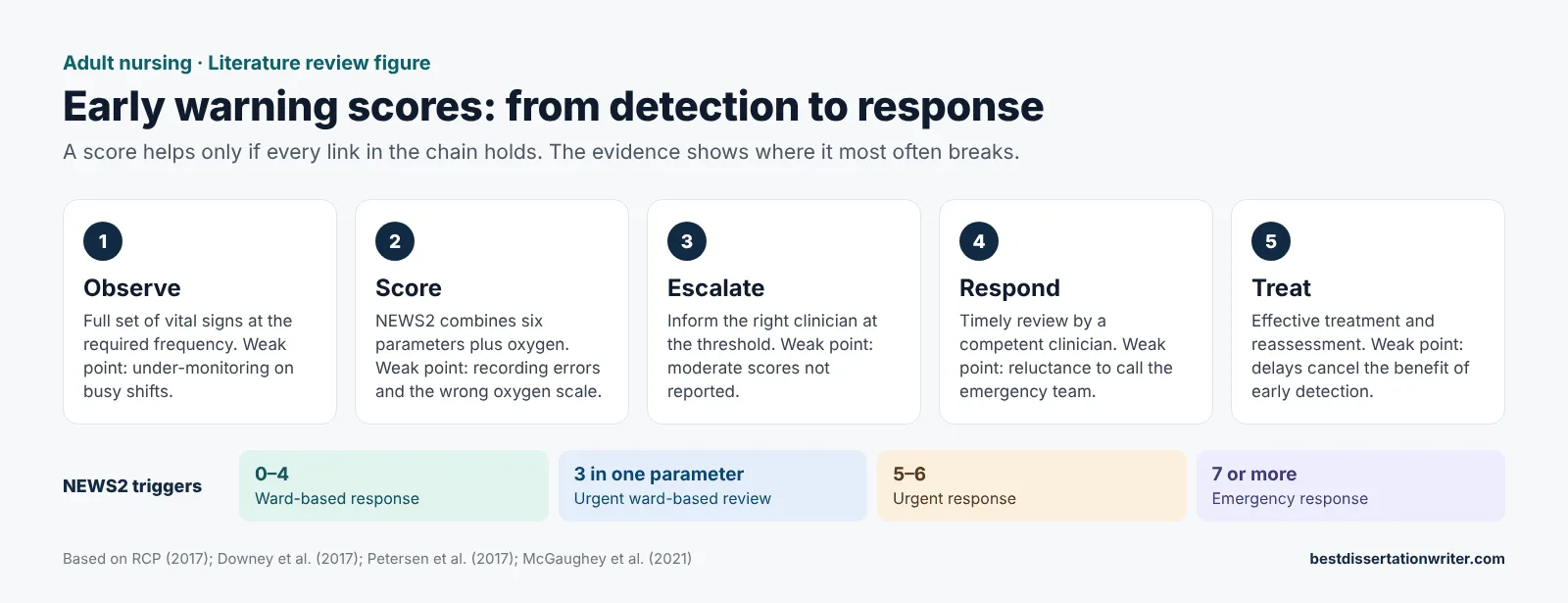
The integrative and qualitative evidence helps to locate those weak points. Under-monitoring during busy shifts, reluctance to escalate moderate scores and anxiety about calling emergency teams all reduce the chance that a high score leads to action. These findings appear across the Danish studies and the international research included in the reviews, which suggests they reflect common features of ward work rather than purely local problems. They also show that clinical deterioration is recognised through a combination of objective data and nurses’ knowledge of the patient, rather than through the number alone.
The evidence base has important limitations. Gerry et al. (2020) rated all development and validation studies at high risk of bias, and the Cochrane review judged most outcome evidence to be of low or very low certainty. Many studies come from single health systems, and the qualitative studies, although detailed, involved small samples from Danish hospitals. This review was also limited to English-language publications and excluded emergency department, paediatric and maternity versions of early warning scores, so its conclusions apply to adult ward patients only.
The findings also have implications for how NEWS2 is implemented. Pimentel et al. (2019) showed that the second oxygen saturation scale performs poorly when it is used for the wrong patients, so wards need clear criteria, agreed with the medical team and documented in the notes, for when it applies. Similarly, the finding that nurses rarely escalate moderate scores (Petersen et al., 2017) suggests that the volume of alerts must stay manageable. If too many patients trigger reviews, staff may start to ignore them, a form of alarm fatigue that undermines the whole system.
Despite these limitations, the findings are consistent enough to guide practice. Early warning scores are best understood as a safety net that standardises observation and communication, not as a substitute for clinical judgement. Their effectiveness depends on reliable observations, a supportive escalation culture and responders who are available and approachable. Future research should evaluate the whole detection and response pathway, report calibration as well as discrimination, and test continuous monitoring and electronic alerts that may close the gaps between manual observations.
Implications of Early Warning Scores Evidence for Practice
For adult nurses, the evidence supports completing full sets of observations at the frequency the score requires, even when wards are busy, and recording them promptly. Nurses should escalate according to NEWS2 thresholds but also act on their own concern when a patient appears unwell despite a low score. Ward managers should protect staffing for observations, avoid delegating risk assessment to staff without suitable training and build a culture in which escalation is welcomed rather than criticised.
Educators should combine training on the score with simulation that develops communication and teamwork, using structured tools such as SBAR to support clear escalation. The same principles of reliable observation and timely action apply to other ward safety priorities, including recognising sepsis with the Sepsis Six care bundle, preventing falls and preventing hospital-acquired pressure ulcers.
Conclusion
This review examined the effectiveness of early warning scores in detecting and responding to clinical deterioration in hospitalised adults. NEWS and NEWS2 identify patients at high short-term risk with good accuracy, but there is little high-certainty evidence that introducing them alone improves mortality or other patient outcomes. The main reason appears to lie in how the scores are used: incomplete observations, delayed escalation and barriers to calling for help weaken the link between detection and treatment.
Nurses can strengthen that link by combining the score with clinical judgement, escalating promptly and speaking up when they are worried. Future gains are more likely to come from strengthening the response to early warning scores than from adding further complexity to the scores themselves. Used in this way, the score remains a valuable part of safe adult nursing care.
References
Alam, N., Hobbelink, E. L., van Tienhoven, A. J., van de Ven, P. M., Jansma, E. P., & Nanayakkara, P. W. B. (2014). The impact of the use of the Early Warning Score (EWS) on patient outcomes: A systematic review. Resuscitation, 85(5), 587–594. https://doi.org/10.1016/j.resuscitation.2014.01.013
Downey, C. L., Tahir, W., Randell, R., Brown, J. M., & Jayne, D. G. (2017). Strengths and limitations of early warning scores: A systematic review and narrative synthesis. International Journal of Nursing Studies, 76, 106–119. https://doi.org/10.1016/j.ijnurstu.2017.09.003
Gerry, S., Bonnici, T., Birks, J., Kirtley, S., Virdee, P. S., Watkinson, P. J., & Collins, G. S. (2020). Early warning scores for detecting deterioration in adult hospital patients: Systematic review and critical appraisal of methodology. BMJ, 369, m1501. https://doi.org/10.1136/bmj.m1501
Langkjaer, C. S., Bundgaard, K., Bunkenborg, G., Nielsen, P. B., Iversen, K. K., Bestle, M. H., & Bove, D. G. (2023). How nurses use National Early Warning Score and Individual Early Warning Score to support their patient risk assessment practice: A fieldwork study. Journal of Advanced Nursing, 79(2), 789–797. https://doi.org/10.1111/jan.15547
Massey, D., Chaboyer, W., & Anderson, V. (2017). What factors influence ward nurses’ recognition of and response to patient deterioration? An integrative review of the literature. Nursing Open, 4(1), 6–23. https://doi.org/10.1002/nop2.53
McGaughey, J., Fergusson, D. A., Van Bogaert, P., & Rose, L. (2021). Early warning systems and rapid response systems for the prevention of patient deterioration on acute adult hospital wards. Cochrane Database of Systematic Reviews, 2021(11), CD005529. https://doi.org/10.1002/14651858.CD005529.pub3
Petersen, J. A., Rasmussen, L. S., & Rydahl-Hansen, S. (2017). Barriers and facilitating factors related to use of early warning score among acute care nurses: A qualitative study. BMC Emergency Medicine, 17, Article 36. https://doi.org/10.1186/s12873-017-0147-0
Pimentel, M. A. F., Redfern, O. C., Gerry, S., Collins, G. S., Malycha, J., Prytherch, D., Schmidt, P. E., Smith, G. B., & Watkinson, P. J. (2019). A comparison of the ability of the National Early Warning Score and the National Early Warning Score 2 to identify patients at risk of in-hospital mortality: A multi-centre database study. Resuscitation, 134, 147–156. https://doi.org/10.1016/j.resuscitation.2018.09.026
Royal College of Physicians. (2017). National Early Warning Score (NEWS) 2: Standardising the assessment of acute-illness severity in the NHS. Updated report of a working party. RCP. https://www.rcp.ac.uk/resources/national-early-warning-score-news-2/
Smith, G. B., Prytherch, D. R., Meredith, P., Schmidt, P. E., & Featherstone, P. I. (2013). The ability of the National Early Warning Score (NEWS) to discriminate patients at risk of early cardiac arrest, unanticipated intensive care unit admission, and death. Resuscitation, 84(4), 465–470. https://doi.org/10.1016/j.resuscitation.2012.12.016
Wood, C., Chaboyer, W., & Carr, P. (2019). How do nurses use early warning scoring systems to detect and act on patient deterioration to ensure patient safety? A scoping review. International Journal of Nursing Studies, 94, 166–178. https://doi.org/10.1016/j.ijnurstu.2019.03.012
Cite this example
Best Dissertation Writers (2026) The Effectiveness of Early Warning Scores in Detecting and Responding to Clinical Deterioration in Hospitalised Adult Patients: A Systematic Review. Available at: https://bestdissertationwriter.com/early-warning-scores-literature-review/
Best Dissertation Writers
Get expert help with your nursing literature review
Share your topic and deadline with Best Dissertation Writers and get support tailored to your module brief.