Nursing Practices for the Prevention and Control of Hospital-Acquired Infections: A Narrative Review
 By Dr. Robertson Prime, Research Fellow
Updated October 12, 2026
15 min read
About 3,100 words
In this review
Abstract
Background: Hospital-acquired infections are among the most common adverse events in hospitals, prolonging admissions and, in the most serious cases, contributing to death. Around 2.6 million new cases of six common infections are estimated to occur each year in the European Union and European Economic Area, and many arise from everyday clinical activities such as touching patients and handling devices.
Aim: This narrative review aimed to identify which nursing practices are supported by evidence for preventing and controlling infection acquired in hospital by adult inpatients, and what influences whether they are carried out consistently.
Methods: Evidence was identified through targeted searches of openly accessible bibliographic records, publisher websites and the reference lists of key reviews. Seven sources published between 2000 and 2018 were included: two clinical guidelines, two systematic reviews, one Cochrane review, one modelling study of disease burden and one landmark intervention study, appraised with checklists drawing on CASP tools and synthesised narratively into themes.
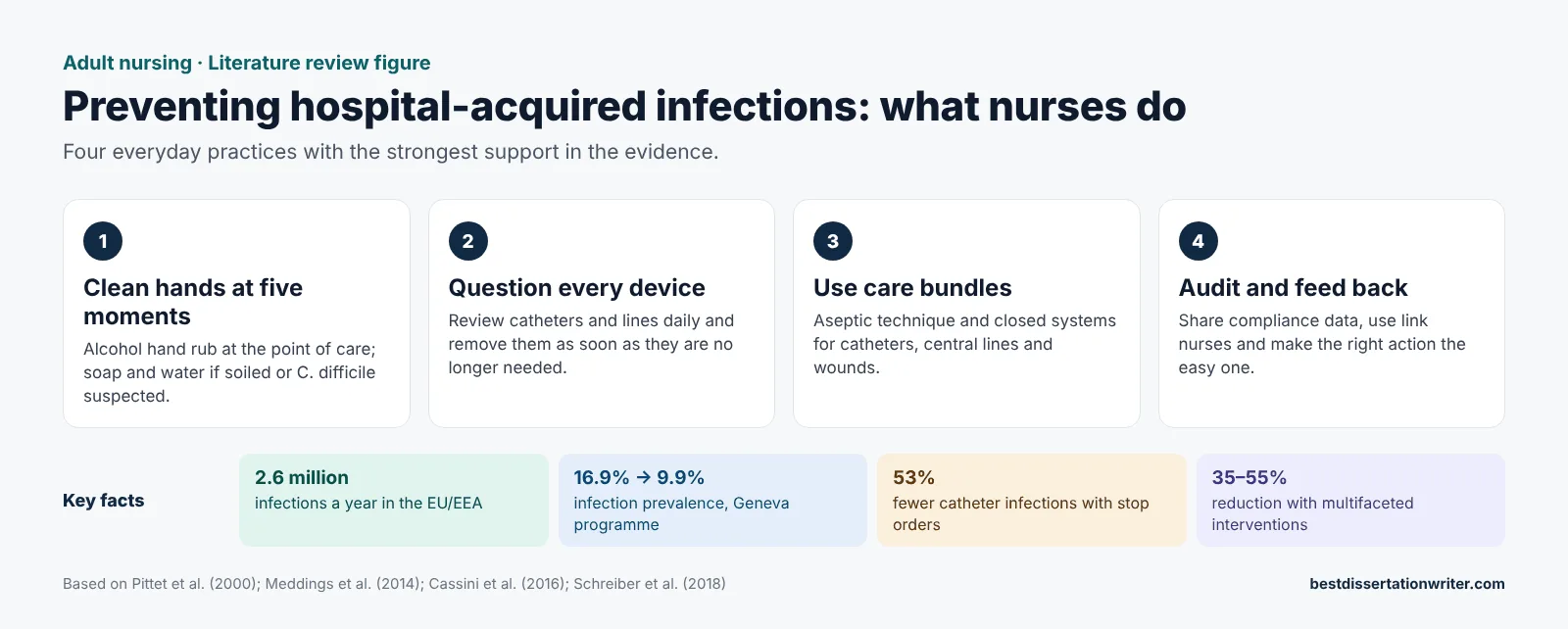
Findings: Hand hygiene is the foundation of prevention: in one hospital-wide programme, improved compliance accompanied a fall in infection prevalence from 16.9% to 9.9%, although a Cochrane review rated the evidence for multimodal hand hygiene interventions as low certainty. Urinary catheter reminders and stop orders reduced catheter-associated urinary tract infections by 53%, and evidence-based bundles were associated with reductions in device-related infections across high-, middle- and low-income countries. Sustaining infection control depends on workload, equipment at the point of care, feedback and leadership.
Conclusion: Nurses should perform hand hygiene at each of the five moments and review every urinary catheter and vascular access device daily, removing it once it is no longer needed. Organisations must provide the staffing, equipment, feedback and leadership that make these practices routine.
Keywords: hospital-acquired infections, hand hygiene, infection control
Introduction
This narrative review critically examines recent evidence on hospital-acquired infections and its implications for adult nursing practice.
Infections that patients develop while receiving care are among the most common adverse events in hospitals. They prolong admissions, expose patients to further treatment and antibiotics, add to the pressure on beds and, in the most serious cases, contribute to death. Because many hospital-acquired infections arise from everyday clinical activities such as touching patients, handling devices and caring for wounds, they are widely regarded as a nursing-sensitive outcome that ward teams can influence directly.
Nurses carry out most of the hands-on care that determines whether micro-organisms are passed between patients, staff and equipment. They insert and maintain urinary catheters and intravenous lines, dress surgical wounds, help patients to wash and eat, and decide when isolation is needed. National guidance therefore places nurses at the centre of efforts to prevent hospital-acquired infections, and nursing compliance with simple measures such as hand hygiene is closely monitored in most hospitals.
A narrative design was chosen because the question draws on different kinds of evidence, including burden-of-disease estimates, national guidelines, Cochrane reviews and large intervention studies, which are best brought together through critical discussion rather than statistical pooling.
Review question
Which nursing practices are supported by evidence for preventing and controlling hospital-acquired infections in adult inpatients, and what factors influence whether they are carried out consistently?
Background to Hospital-Acquired Infections
A healthcare-associated infection is one that was neither present nor incubating when the patient was admitted and that develops as a result of care. The most common types are pneumonia, urinary tract infections, surgical site infections, bloodstream infections and gastrointestinal infections such as Clostridioides difficile. Many are linked to invasive devices, which bypass the body’s natural defences and offer a route for bacteria to enter tissues or the bloodstream.
The scale of the problem is considerable. Using data from European point-prevalence surveys, Cassini et al. (2016) estimated that around 2.6 million new cases of six common hospital-acquired infections occur each year in the European Union and European Economic Area. Together these infections accounted for 501 disability-adjusted life years per 100,000 population, a burden greater than that of 32 other communicable diseases combined, including influenza and tuberculosis. Pneumonia and bloodstream infections caused more than 60% of this burden.
These figures matter for nursing because a substantial share of hospital-acquired infections is considered preventable. Patients in adult wards are increasingly old, frail and living with long-term conditions such as diabetes, which raise their risk of infection and of poor outcomes once infected. Rising antimicrobial resistance makes prevention even more important, since infections that cannot be treated easily must be stopped before they start. Effective infection control is therefore a core part of safe nursing care rather than a specialist task.
Search Strategy and Methods
Evidence for this example was identified through targeted searches of openly accessible bibliographic records, publisher websites and the reference lists of key reviews. Search terms combined keywords for infection (“hospital-acquired infections”, “healthcare-associated infection”, “nosocomial infection”, “catheter-associated urinary tract infection”) with terms for prevention (“hand hygiene”, “infection control”, “prevention”, “nurs*”), joined with the Boolean operators AND and OR. A full narrative review for assessment would run the same strategy in CINAHL, PubMed/MEDLINE, the Cochrane Library and Embase and report the number of records screened in a PRISMA flow diagram.
Sources were eligible if they addressed the burden, prevention or control of hospital-acquired infections in adult inpatients and had clear relevance to nursing practice. Priority was given to systematic reviews, national and international guidelines and large intervention studies. Studies confined to neonatal or paediatric units, laboratory studies of disinfectants and studies of antibiotic prescribing without a nursing component were excluded.
Seven sources published between 2000 and 2018 were included: two clinical guidelines, two systematic reviews, one Cochrane review, one modelling study of disease burden and one landmark intervention study (Table 1). The older studies were retained deliberately because they continue to shape current guidance on hospital-acquired infections. Each source was appraised with a checklist matched to its design, drawing on the Critical Appraisal Skills Programme (CASP) tools, and findings were grouped into themes through a process of comparison and synthesis.
Key Findings on Hospital-Acquired Infections
Three themes were identified: hand hygiene as the foundation of prevention, the role of device care and care bundles, and the organisational and behavioural factors that determine whether infection control measures are sustained. Table 1 summarises the included sources.
| Author, year | Design | Setting and sample | Key finding |
|---|---|---|---|
| Pittet et al. (2000) | Before-and-after intervention study | Teaching hospital, Geneva | Hand hygiene compliance rose from 47.6% to 66.2%; infection prevalence fell from 16.9% to 9.9%; MRSA transmission halved. |
| World Health Organization (2009) | International guideline | All healthcare settings | Five moments for hand hygiene; alcohol hand rub preferred; multimodal improvement strategy. |
| Loveday et al. (2014) | National guideline (epic3) | NHS hospitals, England | Standard precautions and evidence-based care of urinary catheters and central venous devices. |
| Meddings et al. (2014) | Integrative review | 30 studies of hospitalised adults | Catheter reminders and stop orders reduced catheter-associated urinary tract infections by 53%. |
| Cassini et al. (2016) | Burden-of-disease modelling study | EU/EEA point-prevalence data | About 2.6 million infections a year; 501 DALYs per 100,000; burden greater than 32 other communicable diseases. |
| Gould et al. (2017) | Cochrane systematic review | 26 studies of hand hygiene interventions | Multimodal interventions may slightly improve compliance (low certainty); effects on infection uncertain. |
| Schreiber et al. (2018) | Systematic review and meta-analysis | 144 studies, 2005–2016 | Multifaceted interventions associated with 35–55% fewer device-related and surgical site infections. |
Theme 1: Hand Hygiene as the Foundation of Prevention
Contaminated hands are the main route by which micro-organisms are transferred between patients in hospital. The World Health Organization (2009) guidelines set out five moments for hand hygiene: before touching a patient, before a clean or aseptic procedure, after a risk of exposure to body fluids, after touching a patient and after touching the patient’s surroundings. The guidelines recommend alcohol-based hand rub as the preferred method in most situations because it is faster, more effective and better tolerated than soap and water, which remain necessary when hands are visibly soiled or when Clostridioides difficile is suspected.
The most influential evidence that improving hand hygiene can reduce hospital-acquired infections comes from the hospital-wide programme reported by Pittet et al. (2000) in Geneva. The programme combined bedside alcohol hand rub, posters, education and regular feedback of compliance rates. Over four years, compliance rose from 47.6% to 66.2%, the prevalence of hospital-acquired infections fell from 16.9% to 9.9% and transmission of meticillin-resistant Staphylococcus aureus (MRSA) halved. Use of hand rub increased more than fourfold. This study laid the foundation for the multimodal approach later adopted by the World Health Organization.
However, the Cochrane review by Gould et al. (2017) offers a more cautious picture. Across 26 studies, multimodal interventions combining education, reminders and feedback may slightly improve hand hygiene compliance, but the certainty of the evidence was low. Making alcohol hand rub available at the point of care probably improves compliance slightly. Few studies measured infection rates, and their effects were small and uncertain. The review shows that compliance is hard to change and that the link between compliance and fewer hospital-acquired infections is difficult to demonstrate in rigorous trials.
Theme 2: Preventing Hospital-Acquired Infections Linked to Devices
Invasive devices are a major source of risk, and their care is largely a nursing responsibility. The epic3 national guidelines for NHS hospitals in England provide evidence-based recommendations on standard infection control precautions, the care of short-term urinary catheters and the care of central venous access devices (Loveday et al., 2014). Key nursing recommendations include using catheters only when clinically necessary, maintaining a closed drainage system, using aseptic technique when accessing lines and reviewing the need for every device daily.
Catheter-associated urinary tract infections illustrate how simple nursing actions can reduce harm. In an integrative review of 30 studies, Meddings et al. (2014) found that urinary catheter reminders and stop orders, which prompt staff to remove catheters that are no longer needed, reduced the rate of catheter-associated urinary tract infections by 53%. Several of these interventions were nurse-led, allowing nurses to remove catheters against agreed criteria without waiting for a medical decision. Reducing catheter use did not lead to significant harm, such as increased reinsertion.
Evidence from multifaceted programmes extends this finding to other device-related infections. In a systematic review and meta-analysis of 144 studies, Schreiber et al. (2018) found that evidence-based interventions, usually delivered as bundles of several measures, were associated with reductions of around 35% to 55% in the rates of catheter-associated urinary tract infections, central line-associated bloodstream infections, ventilator-associated pneumonia and surgical site infections. The reductions were seen in high-, middle- and low-income countries alike, suggesting that a large proportion of hospital-acquired infections remains preventable regardless of resources.
Theme 3: Sustaining Infection Control in Everyday Practice
The sources consistently show that knowing what to do is not enough. Infection control depends on staff carrying out simple measures reliably, many times a day, often under pressure. In the Geneva programme, compliance was lowest during periods of high workload and in intensive care, where the number of hand hygiene opportunities per hour was greatest (Pittet et al., 2000). Making the right action easy, by placing hand rub at the point of care and reducing unnecessary devices, appears more effective than relying on memory and goodwill alone.
Feedback, leadership and a culture of shared responsibility were recurring features of successful programmes. The World Health Organization (2009) multimodal strategy combines system change, training, monitoring and feedback, reminders in the workplace and an institutional safety climate. Gould et al. (2017) noted that the most successful interventions often included several of these elements, although the contribution of each one could not be separated. Nurses who act as infection prevention link practitioners can help to translate these strategies into ward routines.
The quality of the evidence also limits what can be concluded. Schreiber et al. (2018) judged almost all included studies to be at high risk of bias, mainly because most used before-and-after designs without control groups. Such designs can overstate the effect of an intervention, because infection rates may fall for other reasons, such as wider national campaigns or changes in surveillance. These limitations do not mean that prevention is ineffective, but they suggest that the size of the benefit is uncertain.
Patients and families can also contribute to prevention. The World Health Organization (2009) encourages healthcare workers to explain why hand hygiene matters and to welcome reminders from patients, although many patients feel uncomfortable challenging staff. Simple steps, such as offering patients hand wipes before meals, explaining why a catheter is being removed and showing visitors where to find hand rub, extend infection prevention beyond the actions of staff and help to reduce hospital-acquired infections across the whole ward.
Discussion
This review confirms that hospital-acquired infections remain a large and largely preventable cause of harm. The burden estimates of Cassini et al. (2016) show that these infections affect population health on a scale comparable to well-known infectious diseases, while the meta-analysis by Schreiber et al. (2018) suggests that between a third and a half of device-related infections could be avoided. Many of the measures responsible for this reduction, from hand hygiene to the timely removal of catheters, fall within the scope of everyday nursing practice.
A tension runs through the evidence. Observational programmes such as that of Pittet et al. (2000) report striking falls in infection, whereas the more rigorous Cochrane review by Gould et al. (2017) finds only modest improvements in compliance and uncertain effects on infection. One explanation is that successful programmes change many things at once, including culture, leadership and equipment, which trials of single interventions cannot capture. Another is that before-and-after studies may exaggerate benefit. Nurses should therefore view multimodal approaches as the best available option, while recognising that the evidence is not conclusive.
The findings also highlight the importance of the environment in which nurses work. Compliance falls when workload is high, when equipment is not available at the bedside and when staff do not receive feedback. This suggests that preventing hospital-acquired infections is not only a matter of individual knowledge or conscientiousness, but also of staffing, ward design and organisational priorities. Blaming individual nurses for low compliance is unlikely to work if the system makes good practice difficult.
The evidence on devices offers a useful lesson for other areas of practice. Removing an unnecessary catheter is a single, clearly defined action that eliminates a risk entirely, which may explain why stop orders and nurse-led removal produced such consistent results (Meddings et al., 2014). By contrast, hand hygiene must be repeated dozens of times each shift and is harder to sustain. Strategies that reduce the number of opportunities for error, alongside those that improve compliance, may therefore offer the most reliable route to fewer hospital-acquired infections in busy adult wards.
The evidence base has limitations. Several key sources are more than a decade old, many intervention studies came from intensive care rather than general wards, and few measured patient outcomes beyond infection rates. This review relied on openly accessible, English-language sources, and a formal systematic search might identify further studies. Future research should use controlled designs on general adult wards and examine which components of multimodal programmes matter most for preventing hospital-acquired infections.
Implications of Hospital-Acquired Infections Evidence for Practice
For adult nurses, the evidence on hospital-acquired infections supports a small number of reliable habits. Nurses should perform hand hygiene at each of the five moments, using alcohol hand rub unless hands are soiled or diarrhoeal illness is suspected, and should ensure that hand rub is available at every bedside. Every urinary catheter and vascular access device should be reviewed daily, removed as soon as it is no longer needed and cared for using aseptic technique. Nurses should also use standard precautions, isolate patients promptly when indicated and teach patients and visitors about hand hygiene.
Ward managers should support these practices with regular audit and feedback, nurse-led catheter removal protocols, adequate staffing and access to infection prevention teams. Infection prevention links closely with other safety priorities: accurate antibiotic administration depends on avoiding medication administration errors, and patients with poorly controlled type 2 diabetes are at higher risk of wound and urinary infections. Preventing infection also supports recovery and mobility, reducing the risk of hospital-acquired pressure ulcers and helping staff to recognise deterioration early through early warning scores.
Conclusion
This narrative review examined nursing practices for preventing and controlling hospital-acquired infections in adult inpatients. The evidence shows that these infections cause a substantial burden of harm and that a large proportion may be preventable through hand hygiene, careful device management and multifaceted programmes. Although the strength of the evidence varies and many studies are at high risk of bias, the measures involved are simple, low-cost and within the control of nursing teams.
Reducing hospital-acquired infections depends less on new technology than on making proven practices reliable. Nurses can lead this by performing hand hygiene consistently, questioning the need for every device and promoting a ward culture in which infection control is everyone’s responsibility. Organisations, in turn, must provide the staffing, equipment, feedback and leadership that allow good practice to become routine.
References
Cassini, A., Plachouras, D., Eckmanns, T., Abu Sin, M., Blank, H.-P., Ducomble, T., Haller, S., Harder, T., Klingeberg, A., Sixtensson, M., Velasco, E., Weiß, B., Kramarz, P., Monnet, D. L., Kretzschmar, M. E., & Suetens, C. (2016). Burden of six healthcare-associated infections on European population health: Estimating incidence-based disability-adjusted life years through a population prevalence-based modelling study. PLoS Medicine, 13(10), e1002150. https://doi.org/10.1371/journal.pmed.1002150
Gould, D. J., Moralejo, D., Drey, N., Chudleigh, J. H., & Taljaard, M. (2017). Interventions to improve hand hygiene compliance in patient care. Cochrane Database of Systematic Reviews, (9), CD005186. https://doi.org/10.1002/14651858.CD005186.pub4
Loveday, H. P., Wilson, J. A., Pratt, R. J., Golsorkhi, M., Tingle, A., Bak, A., Browne, J., Prieto, J., & Wilcox, M. (2014). epic3: National evidence-based guidelines for preventing healthcare-associated infections in NHS hospitals in England. Journal of Hospital Infection, 86(Suppl. 1), S1–S70. https://doi.org/10.1016/S0195-6701(13)60012-2
Meddings, J., Rogers, M. A. M., Krein, S. L., Fakih, M. G., Olmsted, R. N., & Saint, S. (2014). Reducing unnecessary urinary catheter use and other strategies to prevent catheter-associated urinary tract infection: An integrative review. BMJ Quality & Safety, 23(4), 277–289. https://doi.org/10.1136/bmjqs-2012-001774
Pittet, D., Hugonnet, S., Harbarth, S., Mourouga, P., Sauvan, V., Touveneau, S., & Perneger, T. V. (2000). Effectiveness of a hospital-wide programme to improve compliance with hand hygiene. The Lancet, 356(9238), 1307–1312. https://doi.org/10.1016/S0140-6736(00)02814-2
Schreiber, P. W., Sax, H., Wolfensberger, A., Clack, L., Kuster, S. P., & Swissnoso. (2018). The preventable proportion of healthcare-associated infections 2005–2016: Systematic review and meta-analysis. Infection Control & Hospital Epidemiology, 39(11), 1277–1295. https://doi.org/10.1017/ice.2018.183
World Health Organization. (2009). WHO guidelines on hand hygiene in health care: First global patient safety challenge. Clean care is safer care. https://www.who.int/publications/i/item/9789241597906
Cite this example
Best Dissertation Writers (2026) Nursing Practices for the Prevention and Control of Hospital-Acquired Infections: A Narrative Review. Available at: https://bestdissertationwriter.com/hospital-acquired-infections-review/
Best Dissertation Writers
Get expert help with your nursing literature review
Share your topic and deadline with Best Dissertation Writers and get support tailored to your module brief.