Nurse-Led Approaches to the Management of Type 2 Diabetes in Adult Hospital Settings: A Scoping Review
 By Dr. Robertson Prime, Research Fellow
Updated October 12, 2026
14 min read
About 2,800 words
In this review
Abstract
Background: Most people with type 2 diabetes in hospital are admitted for another reason, and acute illness, changes in eating and new medicines make blood glucose harder to control. In England, 18% of hospital beds were occupied by a person with diabetes in 2019, and nurses carry out much of the day-to-day management of their care.
Aim: This scoping review aimed to map what is known about nurse-led approaches to managing the condition in adult hospital settings and what gaps remain.
Methods: Evidence was identified through targeted searches of openly accessible bibliographic records, publisher websites and the reference lists of key reviews. Following the Arksey and O’Malley framework, six sources published between 2002 and 2021 were included: three systematic reviews, one national audit, one large randomised controlled trial and one observational cohort study. In keeping with scoping methods, formal quality appraisal was not used to exclude sources, but the strengths and limitations of each were noted, and data were charted and grouped into themes.
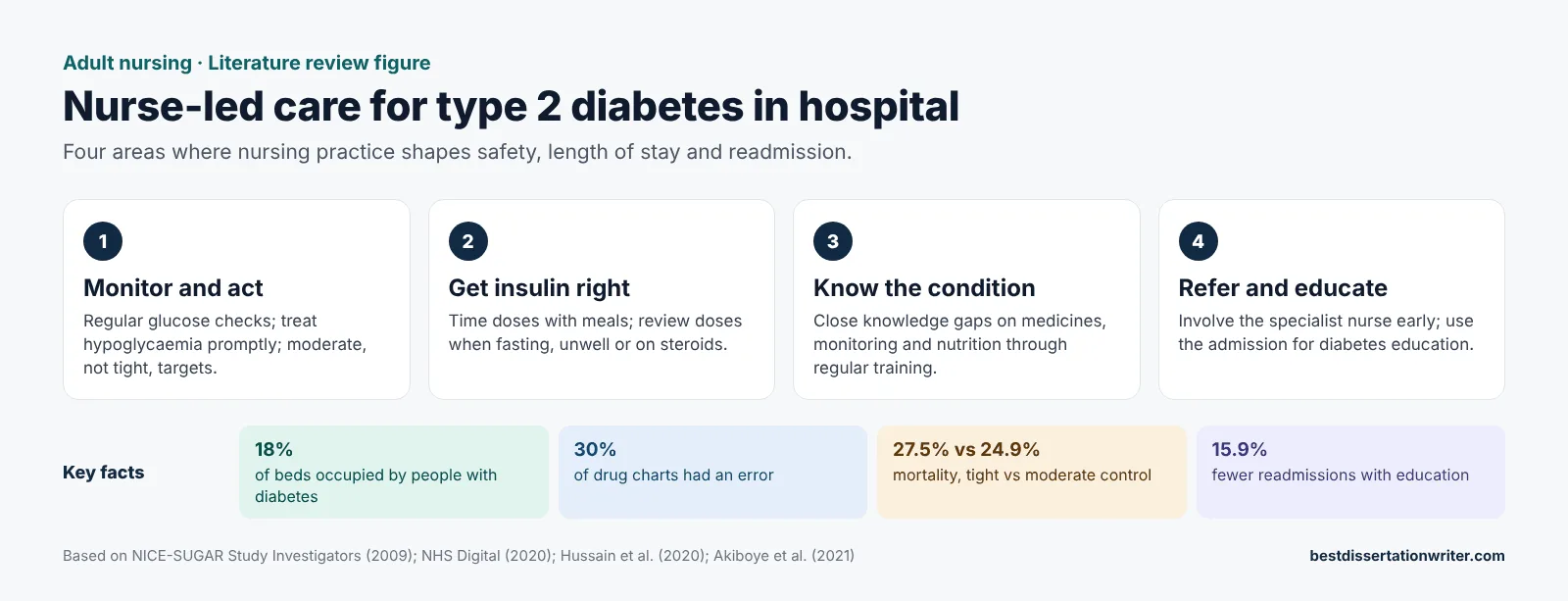
Findings: Safe inpatient glycaemic control prioritises avoiding hypoglycaemia: in the NICE-SUGAR trial, intensive glucose control increased 90-day mortality (27.5% compared with 24.9%). Ward nurses showed widespread and persistent gaps in diabetes knowledge, particularly about medicines, monitoring, nutrition and complications. Diabetes inpatient specialist nurses were associated with shorter hospital stays, and inpatient diabetes education with a 15.9% lower readmission rate over twelve months.
Conclusion: Nurses should monitor blood glucose regularly, prevent and promptly treat hypoglycaemia, time insulin with meals and use each admission for diabetes education. Organisations need to invest in ward nurse training and specialist staffing.
Keywords: type 2 diabetes, inpatient glycaemic control, diabetes education
Introduction
This scoping review critically examines recent evidence on type 2 diabetes and its implications for adult nursing practice.
Diabetes is now one of the most common conditions seen among hospital inpatients, yet most people with diabetes are not admitted because of it. They come into hospital for surgery, infections, heart failure, strokes or falls, and their diabetes must be managed alongside the main reason for admission. Acute illness, changes in eating, new medicines such as steroids and the disruption of normal routines all make blood glucose harder to control, and both high and low glucose levels can delay recovery.
Nurses are responsible for much of the day-to-day management of type 2 diabetes in hospital. They monitor capillary blood glucose, give insulin and oral medicines, recognise and treat hypoglycaemia, coordinate meals with medication, check feet and prepare patients for discharge. Diabetes inpatient specialist nurses also advise ward teams and support patients with complex needs. The quality of this care has a direct effect on patient safety, length of stay and the patient’s confidence in managing their condition after discharge.
The question is timely because the number of adults living with type 2 diabetes continues to rise, and hospitals will see more of these patients each year. A scoping design was chosen because the topic spans different types of evidence, including national audits, trials of glucose targets, reviews of specialist nursing and reviews of inpatient education, and the aim is to map this evidence rather than to answer a narrow effectiveness question.
Review question
What is known about nurse-led approaches to managing type 2 diabetes in adult hospital settings, and what gaps remain?
Background to Type 2 Diabetes
Type 2 diabetes is a long-term condition in which the body does not use insulin effectively and, over time, does not produce enough of it. It accounts for around 90% of all diabetes in adults and is closely linked to age, excess weight and physical inactivity. Many people manage it with diet and oral medicines, but a growing proportion use insulin or newer injectable therapies, which increases the complexity of their care when they become unwell.
The number of hospital inpatients living with diabetes has grown steadily. The National Diabetes Inpatient Audit for England found that 18% of hospital beds were occupied by a person with diabetes in 2019, up from 14% in 2010 (NHS Digital, 2020). Since type 2 diabetes is by far the most common form, most of these patients will have this form of the condition. The audit also showed that care often falls short, with around 30% of drug charts containing at least one medication error and 18% containing an insulin error.
Raised blood glucose in hospital is associated with poor outcomes. In a study of more than 2,000 adult admissions, Umpierrez et al. (2002) found that hyperglycaemia was present in 38% of patients. In-hospital mortality was 16% among patients with newly identified hyperglycaemia, compared with 3% among those with known diabetes and 1.7% among those with normal glucose levels. These findings highlighted the importance of recognising and managing raised glucose in all inpatients, not only those with a known diagnosis of type 2 diabetes.
Search Strategy and Methods
Evidence for this example was identified through targeted searches of openly accessible bibliographic records, publisher websites and the reference lists of key reviews. Search terms combined keywords for the condition (“type 2 diabetes”, “diabetes mellitus”, “hyperglycaemia”) with terms for the setting and the nursing role (“inpatient*”, “hospital*”, “nurs*”, “diabetes specialist nurse”, “inpatient glycaemic control”, “diabetes education”), joined with the Boolean operators AND and OR. A full scoping review for assessment would run the same strategy in CINAHL, PubMed/MEDLINE, the Cochrane Library and Embase and report the number of records screened in a PRISMA flow diagram.
Following the Arksey and O’Malley framework for scoping reviews, sources were included if they addressed the management of diabetes in adult hospital inpatients and had relevance to nursing care. Because type 2 diabetes accounts for most inpatients with diabetes, sources covering diabetes in general were included where their findings applied to this group. Grey literature such as national audits was included because it provides the most current picture of inpatient care for type 2 diabetes in England. Sources focused on children, pregnancy, type 1 diabetes alone or outpatient care were excluded.
Six sources published between 2002 and 2021 were included: three systematic reviews, one national audit, one large randomised controlled trial and one observational cohort study (Table 1). In keeping with scoping review methods, formal quality appraisal was not used to exclude sources, but the strengths and limitations of each were noted. Data were charted on source type, setting, focus and main findings, and then grouped into themes.
Key Findings on Type 2 Diabetes
Three themes were identified: achieving safe inpatient glycaemic control, the knowledge and skills of ward nurses, and the contribution of specialist nurses and diabetes education. Table 1 summarises the included sources.
| Author, year | Design | Setting and sample | Key finding |
|---|---|---|---|
| Umpierrez et al. (2002) | Retrospective cohort study | 2,030 adult admissions; one US hospital | Hyperglycaemia in 38% of admissions; mortality 16% with new hyperglycaemia vs 1.7% with normal glucose. |
| NICE-SUGAR Study Investigators (2009) | Randomised controlled trial | 6,104 critically ill adults; multicentre | Intensive glucose control increased 90-day mortality (27.5% vs 24.9%) and severe hypoglycaemia. |
| Alotaibi et al. (2016) | Integrative review | 25 studies of nurses’ diabetes knowledge | Widespread, persistent gaps in knowledge of medicines, monitoring, nutrition and complications. |
| NHS Digital (2020) | National audit (NaDIA 2019) | Hospitals in England | 18% of beds occupied by people with diabetes; 30% of charts with an error; 7% had severe hypoglycaemia. |
| Hussain et al. (2020) | Systematic review | 8 studies, 3,828 participants | Inpatient diabetes education linked to shorter stays and 15.9% fewer readmissions. |
| Akiboye et al. (2021) | Systematic review | 10 studies of diabetes specialist nurses | Specialist nurses linked to stays shorter by 0.5–3 days and fewer drug errors; no effect on mortality. |
Theme 1: Safe Inpatient Glycaemic Control
The evidence shows that the goal of inpatient glycaemic control is safety rather than tight targets. The NICE-SUGAR trial randomised 6,104 critically ill adults to intensive glucose control, with a target of 4.5 to 6.0 mmol/L, or conventional control, with a target below 10 mmol/L (NICE-SUGAR Study Investigators, 2009). Mortality at 90 days was higher in the intensive group (27.5% compared with 24.9%), and severe hypoglycaemia occurred in 6.8% of patients in the intensive group compared with 0.5% in the conventional group.
Although the trial took place in intensive care, its findings have shaped practice on general wards, where moderate targets are now recommended for most patients. For nurses caring for people with type 2 diabetes, this means that preventing hypoglycaemia is as important as treating high glucose. The national audit found that 7% of inpatients with diabetes experienced a severe hypoglycaemic episode during the final week of their stay, although this had fallen from 12% in 2010 (NHS Digital, 2020).
Hypoglycaemia in hospital is often linked to factors that nurses can influence, such as delayed or missed meals, insulin given without food, failure to adjust doses when patients stop eating and poor communication between shifts. The high rate of insulin errors reported by NHS Digital (2020) shows that safe inpatient glycaemic control depends on accurate prescribing, administration and monitoring, and that each of these steps involves nursing judgement.
Theme 2: Nurses’ Knowledge and Skills in Type 2 Diabetes
Several sources point to gaps in the diabetes knowledge of ward nurses. In an integrative review of 25 studies from different countries, Alotaibi et al. (2016) found widespread and persistent deficiencies in nurses’ knowledge of diabetes, particularly in relation to medicines, blood glucose monitoring, nutrition and complications. The authors identified several barriers to learning, including limited continuing education, heavy workloads and the absence of diabetes content in some nursing curricula.
These gaps are reflected in patients’ experiences. In the national audit, only around 64% of inpatients with diabetes felt that staff knew enough about diabetes to meet their needs, a figure that has barely changed since 2010 (NHS Digital, 2020). Many patients with type 2 diabetes have managed their condition for years and may know more about their own treatment than the staff caring for them, which can undermine trust when routines are changed without explanation.
Monitoring practice is another area where skills matter. Capillary blood glucose testing is often delegated to healthcare assistants, but nurses remain responsible for interpreting results, recognising trends and acting on them. Readings that are recorded but not acted on, or that are taken at the wrong time in relation to meals and insulin, offer little protection. Clear escalation thresholds and documentation that links each reading to a decision can help ensure that monitoring leads to timely action rather than simply generating numbers on a chart.
Knowledge gaps are especially important as treatment for type 2 diabetes becomes more complex. Newer medicines, insulin regimens and technologies require nurses to understand how each one works and when doses need adjusting during acute illness or fasting. Without this knowledge, nurses may withhold doses unnecessarily or give them when they should be omitted, both of which can cause harm.
Theme 3: Specialist Nurses and Diabetes Education
Diabetes inpatient specialist nurses offer one response to these gaps. In a systematic review of ten studies, Akiboye et al. (2021) found that introducing a specialist nurse or team was associated with shorter hospital stays, usually by between half a day and three days, and reductions in bed occupancy. Single studies reported fewer drug errors, better patient knowledge and satisfaction, and improved glucose control after discharge. However, most studies used before-and-after designs, and no effect on mortality was found.
Inpatient diabetes education may also improve outcomes. In a systematic review of eight studies involving 3,828 participants, Hussain et al. (2020) found that patients who received diabetes education during their admission had shorter hospital stays and a 15.9% lower readmission rate over twelve months than those who did not. A possible reduction in mortality was not statistically significant. Education was usually delivered by diabetes specialist nurses or educators, suggesting that the specialist and education roles work together.
Despite this evidence, access to specialist support remains uneven. The national audit found that 18% of hospital sites in England had no diabetes inpatient specialist nurse in 2019, although this was an improvement on earlier years (NHS Digital, 2020). Where specialist teams are limited, ward nurses must provide more of the education and day-to-day decision-making for patients with type 2 diabetes.
Discussion
This scoping review shows that the management of type 2 diabetes in hospital has shifted from an emphasis on tight glucose targets towards safety, particularly the prevention of hypoglycaemia and medication errors. The NICE-SUGAR trial demonstrated that aggressive control can cause harm, and national audit data show that hypoglycaemia and insulin errors remain common. For nurses, this means that careful monitoring, accurate administration and the coordination of insulin with meals are central to safe care.
The evidence also suggests that specialist nursing and education improve outcomes that matter to hospitals and patients, particularly length of stay and readmission. However, these benefits depend on adequate specialist staffing, which remains uneven, and on ward nurses having enough knowledge to deliver safe care between specialist visits. The persistent knowledge gaps identified by Alotaibi et al. (2016) suggest that relying on specialist teams alone is insufficient; every adult nurse needs core competence in managing diabetes.
A further point concerns the patient’s own expertise. Many people with type 2 diabetes manage their condition independently at home, and hospital admission can remove this control. Supporting self-management in hospital, where it is safe to do so, may improve satisfaction and help patients to resume their routines after discharge.
In practice, this might include allowing patients to test their own glucose or adjust their own insulin under agreed conditions, with nurses checking and recording the results. Such arrangements require clear policies and good communication, but they recognise that the patient is often the person who knows their own condition best. Where self-management is not possible, explaining why treatment has changed, and agreeing how the patient will return to their usual routine before discharge, can preserve trust and reduce confusion once the patient is home. Diabetes education delivered during the admission provides an opportunity to address problems that contributed to the admission and to prepare patients for changes in treatment.
The evidence base has important limitations. Much of it comes from observational designs and from the United Kingdom and United States, and several sources included all types of diabetes without reporting results separately for type 2 diabetes. The NICE-SUGAR trial took place in intensive care, so its application to general wards involves some extrapolation. This review relied on openly accessible, English-language sources. Future research should test nurse-led interventions on general wards using controlled designs and report outcomes specifically for patients with type 2 diabetes.
Implications of Type 2 Diabetes Evidence for Practice
For adult nurses, the evidence on type 2 diabetes supports regular blood glucose monitoring for all inpatients with diabetes, prompt treatment of hypoglycaemia according to local protocols and careful timing of insulin with meals. Nurses should check that insulin doses are reviewed when patients are fasting, unwell or taking steroids, and should involve patients in decisions about their own treatment. Referring patients with complex needs to the diabetes inpatient specialist team early, and using every admission as an opportunity for diabetes education, can shorten stays and reduce readmissions.
Managers and educators should provide regular diabetes training for ward nurses, ensure that specialist nursing support is available and audit insulin errors and hypoglycaemia. Good diabetes care also supports surgical recovery on enhanced recovery pathways, where glucose control affects wound healing, and it should be built into discharge planning so that patients leave with a clear plan. Safe insulin practice is closely linked to preventing medication administration errors, and good glucose control reduces the risk of hospital-acquired infections.
Conclusion
This scoping review mapped the evidence on nurse-led approaches to managing type 2 diabetes in adult hospital settings. Inpatients with diabetes now occupy almost one in five hospital beds, and many experience medication errors, insulin errors or hypoglycaemia during their stay. The evidence supports moderate rather than tight glucose targets, highlights persistent gaps in ward nurses’ knowledge and suggests that specialist nurses and inpatient education can shorten stays and reduce readmissions.
Improving care for people with type 2 diabetes in hospital requires both specialist expertise and confident, knowledgeable ward nurses. Nurses can make a significant difference by monitoring carefully, preventing hypoglycaemia, respecting patients’ own expertise and using each admission to strengthen self-management, supported by organisations that invest in training and specialist staffing.
References
Akiboye, F., Sihre, H. K., Al Mulhem, M., Rayman, G., Nirantharakumar, K., & Adderley, N. J. (2021). Impact of diabetes specialist nurses on inpatient care: A systematic review. Diabetic Medicine, 38(9), e14573. https://doi.org/10.1111/dme.14573
Alotaibi, A., Al-Ganmi, A., Gholizadeh, L., & Perry, L. (2016). Diabetes knowledge of nurses in different countries: An integrative review. Nurse Education Today, 39, 32–49. https://doi.org/10.1016/j.nedt.2016.01.017
Hussain, Z., Alkharaiji, M., & Idris, I. (2020). Evaluating the effect of inpatient diabetes education on length of stay, readmission rates and mortality rates: A systematic review. British Journal of Diabetes, 20(2), 96–103. https://doi.org/10.15277/bjd.2020.256
NHS Digital. (2020). National Diabetes Inpatient Audit (NaDIA), England, 2019. Healthcare Quality Improvement Partnership. https://www.hqip.org.uk/wp-content/uploads/2020/11/REF165a_NaDIA2019_Full-Report-v1.0_snapshot_FINAL-13-11-2020.pdf
NICE-SUGAR Study Investigators. (2009). Intensive versus conventional glucose control in critically ill patients. New England Journal of Medicine, 360(13), 1283–1297. https://doi.org/10.1056/NEJMoa0810625
Umpierrez, G. E., Isaacs, S. D., Bazargan, N., You, X., Thaler, L. M., & Kitabchi, A. E. (2002). Hyperglycemia: An independent marker of in-hospital mortality in patients with undiagnosed diabetes. The Journal of Clinical Endocrinology & Metabolism, 87(3), 978–982. https://doi.org/10.1210/jcem.87.3.8341
Cite this example
Best Dissertation Writers (2026) Nurse-Led Approaches to the Management of Type 2 Diabetes in Adult Hospital Settings: A Scoping Review. Available at: https://bestdissertationwriter.com/type-2-diabetes-literature-review/
Best Dissertation Writers
Get expert help with your nursing literature review
Share your topic and deadline with Best Dissertation Writers and get support tailored to your module brief.