Accuracy and Reliability of Fluid Balance Monitoring in Adult Inpatients: An Integrative Review of Nursing Practice
 By Dr. Robertson Prime, Research Fellow
Updated October 12, 2026
15 min read
About 2,900 words
By Dr. Robertson Prime, Research Fellow
Updated October 12, 2026
15 min read
About 2,900 words
In this review
Abstract
Background: Fluid balance monitoring is a core nursing responsibility, because doctors rely on fluid balance chart totals to prescribe intravenous fluids and diuretics. Too little fluid can lead to low blood pressure and acute kidney injury, while too much can cause breathing difficulties and swelling, yet charts are widely reported to be incomplete and unreliable.
Aim: This integrative review aimed to examine how accurate and reliable the recording of fluid intake and output is in adult inpatients, what factors affect its quality, and what helps to improve it.
Methods: Evidence was identified through targeted searches of openly accessible bibliographic records, publisher websites and the reference lists of key reviews. Six sources published between 2013 and 2022 were included: one national guideline, two systematic reviews, one large audit, one quality improvement project and one measurement study. Following the Whittemore and Knafl framework, each source was appraised with a tool matched to its design and findings were synthesised thematically.
Findings: In an audit of 2,199 inpatients, 77% of chart entries were accurate overall, but only 21% of output entries were accurate, often because of unquantified entries such as “voided in toilet”. Visual estimates of fluid volume varied widely among nurses, patients and volunteers, and daily fluid balance totals frequently did not match changes in body weight. A ward improvement project raised doctor–nurse agreement on who needed monitoring from 52.5% to 77%, but correct chart completion improved only slightly.
Conclusion: Nurses should start monitoring only when there is a clear clinical reason, measure rather than estimate intake and output, and interpret charts alongside weight, observations and blood results. Equipment and training are needed to make accurate recording possible.
Keywords: fluid balance monitoring, intake and output, monitoring accuracy
Introduction
This integrative review critically examines recent evidence on fluid balance monitoring and its implications for adult nursing practice.
Water makes up around 60% of the adult body, and keeping the volume and distribution of body fluid within safe limits is essential for the heart, kidneys, brain and other organs to function. Illness, surgery, fever, vomiting, diarrhoea, bleeding and intravenous therapy can all upset this balance. Too little fluid can lead to low blood pressure, acute kidney injury and confusion, while too much can cause breathing difficulties, swelling and impaired wound healing.
In hospitals, the main tool for tracking fluid status is the fluid balance chart, on which staff record all fluid going into and coming out of the patient. Nurses and healthcare assistants complete most of these records, and nurses interpret them, alert medical staff to problems and use them to guide care. Doctors rely on the totals to prescribe intravenous fluids and diuretics. Accurate fluid balance monitoring is therefore a core nursing responsibility with direct consequences for patient safety.
Despite its importance, fluid balance monitoring is widely reported to be incomplete and unreliable. An integrative design was chosen because the evidence spans national guidance, systematic reviews, audits, quality improvement projects and measurement studies, which need to be combined to answer this question.
Review question
How accurate and reliable is fluid balance monitoring in adult inpatients, what factors affect its quality, and what helps to improve it?
Background to Fluid Balance Monitoring
Fluid balance is the difference between fluid intake and fluid output over a defined period, usually 24 hours. Intake includes oral fluids, intravenous fluids, enteral feeds and fluids given with medicines, while output includes urine, vomit, stool, wound and drain losses. Insensible losses through the skin and breathing, usually estimated at several hundred millilitres a day, are not measured directly. A positive balance means the patient has taken in more than they have lost, and a negative balance the reverse.
National guidance highlights the role of fluid balance monitoring in safe intravenous therapy. The National Institute for Health and Care Excellence (NICE, 2013) recommends that fluid and electrolyte needs are assessed using trends in early warning scores, fluid balance charts and weight, and that patients receiving intravenous fluids are reassessed at least daily, including review of their fluid balance charts, and weighed twice weekly. The guideline also introduced the “5 Rs” of fluid prescribing: resuscitation, routine maintenance, replacement, redistribution and reassessment.
The consequences of getting fluid balance wrong are significant. In a systematic review of critically ill and injured patients, Malbrain et al. (2014) reported that a persistently positive fluid balance and fluid overload were associated with worse outcomes, including higher mortality, and recommended that fluid is actively removed once the acute phase has passed. Although that review focused on intensive care, fluid overload and dehydration are also common problems on general wards, where monitoring is often less intensive. On these wards, fluid balance monitoring is frequently the only systematic record of a patient’s fluid status between blood tests, which makes its accuracy especially important.
Search Strategy and Methods
Evidence for this example was identified through targeted searches of openly accessible bibliographic records, publisher websites and the reference lists of key reviews. Search terms combined keywords for the practice (“fluid balance monitoring”, “fluid balance chart*”, “intake and output”) with terms for quality and nursing (“accuracy”, “monitoring accuracy”, “documentation”, “nurs*”, “audit”, “weight”), joined with the Boolean operators AND and OR. A full integrative review for assessment would run the same strategy in CINAHL, PubMed/MEDLINE, the Cochrane Library and Embase and report the number of records screened in a PRISMA flow diagram.
Sources were eligible if they examined the accuracy, completion or use of fluid balance records in adult inpatients, or provided national guidance or outcome evidence relevant to fluid balance monitoring. Audits, quality improvement reports, measurement studies, systematic reviews and guidelines were included. Because fluid balance monitoring is carried out mainly by ward staff, sources reporting nursing or healthcare assistant practice were prioritised. Studies limited to children, renal dialysis units or laboratory measures of hydration were excluded.
Six sources published between 2013 and 2022 were included: one national guideline, two systematic reviews, one large audit, one quality improvement project and one measurement study (Table 1). Following the Whittemore and Knafl framework for integrative reviews, each source was appraised with a tool matched to its design, data were extracted into a matrix and findings were compared and grouped into themes.
Key Findings on Fluid Balance Monitoring
Three themes were identified: the accuracy and completeness of fluid balance charts, the reliability of measurements and their agreement with body weight, and the strategies tested to improve practice. Table 1 summarises the included sources, and Figure 1 presents the accuracy data reported in the audit and quality improvement studies.
| Author, year | Design | Setting and sample | Key finding |
|---|---|---|---|
| NICE (2013) | National guideline (CG174) | Adults receiving IV fluids in hospital; England | Assess fluid needs using early warning scores, fluid balance charts and weight; review daily and weigh twice weekly. |
| Malbrain et al. (2014) | Systematic review | Critically ill and injured adults | Fluid overload and persistently positive balance associated with worse outcomes, including mortality. |
| Jeyapala et al. (2015) | Quality improvement project | Two acute medical wards | Only 25.4% of charts correctly completed at baseline; small, non-significant improvement after interventions. |
| Davies et al. (2019) | Systematic review | 13 cohort studies of critically ill adults | Fluid balance totals often disagreed with weight change; both methods together recommended. |
| Lim et al. (2021) | Retrospective audit | 2,199 adult inpatients; Singapore | 77% of entries accurate overall; intake 100% accurate but output only 21%; 22% had no indication. |
| Michelsen et al. (2022) | Measurement study | Nurses, patients and healthy persons; clinical setting | High variation in visual estimates of fluid volume; container and fluid type affected estimates. |
Theme 1: Accuracy and Completeness of Fluid Balance Charts
The largest study included was an audit of 2,199 adult inpatients in a tertiary hospital in Singapore (Lim et al., 2021). Around two-thirds of patients were on intake and output monitoring, and most of these charts had been started by nurses rather than prescribed by doctors. Over one-fifth of monitored patients had no clear clinical indication for monitoring. Overall, 77% of chart entries were accurate, but while oral and intravenous intake were recorded accurately, only 21% of output entries were accurate. The most common problem was unquantified entries such as “voided in toilet”.
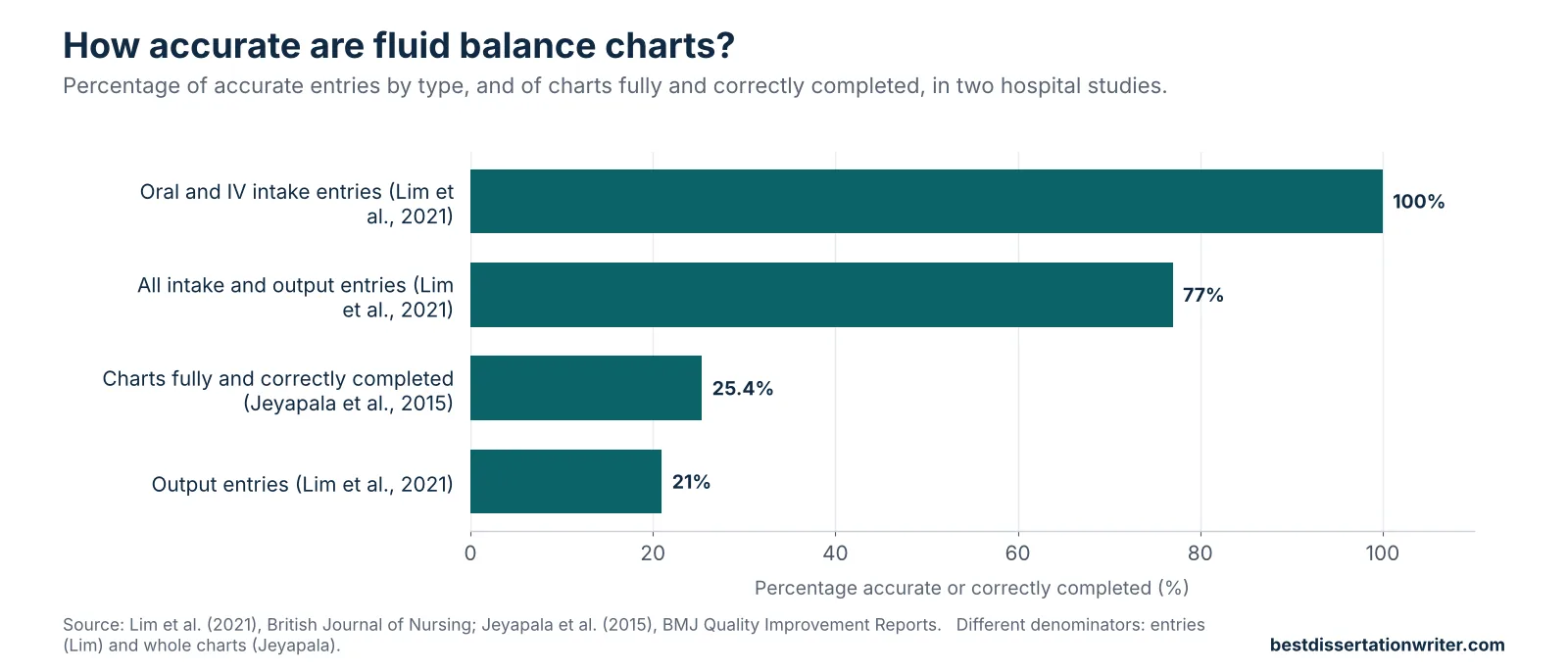
A quality improvement project on two acute medical wards found even lower standards of completion (Jeyapala et al., 2015). At baseline, an average of only 25.4% of fluid balance charts were filled in correctly, and doctors and nurses agreed on which patients needed monitoring in only around half of cases. These findings suggest that charts are often started without a clear purpose and then completed inconsistently, which undermines their value for clinical decisions.
Several practical reasons for poor completion emerge from these studies. Charts are often kept at the end of the bed or in a separate folder, so drinks and toilet visits are missed when staff are busy. Patients who are independent may not know they are being monitored and may empty urinals or use the toilet without telling staff. Shift changes create further gaps when running totals are not handed over. These everyday barriers help to explain why fluid balance monitoring is so often incomplete, even when staff understand its purpose.
Taken together, these studies show that the weakest point in fluid balance monitoring is the measurement of output. Recording a cup of tea or an intravenous infusion is relatively straightforward, whereas measuring urine for a mobile patient who uses the toilet independently is much harder. When output is not measured, the calculated balance appears falsely positive, which may lead to unnecessary diuretics or to dehydration being missed.
Theme 2: Reliability of Measurement and Agreement With Body Weight
Even when entries are made, the volumes recorded may be inaccurate. In a measurement study, Michelsen et al. (2022) asked nurses, patients and healthy volunteers to estimate fluid volumes in a clinical setting and found high variation in all three groups. The type of container and the type of fluid affected how volumes were perceived, suggesting that visual estimation is an unreliable basis for intake and output records. This suggests that, in everyday ward practice, monitoring accuracy is likely to depend heavily on using graduated containers and standard cup sizes, rather than on staff experience, and that patients asked to record their own drinks need clear guidance on the volumes of the cups and jugs they use.
Body weight is often proposed as a more objective measure of fluid status, since a change of one kilogram over a short period largely reflects a change of about one litre of body water. In a systematic review of 13 cohort studies in critically ill adults, Davies et al. (2019) found that daily fluid balance totals frequently did not match changes in body weight. Fluid balance charting was affected by inaccuracies, while weight was difficult to measure consistently. The authors concluded that using both methods together is more likely to estimate fluid status effectively than relying on either alone.
These findings raise important questions about monitoring accuracy. If charts are incomplete and estimated volumes vary widely, the cumulative balance over several days may be substantially wrong. This matters most for patients at high risk, such as those with heart failure, kidney injury or sepsis, for whom treatment decisions depend on knowing whether they are dry or overloaded. In these groups, inaccurate fluid balance monitoring can lead directly to inappropriate prescribing of fluids or diuretics.
Theme 3: Strategies to Improve Fluid Balance Monitoring
Attempts to improve practice have had mixed results. Jeyapala et al. (2015) introduced several changes, including education for nurses and healthcare assistants, magnets on the ward board to show which patients needed monitoring and a simplified chart. Agreement between doctors and nurses on which patients required monitoring improved from 52.5% to 77%, and the number of unnecessary charts fell. However, the proportion of charts completed correctly improved only slightly, from 25.4% to 28.4%, which was not statistically significant.
Lim et al. (2021) recommended clearer criteria for starting and stopping monitoring, so that effort is focused on patients who genuinely need it, and better methods for measuring output, such as urinals and measuring jugs for patients who are able to use them. NICE (2013) similarly emphasises daily reassessment and the combined use of charts, weight and clinical assessment. These recommendations suggest that improvement depends on reducing unnecessary charts, making measurement easier and integrating charts with other indicators of fluid status.

Discussion
This review shows that fluid balance monitoring in adult inpatients is frequently incomplete and inaccurate, particularly in the measurement of output. Studies from different countries report similar problems, suggesting that these are not local failures but features of how fluid balance charts are used across hospitals. Since prescribing decisions often rely on the calculated balance, these inaccuracies have direct implications for patient safety.
A recurring finding is that charts are often started without a clear indication or purpose. When many patients are on monitoring, staff time is spread thinly and the importance of each chart is diluted. Focusing fluid balance monitoring on patients who need it, with a clear reason recorded and a plan for when to stop, may improve both completion and accuracy. This is consistent with the improved doctor–nurse agreement achieved by Jeyapala et al. (2015) using simple visual prompts.
The evidence also suggests that no single measure is sufficient. Fluid balance charts, body weight, clinical examination, early warning scores and blood results each provide part of the picture, and combining them gives a more reliable assessment (Davies et al., 2019; NICE, 2013). Nurses are well placed to bring these sources together, but they need time, equipment such as accurate scales and measuring jugs, and training in how to interpret the information.
Electronic records offer a possible way forward. Electronic charts can total intake and output automatically, prompt staff when entries are overdue and display trends alongside weight and blood results. However, the audit by Lim et al. (2021) was carried out using electronic charts and still found poor accuracy for output, which shows that technology alone does not solve the underlying problem of measuring what patients actually pass. Improving fluid balance monitoring therefore depends on practical changes at the bedside as well as on better recording systems.
The evidence base has limitations. Several studies were single-site audits or small quality improvement projects, the systematic review focused on critically ill patients and the measurement study did not report results separately for ward nurses. Few studies linked chart accuracy to patient outcomes. This review relied on openly accessible, English-language sources. Future research should test interventions to improve output measurement on general wards and examine the effect of better fluid balance monitoring on outcomes such as acute kidney injury.
Implications of Fluid Balance Monitoring Evidence for Practice
For adult nurses, the evidence supports starting fluid balance monitoring only when there is a clear clinical reason, recording the indication and reviewing the need daily. All intake and output should be measured rather than estimated, using measuring jugs, urinals and graduated containers, and entries such as “voided in toilet” should be avoided. Patients who are able should be taught to help record their own intake and output. Charts should be totalled at the agreed time, and abnormal balances escalated alongside weight, observations and blood results.
Ward managers should ensure that equipment is available and that staff receive training on monitoring accuracy. Accurate charts are essential when caring for patients with sepsis, where urine output is part of the Sepsis Six, and for patients with chronic obstructive pulmonary disease and heart failure who are at risk of fluid overload. Explaining fluid targets to patients also supports medication adherence with diuretics after discharge, and early detection of deterioration links fluid balance to early warning scores.
Conclusion
This integrative review examined the accuracy and reliability of fluid balance monitoring in adult inpatients. Charts are often started without a clear purpose and completed inconsistently, and output is the least accurately recorded element. Visual estimates of volume are unreliable, and fluid balance totals often fail to match changes in body weight.
Improving fluid balance monitoring requires focusing on patients who need it, measuring rather than estimating, combining charts with weight and clinical assessment, and providing the equipment and training that make accurate recording possible. Nurses are central to each of these steps, and better charts can support safer fluid prescribing and earlier recognition of deterioration.
References
Davies, H., Leslie, G., Jacob, E., & Morgan, D. (2019). Estimation of body fluid status by fluid balance and body weight in critically ill adult patients: A systematic review. Worldviews on Evidence-Based Nursing, 16(6), 470–477. https://doi.org/10.1111/wvn.12394
Jeyapala, S., Gerth, A., Patel, A., & Syed, N. (2015). Improving fluid balance monitoring on the wards. BMJ Quality Improvement Reports, 4(1), u209890.w4102. https://doi.org/10.1136/bmjquality.u209890.w4102
Lim, S. H., Lim, M. L., Aloweni, F. A. B., & Ang, S. Y. (2021). Audit of the appropriateness and accuracy of fluid intake and output monitoring: Experience in a tertiary hospital. British Journal of Nursing, 30(11), 660–664. https://doi.org/10.12968/bjon.2021.30.11.660
Malbrain, M. L. N. G., Marik, P. E., Witters, I., Cordemans, C., Kirkpatrick, A. W., Roberts, D. J., & Van Regenmortel, N. (2014). Fluid overload, de-resuscitation, and outcomes in critically ill or injured patients: A systematic review with suggestions for clinical practice. Anaesthesiology Intensive Therapy, 46(5), 361–380. https://doi.org/10.5603/AIT.2014.0060
Michelsen, C. F., Svendsen, M. B. S., Bagger, M. L., & Konradsen, H. (2022). A study on accuracy and precision of fluid volume measurements by nurses, patients and healthy persons in a clinical setting. Nursing Open, 9(2), 1303–1310. https://doi.org/10.1002/nop2.1173
National Institute for Health and Care Excellence. (2013). Intravenous fluid therapy in adults in hospital (Clinical guideline CG174; updated 2017). https://www.nice.org.uk/guidance/cg174
Cite this example
Best Dissertation Writers (2026) Accuracy and Reliability of Fluid Balance Monitoring in Adult Inpatients: An Integrative Review of Nursing Practice. Available at: https://bestdissertationwriter.com/fluid-balance-monitoring-review-review/
Best Dissertation Writers
Get expert help with your nursing literature review
Share your topic and deadline with Best Dissertation Writers and get support tailored to your module brief.