The Role of Nurses in Recognising and Responding to Child Abuse and Neglect: A Review of the Literature
 By Dr. Robertson Prime, Research Fellow
Updated October 12, 2026
14 min read
About 2,800 words
In this review
Abstract
Background: Child abuse and neglect is common but largely hidden, because maltreatment usually happens in private and often remains unrecognised unless someone outside the family notices and acts. Nurses such as health visitors, school nurses and emergency department nurses see children regularly and are often the first to notice an unexplained injury, a worrying interaction or a withdrawn child.
Aim: This narrative review aimed to explore what is known about the role of nurses in recognising and responding to maltreatment, and what helps or hinders them in fulfilling this safeguarding role.
Methods: Evidence was identified through targeted searches of openly accessible bibliographic records, publisher websites and the reference lists of key reviews. Five sources published between 2009 and 2026 were included: an epidemiological review, a national guideline, an international fact sheet, an integrative review and a scoping review of nursing practice, each appraised with an appropriate checklist and synthesised narratively into themes.
Findings: In high-income countries, an estimated 4% to 16% of children are physically abused and around one in ten are neglected or psychologically abused each year, yet substantiated maltreatment is less than a tenth of the self-reported burden. An integrative review of 60 international studies found that nurses frequently lacked the knowledge, skills and support to act on concerns, needed validation of their concerns and struggled to balance surveillance with support for families. A scoping review of 41 studies found that most nursing child protection work was preventive, through home visiting and parent education, with positive but variable effects.
Conclusion: Nurses should consider maltreatment when presentations do not fit the explanation, document concerns accurately and discuss them promptly with safeguarding leads without waiting for proof. Organisations should back training with supervision, clear procedures and feedback on referrals.
Keywords: child abuse and neglect, safeguarding, child protection
Introduction
This narrative review critically examines recent evidence on child abuse and neglect and its implications for children’s nursing practice.
Every year, large numbers of children experience physical, emotional or sexual abuse, or are neglected by the adults responsible for their care. The effects can be immediate, such as injuries, hunger or fear, and long-lasting, including mental health problems, difficulties in learning and relationships, risky behaviours and poorer physical health in adulthood. Because maltreatment usually happens in private, it often remains hidden unless someone outside the family notices and acts.
Nurses are among the professionals most likely to encounter children who are being harmed. Health visitors, school nurses, emergency department nurses and children’s nurses in hospital all see children regularly, often in situations where families are under stress. Safeguarding is therefore a core responsibility for every nurse who works with children or their parents, and nurses are often the first to notice an unexplained injury, a worrying interaction or a child who seems withdrawn.
Responding well is as important as recognising concerns. Nurses must decide what to record, whom to tell and how to continue caring for the child and family while concerns are explored. Poorly handled responses can leave children at risk or damage relationships with families who need support, so understanding the evidence on nurses’ roles in child abuse and neglect is essential for safe practice.
A narrative design was chosen because the evidence includes epidemiological reviews, national guidance and integrative and scoping reviews of nursing practice, which are best brought together through critical discussion.
Review question
What is known about the role of nurses in recognising and responding to child abuse and neglect, and what helps or hinders them in fulfilling this role?
Background to Child Abuse and Neglect
The World Health Organization (2026) defines child maltreatment as the abuse and neglect of children under 18 years of age, including physical, emotional and sexual abuse, neglect and exploitation that harms or could harm a child’s health, survival, development or dignity within a relationship of responsibility, trust or power. It estimates that around six in ten children under five regularly experience physical punishment or psychological violence from caregivers, and that around one in five women and one in seven men report having been sexually abused as children.
In high-income countries, Gilbert et al. (2009) estimated that between 4% and 16% of children are physically abused each year, and that around one in ten are neglected or psychologically abused. Yet the proportion of children whose maltreatment is substantiated by child protection agencies is less than a tenth of the self-reported burden. This gap shows that most cases of child abuse and neglect never come to the attention of services, highlighting the importance of professionals who can recognise and respond to concerns.
National guidance supports professionals in this task. In England, the National Institute for Health and Care Excellence (NICE, 2009) guideline on child maltreatment describes clinical features and circumstances that should prompt professionals to consider or suspect maltreatment, such as injuries inconsistent with the explanation given, delays in seeking care and concerning interactions between parent and child. The guideline emphasises that professionals do not need proof of child abuse and neglect before acting; they need to recognise when to consider maltreatment and follow local safeguarding procedures.
Risk factors at the level of the family and community are well recognised, including parental mental illness, substance misuse, domestic violence, poverty and social isolation. These factors do not mean that a child is being harmed, but they increase vulnerability and may signal that a family needs additional support. Nurses who understand these influences can offer early help and refer families to services before difficulties escalate, while remaining alert to signs that a child is already at risk.
Search Strategy and Methods
Evidence for this example was identified through targeted searches of openly accessible bibliographic records, publisher websites and the reference lists of key reviews. Search terms combined keywords for the problem (“child abuse and neglect”, “child maltreatment”, “child protection”, “safeguarding”) with terms for the profession and actions (“nurs*”, “recognition”, “reporting”, “response”), joined with the Boolean operators AND and OR. A full narrative review for assessment would run the same strategy in CINAHL, PubMed/MEDLINE, PsycINFO and the Cochrane Library and report the number of records screened in a PRISMA flow diagram.
Sources were eligible if they described the scale of child abuse and neglect, provided guidance on recognition, or examined nurses’ roles and experiences in safeguarding children. Studies focused only on legal processes or on adult survivors were excluded. Five sources published between 2009 and 2026 were included: one epidemiological review, one national guideline, one international fact sheet, one integrative review and one scoping review of nursing practice (Table 1). Each source was appraised using an appropriate checklist, and findings were compared and grouped into themes.
Key Findings on Child Abuse and Neglect
Three themes were identified: the hidden scale of maltreatment, nurses’ knowledge and confidence in recognising and responding, and the tensions and systems that shape nursing practice. Table 1 summarises the included sources, and Figure 1 compares self-reported rates of maltreatment with rates substantiated by child protection services.
| Author, year | Design | Setting and sample | Key finding |
|---|---|---|---|
| Gilbert et al. (2009) | Epidemiological review | High-income countries | 4–16% of children physically abused and about 10% neglected each year; substantiated rates less than a tenth of self-reported. |
| NICE (2009) | National guideline (CG89) | Children under 18; England | Clinical features and circumstances that should prompt professionals to consider or suspect maltreatment. |
| Lines et al. (2017) | Integrative review | 60 international studies of nurses | Insufficient knowledge, need for validation and communication, and tension between surveillance and support. |
| Lines et al. (2018) | Scoping review | 41 studies from seven countries | Most nursing work preventive (home visiting, parent education); positive but variable effects. |
| World Health Organization (2026) | International fact sheet | Worldwide estimates | Six in ten under-fives regularly experience physical punishment or psychological violence. |
Theme 1: The Hidden Scale of Maltreatment
The most striking finding across the epidemiological evidence is how much maltreatment goes unrecognised. Gilbert et al. (2009) reported that substantiated maltreatment affected around 1.2% of children in the United States and less than 1% in Canada and Australia each year, and that only around 0.3% of children in England began a child protection plan in 2007. In contrast, self-report studies suggested that around one in ten children experienced neglect or psychological abuse each year.
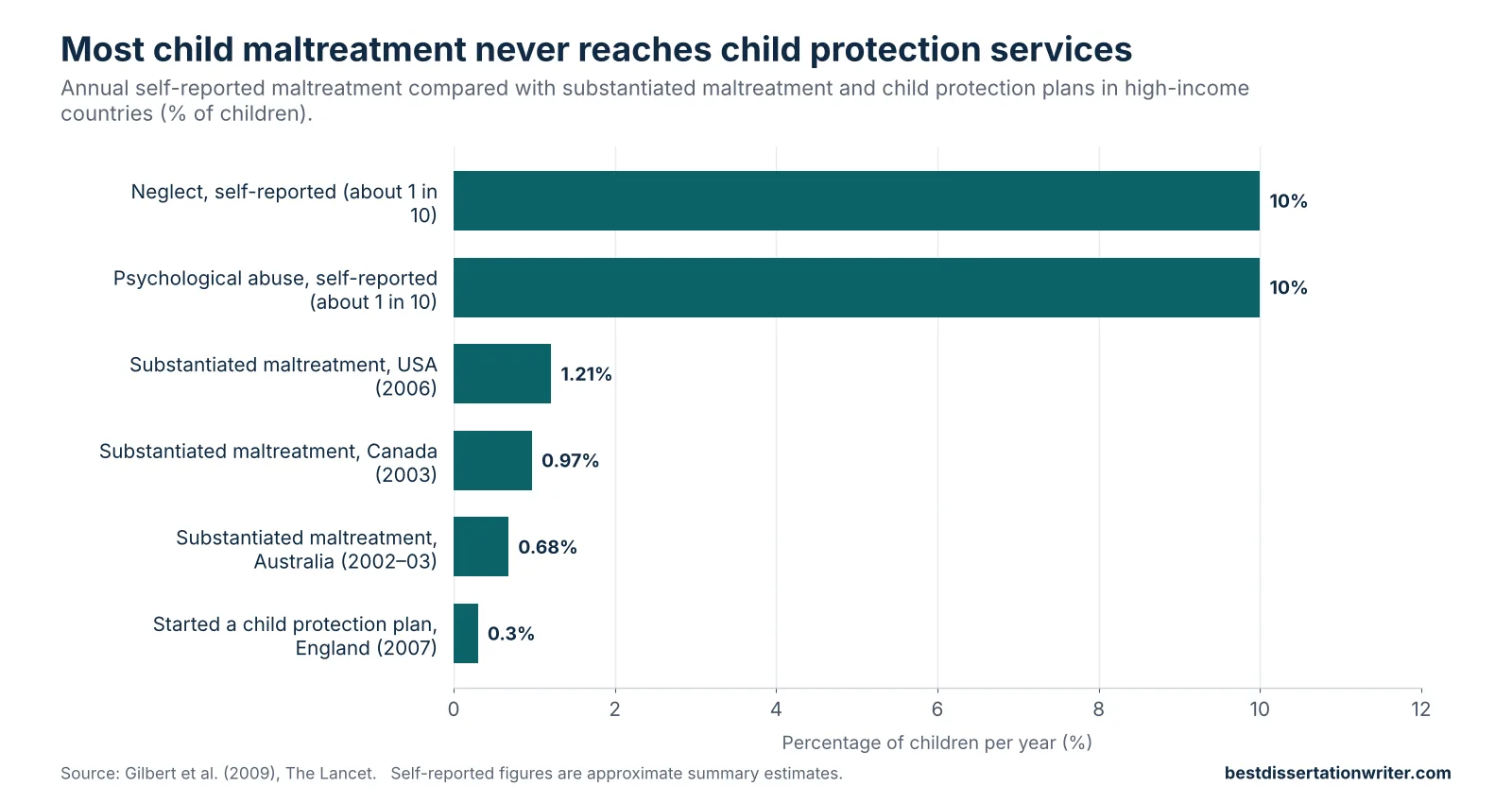
This gap means that professionals, including nurses, are likely to encounter children experiencing child abuse and neglect without realising it. Many signs are subtle or non-specific, such as poor weight gain, repeated minor injuries, frequent missed appointments or changes in behaviour. Recognising these patterns requires knowledge, curiosity and willingness to consider maltreatment as a possible explanation.
Neglect is particularly difficult to recognise. Unlike a physical injury, neglect usually develops gradually and is identified through patterns, such as persistent poor hygiene, untreated dental decay, failure to attend health appointments or a child who is often hungry. Nurses who see a child repeatedly, such as health visitors and school nurses, may be best placed to notice these patterns, provided that information is recorded and shared so that a full picture can be built over time. Gilbert et al. (2009) noted that neglect is among the most common forms of maltreatment, which makes this aspect of child abuse and neglect especially important for nursing practice.
Theme 2: Nurses’ Knowledge and Confidence
Nurses often feel unprepared for safeguarding work. In an integrative review of 60 international studies, Lines et al. (2017) found that nurses frequently lacked the knowledge, skills and support to act on concerns about children’s safety. Three themes emerged: insufficient knowledge, the need for validation of concerns and better communication with other professionals, and the challenge of balancing surveillance with support for vulnerable families. Although many nurses had received some training, most studies reported gaps in knowledge and confidence.
Nurses in the included studies often relied on doctors or senior colleagues to confirm their concerns and were sometimes dissatisfied with the response of child protection services. They described being excluded from information about what happened to children after a referral, which left them uncertain whether their actions had made a difference. These experiences may discourage nurses from raising concerns in future, particularly when signs of child abuse and neglect are ambiguous.
Specific knowledge gaps matter. Nurses need to understand patterns of injury that should raise concern, such as bruising in babies who are not yet mobile, injuries in unusual places and burns with clear outlines. They also need to understand how to talk with children who may disclose abuse, how to record what is said without leading questions and how to share information appropriately. NICE (2009) provides lists of features that should prompt professionals to consider or suspect maltreatment, but applying these in busy clinical settings requires practice and support.
Theme 3: Tensions and Systems in Safeguarding Practice
Nurses’ safeguarding role extends beyond recognition and reporting. In a scoping review of 41 studies from seven countries, Lines et al. (2018) found that most nursing interventions focused on preventing abuse, particularly through postnatal home visiting and parent education, while fewer addressed detection or support after abuse. Nurses had positive effects on some measures of child abuse and neglect, but results varied, and many forms of nursing child protection work were absent from the research literature.
A recurring tension is the dual role of supporting families while monitoring children’s safety. Nurses build trusting relationships with parents, yet they may need to share concerns with child protection services, which can feel like a betrayal of that trust. Lines et al. (2017) found that nurses struggled with this balance, which can delay action. Clear policies, supervision and support from safeguarding leads help nurses to manage this tension and to remember that the child’s welfare is paramount. Being open with parents about concerns, where this does not place the child at greater risk, can also help to preserve trust.
Discussion
This review shows that child abuse and neglect is common but largely hidden, and that nurses are well placed to recognise it but often lack the knowledge, confidence and support to do so. The large gap between self-reported and substantiated maltreatment means that every contact with a child is a potential opportunity for recognition, but only if professionals know what to look for and feel able to act.
Training alone does not appear to be enough. Many nurses had received some safeguarding training yet still felt unprepared, suggesting that knowledge must be reinforced by supervision, peer discussion and feedback on the outcomes of referrals. Organisations that provide accessible safeguarding leads, regular case discussion and clear escalation routes are likely to enable nurses to act with greater confidence.
The tension between support and surveillance deserves recognition rather than avoidance. Most families who come to the attention of nurses are struggling rather than deliberately harmful, and early help can prevent problems from escalating. The scoping review by Lines et al. (2018) suggests that much nursing child protection work is preventive, through home visiting and parent education. Framing safeguarding as part of supporting families, while remaining alert to risk, may help nurses to respond to child abuse and neglect in ways that protect children and maintain relationships.
Feedback and inter-agency communication emerged as important but often missing. When nurses refer concerns and hear nothing further, they cannot learn whether their judgement was sound or what happened to the child. Systems that routinely inform referring professionals of outcomes, within appropriate confidentiality limits, could strengthen learning and confidence. Joint training with social workers, police and doctors may also improve mutual understanding of roles and thresholds.
The emotional impact on nurses should also be acknowledged. Caring for children who have been harmed, raising concerns about families nurses know well and giving evidence in child protection processes can be distressing. Without support, nurses may avoid situations that might lead to safeguarding concerns or experience lasting stress. Restorative supervision and access to safeguarding leads are therefore important for staff wellbeing as well as for the quality of decisions about child abuse and neglect.
The evidence base has limitations. The epidemiological data are now dated, many studies of nurses’ experiences were small and qualitative, and international differences in child protection systems limit generalisability. Few studies measured whether nursing actions improved outcomes for children. This review relied on openly accessible, English-language sources, so relevant work in other languages may be missing. Future research should evaluate interventions that strengthen nurses’ safeguarding practice and examine children’s outcomes, including whether earlier recognition leads to timely help and safer home environments.
Implications of Child Abuse and Neglect Evidence for Practice
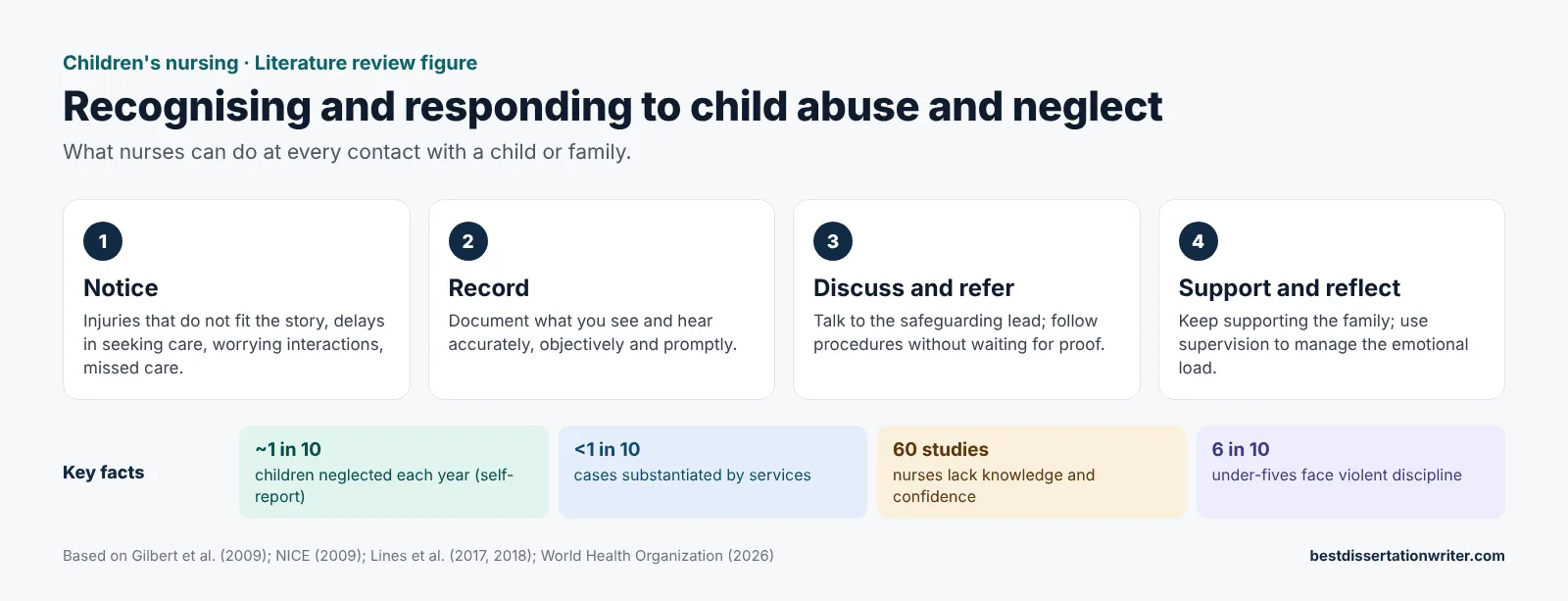
For children’s nurses, the evidence supports maintaining up-to-date safeguarding knowledge, considering maltreatment when injuries or presentations do not fit the explanation, and documenting concerns accurately and objectively. Nurses should discuss concerns promptly with safeguarding leads, follow local procedures without waiting for certainty, and make referrals to child protection services when a child may be at risk. Supervision and reflective practice should be used to manage the emotional demands of this work.
Nurses should also listen to children directly, giving them opportunities to speak privately where appropriate and taking any disclosure seriously. Information should be shared with other professionals in line with local policy, and nurses should seek feedback on referrals so that they can learn from each case. Managers can support this by ensuring that safeguarding training is regular, practical and linked to real cases.
Safeguarding is relevant across all areas of child health. Repeated missed appointments or poor control in young people with asthma or children with type 1 diabetes can sometimes indicate neglect, although most have other explanations. Working within family-centred care supports trusting relationships with parents, and concerns about weight may occasionally overlap with safeguarding in childhood obesity.
Conclusion
This narrative review examined the role of nurses in recognising and responding to child abuse and neglect. Maltreatment is common but largely hidden, and nurses are well placed to notice it, yet many lack the knowledge, confidence and support to act effectively.
Strengthening nurses’ safeguarding practice requires ongoing education, accessible expert support, clear procedures and feedback on referrals. With these in place, nurses can play a central role in protecting children from child abuse and neglect while continuing to support the families who care for them.
References
Gilbert, R., Widom, C. S., Browne, K., Fergusson, D., Webb, E., & Janson, S. (2009). Burden and consequences of child maltreatment in high-income countries. The Lancet, 373(9657), 68–81. https://doi.org/10.1016/S0140-6736(08)61706-7
Lines, L., Grant, J., & Hutton, A. (2018). How do nurses keep children safe from abuse and neglect, and does it make a difference? A scoping review. Journal of Pediatric Nursing, 43, e75–e84. https://doi.org/10.1016/j.pedn.2018.07.010
Lines, L., Hutton, A., & Grant, J. (2017). Integrative review: Nurses’ roles and experiences in keeping children safe. Journal of Advanced Nursing, 73(2), 302–322. https://doi.org/10.1111/jan.13101
National Institute for Health and Care Excellence. (2009). Child maltreatment: When to suspect maltreatment in under 18s (Clinical guideline CG89; updated 2017). https://www.nice.org.uk/guidance/cg89
World Health Organization. (2026). Child maltreatment [Fact sheet]. https://www.who.int/news-room/fact-sheets/detail/child-maltreatment
Cite this example
Best Dissertation Writers (2026) The Role of Nurses in Recognising and Responding to Child Abuse and Neglect: A Review of the Literature. Available at: https://bestdissertationwriter.com/child-abuse-and-neglect-review-review/
Best Dissertation Writers
Get expert help with your nursing literature review
Share your topic and deadline with Best Dissertation Writers and get support tailored to your module brief.