The Effectiveness of Paediatric Early Warning Systems in Identifying Deteriorating Children: A Systematic Review
 By Dr. Robertson Prime, Research Fellow
Updated October 12, 2026
15 min read
About 3,000 words
In this review
Abstract
Background: Paediatric early warning systems were developed to help staff identify deterioration earlier in children in hospital, whose signs of decline are often subtle. They combine a score calculated from routine observations with rules for escalation, and in November 2023 NHS England released national PEWS observation and escalation charts for general children’s wards.
Aim: This systematic review aimed to examine how effective these systems are in identifying deteriorating children in hospital and whether they improve patient outcomes.
Methods: Evidence was identified through targeted searches of openly accessible bibliographic records, publisher websites and the reference lists of key reviews. Six sources published between 2016 and 2023 were included: three systematic reviews, a cluster randomised trial, a case-control validation study and a national guidance resource, appraised with CASP checklists and synthesised narratively.
Findings: In a comparison of 18 published systems, the ability to predict critical deterioration ranged from an AUROC of 0.62 to 0.89, and positive predictive values in most validation studies were only about 2% to 6%, creating a risk of alarm fatigue. The EPOCH trial of 144,539 patient discharges found no difference in hospital mortality but fewer significant clinical deterioration events with Bedside PEWS. Reviews suggested that benefits depend on the wider response system, including teamwork, communication and staff confidence.
Conclusion: Nurses should record observations accurately, combine scores with clinical judgement and parental concern, and escalate confidently within a supportive team.
Keywords: paediatric early warning systems, PEWS, paediatric early warning score
Introduction
This systematic review critically examines recent evidence on paediatric early warning systems and its implications for children’s nursing practice.
Children in hospital can deteriorate quickly, and the signs are often subtle. Rising heart and breathing rates, increasing work of breathing, prolonged capillary refill or a change in behaviour may precede cardiac arrest, unplanned admission to paediatric intensive care or death. Failure to recognise and act on these signs has been identified repeatedly in reviews of serious incidents, and children’s physiological norms change with age, which makes recognition harder than in adults.
Paediatric early warning systems were developed to help staff identify deterioration earlier. They usually combine a paediatric early warning score (PEWS), calculated from routine observations, with rules about when and how to escalate concerns. Children’s nurses record most observations, calculate the score and initiate escalation, so they are central to whether these systems work in practice.
A systematic approach was chosen so that systematic reviews, a large randomised trial, a validation study and national guidance could be identified and appraised together. Clarifying the evidence matters because these systems are now widely used and, in England, a national system has been introduced, yet questions remain about what they achieve.
Review question
How effective are paediatric early warning systems in identifying deteriorating children in hospital, and do they improve patient outcomes?
Background to Paediatric Early Warning Systems
Early warning approaches in children developed from adult track and trigger systems. A track and trigger tool tracks observations over time and triggers a response when values cross set thresholds. Some tools add points for each abnormal observation to produce a score, while others use single-parameter triggers, such as a very high respiratory rate, to call a medical emergency team. In the literature these tools are described variously as paediatric track and trigger tools, PEWS or early warning scores.
A distinction is often drawn between the tool and the wider system. A paediatric early warning score is the afferent component that detects deterioration. Paediatric early warning systems also include the efferent response, such as review by a senior doctor or a rapid response team, as well as staff training, communication, escalation policies and organisational culture. Evaluating the score alone may therefore underestimate or overestimate what the whole system can achieve. Paediatric early warning systems depend as much on people, communication and processes as on the observation chart itself.
Until recently, hospitals in the United Kingdom used many different charts. In November 2023 NHS England released national PEWS observation and escalation charts for general children’s wards, with four age bands: 0 to 11 months, 1 to 4 years, 5 to 12 years, and 13 years and over (NHS England, 2023). According to the Royal College of Paediatrics and Child Health (RCPCH, n.d.), the score is based on heart rate, respiratory rate, respiratory distress, blood pressure, oxygen saturation, oxygen delivery and capillary refill time.
The national chart also records temperature, level of consciousness and pain without scoring them, and allows escalation to be triggered by the score, by parental concern or by a nurse’s clinical intuition (RCPCH, n.d.). This design recognises that numbers alone may miss deterioration. At the time of release, use of the chart was not mandatory, and it was supported by an e-learning programme for staff.
Search Strategy and Methods
Evidence for this example was identified through targeted searches of openly accessible bibliographic records, publisher websites and the reference lists of key reviews. Search terms combined keywords for the intervention (“paediatric early warning systems”, “PEWS”, “track and trigger”, “early warning score”, “rapid response”) with terms for population and outcomes (“child*”, “paediatric”, “deteriorat*”, “cardiac arrest”, “intensive care transfer”, “mortality”), joined with the Boolean operators AND and OR. A full systematic review for assessment would run the same strategy in CINAHL, PubMed/MEDLINE, the Cochrane Library and Embase and report the number of records screened in a PRISMA flow diagram.
Sources were eligible if they evaluated the validity or effectiveness of paediatric early warning systems or scores in hospitalised children aged 0 to 18 years, and reported outcomes such as cardiac or respiratory arrest, unplanned intensive care transfer, mortality or staff and process outcomes. Systematic reviews, randomised trials and large validation studies were prioritised, together with national guidance. Studies limited to neonatal units or to prehospital triage were excluded.
Six sources published between 2016 and 2023 were included: three systematic reviews, one cluster randomised trial, one case-control validation study and one national guidance resource (Table 1). The quality of each source was appraised using the Critical Appraisal Skills Programme (CASP) checklist appropriate to its design, and findings were synthesised narratively and grouped into themes.
Key Findings on Paediatric Early Warning Systems
Three themes were identified: the ability of paediatric early warning systems to predict deterioration, their effect on patient outcomes, and the wider system and nursing factors that shape their effectiveness. Table 1 summarises the included sources, and Figure 1 compares how accurately different scores predicted critical deterioration in one children’s hospital.
| Author, year | Design | Setting and sample | Key finding |
|---|---|---|---|
| Chapman et al. (2016) | Systematic review (GRADE) | 55 studies; 33 paediatric track and trigger systems | Very low-quality evidence for PEWS alone; moderate to low evidence, with some benefit, within rapid response systems. |
| Chapman et al. (2017) | Retrospective case-control validation study | 18 systems; 297 events in 224 children; UK tertiary children’s hospital | AUROC ranged from 0.62 to 0.89; trigger systems performed worst; choice of score matters. |
| Lambert et al. (2017) | Systematic review | 90 studies of varied design | Limited robust evidence on the best system; benefits for teamwork, communication and staff confidence. |
| Parshuram et al. (2018) | Cluster randomised controlled trial (EPOCH) | 21 hospitals in 7 countries; 144,539 discharges | No reduction in mortality (adjusted OR 1.01); fewer significant clinical deterioration events (rate ratio 0.77). |
| Trubey et al. (2019) | Systematic review | 36 validation and 30 effectiveness studies; 27 tools | Good accuracy for some tools but low positive predictive value; no mortality benefit in high-quality studies. |
| NHS England (2023) | National observation and escalation charts | General children’s wards in England; four age bands | Standardised PEWS with escalation on score, parental concern or clinical intuition; not mandated at release. |
Theme 1: Predicting Deterioration with Paediatric Early Warning Systems
Chapman et al. (2017) compared 18 published systems, 12 scoring tools and 6 trigger tools, using data from a UK tertiary children’s hospital. The study included 297 deterioration events in 224 children, matched with control patients, and the outcomes were cardiac or respiratory arrest, unplanned intensive care transfer or unexpected death. Performance varied widely. The area under the receiver operating characteristic curve (AUROC) ranged from 0.62 for the Bristol PEWS to 0.89 for the Cardiff and Vale PEWS, and trigger systems occupied the six lowest places.
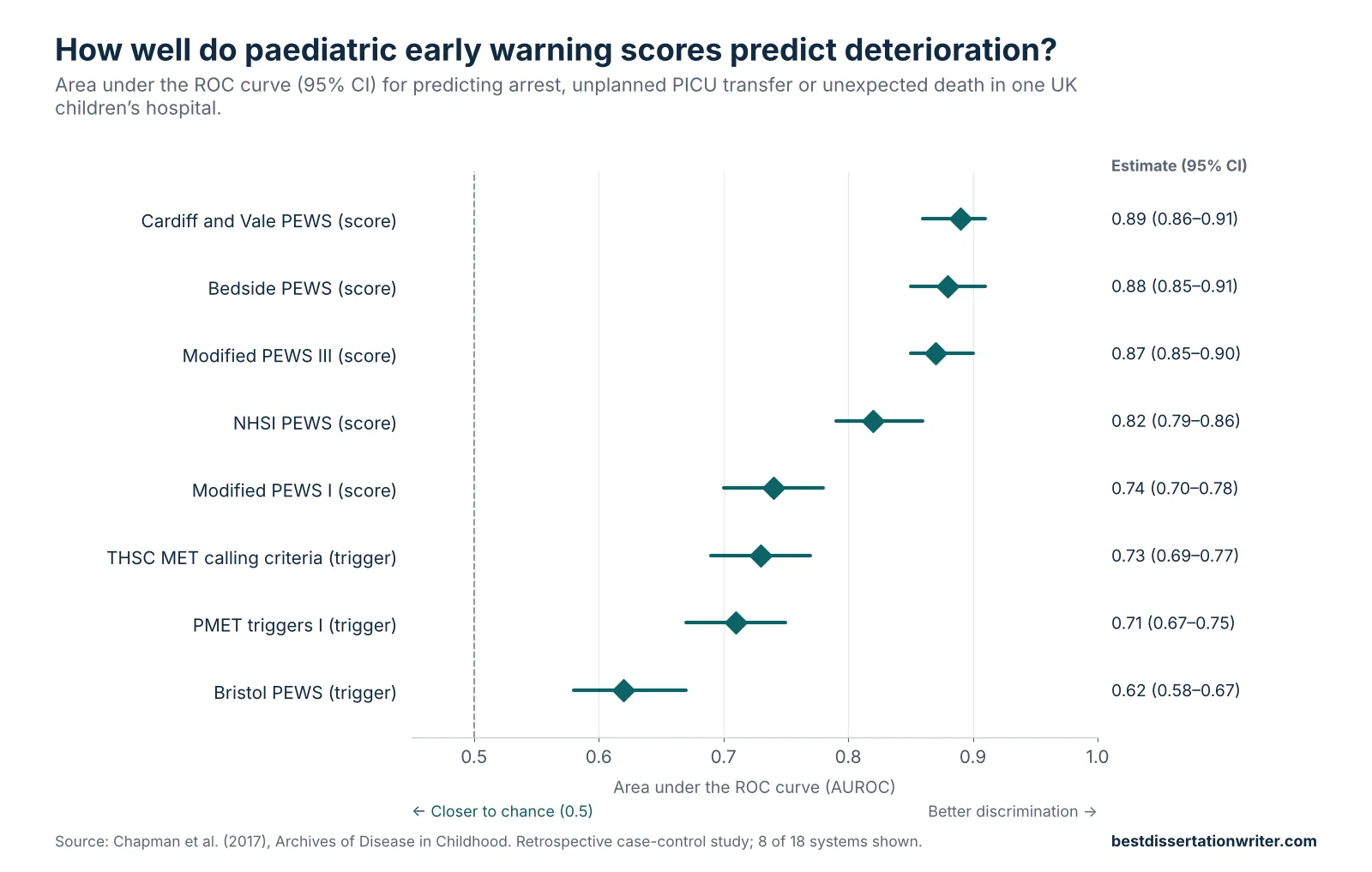
These findings suggest that the choice of paediatric early warning score matters. Three scores reached an AUROC of 0.87 or above, but more complex scores did not reliably perform better than simpler ones. The study was retrospective, used one hospital’s data and calculated scores from existing records rather than in real time, so performance in everyday practice may be lower. Even so, it provides a rare head-to-head comparison of many tools.
The wider evidence presents a similar picture. Trubey et al. (2019) identified 36 validation studies of 27 different tools and found that some showed good diagnostic accuracy, mainly for predicting transfer to paediatric intensive care. However, the positive predictive value was consistently low, ranging from about 2% to 6% in most studies. This means that most children who trigger an alert will not go on to deteriorate seriously, creating a risk of alarm fatigue among nurses.
Theme 2: Effects on Patient Outcomes
The most rigorous test of a PEWS is the EPOCH cluster randomised trial by Parshuram et al. (2018). Twenty-one hospitals in seven countries were randomised to the Bedside PEWS or usual care, and 144,539 patient discharges were included. All-cause hospital mortality did not differ significantly: 1.93 per 1000 discharges with Bedside PEWS and 1.56 with usual care (adjusted odds ratio 1.01, 95% confidence interval 0.61 to 1.69). Significant clinical deterioration events were less frequent with Bedside PEWS (0.50 versus 0.84 per 1000 patient-days; adjusted rate ratio 0.77).
EPOCH is a large, well-designed trial, and its finding of no effect on mortality is important. However, hospital mortality was very low in both groups, which makes a difference difficult to detect, and usual care in many participating hospitals may already have included some form of early warning or rapid response. The reduction in deterioration events suggests that the system may help teams act earlier, even if this did not translate into fewer deaths during the trial.
Systematic reviews reach cautious conclusions. Chapman et al. (2016) identified 33 paediatric track and trigger systems from 55 studies and found that evidence for implementing a PEWS alone was very low quality, with most outcomes not statistically significant. Where the tool formed part of a wider rapid response system, the evidence was moderate to low and some outcomes improved. Trubey et al. (2019) found that several uncontrolled before-and-after studies reported fewer deaths, arrests or emergency calls, but three high-quality multicentre studies found no change in mortality or arrests.
Trubey et al. (2019) did find moderate evidence from four studies that children transferred to intensive care needed fewer critical interventions early in their stay, suggesting earlier recognition. They described the literature as showing an absence of evidence rather than evidence of absence, and concluded that calls to make such tools mandatory across all paediatric units were not supported by the evidence base. This finding contrasts with national moves to standardise charts.
Theme 3: Systems, Teamwork and Nursing Practice
Lambert et al. (2017) reviewed 90 studies and concluded that, although PEWS are widely used internationally, there is limited robust evidence about which system is most effective. Some studies showed positive trends in clinical and process outcomes, and favourable effects were reported for multidisciplinary teamwork, communication and staff confidence in recognising, reporting and acting on deterioration. These benefits may be as important as the score itself.
The authors argued that no included study had evaluated paediatric early warning systems as complex healthcare interventions. They recommended that future research treat them as sociotechnical systems within a wider safety culture, supported by governance, leadership, targeted training and continuous improvement. This view helps to explain why the same score can perform differently in different hospitals: the response to the score depends on staffing, hierarchy, communication and trust between nurses and doctors.
The national chart in England reflects this thinking by allowing escalation on the basis of parental concern or a nurse’s clinical intuition, not only the score (RCPCH, n.d.). It also standardises the language used to describe deterioration across hospitals, so that a nurse moving between units does not need to learn a new chart. Whether these features improve outcomes has not yet been established in published trials.
For nurses, these findings shift attention from the chart to the conversations that follow it. Paediatric early warning systems can give junior nurses an objective reason to escalate and a shared language for describing concern, which may explain the improved staff confidence reported by Lambert et al. (2017). However, a score can also be used to dismiss concern when it is low, so the value of parental and nursing judgement as independent triggers should be emphasised in training and supervision.
Discussion
This review shows that paediatric early warning systems can identify many children at risk of deterioration, but that their predictive accuracy varies considerably between tools and their effect on hard outcomes such as mortality is unproven. The strongest evidence, the EPOCH trial, found no reduction in mortality but fewer clinical deterioration events. Systematic reviews consistently describe the evidence as limited and of low quality, with frequent methodological weaknesses.
The low positive predictive value of most tools is a key concern for nursing. If most alerts are false alarms, nurses and doctors may begin to ignore them or to override the score, undermining the system. Conversely, a high threshold may miss deteriorating children. Paediatric early warning systems therefore require careful calibration and should support, rather than replace, clinical judgement and knowledge of the individual child.
The reviews by Lambert et al. (2017) and Chapman et al. (2016) suggest that benefits are more likely when the score is embedded in a wider system with a reliable response. A paediatric early warning score that triggers escalation is of little value if senior review is delayed or nurses feel unable to challenge decisions. Teamwork, communication and staff confidence may explain much of the observed benefit, and these are areas in which nursing leadership is crucial.
There is a tension between the evidence and national policy. Trubey et al. (2019) cautioned against mandating PEWS, yet England has introduced a standardised chart, although its use was not mandated at release. Standardisation may still be justified on grounds of consistency, communication and training, even without trial evidence of reduced mortality. Evaluating the national system carefully, including its effects on alarm burden and nursing workload, will be important.
The evidence base has limitations. Most validation studies were retrospective and single-centre, many effectiveness studies used uncontrolled before-and-after designs, and outcomes were defined inconsistently. Few studies examined nurses’ experiences or the role of parental concern. This review relied on openly accessible, English-language sources and did not involve independent double screening. Future research should evaluate paediatric early warning systems as complex interventions, using prospective multicentre designs and including process, staff and family outcomes.
Implications of Paediatric Early Warning Systems Evidence for Practice
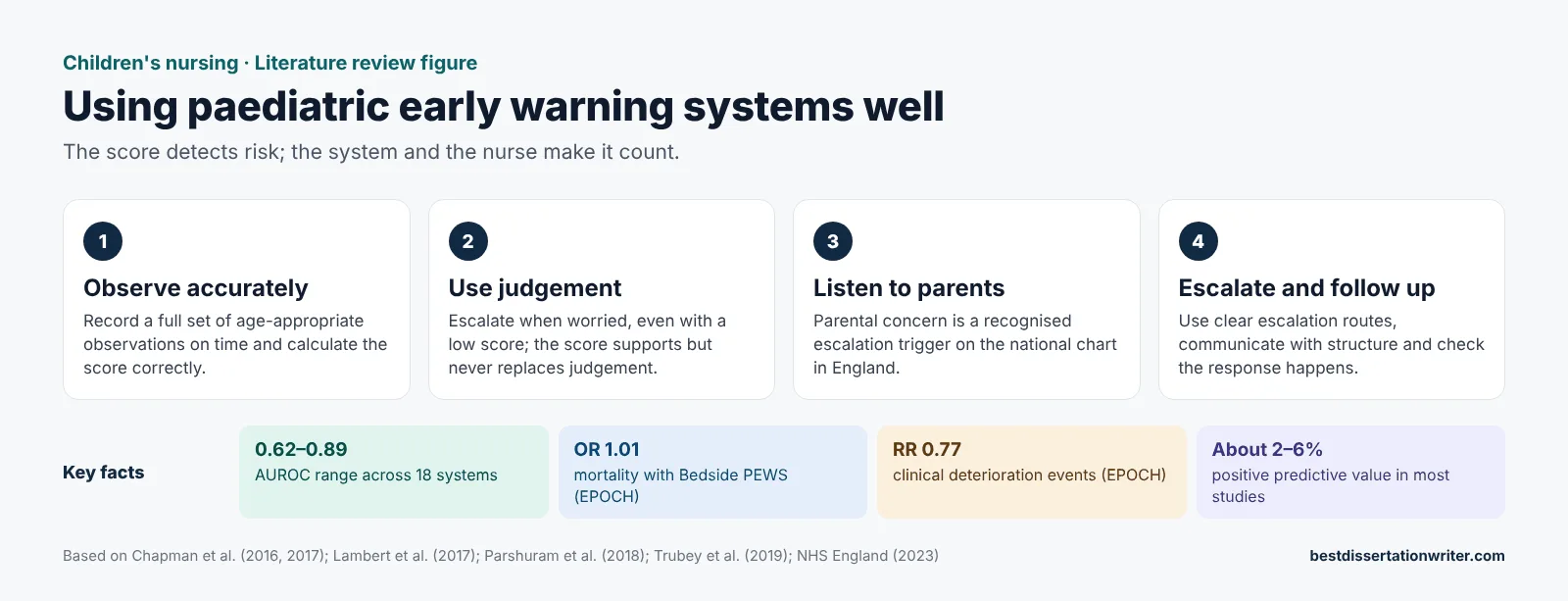
For children’s nurses, the evidence supports the accurate and timely recording of observations, correct calculation of the PEWS and prompt escalation according to local policy. Nurses should use clinical judgement alongside the score, escalate when worried even if the score is low, and listen to parents who notice that their child is not themselves. Training, simulation and clear escalation routes are needed to ensure that alerts lead to timely senior review.
These principles mirror those of adult early warning scores. Such tools need particular care for children undergoing cancer treatment, who may deteriorate rapidly with infection, and for febrile children, where fever management in children should be interpreted alongside other observations. Frequent observations and alarms also contribute to the psychological effects of hospitalisation, so nurses should explain monitoring to children and families.
Conclusion
This systematic review examined the effectiveness of paediatric early warning systems in identifying deteriorating children. The evidence shows that many scores can predict deterioration reasonably well, although accuracy varies and false alarms are common. A large randomised trial found no reduction in mortality but fewer deterioration events, and reviews suggest that benefits depend on the wider system rather than the score alone.
Children’s nurses are central to whether paediatric early warning systems work. By recording observations accurately, combining scores with clinical judgement and parental concern, and escalating confidently within a supportive team, nurses can help ensure that deteriorating children are recognised and treated in time.
References
Chapman, S. M., Wray, J., Oulton, K., & Peters, M. J. (2016). Systematic review of paediatric track and trigger systems for hospitalised children. Resuscitation, 109, 87–109. https://doi.org/10.1016/j.resuscitation.2016.07.230
Chapman, S. M., Wray, J., Oulton, K., Pagel, C., Ray, S., & Peters, M. J. (2017). ‘The Score Matters’: Wide variations in predictive performance of 18 paediatric track and trigger systems. Archives of Disease in Childhood, 102(6), 487–495. https://doi.org/10.1136/archdischild-2016-311088
Lambert, V., Matthews, A., MacDonell, R., & Fitzsimons, J. (2017). Paediatric early warning systems for detecting and responding to clinical deterioration in children: A systematic review. BMJ Open, 7(3), e014497. https://doi.org/10.1136/bmjopen-2016-014497
NHS England. (2023). National paediatric early warning system (PEWS) observation and escalation charts. https://www.england.nhs.uk/publication/national-pews-observation-and-escalation-charts/
Parshuram, C. S., Dryden-Palmer, K., Farrell, C., Gottesman, R., Gray, M., Hutchison, J. S., Helfaer, M., Hunt, E. A., Joffe, A. R., Lacroix, J., Moga, M. A., Nadkarni, V., Ninis, N., Parkin, P. C., Wensley, D., Willan, A. R., & Tomlinson, G. A. (2018). Effect of a pediatric early warning system on all-cause mortality in hospitalized pediatric patients: The EPOCH randomized clinical trial. JAMA, 319(10), 1002–1012. https://doi.org/10.1001/jama.2018.0948
Royal College of Paediatrics and Child Health. (n.d.). UK paediatric early warning systems (PEWS). https://www.rcpch.ac.uk/resources/uk-paediatric-early-warning-systems
Trubey, R., Huang, C., Lugg-Widger, F. V., Hood, K., Allen, D., Edwards, D., Lacy, D., Lloyd, A., Mann, M., Mason, B., Oliver, A., Roland, D., Sefton, G., Skone, R., Thomas-Jones, E., Tume, L. N., & Powell, C. (2019). Validity and effectiveness of paediatric early warning systems and track and trigger tools for identifying and reducing clinical deterioration in hospitalised children: A systematic review. BMJ Open, 9(5), e022105. https://doi.org/10.1136/bmjopen-2018-022105
Cite this example
Best Dissertation Writers (2026) The Effectiveness of Paediatric Early Warning Systems in Identifying Deteriorating Children: A Systematic Review. Available at: https://bestdissertationwriter.com/paediatric-early-warning-systems-review/
Best Dissertation Writers
Get expert help with your nursing literature review
Share your topic and deadline with Best Dissertation Writers and get support tailored to your module brief.