The Psychological Effects of Hospitalisation on Children and Nursing Strategies to Reduce Distress: A Literature Review
 By Dr. Robertson Prime, Research Fellow
Updated October 12, 2026
15 min read
About 3,100 words
In this review
Abstract
Background: The psychological effects of hospitalisation on children range from short-lived fear and tearfulness to sleep problems, regression and new behaviour difficulties at home, and in a minority to persistent traumatic stress. These reactions can also affect pain, recovery and the child’s willingness to accept healthcare in future. Nurses spend more time with hospitalised children than any other professional, so their approach to admission, procedures and communication can make a considerable difference.
Aim: This narrative review aimed to examine how a hospital stay affects children psychologically and which broad nursing strategies can reduce child distress during and after admission.
Methods: Evidence was identified through targeted searches of openly accessible bibliographic records, publisher websites and the reference lists of key reviews. Seven sources published between 2006 and 2022 were included: two qualitative interview studies, a doctoral thesis, a prospective cohort study, a systematic review, a mixed-method systematic review and a meta-analysis, appraised with CASP checklists and synthesised narratively.
Findings: Children feared pain, procedures, separation from parents and loss of control, and many of these fears were linked directly to nursing activities. Children who were anxious before surgery had more pain, more postoperative anxiety and sleep problems, and a higher incidence of emergence delirium (9.7% compared with 1.5%). After paediatric intensive care, between 10.0% and 30.4% of children met criteria for post-traumatic stress disorder at three to six months, although most children and families were resilient. Preparation matched to each child and parent, age-appropriate information, choice and parental presence emerged as the main nursing strategies to reduce distress.
Conclusion: Children’s nurses should prepare children and parents, offer information and choice, encourage parental presence and identify higher-risk children, such as those leaving intensive care, so that behaviour changes after discharge are recognised and followed up.
Keywords: psychological effects of hospitalisation, child distress, hospitalised children
Introduction
This narrative review critically examines recent evidence on psychological effects of hospitalisation and its implications for children’s nursing practice.
Every year large numbers of children are admitted to hospital for planned surgery, acute illness, injury or the treatment of long-term conditions. For most, the stay is short and the medical outcome is good. Yet a hospital admission can be one of the most stressful events of childhood. Children are separated from home and routine, meet unfamiliar staff and equipment and undergo procedures that may hurt or frighten them, often without fully understanding why.
The psychological effects of hospitalisation range from short-lived fear and tearfulness to sleep problems, regression and new behaviour difficulties at home, and in a minority of children to persistent traumatic stress. These reactions matter in their own right, but they can also affect pain, recovery and the child’s willingness to accept healthcare in future. Nurses spend more time with hospitalised children than any other professional, so their approach to admission, procedures and communication can make a considerable difference to how children experience their stay.
A narrative design was chosen because the evidence spans qualitative interviews, cohort studies, systematic reviews, meta-analysis and theoretical models, which cannot be pooled statistically. A narrative synthesis allows these sources to be compared and critically discussed. Play-based interventions are covered elsewhere, so this review focuses on children’s experiences, the effects of admission and wider nursing strategies.
Review question
What are the psychological effects of hospitalisation on children, and which broad nursing strategies can reduce child distress during and after a hospital stay?
Background to Psychological Effects of Hospitalisation
Interest in how hospital affects children has a long history. Mid-twentieth-century observations of young children separated from their parents in hospital led to major reforms, including open visiting, parents staying overnight and the development of children’s wards designed around family needs. Understanding the psychological effects of hospitalisation therefore shaped how modern children’s services are organised. Today parents are usually present, yet hospitalised children still face many of the same stressors: unfamiliar surroundings, loss of routine, painful procedures and uncertainty about what will happen next.
Children’s reactions depend on their age and development. Infants and toddlers are most affected by separation and disruption of routine, preschool children may misunderstand illness and fear bodily harm, school-age children are concerned about pain, loss of control and missing school, and adolescents may worry about privacy, appearance and independence. Temperament, previous healthcare experiences, the severity of illness and parents’ own anxiety also influence how a child copes, so the psychological effects of hospitalisation vary widely between children.
A useful framework for understanding these responses is paediatric medical traumatic stress, which describes the psychological and physiological responses of children and families to pain, injury, serious illness and frightening medical experiences. Most children show some distress that resolves over time, but a smaller group develop persistent symptoms such as intrusive memories, avoidance and hyperarousal. This view treats distress as a normal reaction to abnormal events, while recognising that some children need extra support.
Search Strategy and Methods
Evidence for this example was identified through targeted searches of openly accessible bibliographic records, publisher websites and the reference lists of key reviews. Search terms combined keywords for the population and setting (“child*”, “paediatric”, “hospitali*”, “admission”, “intensive care”) with terms for psychological outcomes and care (“anxiety”, “fear”, “distress”, “behaviour change”, “traumatic stress”, “preparation”, “nursing”), joined with the Boolean operators AND and OR. A full narrative review for assessment would run the same strategy in CINAHL, PubMed/MEDLINE, the Cochrane Library, Embase and PsycINFO and report the number of records screened in a PRISMA flow diagram.
Sources were eligible if they examined the psychological effects of hospitalisation on children aged 0 to 18 years, including fear, anxiety, behaviour change and traumatic stress, or evaluated non-pharmacological strategies to reduce distress in hospital. Qualitative studies, cohort studies, systematic reviews and meta-analyses were included. Studies focused mainly on play therapy, on parents’ outcomes alone or on outpatient care without admission were excluded.
Seven sources published between 2006 and 2022 were included: two qualitative interview studies, a doctoral thesis reporting the Finnish fear and coping research in full, a prospective cohort study, a systematic review of traumatic stress research, a mixed-method systematic review of preparation programmes and a meta-analysis of outcomes after intensive care (Table 1). Each source was appraised using the Critical Appraisal Skills Programme (CASP) checklist appropriate to its design. Findings were then grouped into themes and synthesised narratively to build a picture of the psychological effects of hospitalisation, with attention to the strengths and weaknesses of each design.
Key Findings on Psychological Effects of Hospitalisation
Three themes were identified: children’s fears and experiences in hospital, the short- and longer-term psychological effects of hospitalisation, and nursing strategies to reduce child distress. Table 1 summarises the included sources, and Figure 1 shows the most common hospital fears reported by young children in hospital.
| Author, year | Design | Setting and sample | Key finding |
|---|---|---|---|
| Coyne (2006) | Qualitative interview study | 11 children aged 7–14; four paediatric units, England | Children feared separation, unfamiliar surroundings, investigations and loss of control; wanted information and consultation. |
| Kain et al. (2006) | Prospective cohort study | 241 children aged 5–12; tonsillectomy and adenoidectomy, USA | Anxious children had more pain, more emergence delirium (9.7% vs 1.5%) and more anxiety and sleep problems. |
| Salmela et al. (2009) | Qualitative interview study | 90 children aged 4–6; hospital and kindergartens, Finland | Over 90% feared at least one thing in hospital; pain, injections and admission most common. |
| Salmela (2010) | Doctoral thesis (qualitative interview studies) | 179 interviews with children aged 4–6; Helsinki, Finland | Presence of parents was the most common coping strategy (70%), followed by the child’s own toy. |
| Price et al. (2016) | Systematic review | 216 papers on paediatric medical traumatic stress since 2005 | Integrative Trajectory Model; parent and child stress linked; competency-based, stepped support recommended. |
| Dai and Livesley (2018) | Mixed-method systematic review | 19 controlled trials and 11 qualitative studies; elective surgery | Multimedia and web-based preparation may reduce anxiety; information should be tailored to parent and child. |
| Ko et al. (2022) | Systematic review and meta-analysis | 31 studies, 7,786 children after intensive care | 5.3%–88.0% had a psychological disorder; 10.0%–30.4% met PTSD criteria at 3–6 months. |
Theme 1: Children’s Fears and Experiences in Hospital
Listening to children themselves gives a direct view of what makes hospital stressful. Coyne (2006) interviewed 11 children aged 7 to 14 years in four paediatric units in England. The children described fears about separation from parents and family, the unfamiliar environment, investigations and treatments, and loss of self-determination. Losing control over everyday matters, such as when to eat, sleep or wash, made their fears worse. Children wanted information suited to their needs and to be consulted about their care.
Similar fears are reported by much younger children. Salmela et al. (2009) used picture-supported interviews with 90 children aged 4 to 6 years in Finland, recruited from a university hospital and from kindergartens. More than 90% said they were afraid of at least one thing in hospital, and hospitalised children reported more fears than those in kindergarten. Among the children interviewed in hospital, the most common fears were pain (70%), injections and other nursing interventions (52%), being admitted to hospital (41%) and sample-taking and tests (37%).
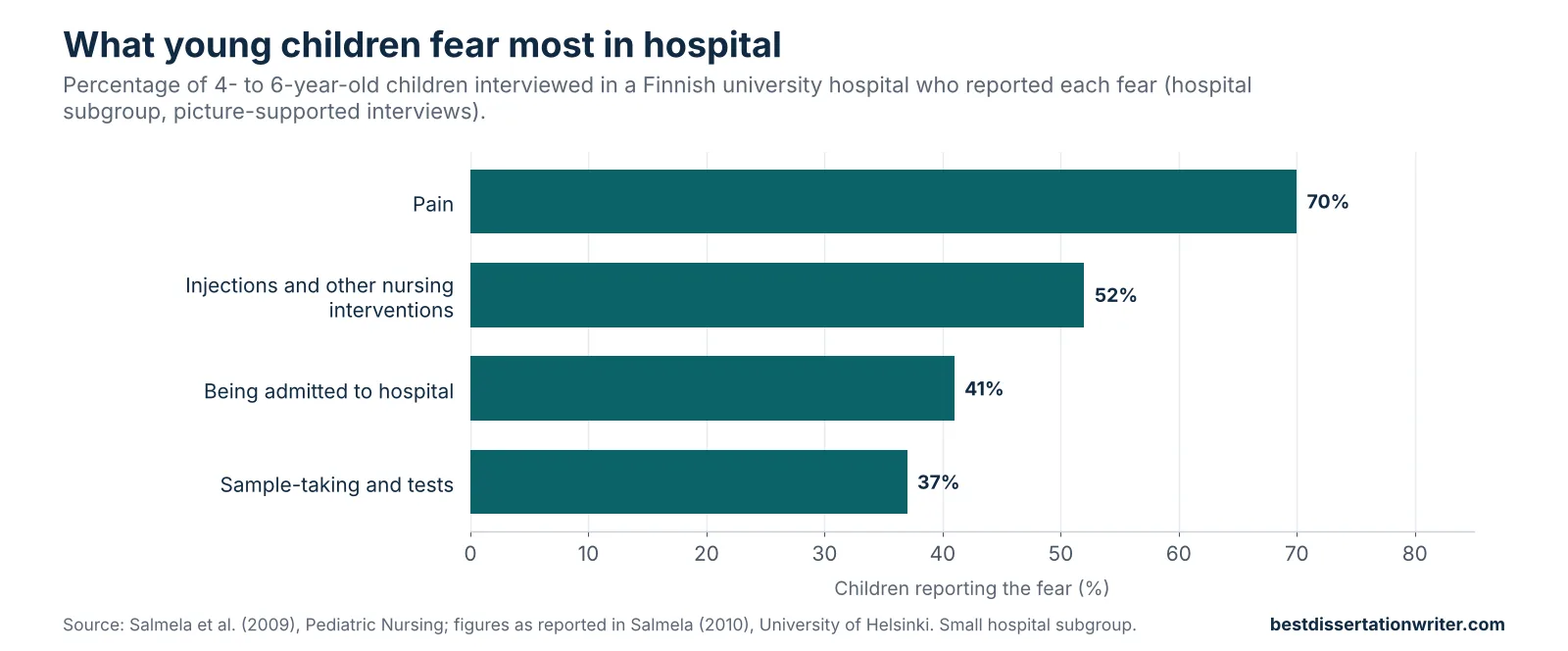
These studies are small and qualitative, so their percentages should not be generalised to all hospitalised children. The hospital subgroup in the Finnish study was particularly small, and both studies took place in single countries. Their strength lies in giving children a voice, and the consistency of their findings is striking: across ages and settings, children fear pain, procedures, separation and the unknown. Many of these fears are directly linked to nursing activities, which places nurses at the centre of efforts to reduce child distress.
Theme 2: Short- and Longer-Term Psychological Effects of Hospitalisation
Fear before a procedure can influence recovery. In a prospective study of 241 children aged 5 to 12 years undergoing tonsillectomy and adenoidectomy, Kain et al. (2006) found that children who were anxious before surgery experienced more pain in hospital and during the first three days at home, and used more codeine and paracetamol at home. Anxious children also had a higher incidence of emergence delirium (9.7% compared with 1.5%) and more postoperative anxiety and sleep problems over the following two weeks.
This study is valuable because it followed children after discharge, showing that the psychological effects of hospitalisation can extend into the home. However, it involved a single type of operation in one country, and its observational design cannot prove that anxiety caused poorer recovery rather than sharing common causes such as temperament. Even so, its findings suggest that reducing anxiety before procedures may benefit both comfort and recovery, a hypothesis that later intervention studies have tested.
For children who need intensive care, the effects can be more serious and longer lasting. Ko et al. (2022) meta-analysed 31 studies involving 7,786 children admitted to paediatric intensive care. Between 5.3% and 88.0% of children had at least one psychological disorder at follow-up, and between 10.0% and 30.4% met criteria for post-traumatic stress disorder at three to six months. Children who had been in intensive care also had more emotional and behavioural problems at four years than healthy children.
The wide ranges reported by Ko et al. (2022) reflect differences in populations, measures and follow-up, and many studies were observational. Price et al. (2016) reviewed 216 papers on paediatric medical traumatic stress and updated the model as the Integrative Trajectory Model. The review confirmed that most children and parents are resilient, linked parent and child traumatic stress and suggested that traumatic stress may affect later health outcomes. Together, these sources show that while most distress is temporary, a significant minority of hospitalised children need follow-up and support.
Theme 3: Nursing Strategies to Reduce Child Distress
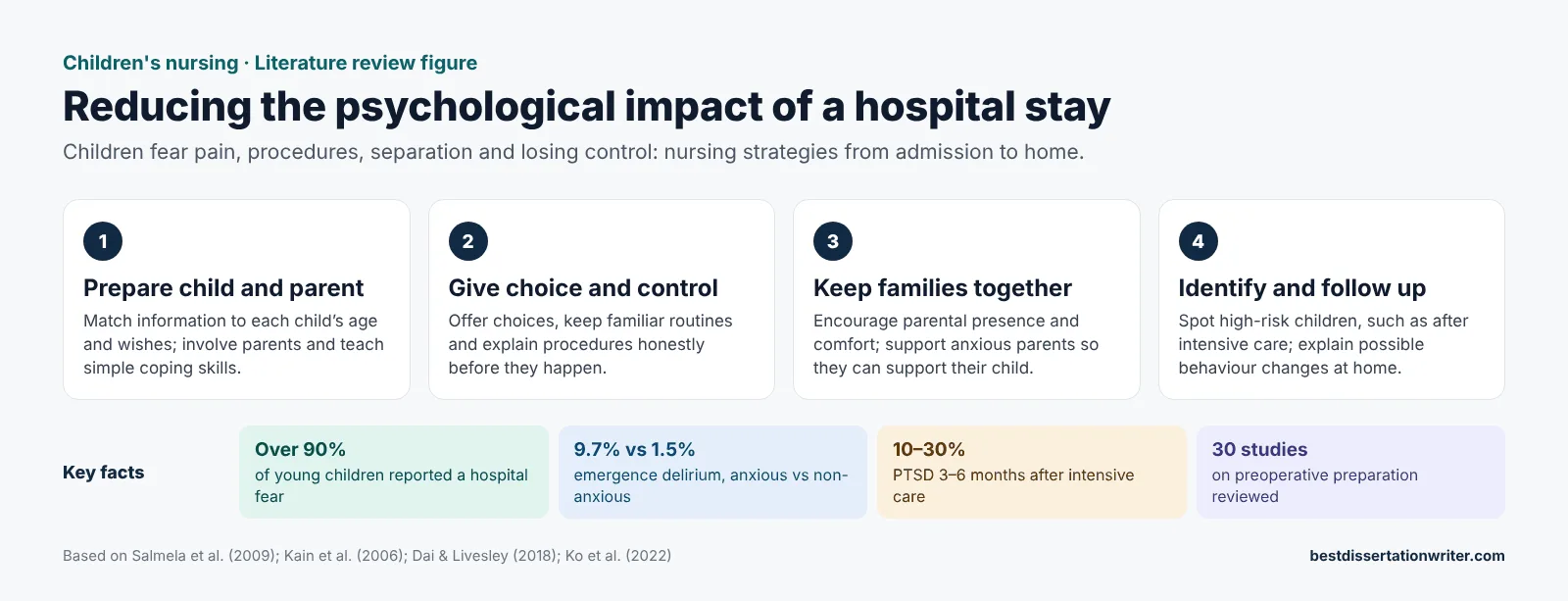
Preparation is one of the most widely studied strategies for limiting the psychological effects of hospitalisation. Dai and Livesley (2018) combined 19 controlled trials and 11 qualitative studies of preoperative psychological preparation programmes. Educational multimedia and web-based programmes may reduce preoperative anxiety, whereas evidence for books and some other approaches was uncertain. The qualitative studies showed that parents and children wanted different amounts of information. The authors concluded that successful programmes match information to each parent and child, actively involve both and teach coping skills.
Wider strategies emerge from the other sources. Coyne (2006) highlighted the importance of age-appropriate information, consulting children about their care and allowing them some control over routines. Price et al. (2016) recommended a competency-based approach that builds on family strengths, provides universal support to all families and identifies children and parents at higher risk for more targeted help. These recommendations fit naturally with everyday nursing work, from admission and orientation to the ward through to discharge planning.
Parents are central to all these strategies. The presence of a parent was the most commonly reported coping strategy among young Finnish children (Salmela, 2010), and Price et al. (2016) emphasised the link between parent and child traumatic stress. Supporting parents to understand procedures, manage their own anxiety and comfort their child is therefore an indirect but powerful way to reduce child distress. Brief screening for parental distress and clear explanation can help nurses to identify families who need additional support.
Discussion
This review shows that the psychological effects of hospitalisation on children are common, varied and sometimes lasting. Children fear pain, procedures, separation and loss of control; anxiety before procedures is associated with more pain, emergence delirium and behaviour problems at home; and after intensive care a significant minority develop post-traumatic stress and other difficulties. At the same time, most children cope well, especially when they are prepared, informed and supported by their families.
A recurring theme across the sources is control. Coyne (2006) found that loss of control intensified children’s fears, and Dai and Livesley (2018) found that effective preparation actively involves children rather than simply giving information. Offering choices, explaining what will happen and involving children in decisions are simple strategies that restore some control. These approaches are low in cost and can be used by every nurse, which makes them particularly important where specialist psychological services are limited. Restoring a sense of control may be one of the most direct ways of limiting the psychological effects of hospitalisation.
The evidence also shows a tension between universal and targeted care. Most children need only good everyday practice, such as clear explanation, comfort and parental presence, whereas a minority need specialist assessment and follow-up. The Integrative Trajectory Model described by Price et al. (2016) offers a way to reconcile these needs, combining universal support with screening for higher risk. However, few hospitals routinely screen children for traumatic stress, and the psychological effects of hospitalisation are rarely followed up after discharge.
The quality of the evidence varies. The qualitative studies were small, the cohort study was limited to one procedure and the intensive care meta-analysis combined very different studies. Intervention research has concentrated on preparation for surgery, so strategies for acute medical admissions and long stays are less well evaluated. These gaps mean that much of current practice rests on consistent but indirect evidence rather than on robust trials.
This review relied on openly accessible, English-language sources, included a limited number of studies and did not involve independent double screening or formal quality scoring. Several sources were published before 2010, although their findings remain widely cited. Future research should evaluate nurse-led strategies in randomised trials, include medical as well as surgical admissions, follow children for several months after discharge and explore the experiences of infants, adolescents and children with disabilities or limited language, who are under-represented in current research.
Implications of Psychological Effects of Hospitalisation Evidence for Practice
For children’s nurses, the evidence supports preparing children and parents before admission and procedures, using information matched to each child’s age and wishes, and orienting families to the ward on arrival. Nurses should offer choices, keep familiar routines where possible, encourage parental presence and comfort, minimise unnecessary separation and explain procedures honestly. Children with high anxiety before surgery, those admitted to intensive care and those with distressed parents should be identified, and families should be told about behaviour changes that may follow discharge and when to seek help.
These strategies sit within family-centred care, and distraction and preparation through play therapy can complement them. For infants, keeping familiar feeding routines guided by evidence on infant nutrition helps to reduce disruption. Tablets and videos can calm older children during procedures, but their use should be balanced against advice on screen time.
Conclusion
This narrative review examined the psychological effects of hospitalisation on children and the nursing strategies that may reduce distress. Children commonly fear pain, procedures, separation and loss of control; anxiety is linked to poorer recovery and behaviour problems at home; and a minority of children, particularly after intensive care, develop lasting psychological difficulties.
Nurses can reduce these psychological effects of hospitalisation by preparing children and parents, offering information and choice, supporting families and identifying children who need extra help. Although much of the evidence is small-scale or observational, it consistently shows that attention to children’s emotional experience is an essential part of high-quality children’s nursing, not an optional addition.
References
Coyne, I. (2006). Children’s experiences of hospitalization. Journal of Child Health Care, 10(4), 326–336. https://doi.org/10.1177/1367493506067884
Dai, Y., & Livesley, J. (2018). A mixed-method systematic review of the effectiveness and acceptability of preoperative psychological preparation programmes to reduce paediatric preoperative anxiety in elective surgery. Journal of Advanced Nursing, 74(9), 2022–2037. https://doi.org/10.1111/jan.13713
Kain, Z. N., Mayes, L. C., Caldwell-Andrews, A. A., Karas, D. E., & McClain, B. C. (2006). Preoperative anxiety, postoperative pain, and behavioral recovery in young children undergoing surgery. Pediatrics, 118(2), 651–658. https://doi.org/10.1542/peds.2005-2920
Ko, M. S. M., Poh, P.-F., Heng, K. Y. C., Sultana, R., Murphy, B., Ng, R. W. L., & Lee, J. H. (2022). Assessment of long-term psychological outcomes after pediatric intensive care unit admission: A systematic review and meta-analysis. JAMA Pediatrics, 176(3), e215767. https://doi.org/10.1001/jamapediatrics.2021.5767
Price, J., Kassam-Adams, N., Alderfer, M. A., Christofferson, J., & Kazak, A. E. (2016). Systematic review: A reevaluation and update of the integrative (trajectory) model of pediatric medical traumatic stress. Journal of Pediatric Psychology, 41(1), 86–97. https://doi.org/10.1093/jpepsy/jsv074
Salmela, M. (2010). Hospital-related fears and coping strategies in 4–6-year-old children [Doctoral dissertation, University of Helsinki]. Helda. https://helda.helsinki.fi/server/api/core/bitstreams/a4b75b05-2e36-4ef0-91c4-18c1c88075ce/content
Salmela, M., Salanterä, S., & Aronen, E. T. (2009). Child-reported hospital fears in 4 to 6-year-old children. Pediatric Nursing, 35(5), 269–276.
Cite this example
Best Dissertation Writers (2026) The Psychological Effects of Hospitalisation on Children and Nursing Strategies to Reduce Distress: A Literature Review. Available at: https://bestdissertationwriter.com/psychological-effects-of-hospitalisation/
Best Dissertation Writers
Get expert help with your nursing literature review
Share your topic and deadline with Best Dissertation Writers and get support tailored to your module brief.