Nursing Care for People with a Dual Diagnosis of Mental Illness and Substance Misuse: An Integrative Review
 By Dr. Robertson Prime, Research Fellow
Updated October 12, 2026
15 min read
About 2,900 words
In this review
Abstract
Background: A dual diagnosis of mental illness and problematic alcohol or drug use is associated with more frequent relapse, hospital admission, physical illness, homelessness and early death. People with co-occurring disorders are often passed between mental health and addiction services and can fall through the gaps in care. Mental health nurses are among the professionals most likely to work with this group, yet they frequently report feeling unprepared.
Aim: This integrative review aimed to examine how common substance use disorders are among people with severe mental illness, and what the evidence shows about psychosocial interventions and integrated care for this group.
Methods: Evidence was identified through targeted searches of openly accessible bibliographic records, publisher websites and the reference lists of key reviews. Six sources published between 2009 and 2019 were included: a nursing systematic review of psychosocial treatments, a systematic review of client satisfaction, a national guideline, a national commissioning guide, a prevalence meta-analysis and a Cochrane review, appraised with CASP checklists and synthesised narratively.
Findings: A meta-analysis of 123 studies found that 41.7% of people with schizophrenia spectrum disorders had a substance use disorder, with men much more affected than women. An earlier nursing review found that motivational interviewing had the strongest short-term evidence for reducing substance use, but a later Cochrane review of 41 trials found no high-quality evidence that any psychosocial treatment, including integrated care, was better than standard care. Integrated treatment was nevertheless usually associated with higher client satisfaction, and national guidance stresses that people should not be excluded from services because of substance misuse.
Conclusion: Nurses should screen routinely and without judgement for alcohol and drug use, use motivational approaches, treat missed appointments as a reason for active follow-up and coordinate care across services through a shared care plan.
Keywords: dual diagnosis, co-occurring disorders, substance misuse, integrated care
Introduction
This integrative review critically examines recent evidence on dual diagnosis and its implications for mental health nursing practice.
Many people who use mental health services also use alcohol or drugs in ways that harm their health. The combination is associated with more frequent relapse, hospital admission, physical illness, homelessness, contact with the criminal justice system and early death. People with co-occurring disorders often describe being passed between mental health and addiction services, with each service suggesting that the other problem must be treated first. As a result, they can fall through the gaps in care at the very times when they most need help.
Mental health nurses are among the professionals most likely to work with people who have a dual diagnosis. They assess and monitor mental state and substance use, coordinate care in community teams, manage withdrawal and intoxication on inpatient wards, and build the relationships that keep people engaged with services. Yet nurses frequently report feeling unprepared for this work, and attitudes towards people who use substances can be pessimistic. Understanding what works is therefore an important question for nursing practice.
An integrative design was chosen because the evidence includes prevalence meta-analyses, randomised trials, reviews of client satisfaction and national guidance, which together give a fuller picture of dual diagnosis care than any single type of evidence.
Review question
How common is dual diagnosis among people with severe mental illness, and what does the evidence show about psychosocial interventions and integrated care for this group?
Background to Dual Diagnosis
In the United Kingdom, the term dual diagnosis is commonly used for people who have both a mental health problem and problematic use of alcohol or drugs. Internationally, the terms co-occurring disorders and comorbidity are also used. The definition can be narrow, focusing on severe mental illnesses such as schizophrenia and bipolar disorder alongside substance misuse, or broad, including common mental health problems such as depression and anxiety among people in addiction treatment.
Co-occurring conditions are common in both directions. Public Health England (2017) reported that most people in community substance misuse treatment experience mental health problems, including 70% of drug users and 86% of alcohol users, and that a history of alcohol or drug use was recorded in 54% of suicides among people experiencing mental health problems. Despite this, people with co-occurring conditions are often excluded from services because they do not fit neatly into the eligibility criteria of either system.
Two broad models of care have been described. In parallel or sequential care, mental health and substance misuse treatment are delivered by separate services, either at the same time or one after the other. In integrated care, the same clinician or team addresses both problems together, using a shared care plan. In England, the NICE guideline on coexisting severe mental illness and substance misuse (NG58) focuses on community health and social care services and on partnership working between agencies (National Institute for Health and Care Excellence [NICE], 2016).
The reasons why people with severe mental illness use alcohol and drugs are varied. Some describe using substances to cope with distressing symptoms, side effects of medication, boredom, loneliness or trauma, while others use them for the same social reasons as anyone else. Substance use can worsen psychotic symptoms, reduce adherence to treatment and increase the risk of violence and victimisation. Understanding these reasons helps nurses to respond to dual diagnosis with curiosity rather than blame, and to plan care that addresses the needs substance use is meeting.
Search Strategy and Methods
Evidence for this example was identified through targeted searches of openly accessible bibliographic records, publisher websites and the reference lists of key reviews. Search terms combined keywords for the population (“dual diagnosis”, “co-occurring disorders”, “comorbid*”, “severe mental illness”, “schizophrenia”, “substance misuse”, “substance use disorder”) with terms for care (“integrated care”, “psychosocial intervention”, “motivational interviewing”, “nurs*”, “satisfaction”, “prevalence”), joined with the Boolean operators AND and OR. A full integrative review for assessment would run the same strategy in CINAHL, PubMed/MEDLINE, the Cochrane Library and Embase and report the number of records screened in a PRISMA flow diagram.
Sources were eligible if they reported the prevalence of substance use among people with severe mental illness, evaluated psychosocial interventions or models of care for people with a dual diagnosis, explored service users’ experiences of treatment, or provided national guidance for UK services. Systematic reviews, meta-analyses and guidelines were prioritised. Studies limited to people with substance misuse alone, or to pharmacological treatments only, were excluded.
Six sources on dual diagnosis published between 2009 and 2019 were included: a nursing systematic review of psychosocial treatments, a systematic review of client satisfaction, a national guideline, a national commissioning guide, a prevalence meta-analysis and a Cochrane review (Table 1). The quality of each source was appraised using the Critical Appraisal Skills Programme (CASP) checklist appropriate to its design, and the findings were synthesised narratively, as is usual in integrative reviews.
Key Findings on Dual Diagnosis
Three themes were identified: the scale of substance use among people with severe mental illness, the effectiveness of psychosocial interventions, and the role of integrated care and partnership working. Table 1 summarises the included sources, and Figure 1 presents the effects of different psychosocial interventions on loss to treatment, a key outcome for a group that often disengages from services.
| Author, year | Design | Setting and sample | Key finding |
|---|---|---|---|
| Cleary et al. (2009) | Systematic review | 54 studies (30 RCTs); severe mental illness and substance misuse | Motivational interviewing had the strongest short-term evidence for reducing substance use; CBT alone little support. |
| Schulte et al. (2011) | Systematic review | 27 studies of treatment satisfaction | Satisfaction generally high; integrated treatment usually rated higher than standard treatment. |
| NICE (2016) | National guideline (NG58) | Community health and social care services, England | Do not exclude people because of substance misuse; care coordinator; follow up missed appointments. |
| Public Health England (2017) | National commissioning guide | Mental health and alcohol and drug services, England | 70% of drug users and 86% of alcohol users in treatment have mental health problems; services should work together. |
| Hunt et al. (2018) | Systematic review and meta-analysis | 123 studies, 165,811 people with schizophrenia spectrum disorders | 41.7% had any substance use disorder; cannabis 26.2%, alcohol 24.3%; men more affected. |
| Hunt et al. (2019) | Cochrane systematic review | 41 trials, 4,024 participants | No high-quality evidence that any psychosocial intervention, including integrated care, is better than standard care. |
Theme 1: How Common Is Dual Diagnosis in Severe Mental Illness?
Hunt et al. (2018) carried out a meta-analysis of 123 studies including 165,811 people with schizophrenia spectrum disorders in community and clinical settings between 1990 and 2017. The pooled prevalence of any substance use disorder was 41.7%. The most common substances were illicit drugs (27.5%), cannabis (26.2%) and alcohol (24.3%), followed by stimulants (7.3%). Men were much more likely than women to have a substance use disorder (48.0% compared with 22.1%; odds ratio 3.43).
The study also found that substance use disorders were associated with an earlier onset of schizophrenia, and that rates of illicit drug use had increased over time while overall rates had not fallen. The authors called for better research on prevention, detection and treatment, and the findings suggest that substance use is a common rather than exceptional feature of schizophrenia. A strength of the meta-analysis is its large sample, but the included studies used different diagnostic criteria and settings, which contributed to considerable variation between them.
For nurses, these figures mean that substance use should be routinely and sensitively explored with everyone who has a severe mental illness, rather than assessed only when it is obvious. Combined with the high rates of mental health problems reported among people in addiction treatment (Public Health England, 2017), they also suggest that dual diagnosis competence is a core skill for nurses in both mental health and substance misuse services.
Theme 2: Psychosocial Interventions for Dual Diagnosis
In a systematic review published in a nursing journal, Cleary et al. (2009) identified 54 studies, including 30 randomised controlled trials. Motivational interviewing had the strongest evidence for reducing substance use in the short term and, when combined with cognitive behavioural therapy, was associated with improved mental state. Cognitive behavioural therapy alone had little consistent support. Long-term integrated residential programmes and contingency management showed some promise, but the evidence for these was of lower quality or based on few studies.
The later Cochrane review by Hunt et al. (2019) included 41 trials with 4,024 participants and reached more cautious conclusions. It found no high-quality evidence to support any one psychosocial treatment over standard care. Integrated models of care did not reduce loss to treatment at 36 months (risk ratio 1.09, 95% confidence interval 0.82 to 1.45; three trials, 603 participants), and there were no clear differences in deaths, alcohol or drug use, functioning or life satisfaction.
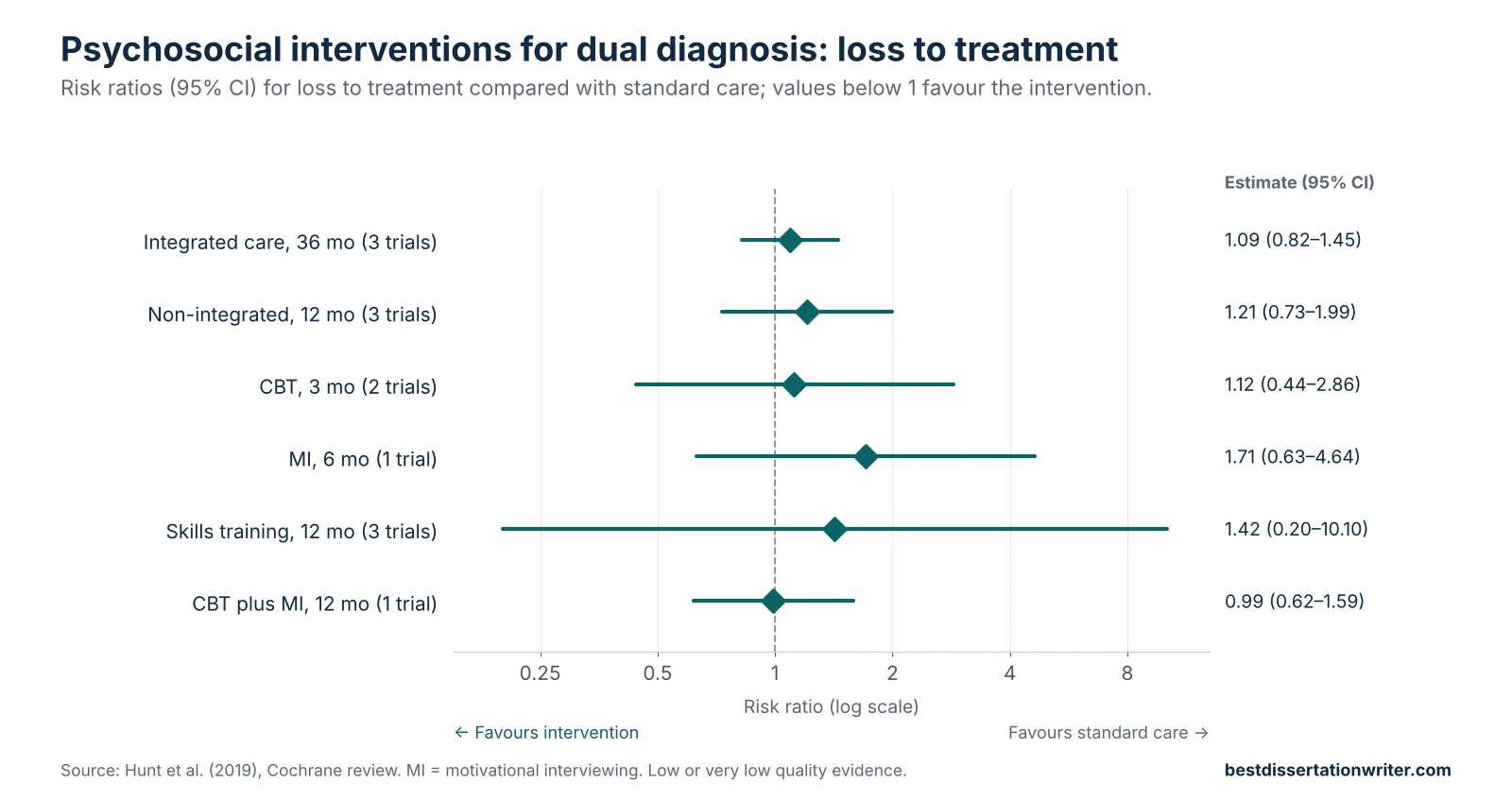
Similarly, non-integrated models, cognitive behavioural therapy, motivational interviewing, skills training and combined cognitive behavioural therapy and motivational interviewing showed no clear effect on loss to treatment, and most evidence was rated low or very low quality. Motivational interviewing improved alcohol abstinence in one very small trial, and contingency management reduced hospitalisation in one trial. The authors noted that differences in study design and outcome measures made comparisons between interventions difficult.
Theme 3: Integrated Care, Partnership and Client Experience
Although trials have not shown clear benefits of integrated care on clinical outcomes, client experience offers a different perspective. Schulte et al. (2011) systematically reviewed 27 studies of treatment satisfaction among people with dual diagnosis. Average satisfaction was high, and in most studies integrated dual diagnosis treatment produced higher satisfaction than standard treatment. In standard services, people with a dual diagnosis were less satisfied than those with a single diagnosis. However, many studies had small samples and did not use validated instruments.
National guidance focuses on access and coordination rather than on a single treatment model. NICE (2016) recommends that people with severe mental illness should not be excluded from secondary mental health services because of their substance misuse, that a care coordinator should be provided, and that missed appointments should be treated as a matter of concern by all practitioners rather than as a reason for discharge. It also calls for staff to be supported to challenge negative attitudes.
Public Health England (2017) similarly encouraged commissioners and providers of mental health and alcohol and drug services to work together to improve access, reduce harm, improve health, enhance recovery and prevent exclusion. Taken together, these sources suggest that the main value of integrated care may lie in keeping people engaged, reducing exclusion and improving their experience of services, even where effects on substance use and symptoms remain uncertain.
Discussion
This review shows that dual diagnosis is common among people with severe mental illness, affecting around four in ten people with schizophrenia spectrum disorders, and that it is associated with exclusion from services. However, the evidence for specific psychosocial interventions is weak, with the most recent Cochrane review finding no high-quality evidence that any one approach is better than standard care. This creates a tension between the strong case for improving care and the limited evidence about how best to do so.
The difference between the earlier nursing review and the later Cochrane review is instructive. Cleary et al. (2009) included non-randomised studies and found promising signals for motivational interviewing, whereas Hunt et al. (2019) restricted inclusion to randomised trials and found that most effects were uncertain. Stricter methods often reduce apparent benefits. Nurses should therefore be cautious about claims that any single dual diagnosis intervention is highly effective, while recognising that absence of clear evidence is not the same as evidence of no effect.
The evidence on integrated care also needs careful interpretation. Integrated care did not improve retention or substance use in trials, but people receiving it reported higher satisfaction (Schulte et al., 2011), and national guidance strongly supports joined-up care. Trial results also depend on what ‘standard care’ means in each setting, and this may differ considerably from current NHS practice. Outcomes that matter to people with a dual diagnosis, such as housing stability, relationships and feeling respected, were rarely measured.
Nurses’ attitudes may influence whether evidence-based approaches are used at all. NICE (2016) recognised the need to challenge negative attitudes, and pessimism about substance use can lead to exclusion or disengagement. Therapeutic optimism, consistent relationships and a non-judgemental approach to dual diagnosis are likely to be as important as the choice of intervention, although these factors are difficult to test in trials.
The evidence base has limitations. Trials were often small, of short duration and heterogeneous, prevalence studies used different definitions, and few studies were conducted in the UK or focused on nursing interventions. This review relied on openly accessible, English-language sources and did not involve independent double screening. Future research should evaluate nurse-led and integrated dual diagnosis care in NHS settings, include service user-defined outcomes and examine how staff training affects engagement and recovery.
Implications of Dual Diagnosis Evidence for Practice
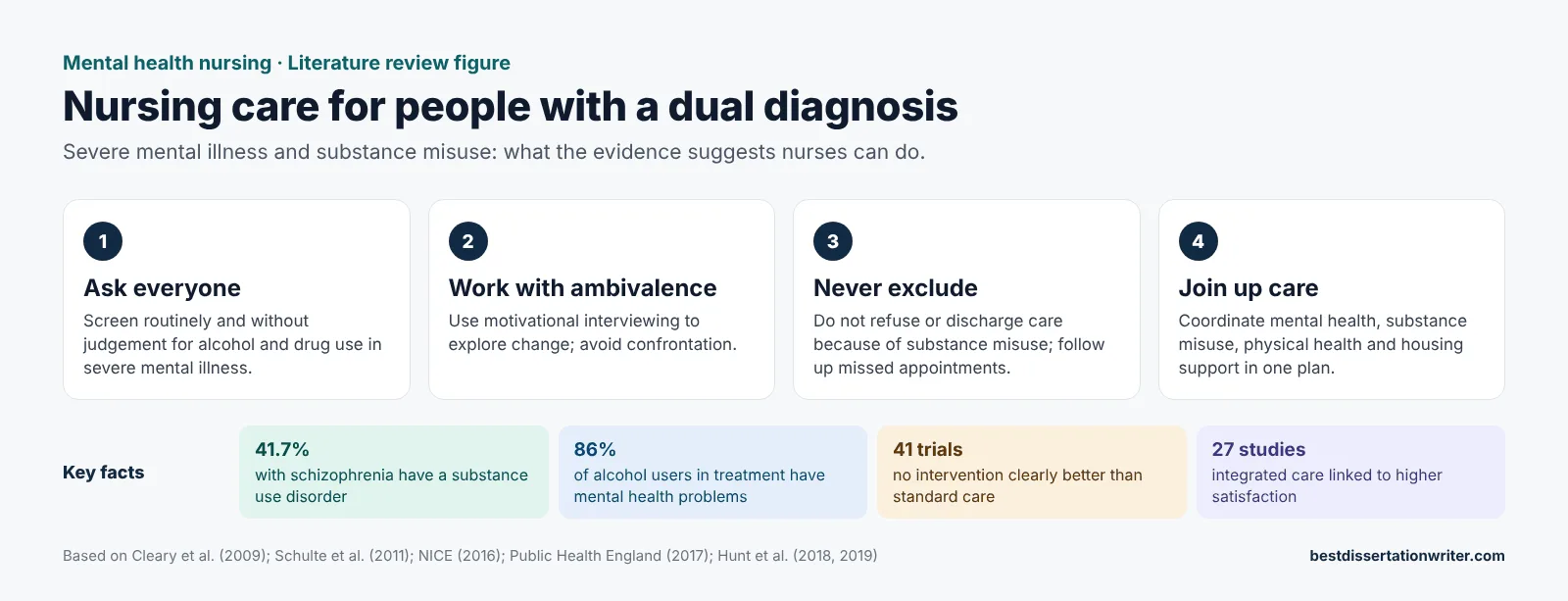
For mental health nurses, the evidence supports routine, non-judgemental screening for alcohol and drug use in everyone with a severe mental illness, and the use of motivational interviewing techniques to explore ambivalence about change. Nurses should avoid excluding or discharging people because of substance misuse, treat missed appointments as a reason for concern and active follow-up, and work closely with substance misuse services, primary care, housing and other agencies through a shared care plan. Physical health checks, harm reduction advice, relapse prevention planning and support for families and carers should also be part of routine care, because people with co-occurring conditions face high risks of physical illness and early death.
Effective integrated care also involves tackling mental illness stigma and offering psychological approaches such as cognitive behavioural therapy where appropriate, alongside motivational work. Peer support from people with lived experience of recovery can strengthen engagement, and the high prevalence of substance use among people with schizophrenia means that co-occurring disorders should be addressed as part of everyday care rather than referred elsewhere.
Conclusion
This integrative review examined evidence on nursing care for people with a dual diagnosis of mental illness and substance misuse. Substance use disorders affect around four in ten people with schizophrenia spectrum disorders, and people with co-occurring conditions are often excluded from services, yet no single psychosocial intervention has high-quality evidence of benefit over standard care.
Integrated care is associated with higher client satisfaction and is strongly supported by national guidance, even though its effects on clinical outcomes remain uncertain. Mental health nurses can improve dual diagnosis care by screening routinely, using motivational approaches, preventing exclusion, coordinating care across services and maintaining hopeful, non-judgemental relationships.
References
Cleary, M., Hunt, G. E., Matheson, S., & Walter, G. (2009). Psychosocial treatments for people with co-occurring severe mental illness and substance misuse: Systematic review. Journal of Advanced Nursing, 65(2), 238–258. https://doi.org/10.1111/j.1365-2648.2008.04879.x
Hunt, G. E., Large, M. M., Cleary, M., Lai, H. M. X., & Saunders, J. B. (2018). Prevalence of comorbid substance use in schizophrenia spectrum disorders in community and clinical settings, 1990–2017: Systematic review and meta-analysis. Drug and Alcohol Dependence, 191, 234–258. https://doi.org/10.1016/j.drugalcdep.2018.07.011
Hunt, G. E., Siegfried, N., Morley, K., Brooke-Sumner, C., & Cleary, M. (2019). Psychosocial interventions for people with both severe mental illness and substance misuse. Cochrane Database of Systematic Reviews, (12), CD001088. https://doi.org/10.1002/14651858.CD001088.pub4
National Institute for Health and Care Excellence. (2016). Coexisting severe mental illness and substance misuse: Community health and social care services (NICE guideline NG58). NICE. https://www.nice.org.uk/guidance/ng58
Public Health England. (2017). Better care for people with co-occurring mental health and alcohol/drug use conditions: A guide for commissioners and service providers. Public Health England. https://www.gov.uk/government/publications/people-with-co-occurring-conditions-commission-and-provide-services
Schulte, S. J., Meier, P. S., & Stirling, J. (2011). Dual diagnosis clients’ treatment satisfaction: A systematic review. BMC Psychiatry, 11, 64. https://doi.org/10.1186/1471-244X-11-64
Cite this example
Best Dissertation Writers (2026) Nursing Care for People with a Dual Diagnosis of Mental Illness and Substance Misuse: An Integrative Review. Available at: https://bestdissertationwriter.com/dual-diagnosis-literature-review/
Best Dissertation Writers
Get expert help with your nursing literature review
Share your topic and deadline with Best Dissertation Writers and get support tailored to your module brief.