
Burnout and Staff Wellbeing Among Nurses Working in Mental Health Units: An Integrative Review
 By Dr. Robertson Prime, Research Fellow
Updated October 12, 2026
15 min read
About 3,000 words
In this review
Abstract
Background: Burnout and staff wellbeing are major concerns in mental health nursing, where nurses support people in acute distress, are repeatedly exposed to trauma that can lead to compassion fatigue, respond to aggression and often work with high caseloads and staff shortages. Exhausted and detached staff may find it harder to form therapeutic relationships and notice changes in risk, while sickness absence and turnover disrupt continuity of care.
Aim: This integrative review aimed to examine how common burnout is among mental health staff, what factors contribute to it, and which interventions can improve wellbeing in mental health nursing.
Methods: Evidence was identified through targeted searches of openly accessible bibliographic records, publisher websites and the reference lists of key reviews. Six sources published between 2016 and 2020 were included: two theoretical reviews, one narrative review, two systematic reviews with meta-analysis and one national mixed-methods evaluation, appraised with CASP checklists and integrated narratively into themes.
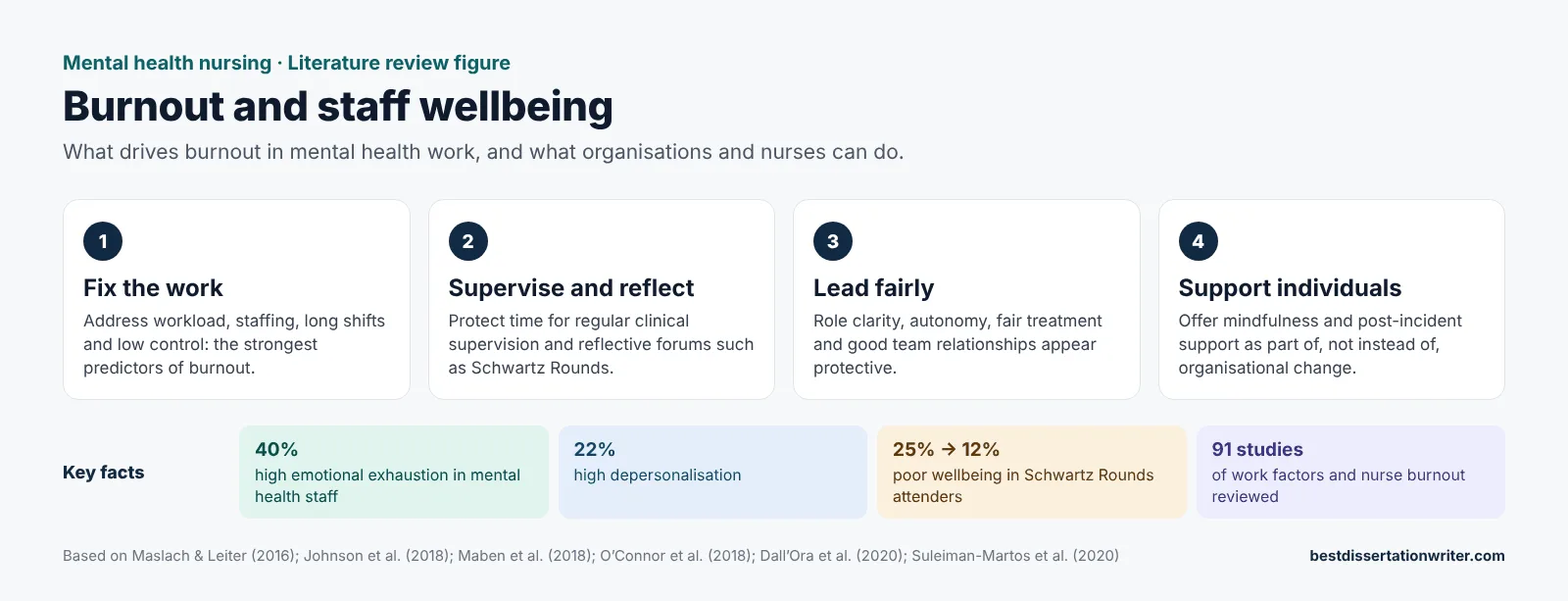
Findings: A meta-analysis of 33 studies found that 40% of mental health professionals had high emotional exhaustion, 22% high depersonalisation and 19% low personal accomplishment. Burnout was driven mainly by workload, low staffing, shifts of 12 hours or more, low control and poor working relationships, showing that occupational stress is shaped by how work is organised, and it was associated with poorer quality of care, patient safety incidents and intention to leave. Among staff attending Schwartz Rounds, poor psychological wellbeing fell from 25% to 12%, but evidence for mindfulness training was inconclusive and interventions for mental healthcare staff generally had small effect sizes.
Conclusion: Services should treat staff wellbeing as part of safe care, combining safe staffing, supportive leadership, regular clinical supervision and reflective forums with individual approaches rather than relying on individual resilience alone.
Keywords: burnout and staff wellbeing, occupational stress, compassion fatigue
Introduction
This integrative review critically examines recent evidence on burnout and staff wellbeing and its implications for mental health nursing practice.
Mental health nursing is rewarding but emotionally demanding work. Nurses on inpatient units and in community teams support people in acute distress, manage risk of suicide and self-harm, respond to aggression and violence, and often work with high caseloads and staff shortages. Over time, these pressures can lead to occupational stress, exhaustion and a gradual loss of the empathy and hope that drew many nurses into the profession.
Burnout matters not only for nurses themselves but also for the people they care for. Exhausted and detached staff may find it harder to form therapeutic relationships, to remain calm during conflict and to notice changes in risk, and high levels of sickness absence and turnover disrupt continuity of care. Burnout and staff wellbeing have therefore become concerns for managers, educators and policymakers as well as for individual practitioners.
An integrative review design was chosen because the evidence includes theoretical work, prevalence meta-analyses, narrative reviews, intervention studies and a mixed-methods evaluation. Integrating these different forms of evidence allows a fuller understanding of both the problem and its potential solutions than any one design alone.
Review question
How common is burnout among mental health staff, what factors contribute to it, and which interventions can improve burnout and staff wellbeing in mental health nursing?
Background to Burnout and Staff Wellbeing
Burnout is most commonly understood through the model developed by Christina Maslach and colleagues, which describes three dimensions: emotional exhaustion, depersonalisation (a cynical or detached response to the people one cares for) and a reduced sense of personal accomplishment. Maslach and Leiter (2016) describe burnout as an occupationally specific form of dysphoria and note that most research has focused on human service occupations, particularly health care. The Maslach Burnout Inventory, which measures these three dimensions, remains the most widely used tool in research.
Maslach and Leiter (2016) also observe that, although research on burnout in psychiatry largely mirrors the wider literature, mental health work involves some distinctive stressors, such as dealing with difficult or violent clients. They highlight ongoing debates about the relationship between burnout and mental illness, attempts to redefine burnout as exhaustion alone, and a lack of evaluative research on interventions. These debates are important for understanding burnout and staff wellbeing, because they influence how the problem is measured and addressed.
Related concepts include occupational stress, which refers to the strain arising from demands at work that exceed a person’s resources, and compassion fatigue, which describes the emotional cost of repeated exposure to the suffering and trauma of others. Compassion fatigue is often discussed alongside secondary traumatic stress and is particularly relevant to mental health nurses, who regularly hear accounts of abuse, trauma and despair. Although these concepts overlap with burnout, they emphasise different causes and may require different responses.
Staff wellbeing is a broader, more positive concept that includes job satisfaction, engagement, psychological health and a sense of meaning at work. Considering burnout and staff wellbeing together encourages organisations to build supportive conditions rather than simply respond once staff are unwell, and to recognise the strengths, such as meaning and team support, that help nurses to stay well.
Search Strategy and Methods
Evidence for this example was identified through targeted searches of openly accessible bibliographic records, publisher websites and the reference lists of key reviews. Search terms combined keywords for the population and setting (“mental health nurs*”, “psychiatric nurs*”, “mental health professionals”, “inpatient”, “community mental health”) with terms for outcomes and interventions (“burnout”, “staff wellbeing”, “occupational stress”, “compassion fatigue”, “clinical supervision”, “Schwartz Rounds”, “mindfulness”), joined with the Boolean operators AND and OR. A full integrative review for assessment would run the same strategy in CINAHL, PubMed/MEDLINE, PsycINFO, the Cochrane Library and Embase and report the number of records screened in a PRISMA flow diagram.
Sources were eligible if they addressed burnout and staff wellbeing among nurses or mental health professionals and reported on concepts, prevalence, contributing factors or interventions. Because this was an integrative review, theoretical papers, systematic reviews, narrative reviews, meta-analyses and mixed-methods evaluations were all eligible. Studies of students only, opinion pieces without evidence and studies of non-healthcare workers were excluded.
Six sources published between 2016 and 2020 were included: one theoretical review of the burnout model, one narrative review of mental healthcare staff wellbeing, one systematic review and meta-analysis of burnout prevalence, one theoretical review of burnout in nursing, one systematic review and meta-analysis of mindfulness training and one national mixed-methods evaluation (Table 1). The quality of each source was appraised using the Critical Appraisal Skills Programme (CASP) checklist appropriate to its design, and findings were integrated narratively into themes relevant to burnout and staff wellbeing in mental health nursing.
Key Findings on Burnout and Staff Wellbeing
Three themes were identified: the prevalence of burnout among mental health professionals; the work factors that drive burnout and its consequences for staff and patients; and interventions to improve burnout and staff wellbeing. Table 1 summarises the included sources, and Figure 1 presents the pooled prevalence of each burnout dimension among mental health professionals.
| Author, year | Design | Setting and sample | Key finding |
|---|---|---|---|
| Maslach and Leiter (2016) | Theoretical review | Burnout research across human service occupations, including psychiatry | Burnout is an occupational dysphoria; mental health work has distinctive stressors; intervention research is scarce. |
| Johnson et al. (2018) | Narrative review | National surveys, reports and studies of mental healthcare staff | Mental healthcare staff report poorer wellbeing than other sectors; intervention effects small. |
| Maben et al. (2018) | Realist-informed mixed-methods evaluation | Schwartz Rounds in England; survey at 10 sites, 177 interviews | Poor psychological wellbeing fell from 25% to 12% among attenders vs 37% to 34% in non-attenders. |
| O’Connor et al. (2018) | Systematic review and meta-analysis | 62 studies; 33 in meta-analysis, 9,409 mental health professionals | High emotional exhaustion 40%, depersonalisation 22%, low personal accomplishment 19%. |
| Dall’Ora et al. (2020) | Theoretical review | 91 quantitative studies of burnout in nursing | Workload, low staffing, long shifts and low control linked to burnout and poorer patient care. |
| Suleiman-Martos et al. (2020) | Systematic review and meta-analysis | 17 studies, 632 nurses; mindfulness training | Authors concluded mindfulness reduces burnout, but pooled effects (two studies) were not significant. |
Theme 1: The Prevalence of Burnout in Mental Health Professionals
O’Connor et al. (2018) conducted a systematic review of 62 studies and a meta-analysis of 33 studies involving 9,409 mental health professionals from a range of disciplines. Using the Maslach Burnout Inventory, they found that 40% of mental health professionals had high emotional exhaustion, 22% had high depersonalisation and 19% had low personal accomplishment. Mean scores indicated high emotional exhaustion, moderate depersonalisation and a reasonably well-preserved sense of personal accomplishment.
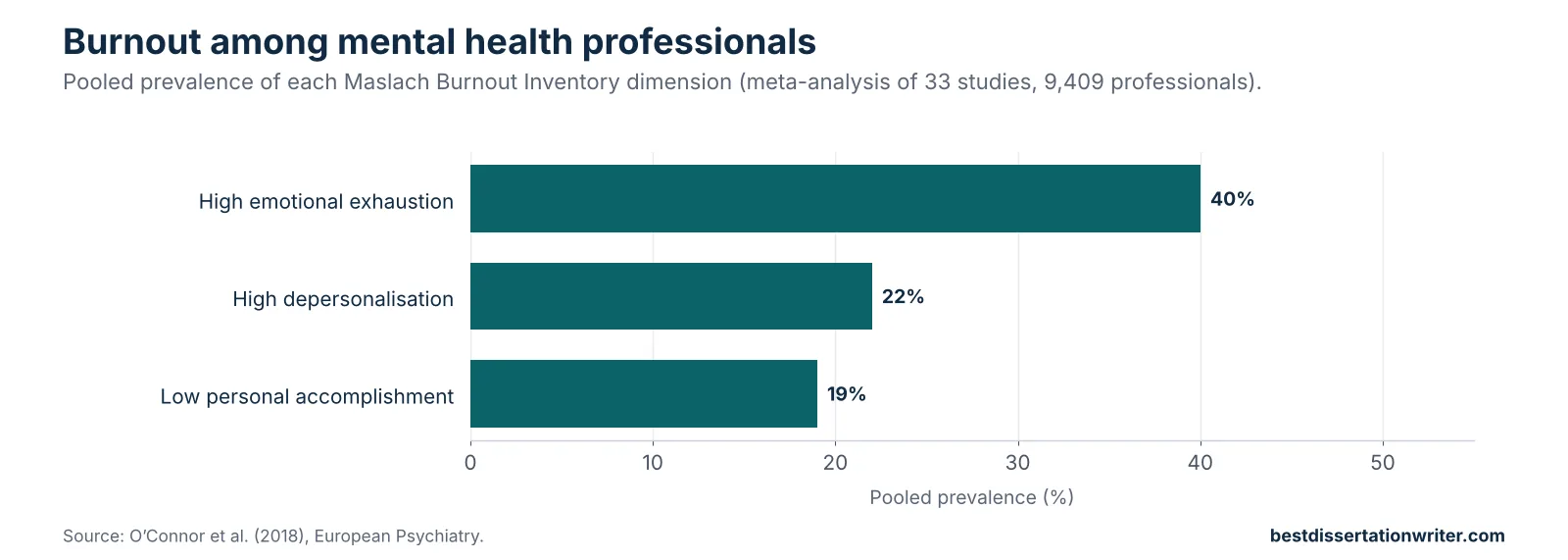
These findings suggest that emotional exhaustion is the dominant feature of burnout in mental health work, while many professionals continue to feel that their work is worthwhile. This pattern offers some hope, since a preserved sense of accomplishment may be a resource for recovery. However, the meta-analysis combined different professions and countries, used different cut-off points and relied on cross-sectional surveys, so it cannot show how burnout changes over time or how it differs between nursing and other professions.
Johnson et al. (2018), in a narrative review of national surveys, reports and research, concluded that staff in mental healthcare report poorer wellbeing than staff in other healthcare sectors. As a narrative review, it did not use systematic methods or pool data, but it brought together evidence from several sources to show that burnout and staff wellbeing are a particular concern in mental health services rather than an isolated problem in individual teams.
Theme 2: Work Factors, Occupational Stress and Consequences
O’Connor et al. (2018) identified workload and relationships at work as key determinants of burnout, while role clarity, professional autonomy, feeling fairly treated and access to regular clinical supervision appeared protective. Older age was associated with higher depersonalisation but also with a greater sense of personal accomplishment. Staff in community mental health teams appeared more vulnerable than those in some specialist community teams, such as assertive outreach and crisis teams.
Dall’Ora et al. (2020) reviewed 91 quantitative studies of burnout in nursing, most of which were cross-sectional. They found consistent support for the predictors proposed in Maslach’s theory, including high workload, low control, low decision latitude, poor social climate or support, value incongruence and low rewards. Low staffing, shifts of 12 hours or more and job insecurity were also linked to burnout, showing that occupational stress is shaped by how work is organised rather than by individual weakness.
The consequences of burnout extend beyond the individual. Dall’Ora et al. (2020) found associations between burnout and poorer general health and sickness absence, and also with reduced job performance, poorer quality of care, patient safety incidents, medication errors, infections, patient falls and intention to leave. Johnson et al. (2018) similarly linked poorer wellbeing and higher burnout to poorer quality and safety of care, higher absenteeism and higher turnover. These links strengthen the case for organisations to treat burnout as a patient safety issue.
Taken together, these findings suggest that burnout and staff wellbeing in mental health nursing are shaped largely by the conditions in which nurses work. Mental health units where staffing is stretched, shifts are long and staff have little control over their work are therefore likely to concentrate the risk factors identified in these reviews. This interpretation is consistent with the evidence, although few of the included studies examined mental health wards specifically.
Theme 3: Interventions to Improve Burnout and Staff Wellbeing
Schwartz Rounds are regular forums in which staff from all disciplines reflect on the emotional and social aspects of their work. In a national evaluation in England, Maben et al. (2018) carried out a two-wave staff survey at ten sites, alongside case studies and interviews. Among staff who attended Rounds, the proportion with poor psychological wellbeing fell from 25% to 12%, a statistically significant reduction, compared with a change from 37% to 34% among non-attenders. No change in work engagement was found.
This evaluation was large and used mixed methods, including 177 interviews and observation of 42 Rounds, but it was not randomised. Staff who chose to attend may have differed from those who did not, and survey response rates were modest, at 30% at baseline and 44% at follow-up. The findings therefore suggest, rather than prove, that Rounds can support staff wellbeing by offering a safe space to share the emotional impact of care, which may help to counter compassion fatigue.
Suleiman-Martos et al. (2020) reviewed 17 studies involving 632 nurses to examine the effect of mindfulness training on burnout. The authors concluded that mindfulness reduced emotional exhaustion and burnout, but most studies were quasi-experimental, and only two studies could be combined in a meta-analysis. The pooled differences for emotional exhaustion, depersonalisation and personal accomplishment all had wide confidence intervals that crossed zero, so the quantitative evidence for mindfulness remains inconclusive.
Johnson et al. (2018) reached a similar conclusion across interventions, noting that interventions for mental healthcare staff are effective but have small effect sizes. They recommended that interventions be grounded in research, emphasise positive aspects for staff and be designed to address both burnout and patient care. Clinical supervision, highlighted as protective by O’Connor et al. (2018), fits this description, although it was not directly evaluated as an intervention in the included sources.
Discussion
This integrative review shows that burnout is common among mental health professionals, with around two in five experiencing high emotional exhaustion, and that mental healthcare staff report poorer wellbeing than colleagues in other sectors. The evidence consistently links burnout to workload, staffing, shift patterns, lack of control and poor working relationships, and to poorer care quality and patient safety.
A key tension lies between individual and organisational approaches. Mindfulness and other individual interventions place responsibility on nurses to manage their own stress, yet the strongest predictors of burnout are features of the work environment (Dall’Ora et al., 2020). Individual interventions may help, but they are unlikely to be sufficient if staffing, workload and leadership problems remain. Organisational approaches to burnout and staff wellbeing, such as safe staffing, supportive leadership, fair treatment and protected time for supervision and reflection, address the root causes of burnout and staff wellbeing problems.
The evidence base for interventions is weaker than the evidence on prevalence and predictors. Maslach and Leiter (2016) noted a shortage of evaluative research, Johnson et al. (2018) reported small effect sizes, and the mindfulness meta-analysis by Suleiman-Martos et al. (2020) rested on only two studies. Reflective approaches such as Schwartz Rounds show promise, but non-randomised designs make it difficult to separate the effect of the intervention from the characteristics of those who choose to attend.
Compassion fatigue and occupational stress deserve more specific attention in mental health nursing. Exposure to trauma, aggression and suicide is a routine part of the work, and nurses may experience moral distress when they cannot provide the care they believe is needed. Supporting staff after serious incidents, offering reflective practice and recognising the emotional labour of mental health nursing are important elements of a whole-organisation approach to burnout and staff wellbeing.
This review has limitations. This review relied on openly accessible, English-language sources, did not involve independent double screening and included a small number of sources. Several sources combined nurses with other professions, and most primary studies were cross-sectional, which prevents conclusions about cause and effect. Future research should use longitudinal and randomised designs, focus specifically on mental health nurses, evaluate organisational as well as individual interventions and measure patient outcomes alongside staff wellbeing.
Implications of Burnout and Staff Wellbeing Evidence for Practice
For mental health services, the evidence supports treating staff wellbeing as a core part of safe care. Managers should monitor workload, staffing and sickness absence, ensure regular clinical supervision and reflective practice, and offer forums such as Schwartz Rounds. Individual approaches, including mindfulness, can be offered as part of a wider strategy but should not replace action on working conditions. Nurses should be encouraged to recognise early signs of exhaustion and detachment in themselves and colleagues and to seek support without stigma.
Burnout can undermine the therapeutic relationship and make it harder to use de-escalation techniques calmly during conflict. Organisational approaches based on trauma-informed care recognise the impact of trauma on staff as well as patients, while well-designed digital mental health interventions may offer flexible support for staff who find it hard to attend sessions in person.
Conclusion
This integrative review examined evidence on burnout and staff wellbeing among mental health professionals and nurses. Emotional exhaustion is common, burnout is driven mainly by workload, staffing and the organisation of work, and it is associated with poorer quality and safety of care. Interventions such as Schwartz Rounds and mindfulness show promise, but the evidence for their effectiveness is limited.
Improving burnout and staff wellbeing among mental health nurses requires action at both individual and organisational levels. Safe staffing, supportive leadership, regular supervision and opportunities for reflection offer the most promising ways to reduce burnout and protect both nurses and the people they care for.
References
Dall’Ora, C., Ball, J., Reinius, M., & Griffiths, P. (2020). Burnout in nursing: A theoretical review. Human Resources for Health, 18(1), 41. https://doi.org/10.1186/s12960-020-00469-9
Johnson, J., Hall, L. H., Berzins, K., Baker, J., Melling, K., & Thompson, C. (2018). Mental healthcare staff well-being and burnout: A narrative review of trends, causes, implications, and recommendations for future interventions. International Journal of Mental Health Nursing, 27(1), 20–32. https://doi.org/10.1111/inm.12416
Maben, J., Taylor, C., Dawson, J., Leamy, M., McCarthy, I., Reynolds, E., Ross, S., Shuldham, C., Bennett, L., & Foot, C. (2018). A realist informed mixed-methods evaluation of Schwartz Center Rounds® in England. Health Services and Delivery Research, 6(37). https://doi.org/10.3310/hsdr06370
Maslach, C., & Leiter, M. P. (2016). Understanding the burnout experience: Recent research and its implications for psychiatry. World Psychiatry, 15(2), 103–111. https://doi.org/10.1002/wps.20311
O’Connor, K., Muller Neff, D., & Pitman, S. (2018). Burnout in mental health professionals: A systematic review and meta-analysis of prevalence and determinants. European Psychiatry, 53, 74–99. https://doi.org/10.1016/j.eurpsy.2018.06.003
Suleiman-Martos, N., Gomez-Urquiza, J. L., Aguayo-Estremera, R., Cañadas-De La Fuente, G. A., De La Fuente-Solana, E. I., & Albendín-García, L. (2020). The effect of mindfulness training on burnout syndrome in nursing: A systematic review and meta-analysis. Journal of Advanced Nursing, 76(5), 1124–1140. https://doi.org/10.1111/jan.14318
Cite this example
Best Dissertation Writers (2026) Burnout and Staff Wellbeing Among Nurses Working in Mental Health Units: An Integrative Review. Available at: https://bestdissertationwriter.com/burnout-and-staff-wellbeing-review/
Best Dissertation Writers
Get expert help with your nursing literature review
Share your topic and deadline with Best Dissertation Writers and get support tailored to your module brief.