Factors Influencing Caesarean Section Rates and Women’s Decision-Making: An Integrative Review
 By Dr. Robertson Prime, Research Fellow
Updated October 12, 2026
15 min read
About 3,100 words
In this review
Abstract
Background: Caesarean section rates have risen steeply worldwide, and in many countries now exceed the level that can be justified by medical need, while in others women who need a caesarean cannot obtain one. Understanding why rates vary, and how women and clinicians make decisions about mode of birth, is essential for safe and respectful maternity care.
Aim: This integrative review aimed to examine the factors influencing caesarean use and women’s decision-making about mode of birth, and what these mean for midwifery practice.
Methods: Evidence was identified through targeted searches of openly accessible bibliographic records, publisher websites and the reference lists of key reviews. Seven sources published between 2011 and 2021 were included: two global epidemiological analyses, a meta-analysis, a Cochrane review, a qualitative and quantitative metasynthesis, a scoping review and a national guideline, appraised with CASP checklists and synthesised thematically.
Findings: The global caesarean rate rose from 12.1% in 2000 to 21.1% in 2015 and is projected to reach 28.5% by 2030, with ten-fold differences between regions. Only 15.6% of women expressed a preference for caesarean birth, although this rose to 29.4% after a previous caesarean. Clinicians’ personal beliefs, litigation fears and private payment models strongly shaped decisions, and interventions aimed at professionals, such as guidelines with audit and feedback, had the most certain effects.
Conclusion: Midwives can help to ensure that caesarean decisions reflect women’s informed preferences by exploring the reasons behind requests, addressing fear of birth and supporting genuinely shared decision-making.
Keywords: caesarean section rates, decision-making, maternal request, birth choices
Introduction
This integrative review critically examines recent evidence on caesarean section rates and its implications for midwifery practice.
Caesarean birth can be life-saving for women and babies when complications arise. Over recent decades, however, the proportion of births by caesarean has risen steeply in many countries, often well beyond what can be explained by medical need. At the same time, many women in low-income settings still lack access to a caesarean when they need one. Both overuse and underuse carry risks, and the wide variation between and within countries has prompted concern from the World Health Organization, governments and professional bodies.
Rising caesarean section rates are often attributed to women requesting surgery without a medical reason. Yet this explanation is contested. Clinicians’ beliefs, fear of litigation, financial incentives, hospital policies and the way choices are presented to women all influence whether a caesarean takes place. For midwives, who support women through pregnancy and birth and are committed to promoting physiological birth while respecting women’s autonomy, understanding these influences is essential for honest and balanced conversations about birth choices and for interpreting local caesarean section rates fairly.
An integrative review was chosen because the evidence combines epidemiological analyses, a meta-analysis of observational studies, a Cochrane review of interventions, qualitative and mixed methods syntheses and national guidance. An integrative design allows these different types of evidence to be combined to build a fuller picture than any single method could provide.
Review question
What factors influence caesarean section rates, how do women and clinicians make decisions about mode of birth, and what are the implications for midwifery practice?
Background to Caesarean Section Rates
A caesarean section may be planned before labour, for example because of placenta praevia or breech presentation, or performed as an emergency during labour. A maternal request caesarean is one requested by a woman without a medical indication, often because of fear of childbirth, a previous traumatic birth or concern about pelvic floor damage. In practice, the boundary between medical indication and preference is often unclear, particularly when the indication is relative rather than absolute.
There is no single ideal caesarean rate for every population, and attention has increasingly moved away from fixed targets towards ensuring that every woman who needs a caesarean receives one, while avoiding surgery that offers no benefit. Population caesarean section rates are therefore used as an indicator of both access to emergency obstetric care and possible overuse. Very low caesarean section rates may signal that women with obstructed labour or other emergencies cannot reach surgery, whereas very high rates suggest that many operations are being performed without clear clinical need.
Caesarean birth carries short-term risks, such as infection, haemorrhage and thromboembolism, and longer-term risks for future pregnancies, including placenta accreta and uterine rupture. It may also affect breastfeeding, early skin-to-skin contact and recovery. For many women, however, a planned caesarean offers a sense of control and safety. Balancing these risks and benefits requires individualised decision-making rather than blanket policies.
In the UK, the National Institute for Health and Care Excellence (NICE, 2021) guideline on caesarean birth sets out how planned caesarean birth should be discussed, including when a woman requests one without a medical indication. The guideline emphasises balanced information, exploration of the reasons for the request and respect for the woman’s informed choice.
Search Strategy and Methods
Evidence for this example was identified through targeted searches of openly accessible bibliographic records, publisher websites and the reference lists of key reviews. Search terms combined keywords for the outcome (“caesarean section rates”, “cesarean”, “mode of birth”) with terms for influences and decisions (“maternal request”, “preference”, “decision-making”, “clinician”, “intervention”, “trend*”), joined with the Boolean operators AND and OR. A full integrative review for assessment would run the same strategy in CINAHL, PubMed/MEDLINE, the Cochrane Library and Embase and report the number of records screened in a PRISMA flow diagram. MIDIRS would also be searched for midwifery literature.
Sources were eligible if they reported population caesarean section rates or trends, women’s preferences for mode of birth, clinicians’ views on caesarean decision-making or interventions to reduce unnecessary caesareans. Systematic and scoping reviews, global epidemiological analyses and national guidance were prioritised. Single-centre audits and studies of surgical technique were excluded, as were studies reporting caesarean section rates without any information on influences, preferences or decisions.
Seven sources published between 2011 and 2021 were included: two global epidemiological analyses, a systematic review and meta-analysis of observational studies, a Cochrane systematic review, a systematic review and metasynthesis, a scoping review and a national clinical guideline (Table 1). The quality of each source was appraised using the Critical Appraisal Skills Programme (CASP) checklist appropriate to its design, and findings were integrated thematically, with attention to points of agreement and tension across methods.
Key Findings on Caesarean Section Rates
Three themes were identified: global trends and inequalities in caesarean use, women’s preferences and the role of maternal request, and clinician and system influences together with interventions to reduce unnecessary caesareans. Table 1 summarises the included sources, and Figure 1 presents the proportion of women preferring caesarean birth in different groups, based on a meta-analysis of observational studies.
| Author, year | Design | Setting and sample | Key finding |
|---|---|---|---|
| Mazzoni et al. (2011) | Systematic review and meta-analysis of observational studies | 38 studies, 19,403 women | 15.6% preferred caesarean birth; 29.4% after a previous caesarean vs 10.1% without. |
| Boerma et al. (2018) | Global epidemiological analysis | 169 countries, 98.4% of the world’s births | Caesarean births rose from 12.1% (2000) to 21.1% (2015); almost five times more frequent among the richest women in low- and middle-income countries. |
| Chen et al. (2018) | Cochrane systematic review | 29 studies of non-clinical interventions | Guidelines with audit and feedback or second opinion gave small, high-certainty reductions; interventions for women low certainty. |
| Panda et al. (2018) | Systematic review and metasynthesis | 34 studies, 7,785 obstetricians and 1,197 midwives, 20 countries | Clinicians’ personal beliefs were a major influence, shaped by litigation, resources and payment models. |
| Coates et al. (2020) | Systematic scoping review | 65 studies of women’s mode of birth preferences | Most women preferred vaginal birth; preference shaped by safety, fear of pain, past experience and professionals. |
| NICE (2021) | National clinical guideline | Caesarean birth, England and Wales | Explore reasons for maternal request, give balanced information, offer mental health support and respect informed choice. |
| Betran et al. (2021) | Global trend and projection analysis | 154 countries, 94.5% of live births | Global caesarean rate 21.1%; projected to reach 28.5% by 2030, with wide regional variation. |
Theme 1: Global Trends and Inequalities in Caesarean Section Rates
Boerma et al. (2018) analysed data from 169 countries covering 98.4% of the world’s births. The number of caesarean births rose from 16.0 million (12.1% of births) in 2000 to 29.7 million (21.1%) in 2015. Rates ranged from 4.1% in West and Central Africa to 44.3% in Latin America and the Caribbean, and from 0.6% in South Sudan to 58.1% in the Dominican Republic. About two-thirds of the global increase was due to more births in health facilities and one-third to greater caesarean use within facilities.
Boerma et al. (2018) also identified marked inequalities within countries. In low-income and middle-income countries, caesareans were almost five times more frequent among the richest than the poorest women, and they were 1.6 times more frequent in private than in public facilities. These findings suggest that wealth, private provision and the organisation of care influence caesarean use, alongside clinical need.
Betran et al. (2021) estimated a global rate of 21.1% using data from 154 countries, ranging from 5.0% in sub-Saharan Africa to 42.8% in Latin America and the Caribbean. If trends continue, the global rate is projected to reach 28.5% by 2030, about 38 million caesareans a year, with projected rates of 63.4% in Eastern Asia. The projections depend on past trends continuing, but they show that caesarean section rates are likely to keep rising without deliberate action. Taken together, the two global analyses show that rising caesarean section rates are a long-term trend rather than a short-term fluctuation, and that both very low and very high rates coexist in the world today.
Theme 2: Women’s Preferences and Maternal Request
The idea that rising rates are driven mainly by women’s demand is not well supported. Mazzoni et al. (2011) pooled 38 observational studies involving 19,403 women and found that only 15.6% of women overall preferred caesarean birth. Preference was higher among women who had had a previous caesarean (29.4%) than among those who had not (10.1%), and higher in middle-income countries (22.1%) than in high-income countries (11.8%).
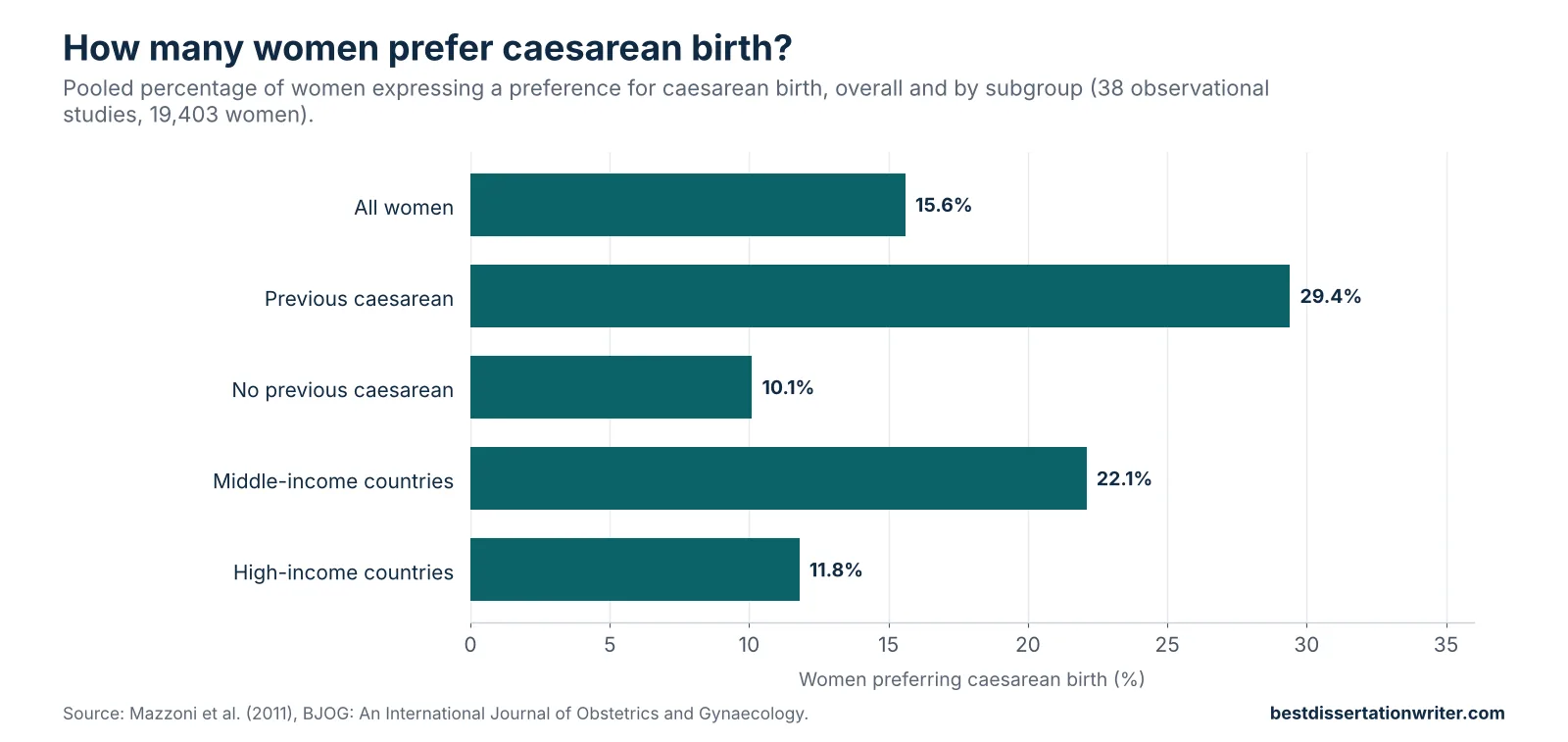
These findings show that most women prefer vaginal birth and that previous birth experience strongly shapes preference. The authors noted that preference rates were well below actual caesarean rates in many countries, suggesting that maternal request alone cannot explain rising caesarean section rates. However, the included studies used different questions and timings, and preferences expressed in surveys may change during pregnancy, so the pooled estimate should be interpreted with caution.
Coates et al. (2020) reviewed 65 studies of women’s birth preferences and their reasons. Most women preferred vaginal birth, but caesarean preference ranged from 5% to 20% in high-income countries and from 1.4% to 50% in low-income and middle-income countries. Six factors were associated with preference: perceptions of safety, fear of pain, previous birth experience, encouragement or dissuasion from health professionals, social and cultural influences, and access to information and education. The authors recommended shared decision-making so that care reflects women’s informed birth choices.
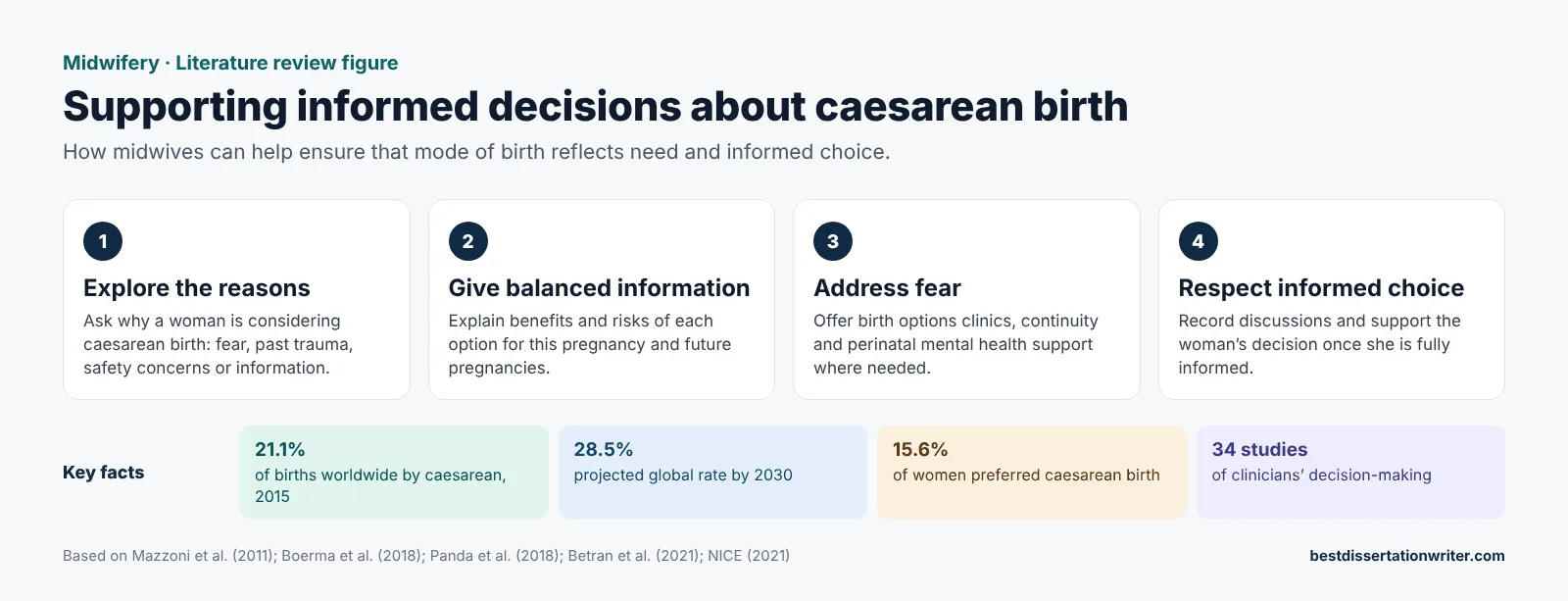
The NICE (2021) guideline describes how a maternal request should be handled. Professionals should explore the reasons for the request, provide balanced information, discuss alternative options such as place of birth, pain relief and continuity of midwifery care, and offer discussion with a senior midwife or obstetrician. Women with tokophobia or severe anxiety should be offered perinatal mental health support. If, after an informed discussion, the woman still requests a caesarean, her choice should be supported. This approach treats a maternal request as the start of a conversation rather than a demand to be accepted or refused.
Theme 3: Clinician and System Influences on Decision-Making
Panda et al. (2018) synthesised 34 studies involving 7,785 obstetricians and 1,197 midwives in 20 countries. Clinicians’ personal beliefs, including professional philosophies, views on maternal request and their interpretation of ambiguous clinical situations, were a major influence on decision-making. These were shaped by health system factors, such as fear of litigation, resources, private and insurance-based payment and local guidelines, and by clinician characteristics, such as convenience, confidence and skills.
This evidence shifts attention from women’s requests to the professional and organisational context. A woman’s ‘choice’ may be shaped by how options are presented, and clinicians who are less confident in vaginal breech birth or instrumental delivery may lean towards caesarean birth. The review included 19 quantitative, 14 qualitative and one mixed methods study, which strengthens its conclusions by combining measures of how often factors were reported with accounts of why they mattered. However, it captured clinicians’ views rather than observed practice, so it cannot show how much each factor changes caesarean section rates.
Chen et al. (2018) reviewed 29 studies of non-clinical interventions to reduce unnecessary caesareans. Interventions aimed at health professionals had the most certain effects: clinical guidelines combined with a mandatory second opinion or with audit and feedback produced small reductions in caesarean rates, with high-certainty evidence. Some interventions for women, such as childbirth workshops and nurse-led relaxation training, appeared to reduce caesareans, but the evidence was of low certainty, while antenatal education for physiological birth and computer-based decision aids made little or no difference.
Discussion
This review shows that caesarean section rates have risen substantially worldwide and vary widely between and within countries. The evidence does not support the common assumption that rising rates are mainly driven by women’s requests. Most women prefer vaginal birth, and the factors that most strongly influence caesarean decisions appear to lie with clinicians and health systems, including professional beliefs, fear of litigation and private payment models.
There is nevertheless an important tension between reducing unnecessary caesareans and respecting autonomy. Women who request a caesarean often do so because of fear, previous trauma or a lack of trust in the care they expect to receive. Treating these requests purely as a target for reduction risks dismissing legitimate concerns. The NICE (2021) guideline resolves this by asking professionals to explore, inform and support, and ultimately to respect an informed maternal request.
The evidence on interventions is mixed. Professional-level strategies such as audit and feedback and second opinions had the strongest evidence, but their effects on rates were small. Interventions aimed at women showed promise in single small trials but were not consistently effective. This suggests that lowering caesarean section rates safely requires changes to professional culture and systems as well as support for individual women. Because the effects of single interventions were small, combining several approaches within a service may be needed to change caesarean section rates meaningfully.
The global picture adds further complexity. In regions where rates are very low, the priority is improving access to safe caesarean birth, whereas in regions with very high rates the challenge is to reduce unnecessary surgery. Inequalities by wealth and type of facility show that caesarean use often reflects social and economic factors rather than clinical need alone, raising questions of equity as well as safety.
This review has limitations. It relied on openly accessible, English-language sources and a targeted rather than exhaustive search, without independent double screening. Several included reviews combined observational studies of variable quality, and the preference data are now more than a decade old. Future research should explore women’s decision-making in diverse settings, evaluate midwife-led birth options services and test interventions that address clinician and system influences.
Implications of Caesarean Section Rates Evidence for Practice
For midwives, the evidence supports balanced, non-judgemental conversations about mode of birth that begin early in pregnancy. When a woman raises a maternal request, midwives should explore the reasons, provide accurate information about the benefits and risks of each option and offer referral to a birth options clinic or perinatal mental health support where appropriate. Women with fear of childbirth may benefit from specialist support, and antenatal education can provide information about labour, pain relief and recovery. Models of continuity of carer allow trusting relationships in which women feel able to discuss their fears and preferences openly.
Midwives should also recognise the influence of previous experiences. Women who have had a traumatic birth or a pregnancy loss may approach the next birth with heightened anxiety, and good bereavement care following stillbirth includes sensitive planning for future pregnancies. At service level, midwives can contribute to audit and feedback on mode of birth, promote skills in physiological and assisted vaginal birth and ensure that local policies support informed, shared decisions.
Conclusion
This integrative review examined the factors influencing caesarean section rates and decision-making about mode of birth. Global rates have risen sharply and vary widely, but most women prefer vaginal birth, and clinician beliefs and system factors appear to influence caesarean use more strongly than maternal request alone.
Midwives can help to ensure that caesarean decisions reflect women’s informed preferences and clinical need by exploring the reasons behind requests, addressing fear, providing balanced information and supporting shared decision-making. Combined with professional and system-level change, this approach offers a way to address rising caesarean section rates while respecting women’s birth choices.
References
Betran, A. P., Ye, J., Moller, A.-B., Souza, J. P., & Zhang, J. (2021). Trends and projections of caesarean section rates: Global and regional estimates. BMJ Global Health, 6(6), e005671. https://doi.org/10.1136/bmjgh-2021-005671
Boerma, T., Ronsmans, C., Melesse, D. Y., Barros, A. J. D., Barros, F. C., Juan, L., Moller, A.-B., Say, L., Hosseinpoor, A. R., Yi, M., de Lyra Rabello Neto, D., & Temmerman, M. (2018). Global epidemiology of use of and disparities in caesarean sections. The Lancet, 392(10155), 1341–1348. https://doi.org/10.1016/S0140-6736(18)31928-7
Chen, I., Opiyo, N., Tavender, E., Mortazhejri, S., Rader, T., Petkovic, J., Yogasingam, S., Taljaard, M., Agarwal, S., Laopaiboon, M., Wasiak, J., Khunpradit, S., Lumbiganon, P., Gruen, R. L., & Betran, A. P. (2018). Non-clinical interventions for reducing unnecessary caesarean section. Cochrane Database of Systematic Reviews, (9), CD005528. https://doi.org/10.1002/14651858.CD005528.pub3
Coates, D., Thirukumar, P., Spear, V., Brown, G., & Henry, A. (2020). What are women’s mode of birth preferences and why? A systematic scoping review. Women and Birth, 33(4), 323–333. https://doi.org/10.1016/j.wombi.2019.09.005
Mazzoni, A., Althabe, F., Liu, N. H., Bonotti, A. M., Gibbons, L., Sánchez, A. J., & Belizán, J. M. (2011). Women’s preference for caesarean section: A systematic review and meta-analysis of observational studies. BJOG: An International Journal of Obstetrics and Gynaecology, 118(4), 391–399. https://doi.org/10.1111/j.1471-0528.2010.02793.x
National Institute for Health and Care Excellence. (2021). Caesarean birth (NICE guideline NG192). https://www.nice.org.uk/guidance/ng192
Panda, S., Begley, C., & Daly, D. (2018). Clinicians’ views of factors influencing decision-making for caesarean section: A systematic review and metasynthesis of qualitative, quantitative and mixed methods studies. PLOS ONE, 13(7), e0200941. https://doi.org/10.1371/journal.pone.0200941
Cite this example
Best Dissertation Writers (2026) Factors Influencing Caesarean Section Rates and Women’s Decision-Making: An Integrative Review. Available at: https://bestdissertationwriter.com/caesarean-section-rates-review-review/
Best Dissertation Writers
Get expert help with your nursing literature review
Share your topic and deadline with Best Dissertation Writers and get support tailored to your module brief.