
Health Literacy Campaigns and Their Effectiveness in Improving Population Health: A Systematic Review
 By Dr. Robertson Prime, Research Fellow
Updated October 28, 2026
14 min read
About 2,900 words
In this review
Abstract
Background: Health literacy, the ability to access, understand, appraise and use health information, is a determinant of health, and many people have limited skills in this area. Health literacy campaigns, including mass media campaigns, are widely used to inform whole populations, but nurses and commissioners need to know what such campaigns can achieve and what they need to succeed.
Aim: This systematic review aimed to examine the evidence on the effectiveness of health literacy campaigns and mass media health campaigns in improving population health, and what this means for public health nursing.
Methods: Evidence was identified through targeted searches of openly accessible bibliographic records, publisher websites and the reference lists of key reviews. Five sources published between 2010 and 2025 were included: four systematic reviews and a World Health Organization fact sheet. The research sources were appraised using CASP checklists and synthesised narratively.
Findings: A systematic review identified 17 definitions and 12 conceptual models of health literacy and proposed an integrated model with 12 dimensions. A review of 96 studies found that low health literacy was consistently associated with more hospitalisations and greater use of emergency care. A review of mass media campaigns concluded that they can produce positive changes in health-related behaviours across large populations, particularly where services and policies support change. A Cochrane review of 11 tobacco control campaign studies found mixed results, with significant falls in smoking prevalence in California and Massachusetts compared with the rest of the United States.
Conclusion: Health literacy campaigns can change behaviour when they are well funded, sustained and supported by services and policy, but evidence for specific campaigns is variable. Nurses can reinforce campaigns through clear communication in everyday practice.
Keywords: health literacy campaigns, health campaigns, population health
Introduction
This systematic review critically examines recent evidence on health literacy campaigns and its implications for public health nursing practice.
Health literacy is the ability to find, understand, judge and use information and services in ways that support good health. The World Health Organization (WHO) states that health literacy is a determinant of health, and that many children, adolescents and adults have limited health literacy skills, even in economically advanced European countries. People with limited health literacy may struggle to understand a medicine label, follow a treatment plan, interpret a screening invitation or know when to seek help.
Health literacy campaigns try to address this at scale. They use mass media, social media, posters, community events and partnerships to deliver messages to large populations, with the aim of improving knowledge, changing attitudes and encouraging healthy behaviour or appropriate use of services. Campaigns have addressed topics such as tobacco, alcohol and other drug use, cancer screening and road safety. They are used because they can reach very large numbers of people with the same message.
Nurses are important to the success of such campaigns, because a campaign message is more likely to lead to action if a trusted professional reinforces it in conversation. Public health nurses also help to plan, deliver and evaluate local campaigns. A systematic review was chosen because the question concerns effectiveness and several robust syntheses exist.
Review question
What does the evidence show about the effectiveness of health literacy campaigns and mass media health campaigns in improving population health, and what are the implications for nursing?
Background to Health Literacy and Health Campaigns
Health literacy has been defined in many ways. A systematic review by Sørensen et al. (2012) identified 17 definitions and 12 conceptual models, and proposed an integrated definition in which health literacy involves people’s knowledge, motivation and competences to access, understand, appraise and apply health information, in order to make decisions in everyday life about healthcare, disease prevention and health promotion. This definition recognises that health literacy is not only a personal skill, but depends on the demands placed on people by health systems.
The WHO makes the same point by recommending strategies and interventions that increase both organisational and personal health literacy. Organisational health literacy refers to how easy it is for people to find and use services, for example whether letters and signs are clear. This is important in campaigns because even a well-understood message will not lead to action if services are hard to reach.
Health literacy campaigns often rely on mass media, which are a main tool for population health communication. Wakefield, Loken and Hornik (2010) noted that campaigns are widely used to expose high proportions of large populations to messages, and that this exposure is usually passive. Campaigns therefore often compete with heavy product marketing, strong social norms and behaviour driven by habit or addiction, which makes their task difficult.
Evaluating health literacy campaigns is challenging. It is rarely possible to randomise whole populations, comparison areas may be exposed to the same messages, and other influences, such as tax changes or legislation, occur at the same time. Reviews therefore draw on a mixture of study designs, and conclusions need to be read with attention to the strength of the evidence.
Search Strategy and Methods
Evidence for this example was identified through targeted searches of openly accessible bibliographic records, publisher websites and the reference lists of key reviews. Search terms combined keywords for the topic (“health literacy”, “mass media campaign”, “health communication”, “population health”) with terms for effectiveness and outcomes (“systematic review”, “behaviour change”, “health outcomes”), joined with the Boolean operators AND and OR. A full systematic review for assessment would search CINAHL, PubMed/MEDLINE, PsycINFO and the Cochrane Library, and report the records screened in a PRISMA flow diagram.
The search was complicated by the fact that few studies describe their work as health literacy campaigns. Evidence on health literacy campaigns therefore had to be drawn from two bodies of research: reviews of health literacy and its link to outcomes, and reviews of mass media campaigns on specific health behaviours. The review treats these as complementary, with the first explaining why health literacy campaigns are needed and the second indicating whether they work.
Sources were eligible if they were systematic reviews of health literacy or of mass media campaigns, or authoritative guidance on health literacy. Single campaign evaluations, which cannot show general effectiveness, and commentaries were excluded.
Five sources published between 2010 and 2025 were included (Table 1). The quality of each research source was considered using the Critical Appraisal Skills Programme (CASP) checklists, and findings were synthesised narratively.
Key Findings on Health Literacy Campaigns
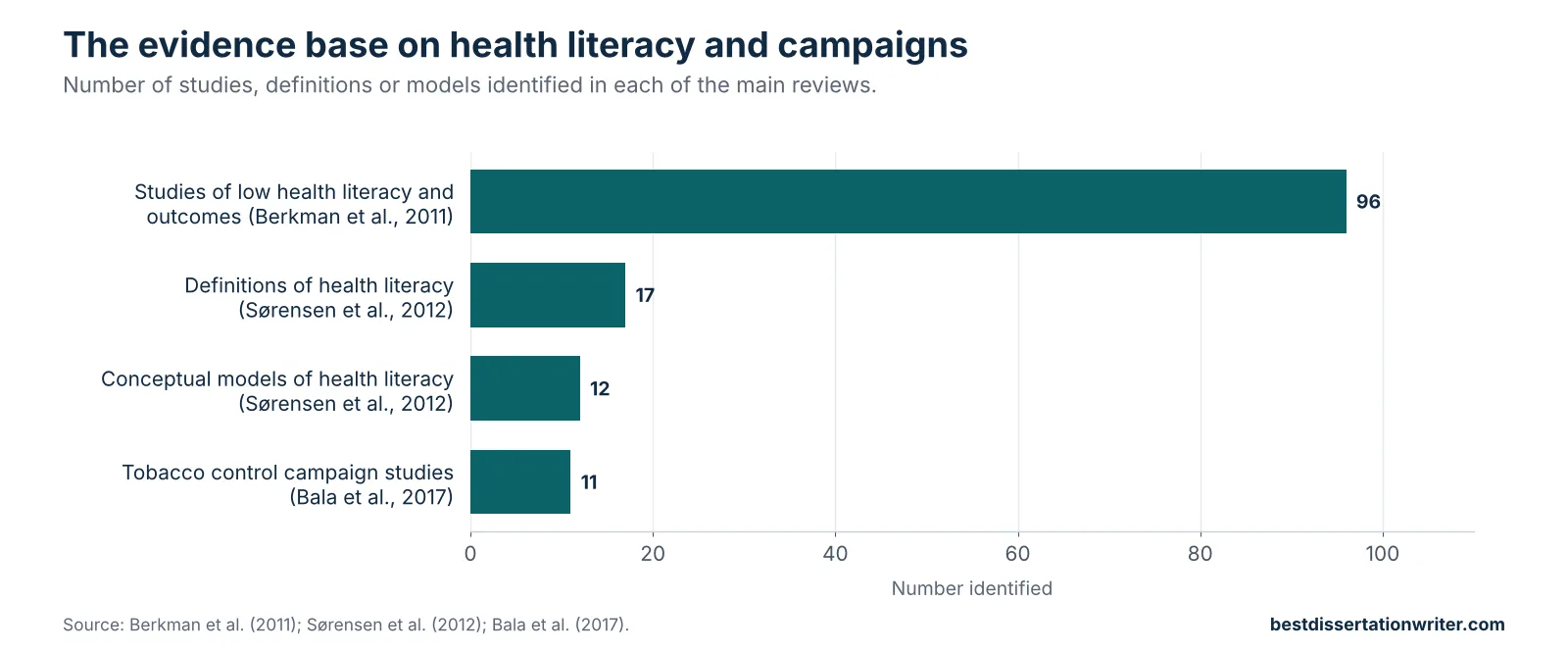
Three themes were identified: why health literacy matters for outcomes, what the evidence shows about mass media health campaigns, and the conditions that make campaigns more likely to work. Table 1 summarises the included sources, and Figure 1 shows the size of the evidence base in the main reviews.
| Author, year | Design | Setting and sample | Key finding |
|---|---|---|---|
| Bala et al. (2017) | Cochrane systematic review | 11 campaign studies | Comprehensive tobacco programmes with mass media can change smoking behaviour; evidence heterogeneous. |
| Berkman et al. (2011) | Systematic review | 96 studies (111 articles) | Low health literacy consistently associated with more hospitalisations and emergency care use. |
| Sørensen et al. (2012) | Systematic review | 17 definitions; 12 models | Integrated model of health literacy with 12 dimensions. |
| Wakefield et al. (2010) | Systematic review | Campaigns in many health areas | Campaigns can produce positive changes in behaviour; need services, policy and sufficient exposure. |
| World Health Organization (2025) | Fact sheet | Global | Health literacy is a determinant of health; many people have limited skills. |
Theme 1: Why Health Literacy Matters for Outcomes
Berkman et al. (2011) updated a systematic review of low health literacy and health outcomes, identifying 96 relevant good- or fair-quality studies reported in 111 articles. Low health literacy was consistently associated with more hospitalisations and with greater use of emergency care. Among older people, low health literacy was associated with poorer overall health status and higher mortality. The authors could not reach firm conclusions about numeracy because of few studies or inconsistent results.
These findings are associations, not proof that low health literacy causes poor outcomes, since people with limited health literacy may differ in education, income and access to care. Even so, they provide a reason for population health work, because a campaign that improved health literacy would be expected to reduce avoidable use of hospital and emergency services if the association were causal.
Sørensen et al. (2012) added a conceptual foundation. Their integrated model covers the competencies of accessing, understanding, appraising and applying health information across three domains of healthcare, disease prevention and health promotion, giving 12 dimensions. The authors suggested that the model could guide the development of health literacy interventions and measurement tools. For campaigns, this means that a message should not only inform, but also help people to find and judge information and to apply it.
For public health nursing, these findings mean that health literacy campaigns have a clear rationale. If people with limited skills use more hospital and emergency care, then helping them to understand and act on health information could improve their health and reduce avoidable demand. The size of the effect of any particular campaign remains uncertain, but the need is well documented, and nurses see its consequences when patients arrive late, miss appointments or misunderstand instructions.
Theme 2: Evidence on Mass Media Health Campaigns
Wakefield et al. (2010) reviewed campaign outcomes across many health areas, including tobacco, alcohol and other drug use, heart disease risk factors, sex-related behaviours, road safety, cancer screening and prevention, child survival, and organ or blood donation. They concluded that mass media campaigns can produce positive changes or prevent negative changes in health-related behaviours across large populations. Outcomes were supported by factors such as access to the services and products that people need, community-based programmes and policies that encourage behaviour change.
The authors also recommended longer, better-funded campaigns, which they said would give populations adequate exposure to the messages. This recommendation matters for nursing and public health planning, because short and poorly funded campaigns may not reach enough people to make a difference.
Bala et al. (2017) focused on tobacco control programmes that included a mass media campaign, in a Cochrane review of 11 campaign studies mostly involving adults. Eight studies reported abstinence or quit rates, of which four showed some positive effect and three showed no significant decrease. Of seven campaigns reporting smoking prevalence, the California and Massachusetts statewide campaigns showed significant decreases compared with the rest of the United States, and three of the remaining seven showed some positive effect. Three of seven large-scale campaigns reporting tobacco consumption found statistically significant decreases.
The reviewers did not pool results because the studies were too heterogeneous, and they noted that most studies lacked comparison communities without a campaign. They concluded that comprehensive tobacco control programmes that include mass media campaigns can be effective in changing adult smoking behaviour, though the evidence is heterogeneous and of variable methodological quality. Massachusetts showed positive results for up to eight years after the campaign.
In summary, the evidence on mass media suggests that health literacy campaigns can work, but are not a quick or inexpensive solution. They are most effective when sustained for years, as in the Massachusetts programme that showed benefit for up to eight years, and when other parts of a programme reinforce the message. Short campaigns that rely on a single message are unlikely to produce lasting change.
Theme 3: Conditions That Make Campaigns More Likely to Work
Three conditions emerge from the sources. First, campaigns work best within a wider programme: in the tobacco review the effective campaigns were part of comprehensive tobacco control programmes, and Wakefield et al. noted the importance of services, community programmes and policy. A campaign that tells people to stop smoking is more effective if cessation support is available, as considered in the review of smoking cessation.
Second, exposure and duration matter. The reviewers noted that the intensity and duration of campaigns may influence effectiveness, although follow-up length and concurrent trends make this hard to quantify. Third, the tobacco review found no consistent relationship between campaign effect and age, education, ethnicity or gender, so it is not possible to say from these reviews which groups benefit most, and campaigns should be evaluated for their effect on health inequalities.
Discussion
This systematic review found that health literacy matters for health, that mass media campaigns can change behaviour across large populations, and that the effects depend on duration, funding and the surrounding services and policies. At the same time, evidence for individual campaigns is variable in quality, and the reviews could not pool results or isolate the effect of campaigns from other influences.
The limited health literacy of many people, noted by the WHO, suggests that health literacy campaigns should be designed carefully. Messages need to be understandable to people with limited skills, delivered through channels they use and tested with the intended audience. Health literacy campaigns that assume high literacy may widen inequalities by benefiting those who are already well informed.
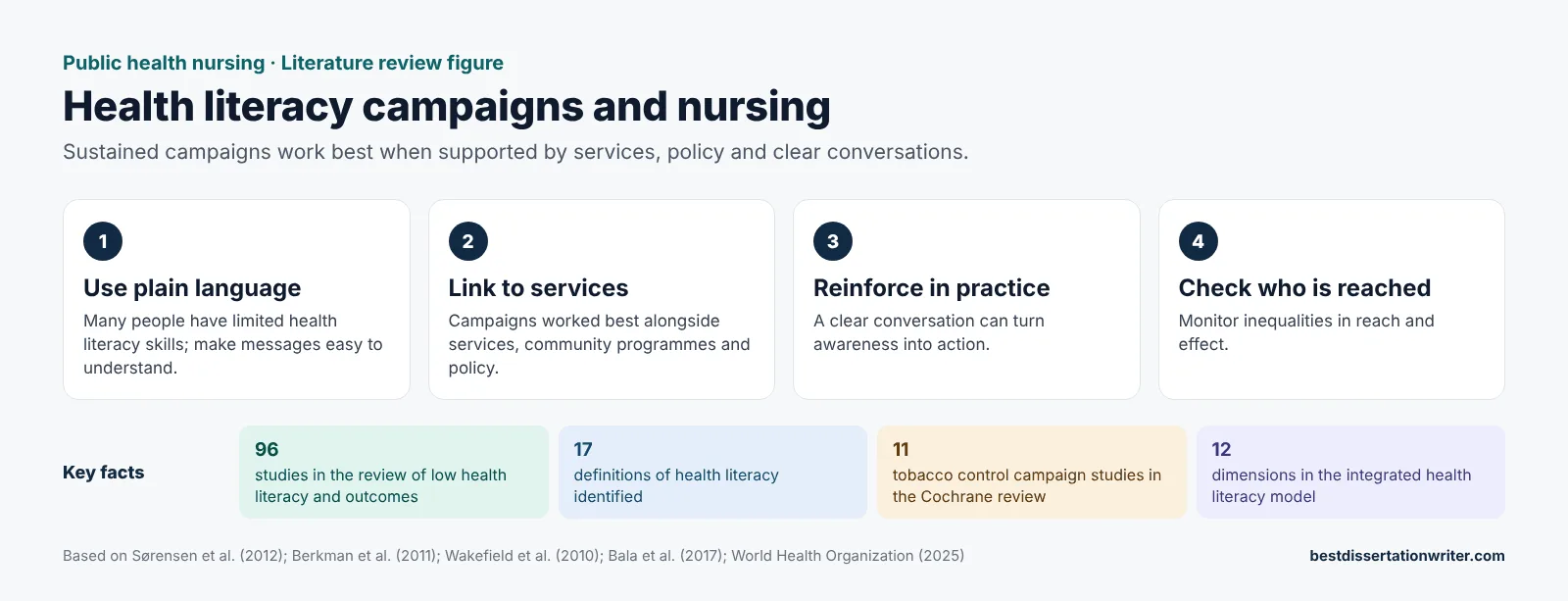
For nursing, a key implication is that a health literacy campaign does not end when the message is broadcast. Nurses meet people when they are deciding whether to act, and a clear conversation can turn awareness into action. Examples include explaining a screening invitation, helping someone to use a vaccination booking system or giving practical advice on stopping smoking. Without such support, a campaign may raise awareness without changing behaviour.
Equity should be a priority. The tobacco review found no consistent differences in effect by age, education, ethnicity or gender, but the evidence was limited and heterogeneous. Campaigns should therefore monitor who is reached and who is not, and be supported by outreach for groups with limited access to media or services. This theme is developed in the related reviews of climate change communication and of refugees and migrants, where language and trust are particular challenges.
Measurement of health literacy campaigns is a particular weakness. Few campaigns measure whether people understand more, and fewer still follow people to see whether behaviour or health improves. Nurses who help to deliver campaigns can contribute by recording questions, misunderstandings and uptake of services, which gives local teams evidence to refine messages and to see whether health literacy campaigns are reaching the people they are designed for.
There are limitations. This review relied on openly accessible, English-language sources and did not involve formal systematic screening. The included reviews cover a wide range of topics, populations and designs, and some are more than a decade old. The evidence on health literacy interventions themselves was not reviewed in detail, and campaigns on social media have developed rapidly since several of the reviews were conducted.
Implications of Health Literacy Campaign Evidence for Practice
For practice, the evidence supports using clear, plain language, checking understanding, linking campaign messages to available services and reinforcing health literacy campaigns in routine conversations. Nurses can also help to plan campaigns by advising on the needs and language of local people, and can contribute to evaluation by recording the questions and concerns that patients raise. Information is available from the WHO health literacy fact sheet.
Nurse education also has a part to play. Pre-registration and continuing programmes should include communication skills, the principles of health literacy and the use of campaign materials in practice, so that nurses can explain and reinforce public messages. Students who have learned to explain complex information simply are better prepared to support health literacy campaigns when they qualify.
Commissioners should fund campaigns for long enough to reach people, combine them with services and policy, and evaluate their effects, including on inequalities. Employers should train staff in health literacy so that organisations make it easy for people to understand and use services.
Conclusion
This systematic review examined evidence on health literacy campaigns and mass media health campaigns. Low health literacy is associated with more hospital and emergency care use, and mass media campaigns can change behaviour when they are sustained and supported by services and policy, although the evidence for specific campaigns is variable.
Nurses have a role in making campaigns work, by communicating clearly, linking messages with services and supporting people in the moment of decision. With better evaluation and attention to equity, health literacy campaigns can contribute to population health.
References
Bala, M. M., Strzeszynski, L., & Topor-Madry, R. (2017). Mass media interventions for smoking cessation in adults. Cochrane Database of Systematic Reviews, (11), CD004704. https://doi.org/10.1002/14651858.CD004704.pub4
Berkman, N. D., Sheridan, S. L., Donahue, K. E., Halpern, D. J., & Crotty, K. (2011). Low health literacy and health outcomes: An updated systematic review. Annals of Internal Medicine, 155(2), 97–107. https://doi.org/10.7326/0003-4819-155-2-201107190-00005
Sørensen, K., Van den Broucke, S., Fullam, J., Doyle, G., Pelikan, J., Slonska, Z., Brand, H., & (HLS-EU) Consortium Health Literacy Project European. (2012). Health literacy and public health: A systematic review and integration of definitions and models. BMC Public Health, 12, 80. https://doi.org/10.1186/1471-2458-12-80
Wakefield, M. A., Loken, B., & Hornik, R. C. (2010). Use of mass media campaigns to change health behaviour. The Lancet, 376(9748), 1261–1271. https://doi.org/10.1016/S0140-6736(10)60809-4
World Health Organization. (2025, December 22). Health literacy [Fact sheet]. https://www.who.int/news-room/fact-sheets/detail/health-literacy
Cite this example
Best Dissertation Writers (2026) Health Literacy Campaigns and Their Effectiveness in Improving Population Health: A Systematic Review. Available at: https://bestdissertationwriter.com/health-literacy-campaigns-review-review/
Best Dissertation Writers
Get expert help with your nursing literature review
Share your topic and deadline with Best Dissertation Writers and get support tailored to your module brief.