
Educational Preparation and Competency Frameworks for Advanced Practice Nursing: A Scoping Review
 By Dr. Robertson Prime, Research Fellow
Updated November 2, 2026
14 min read
About 2,800 words
In this review
Abstract
Background: Advanced practice roles are defined largely by what practitioners are expected to know and be able to do, and competency frameworks set out those expectations. Education, assessment, regulation and workforce planning all draw on competency frameworks, yet frameworks and educational routes differ widely between countries.
Aim: This scoping review aimed to map the evidence on educational preparation and competency frameworks for advanced practice nursing, including capability, continuing education and international variation, and to identify gaps.
Methods: Evidence was identified through targeted searches of openly accessible bibliographic records, publisher websites and repositories. Five sources published between 2023 and 2025 were included: four scoping reviews and a mixed-methods systematic review. Findings were charted and summarised descriptively under themes.
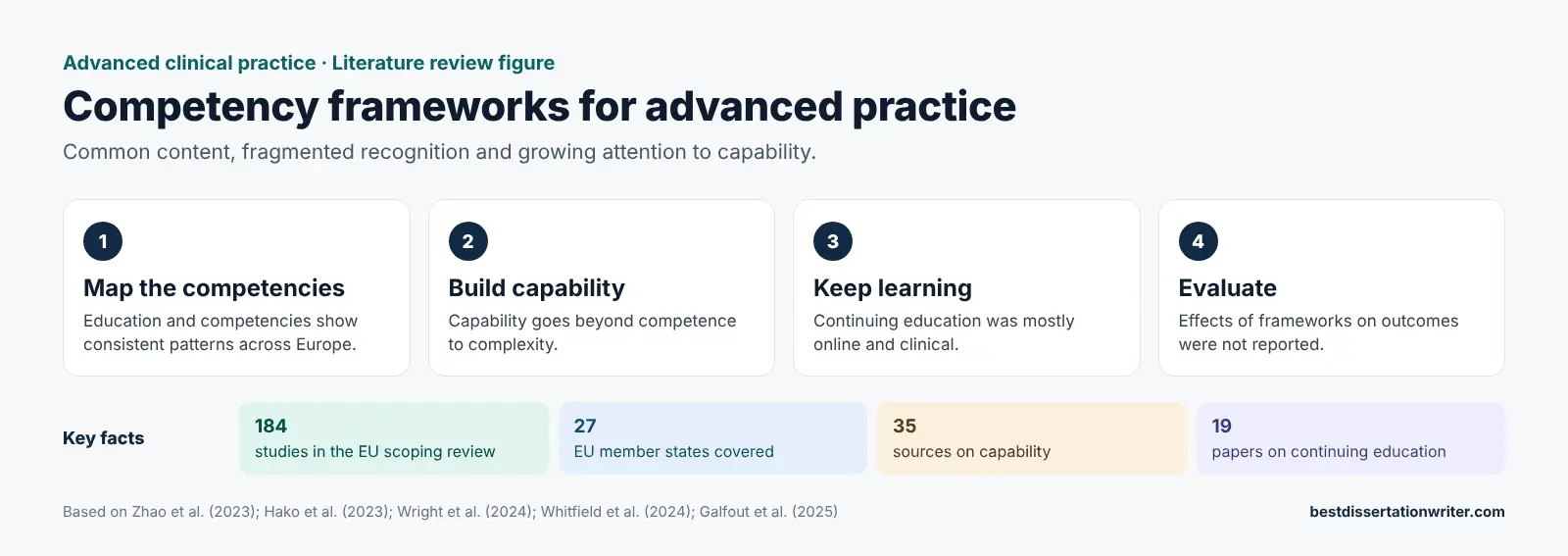
Findings: A scoping review of 184 studies across the 27 European Union member states found consistent patterns in education and competencies but fragmented title recognition and regulation. A scoping review of 35 sources described capability as a distinguishing feature of advanced practice. A mixed-methods systematic review of 11 articles identified six dimensions of capability. A scoping review of 19 papers found that continuing education was mostly online, aimed at clinical competence and focused on nurse practitioners. A scoping review of 41 studies mapped eight competency domains in antimicrobial stewardship.
Conclusion: Competency frameworks and education for advanced practice show common elements but remain fragmented. Capability, continuing education beyond clinical care and evaluation of frameworks are areas where evidence is limited.
Keywords: competency frameworks, advanced practice education, master’s level
Introduction
This scoping review critically examines recent evidence on competency frameworks and its implications for advanced clinical practice.
What does it mean to practise at an advanced level? The answer lies partly in the education that practitioners receive and partly in the competencies against which they are judged. Competency frameworks translate the broad idea of advanced practice into specific statements of knowledge, skills and behaviours. They guide the design of courses, the assessment of practitioners and the expectations of employers.
Frameworks matter because advanced practice is not protected by a single definition in every country. Without agreed expectations, two practitioners with the same title may have very different preparation. Frameworks aim to reduce that variation by setting out common standards, and in some systems they are used to support regulation and credentialing.
Educational preparation for advanced roles has also changed. Master’s level programmes are now common, and attention has turned to what happens after qualification, including continuing education and the development of capability, a concept that goes beyond competence to include the ability to deal with complexity. This scoping review asks: what evidence exists on educational preparation and competency frameworks for advanced practice nursing, how do frameworks and education vary and where are the gaps?
Background to Competency Frameworks in Advanced Clinical Practice
Competency frameworks have different functions. For educators they provide learning outcomes. For regulators and employers they provide standards for authorisation and review. For practitioners they provide a map for development. The governance arrangements that put frameworks into effect, including supervision and credentialing, are discussed in the review of clinical governance.
Frameworks also shape where practitioners work. In remote areas, where practitioners may be the main source of care and have limited access to colleagues, broad capability is especially important, as explored in the review of rural and remote healthcare. The value of the roles themselves, and the evidence on their outcomes, is considered in the review of nurse-led versus physician-led care.
A scoping review is suited to this topic because the literature is varied. It includes empirical studies, policy documents and reviews, and it uses terms such as competence, competency, capability and capacity in overlapping ways. Mapping these concepts and identifying where evidence is available can help educators and policymakers to decide where further work is needed.
The distinction between competence and capability is useful. Competence refers to the ability to perform defined tasks to a standard in familiar conditions. Capability refers to the ability to adapt, to deal with new and unpredictable situations and to continue to learn. Advanced practitioners regularly meet situations that no protocol fully describes, so competency frameworks that capture only task-based competence may not reflect the full demands of the role.
Frameworks are also used to compare roles across countries. Where terms such as nurse practitioner, advanced practice nurse and advanced clinical practitioner differ, a framework that describes competencies can reveal whether the underlying practice is similar. This is one reason why international reviews of competency frameworks have been undertaken, and why their findings are relevant to those designing education and regulation.
Search Strategy and Methods
Evidence for this example was identified through targeted searches of openly accessible bibliographic records, publisher websites and repositories. Search terms combined keywords for the topic (“competency frameworks”, “capability”, “competence”, “education”, “continuing education”, “curriculum”) with terms for the practitioners (“advanced practice nursing”, “nurse practitioner”, “advanced practice nurse”), joined with the Boolean operators AND and OR. A full scoping review would follow Joanna Briggs Institute guidance, search CINAHL, MEDLINE and Scopus and report the process in a PRISMA-ScR flow diagram.
Sources were eligible if they mapped, reviewed or evaluated competency frameworks, capability, education or continuing education for advanced practice nursing, or described competencies for nursing practice that could inform advanced roles. In keeping with scoping review methods, sources were not excluded on the basis of study design.
Five sources published between 2023 and 2025 were included (Table 1). Findings were charted and summarised descriptively under themes. As is usual in a scoping review, the quality of the sources was noted but not used to exclude them.
Key Findings on Competency Frameworks
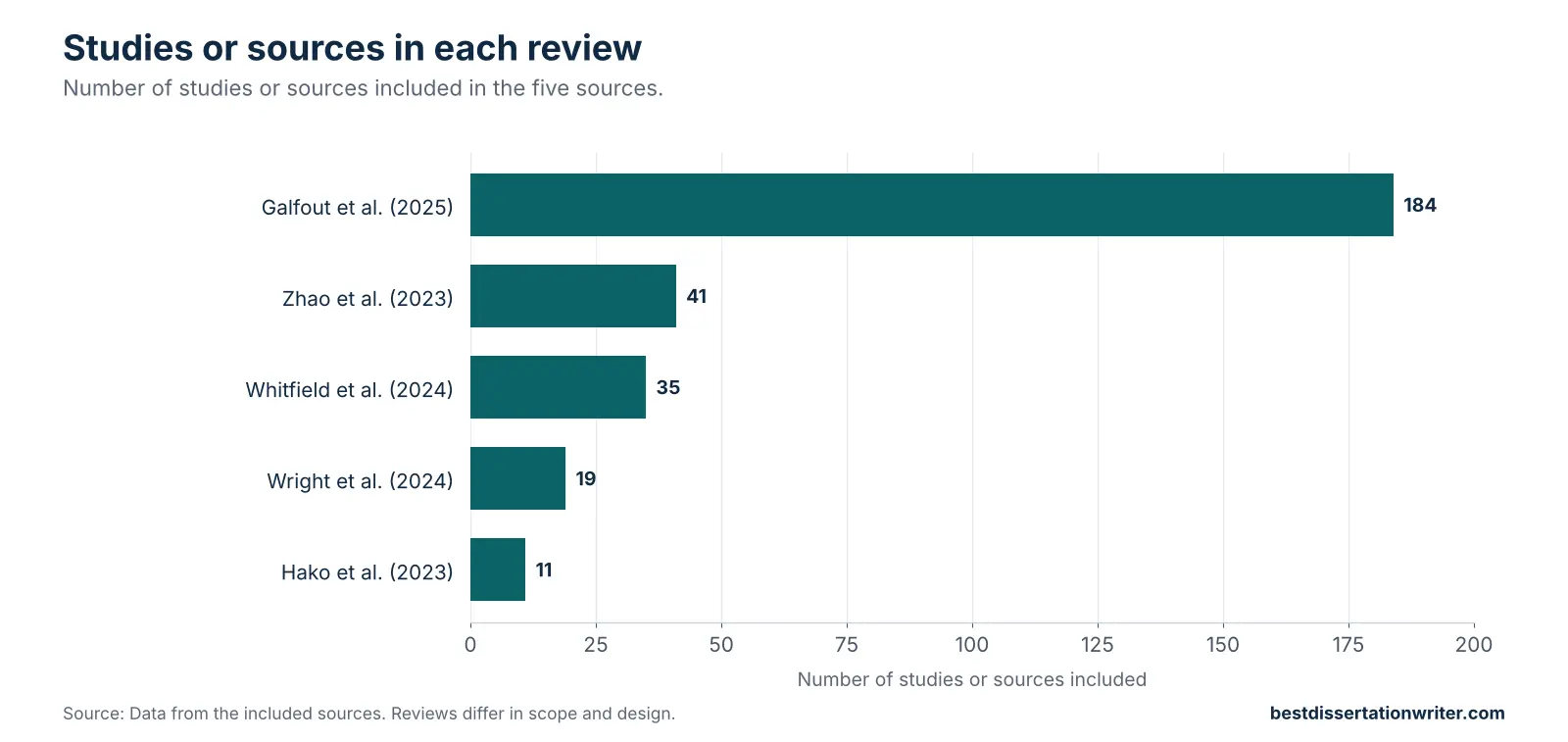
Three themes were identified: international variation in education and frameworks, capability as a concept, and continuing education and specialist competencies. Table 1 summarises the sources, and Figure 1 shows the number of studies or sources in each.
| Author, year | Design | Setting and sample | Key finding |
|---|---|---|---|
| Galfout et al. (2025) | Scoping review | 184 studies across the 27 EU member states | Consistent education and competencies; fragmented recognition and regulation. |
| Hako et al. (2023) | Mixed-methods systematic review | 11 articles from 357 identified | Five capability dimensions plus a new dimension on scope of practice. |
| Whitfield et al. (2024) | Scoping review | 35 sources, 2000 to 2023 | Capability distinguishes advanced practice and guides education. |
| Wright et al. (2024) | Scoping review | 19 papers on continuing education | Mostly online, clinical, US-based and aimed at nurse practitioners. |
| Zhao et al. (2023) | Scoping review | 41 studies on stewardship competencies | Eight competency domains; framework with basic and advanced levels. |
Theme 1: International Variation in Education and Frameworks
Galfout et al. (2025) carried out a scoping review of advanced practice nursing in the European Union, following Joanna Briggs Institute and PRISMA guidance. They screened 2,205 studies, of which 184 met the eligibility criteria, and covered the 27 member states. They reported that advanced nursing practice is relevant in 22 of them, at varying stages of development.
Education, competencies and practice models showed consistent patterns across countries, whereas title recognition, regulation and specialty development remained fragmented, and some countries still lacked formal structures. The authors argued that European Union level recognition could support broader integration of advanced practice nurses, and they presented the comparative findings to inform international policy that strengthens the legitimacy and visibility of these nurses.
This is a wide review whose strength is breadth. It suggests that the underlying content of education and competency frameworks is similar across Europe, even where recognition and regulation differ. Its limit, for readers in the United Kingdom, is that it concerns European Union countries, and the United Kingdom’s own frameworks, such as those for advanced clinical practice in England, are outside its scope.
The European picture illustrates a broader point about competency frameworks. A framework can describe the content of advanced practice without conferring recognition, and recognition can be given without a framework. In countries where titles are not recognised or regulation is fragmented, practitioners with similar education may be treated differently. Competency frameworks can narrow these differences, but they cannot replace the legal and organisational structures that give them force.
Theme 2: Capability as a Concept
Whitfield et al. (2024) carried out a scoping review of capability as a concept in advanced practice nursing and education, searching 18 databases and grey literature, including documents from the World Health Organization, the International Council of Nurses and 48 nursing and health organisations. They included 35 sources published between 2000 and 2023, mostly from Australia, the United Kingdom and the United States.
Capability appeared across many settings, including specialised clinical roles. Educational applications included capability frameworks guiding nurse practitioner education, nursing practice doctorates and postgraduate nurse practitioner training. Where it was defined, definitions were relatively consistent. Capability was described as a distinguishing feature of advanced practice nursing, a measure of clinical proficiency beyond competency and a way of accounting for complexity in healthcare.
The authors concluded that capability serves as both a concept and a framework for describing advanced practice nursing in complex environments that require flexible approaches. Suggested teaching strategies emphasised flexibility, student-directed learning and flexible learning pathways. Hako et al. (2023), in a mixed-methods systematic review of advanced practice nurse capabilities, searched three databases for literature from 1998 to 2021 and included 11 of 357 articles.
They found all five dimensions of Hase and Davis’s capability framework: applying competencies in familiar and unfamiliar situations, creativity, high self-efficacy, knowing how to learn and working well in teams. They also identified a new dimension, identifying factors that affect scope of practice. The authors concluded that capability is necessary for advanced practice nurses’ performance, noted that the topic is little studied and cautioned that country differences and the lack of consensus on roles may limit generalisation.
Theme 3: Continuing Education and Specialist Competencies
Wright et al. (2024) carried out a scoping review of continuing education for advanced practice nurses, following Joanna Briggs Institute methods. They searched seven databases in September 2023 for research published from 2012 to 2023 and included 19 papers. Research had mostly come from the United States, most studies examined online-delivered interventions aimed at clinical care competency, and most targeted nurse practitioners.
The authors concluded that continuing education plays a key role in developing advanced practice competence. They recommended that future research go beyond clinical care to cover education, leadership, organisational strategy, research and evidence implementation, and that programmes be rigorously developed, implemented and evaluated. This echoes the four pillars of advanced practice in the United Kingdom, and it suggests that continuing education has so far focused on the clinical pillar.
Zhao et al. (2023) carried out a scoping review of bedside nurses’ antimicrobial stewardship practice scope and competencies in acute hospitals, retrieving 1,422 records and including 41 studies. They grouped competencies into eight domains, from specialised knowledge to professional quality, and developed a competency framework with basic and advanced levels to inform training, assessment and staffing. The review concerns bedside nurses, but it illustrates how a topic-specific framework can be built from the literature, a method that could be applied to other areas of advanced practice.
Discussion
The sources suggest that education and competency frameworks for advanced practice share common content, but that recognition, regulation and educational routes remain fragmented. Capability is emerging as a concept that captures what distinguishes advanced practice from competent practice, and continuing education is developing mainly in clinical areas.
Taken together, the three themes show that the field is moving from describing roles to describing the qualities of those who fill them. Early frameworks focused on lists of tasks and competencies. More recent work, such as that on capability, emphasises adaptability, self-efficacy and learning. This shift is consistent with the nature of advanced practice, but it makes assessment harder, because capability is more difficult to measure than the performance of a defined skill.
Several gaps emerge. Evidence on the effect of competency frameworks on practice or patient outcomes is not reported in these sources. Continuing education has been studied mostly in the United States and mostly as online clinical training. Capability has been little studied, and there is no consensus on advanced practice roles. Frameworks for particular topics, such as stewardship, exist for bedside nurses but have not been developed in the same way for advanced practitioners.
An important question is who benefits from competency frameworks. Educators gain clarity about what to teach, and employers gain a basis for defining roles. Practitioners gain a map for development, but they may also find that a framework restricts what they are permitted to do. The sources do not explore these tensions, and they do not include the views of practitioners on how frameworks affect their work.
Limitations should be noted. This review relied on openly accessible, English-language sources and included only five. Four are scoping reviews and one is a mixed-methods systematic review, so no primary evaluations of educational programmes were examined. The sources were drawn from different countries and defined advanced practice in different ways. As is usual in a scoping review, the quality of included studies was not assessed, and the figures reported are those in the review abstracts.
These limits mean that the review maps the field and does not evaluate the effectiveness of any framework or course. It can, however, help educators and policymakers to see where a framework would need to be tested, and to identify the concepts, such as capability, that deserve further definition.
One further observation concerns language. The sources use the terms competence, competency and capability in related but distinct ways, and Whitfield et al. noted that where capability was defined, definitions were relatively consistent. Students reading this literature should therefore pay attention to how each author uses these terms, since an apparent disagreement about frameworks may in fact reflect a difference in vocabulary and not a difference in practice. Clear definitions would make comparison between studies and countries easier.
Finally, the sources remind readers that education is only one part of preparation for advanced practice. Supervised experience, mentoring and the culture of the workplace all contribute to how capability develops, and they are less easily captured in published studies than course content. A full picture of preparation would therefore need evidence from practitioners, supervisors and employers as well as from educators.
Implications of Competency Frameworks Evidence for Practice
For practice, the evidence supports the use of competency frameworks to design education and assessment, attention to capability as well as competence, continuing education that covers all four pillars of advanced practice and the evaluation of programmes. Employers should map roles to frameworks and support practitioners to maintain competence. Guidance is available from the NHS England Centre for Advancing Practice, the Nursing and Midwifery Council and the Royal College of Nursing.
Educators designing advanced practice programmes can use the sources to review their curricula. A programme might check that its outcomes cover clinical practice, leadership, education and research, that it develops capability as well as competence, and that its assessment includes complex and unfamiliar situations. Links with employers are important, since supervised practice in the workplace is the setting in which capability is developed and assessed.
Managers and practitioners can use competency frameworks in appraisal and development planning. Mapping a practitioner’s current abilities against the framework can identify areas for continuing education, and agreed development plans can be reviewed regularly. Because most published continuing education has been clinical, services may need to create their own opportunities for developing leadership, teaching and research skills.
Future research should evaluate the effect of competency frameworks and education on practice and outcomes, develop and test measures of capability, examine continuing education outside the United States and beyond clinical skills, and compare frameworks across countries, including the United Kingdom.
Conclusion
This scoping review found that education and competency frameworks for advanced practice show common elements but remain fragmented, and that evidence is limited on capability, continuing education beyond clinical care and the evaluation of frameworks.
Advanced clinical practitioners and educators can use these findings to plan education and development that cover all areas of advanced practice.
References
Galfout, S. M., Schwingrouber, J., & Colson, S. (2025). Advanced practice nursing in the European Union: A scoping review. Nursing Outlook, 73(6), Article 102588. https://doi.org/10.1016/j.outlook.2025.102588
Hako, L., Turunen, H., & Jokiniemi, K. (2023). Advanced practice nurse capabilities: A mixed methods systematic review. Scandinavian Journal of Caring Sciences, 37(1), 3–19. https://doi.org/10.1111/scs.13134
Whitfield, M. M., Bleah, P., Bachynski, J. C., Macdonald, D., Klein, T., Ross-White, A., Mimirinis, M., & Wilson, R. (2024). Capability as a concept in advanced practice nursing and education: A scoping review. JBI Evidence Synthesis. https://doi.org/10.11124/JBIES-23-00201
Wright, M. M. M., Kvist, T. A., Imeläinen, S. M., & Jokiniemi, K. S. (2024). Continuing education for advanced practice nurses: A scoping review. Journal of Advanced Nursing, 80(8), 3037–3058. https://doi.org/10.1111/jan.15911
Zhao, W., Guo, W., Sun, P., Yang, Y., Ning, Y., Liu, R., Xu, Y., Li, S., & Shang, L. (2023). Bedside nurses’ antimicrobial stewardship practice scope and competencies in acute hospital settings: A scoping review. Journal of Clinical Nursing, 32(17–18), 6061–6088. https://doi.org/10.1111/jocn.16731
Cite this example
Best Dissertation Writers (2026) Educational Preparation and Competency Frameworks for Advanced Practice Nursing: A Scoping Review. Available at: https://bestdissertationwriter.com/competency-frameworks-literature-review/
Best Dissertation Writers
Get expert help with your nursing literature review
Share your topic and deadline with Best Dissertation Writers and get support tailored to your module brief.