The Effect of Skin-to-Skin Contact on Neonatal Bonding and Early Outcomes: A Systematic Review
 By Dr. Robertson Prime, Research Fellow
Updated October 12, 2026
15 min read
About 3,000 words
By Dr. Robertson Prime, Research Fellow
Updated October 12, 2026
15 min read
About 3,000 words
In this review
Abstract
Background: Skin-to-skin contact places the naked newborn prone on the mother’s bare chest immediately or soon after birth, and in low birthweight infants the same principle underpins kangaroo mother care. Despite international recommendations, routine separation for weighing, examination and observation persists in many maternity units, particularly after caesarean birth.
Aim: This systematic review aimed to examine the effect of early contact between mother and newborn on bonding, breastfeeding and early neonatal outcomes, and what this means for midwifery practice.
Methods: Evidence was identified through targeted searches of openly accessible bibliographic records, publisher websites and the reference lists of key reviews. Six sources published between 2009 and 2025 were included: two Cochrane reviews, one meta-analysis, two randomised trials and one literature review, appraised with CASP checklists and synthesised thematically.
Findings: The 2025 Cochrane update of 69 trials found that early contact probably increases exclusive breastfeeding from discharge to one month (risk ratio 1.36) and raises infant blood glucose, with low-certainty evidence of better cardiorespiratory stability. A randomised trial of 176 mother–infant pairs found that contact or early suckling in the first two hours was associated with more sensitive mother–infant interaction one year later. For low birthweight infants, kangaroo care reduced mortality at discharge (risk ratio 0.60), and immediate kangaroo mother care reduced deaths in the first 28 days (12.0% versus 15.7%). Contact during caesarean birth is feasible, although that evidence is limited.
Conclusion: Midwives should protect uninterrupted skin-to-skin contact after every birth, including caesarean birth, and support kangaroo care for small babies, while ensuring safe positioning and observation.
Keywords: skin-to-skin contact, immediate contact, kangaroo care
Introduction
This systematic review critically examines recent evidence on skin-to-skin contact and its implications for midwifery practice.
The first hour after birth is a period of rapid physiological adjustment for the newborn and of intense emotional significance for parents. In many maternity units, however, this hour has traditionally been interrupted by routine procedures such as weighing, drying and wrapping, examination and observation away from the mother. Placing the naked baby prone on the mother’s bare chest, covered with a warm blanket, offers a simple alternative that keeps mother and baby together while the baby adapts to life outside the womb. This practice, known as skin-to-skin contact, costs almost nothing and needs no specialist equipment.
Midwives are usually the professionals present at this moment, and their actions largely decide whether a baby is placed with the mother or separated. The way midwives manage the third stage of labour, perineal repair, observations and the transfer from theatre or birth room therefore shapes the experience of every family. Where babies are born early or small, midwives also work with neonatal teams to decide whether contact can begin straight away or must wait until the baby is stable.
A systematic approach was chosen so that Cochrane reviews, meta-analyses and randomised trials could be identified and appraised alongside evidence on caesarean birth, a setting in which separation remains common.
Review question
What is the effect of skin-to-skin contact on mother–infant bonding, breastfeeding and early neonatal outcomes, and what are the implications for midwifery practice?
Background to Skin-to-Skin Contact
Two related practices are described in the literature. For healthy term babies, skin-to-skin contact means placing the naked newborn prone on the mother’s chest immediately (within minutes) or early (within the first hour) after birth. For preterm and low birthweight babies, kangaroo mother care combines prolonged, often continuous contact with exclusive or near-exclusive breastfeeding and early discharge with follow-up. In this review the shorter term kangaroo care is used for this approach, and immediate contact refers to contact that begins in the minutes after birth.
The physiological rationale is well described. The mother’s chest provides warmth, and close contact is thought to support the newborn’s temperature, breathing and blood glucose while promoting instinctive feeding behaviours. For the mother, contact coincides with the release of hormones that support milk ejection and uterine contraction. Researchers have also proposed a sensitive period after birth during which closeness may influence how mothers and babies interact in the longer term.
Despite these potential benefits, separation persists. Barriers include routine procedures, staff shortages, concerns about safety and the practical difficulty of maintaining contact during caesarean birth, when the mother is in theatre and staff are focused on surgery. Sudden unexpected postnatal collapse, although rare, has also raised concerns about safe positioning and observation during early contact, which means that skin-to-skin contact must be supported rather than simply allowed.
For midwives, the question is therefore not only whether contact is beneficial but how to make it routine, safe and inclusive. Evidence on outcomes such as breastfeeding, physiological stability, survival and mother–infant interaction is needed to justify changes to practice and to explain the benefits to parents and colleagues.
Search Strategy and Methods
Evidence for this example was identified through targeted searches of openly accessible bibliographic records, publisher websites and the reference lists of key reviews. Search terms combined keywords for the intervention (“skin-to-skin”, “immediate contact”, “early contact”, “kangaroo care”, “kangaroo mother care”) with terms for outcomes and population (“bonding”, “mother–infant interaction”, “breastfeeding”, “neonatal outcome*”, “newborn*”, “caesarean”), joined with the Boolean operators AND and OR. A full systematic review for assessment would run the same strategy in CINAHL, MIDIRS, PubMed/MEDLINE and the Cochrane Library and report the number of records screened in a PRISMA flow diagram.
Sources were eligible if they evaluated early skin-to-skin contact or kangaroo mother care beginning in the first days after birth and reported breastfeeding, physiological, survival or mother–infant interaction outcomes. Cochrane reviews, meta-analyses and randomised trials were prioritised, and a review of contact during caesarean birth was included because separation is most common in that setting. Studies of skin-to-skin contact with fathers only, and of infant massage, were excluded.
Six sources published between 2009 and 2025 were included: two Cochrane systematic reviews, one meta-analysis, two randomised controlled trials and one literature review of caesarean birth (Table 1). The quality of each source was appraised using the Critical Appraisal Skills Programme (CASP) checklist appropriate to its design, and findings were synthesised thematically. Because skin-to-skin contact cannot be blinded, particular attention was paid to risk of bias and the certainty ratings reported by review authors.
Key Findings on Skin-to-Skin Contact
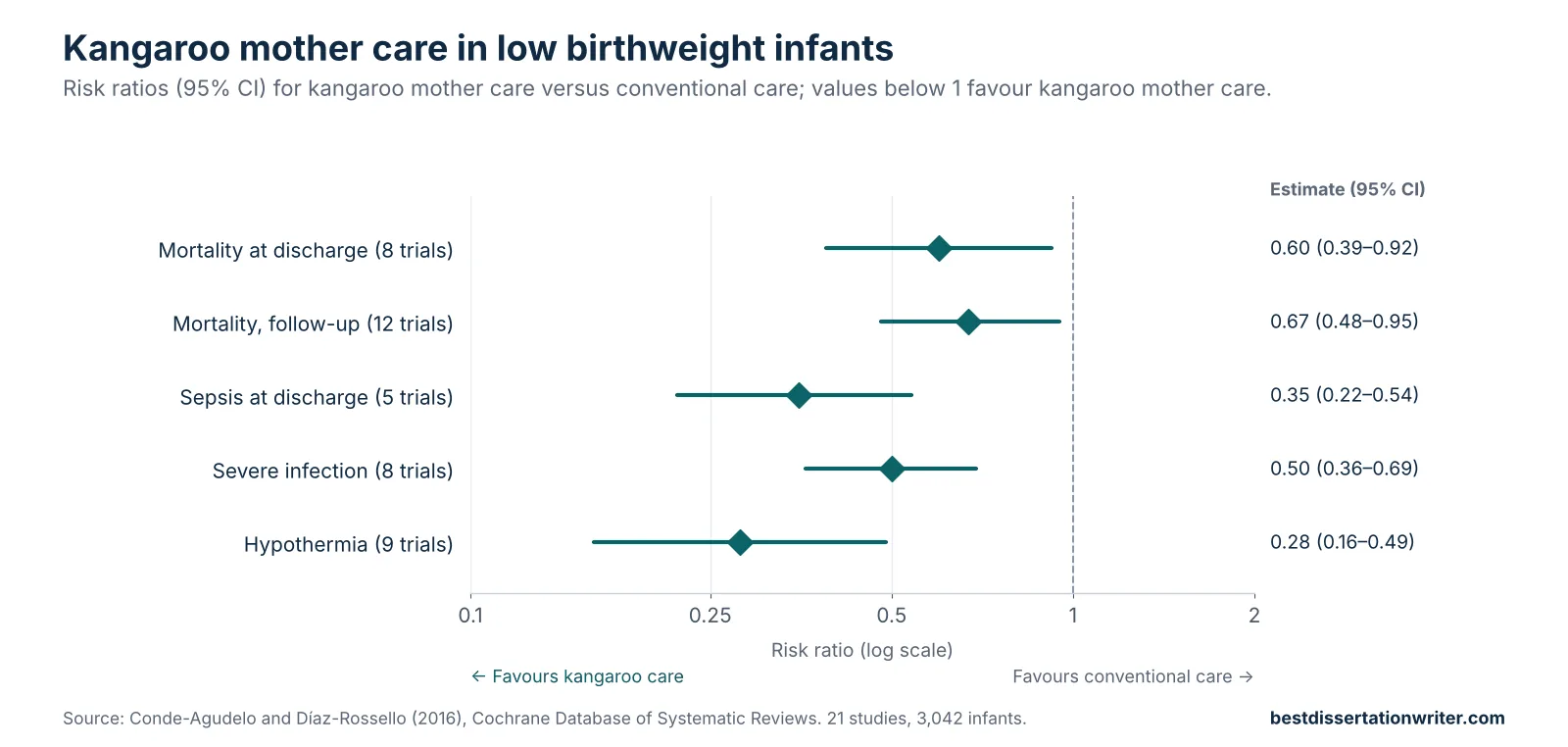
Three themes were identified: the effects of early contact on mother–infant interaction and bonding, its effects on breastfeeding and the physiological stability of healthy newborns, and its effects on survival and serious morbidity in low birthweight infants. Table 1 summarises the included sources, and Figure 1 presents pooled effects of kangaroo mother care on mortality and morbidity.
| Author, year | Design | Setting and sample | Key finding |
|---|---|---|---|
| Bystrova et al. (2009) | Randomised controlled trial (four arms) | 176 mother–infant pairs; interaction rated at one year | Contact or early suckling in first 2 hours improved maternal sensitivity and infant self-regulation; separation not offset by rooming-in. |
| Stevens et al. (2014) | Literature review | 7 papers (2003–2013); caesarean birth, healthy term babies | Contact in theatre feasible with collaboration; limited evidence of better breastfeeding, bonding and satisfaction. |
| Boundy et al. (2016) | Systematic review and meta-analysis | 124 studies; low birthweight newborns | Kangaroo care associated with 36% lower mortality (RR 0.64) and less sepsis, hypothermia and readmission. |
| Conde-Agudelo and Díaz-Rossello (2016) | Cochrane systematic review | 21 studies, 3,042 low birthweight infants | Mortality at discharge RR 0.60; sepsis RR 0.35; hypothermia RR 0.28; better weight gain. |
| WHO Immediate KMC Study Group (2021) | Randomised controlled trial | 3,211 infants with low birth weight | Immediate kangaroo mother care cut 28-day neonatal deaths from 15.7% to 12.0% (RR 0.75). |
| Moore et al. (2025) | Cochrane systematic review | 69 RCTs, 7,290 mother–infant pairs; healthy newborns | Exclusive breastfeeding to one month RR 1.36; higher blood glucose; blood loss effect inconclusive. |
Theme 1: Skin-to-Skin Contact and Mother–Infant Bonding
The strongest direct evidence on bonding came from a randomised trial of 176 mother–infant pairs allocated to four groups: contact after birth with rooming-in, the baby dressed and placed in the mother’s arms with rooming-in, separation in the nursery throughout, or separation after birth followed by rooming-in (Bystrova et al., 2009). Mother–infant interaction was videotaped at one year and rated with the Parent–Child Early Relational Assessment. Skin-to-skin contact, early suckling or both during the first two hours were associated with greater maternal sensitivity, better infant self-regulation and more mutuality and reciprocity at one year than separation.
Two further findings from this trial are important for practice. A two-hour separation after birth had a negative effect that was not compensated for by later rooming-in, which supports the idea of a sensitive period immediately after birth. Swaddling was also associated with lower maternal responsiveness and less mutuality. The trial was relatively small for a four-arm design, and the outcome was measured once, but its randomised design and long follow-up make it unusually strong for this outcome.
Evidence from caesarean birth points in the same direction. In a review of seven papers published between 2003 and 2013, Stevens et al. (2014) concluded that immediate or early contact in theatre could be implemented when staff collaborated, and that it may improve bonding and maternal satisfaction as well as breastfeeding. The authors described the supporting evidence as limited, so these benefits should be regarded as promising rather than proven.
Theme 2: Breastfeeding and Physiological Stability in Healthy Newborns
The 2025 update of the Cochrane review of early contact for healthy newborns included 69 randomised trials with 7,290 mother–infant pairs, 56 of which contributed data to meta-analyses (Moore et al., 2025). Skin-to-skin contact probably increases exclusive breastfeeding from hospital discharge to one month (risk ratio 1.36, 95% CI 1.19 to 1.56; 12 studies, 1,556 pairs) and from six weeks to six months (risk ratio 1.38, 95% CI 1.09 to 1.74; 11 studies, 1,135 pairs), although heterogeneity was substantial.
Physiological outcomes also favoured contact. Babies held in skin-to-skin contact had higher blood glucose (mean difference 10.49 mg/dL, 95% CI 8.39 to 12.59; three studies) and slightly higher temperature (mean difference 0.28°C), a difference the authors did not regard as clinically meaningful. Low-certainty evidence suggested better cardiorespiratory stability. Evidence on placental separation time and maternal blood loss was inconclusive, so claims that contact reduces bleeding are not yet supported by trial evidence.
The review has important limitations. No included trial met all criteria for high methodological quality, most trials were from high- and upper-middle-income countries, and none came from low-income countries. Nevertheless, the consistency of benefit across many trials, with no evidence of harm in the outcomes reported, led the review authors to support immediate contact after birth in middle- and high-income settings. For midwives, this means that skin-to-skin contact should be the default rather than an optional extra.
Theme 3: Kangaroo Care, Survival and Morbidity in Low Birthweight Infants
For low birthweight infants, the stakes are higher. A Cochrane review of 21 studies with 3,042 infants compared kangaroo mother care, usually started after stabilisation, with conventional neonatal care (Conde-Agudelo and Díaz-Rossello, 2016). At discharge or 40 to 41 weeks’ postmenstrual age, kangaroo care reduced mortality (risk ratio 0.60, 95% CI 0.39 to 0.92), nosocomial infection or sepsis (0.35) and hypothermia (0.28). It also improved weight gain and increased exclusive breastfeeding at discharge.
A broader meta-analysis that included 124 studies, among them observational designs, reached similar conclusions (Boundy et al., 2016). Among low birthweight newborns, kangaroo care was associated with 36% lower mortality (risk ratio 0.64, 95% CI 0.46 to 0.89), as well as lower risks of neonatal sepsis, hypothermia, hypoglycaemia and hospital readmission and a higher rate of exclusive breastfeeding. Including non-randomised studies increases the risk of confounding, but the agreement with the Cochrane estimates strengthens confidence in the direction of effect.
The most recent trial tested whether contact should start immediately rather than after stabilisation. In a randomised trial of 3,211 infants coordinated by the World Health Organization, infants in the immediate group received a median of 16.9 hours of skin-to-skin contact a day in the neonatal unit, compared with 1.5 hours in the control group (WHO Immediate KMC Study Group, 2021). Neonatal death in the first 28 days occurred in 12.0% of the intervention group and 15.7% of the control group (relative risk 0.75, 95% CI 0.64 to 0.89). The trial was stopped early on the advice of its monitoring board, which may overestimate the effect.
Discussion
This review found consistent evidence that skin-to-skin contact benefits mothers and babies, and none of the included sources reported clear harm from the practice. For healthy term babies, contact probably increases exclusive breastfeeding and improves blood glucose and physiological stability, and a randomised trial suggests lasting effects on mother–infant interaction. For low birthweight infants, kangaroo care reduces mortality, infection and hypothermia, and starting it immediately appears to save further lives. The direction of effect is the same across randomised trials, Cochrane reviews and a broader meta-analysis.
The evidence on bonding is the least developed part of the picture. Only one included trial measured mother–infant interaction with a validated tool over a long period, and the caesarean evidence relied on small studies with varied outcome measures. Bonding is difficult to define and measure, and mothers who cannot have immediate contact, for example after an emergency caesarean or when the baby needs resuscitation, should not be made to feel that their relationship with their baby has been harmed. Midwives need to present the benefits honestly while reassuring parents that bonding can develop over time.
A tension also exists between promoting contact and ensuring safety. Early contact is not a passive practice; the baby’s airway, colour and breathing must be observed, especially when the mother is tired, sedated or alone. The Cochrane authors found no evidence of harm in the outcomes they assessed, but rare events are unlikely to be detected in trials. Safe skin-to-skin contact therefore depends on correct positioning, regular observation and adequate staffing, rather than on contact alone.
The findings on low birthweight infants also raise questions about how skin-to-skin contact is provided beyond the birth room, and about how neonatal and maternity services are organised. Immediate kangaroo care requires mothers to stay with their babies in the neonatal unit, which in turn requires space, beds and support for mothers recovering from birth. In many settings these resources are not available, and the evidence suggests that service design, not only individual practice, determines whether babies receive the benefits.
The evidence base has limitations. Blinding was impossible, many trials were small and heterogeneity was substantial for several outcomes. The healthy newborn trials came largely from middle- and high-income countries, whereas the strongest survival evidence came from low birthweight infants. This review relied on openly accessible, English-language sources and did not involve independent double screening. Future research should use validated measures of bonding, longer follow-up and implementation studies that test how contact can be made routine after caesarean birth and in neonatal units.
Implications of Skin-to-Skin Contact Evidence for Practice
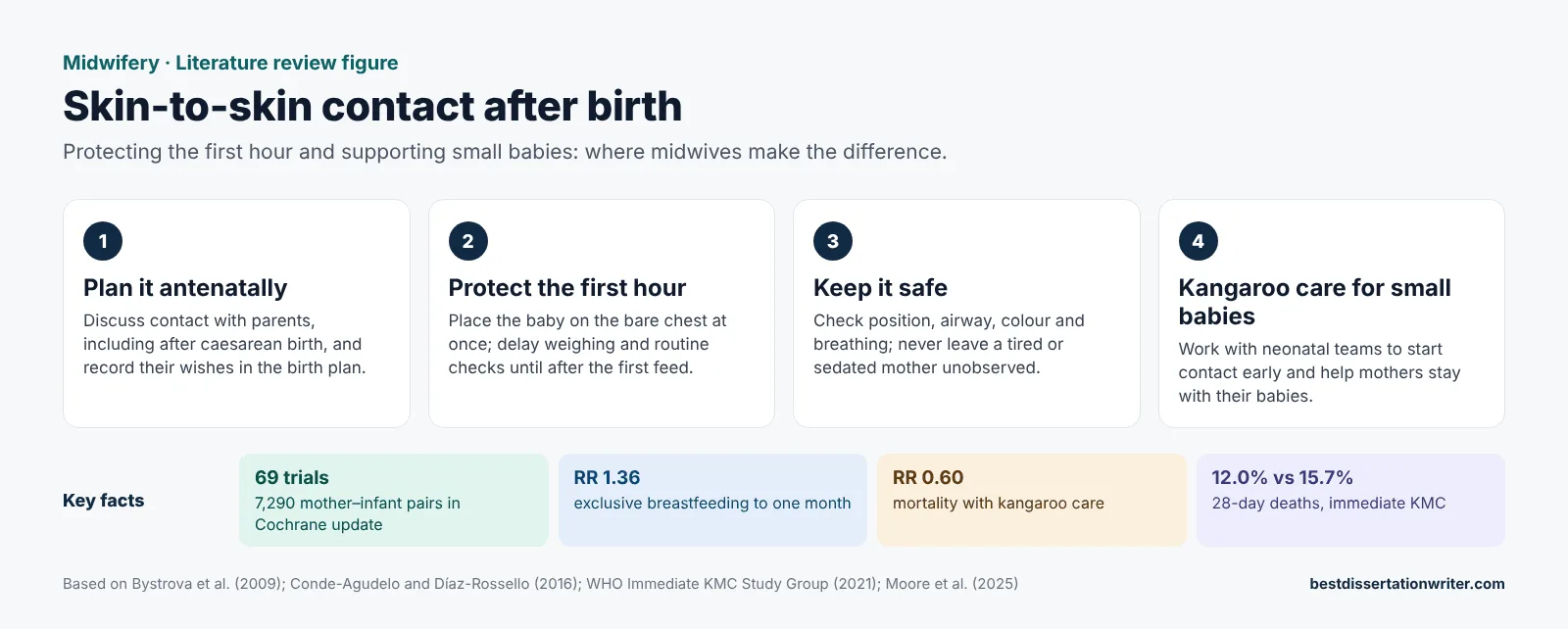
For midwives, the evidence supports uninterrupted contact for at least the first hour after every birth unless there is a clinical reason not to, with routine weighing and examination delayed until after the first feed. Midwives should discuss contact during antenatal conversations, ideally through continuity of carer so that the plan is known and trusted, and should advocate for immediate contact in theatre after caesarean birth. Close observation of the mother is also needed during contact, because the same period carries the risk of postpartum haemorrhage.
Early contact supports breastfeeding initiation, so midwives should help the baby to find the breast without hurrying, and record whether contact took place, for how long and why it was interrupted. Discussing these benefits as part of antenatal education can prepare parents to ask for contact. For small and preterm babies, midwives should work with neonatal colleagues to start kangaroo care as early as possible, support mothers to remain with their babies and ensure that the baby’s airway and observations are monitored throughout.
Conclusion
This systematic review examined the effect of skin-to-skin contact on bonding and early neonatal outcomes. Contact after birth probably increases exclusive breastfeeding and improves newborn physiological stability, is associated with more sensitive mother–infant interaction a year later, and in low birthweight infants reduces mortality and serious morbidity. Evidence on bonding remains limited, and the certainty of several outcomes is low to moderate.
Midwives can make skin-to-skin contact the expected start to life for every baby by planning it antenatally, protecting the first hour from routine procedures, supporting contact after caesarean birth and championing kangaroo care for small babies. Doing so safely requires attentive observation and services designed to keep mothers and babies together.
References
Boundy, E. O., Dastjerdi, R., Spiegelman, D., Fawzi, W. W., Missmer, S. A., Lieberman, E., Kajeepeta, S., Wall, S., & Chan, G. J. (2016). Kangaroo mother care and neonatal outcomes: A meta-analysis. Pediatrics, 137(1), e20152238. https://doi.org/10.1542/peds.2015-2238
Bystrova, K., Ivanova, V., Edhborg, M., Matthiesen, A.-S., Ransjö-Arvidson, A.-B., Mukhamedrakhimov, R., Uvnäs-Moberg, K., & Widström, A.-M. (2009). Early contact versus separation: Effects on mother–infant interaction one year later. Birth, 36(2), 97–109. https://doi.org/10.1111/j.1523-536X.2009.00307.x
Conde-Agudelo, A., & Díaz-Rossello, J. L. (2016). Kangaroo mother care to reduce morbidity and mortality in low birthweight infants. Cochrane Database of Systematic Reviews, (8), CD002771. https://doi.org/10.1002/14651858.CD002771.pub4
Moore, E. R., Brimdyr, K., Blair, A., Jonas, W., Lilliesköld, S., Svensson, K., Ahmed, A. H., Bastarache, L. R., Crenshaw, J. T., Giugliani, E. R. J., Grady, J. E., Zakarija-Grkovic, I., Haider, R., Hill, R. R., Kagawa, M. N., Mbalinda, S. N., Stevens, J., Takahashi, Y., & Cadwell, K. (2025). Immediate or early skin-to-skin contact for mothers and their healthy newborn infants. Cochrane Database of Systematic Reviews, (10), CD003519. https://doi.org/10.1002/14651858.CD003519.pub5
Stevens, J., Schmied, V., Burns, E., & Dahlen, H. (2014). Immediate or early skin-to-skin contact after a Caesarean section: A review of the literature. Maternal & Child Nutrition, 10(4), 456–473. https://doi.org/10.1111/mcn.12128
WHO Immediate KMC Study Group. (2021). Immediate “kangaroo mother care” and survival of infants with low birth weight. New England Journal of Medicine, 384(21), 2028–2038. https://doi.org/10.1056/NEJMoa2026486
Cite this example
Best Dissertation Writers (2026) The Effect of Skin-to-Skin Contact on Neonatal Bonding and Early Outcomes: A Systematic Review. Available at: https://bestdissertationwriter.com/skin-to-skin-contact-literature-review/
Best Dissertation Writers
Get expert help with your nursing literature review
Share your topic and deadline with Best Dissertation Writers and get support tailored to your module brief.