
Caring for Patients in Mental Health Crisis in Emergency Departments: A Scoping Review
 By Dr. Robertson Prime, Research Fellow
Updated November 2, 2026
14 min read
About 2,900 words
In this review
Abstract
Background: A mental health crisis is a period of acute emotional distress, risk or disturbed behaviour in which a person may need urgent help, and the emergency department is often where they go. Emergency nurses assess and care for these patients, frequently without specialist training and in settings that were not designed for mental health care.
Aim: This scoping review aimed to map the evidence on emergency department care for people in a mental health crisis, including the interventions studied, nurses’ experiences and the factors that shape the quality of care.
Methods: Evidence was identified through targeted searches of openly accessible bibliographic records, publisher websites and repositories. Five sources published between 2019 and 2026 were included: three systematic or integrative reviews, a scoping review and a qualitative interview study. Sources were charted and summarised descriptively.
Findings: A systematic scoping review of 277 papers found that interventions were pharmacological, psychological, triage and assessment, educational, case management, referral and follow-up, or mixed, with evidence that was considerable but fragmented. A systematic review of 46 studies found that few interventions measured outcomes across patient, experience and system domains. An integrative review of seven articles on mental health boarders identified six themes including violence, workflow and long waits. An integrative review of nine papers on nurses’ experiences found themes of attitudes, education gaps and structural barriers. An interview study of ten nurses described systemic factors, emotional impact, communication and limited training.
Conclusion: Emergency nurses want to give compassionate care to people in a mental health crisis but are constrained by stigma, limited training and the environment. Integrated pathways, education and support for staff are needed, and evidence on what works is fragmented.
Keywords: mental health crisis, psychiatric presentations, psychiatric emergencies
Introduction
This scoping review critically examines recent evidence on mental health crisis and its implications for emergency nursing practice.
When a person experiences a mental health crisis, they may feel unable to cope, may be at risk of harming themselves or others, or may behave in ways that frighten themselves and those around them. Community services are not always available, particularly at night and at weekends, and so the emergency department has become one of the main places where people in crisis seek help or are brought by family, police or ambulance services.
The emergency department is, however, a difficult place for someone in distress. It is noisy, bright and crowded, and waits can be long. Staff are trained to deal with physical emergencies and may feel less confident with mental health presentations. For the person in a mental health crisis, the first contact with a nurse can shape their whole experience of care and their willingness to seek help again.
Emergency nurses are central to this care. They triage, observe, talk to patients, manage risk, give medication and coordinate with mental health teams. They also work within the pressures described in the reviews of workplace violence and overcrowding. A scoping review was chosen because the literature is broad and varied and the aim is to map what is known and what is not.
Review question
What does the evidence show about care for people in a mental health crisis in emergency departments, what interventions have been studied and what do nurses say about this work?
Background to Mental Health Crisis in the Emergency Department
Presentations to the emergency department related to mental health cover a wide range. They include suicidal thoughts and self-harm, acute anxiety, psychosis, intoxication with mental health symptoms, and distress linked to social problems such as homelessness. Some patients are known to mental health services, while others present for the first time. Each needs a different response, and a single approach is unlikely to suit all.
Patients in a mental health crisis also have physical needs. They may have injuries, may have taken an overdose or may have an undiagnosed physical illness that is causing or worsening their symptoms. Nurses need to assess both physical and mental health and to avoid attributing every symptom to the mental illness. The systematic approach described in the review of primary survey helps with this, and pain and other physical needs, as discussed in the review of delays in analgesia, should not be overlooked.
The way the department is organised affects patients’ experience. Waiting in a busy corridor can increase distress and risk, and a lack of private space limits the ability of nurses to talk. Some services have dedicated assessment rooms or liaison teams, whereas others do not. The literature reviewed here covers interventions of many kinds as well as nurses’ accounts of working within these constraints.
Risk is a constant concern in the care of a person in a mental health crisis. Nurses must judge whether a patient is likely to harm themselves, to leave the department before assessment or to become aggressive. They must do so quickly and with incomplete information. In the most serious situations, such as a patient who has taken a large overdose, the physical danger can be immediate and may extend to cardiac arrest, so mental health assessment and physical monitoring must go together.
Families and carers are also affected. They may have waited a long time to find help, may be frightened for the person and may hold information that is useful for assessment. Involving them, with the patient’s consent, can improve the quality of the assessment and support a safe plan after discharge. The sources reviewed here say little about this, and the point is returned to in the discussion.
Search Strategy and Methods
Evidence for this example was identified through targeted searches of openly accessible bibliographic records, publisher websites and repositories. Search terms combined keywords for the problem (“mental health crisis”, “mental illness”, “mental health presentations”, “self-harm”, “psychiatric emergency”) with terms for the setting and population (“emergency department”, “emergency nurses”, “boarding”, “experiences”, “interventions”), joined with the Boolean operators AND and OR. A full scoping review for assessment would run the same strategy in CINAHL, PubMed/MEDLINE, PsycINFO and Embase and report the records screened in a PRISMA-ScR flow diagram.
Sources were eligible if they reviewed or reported evidence on emergency department care for adults with mental health problems, or on emergency nurses’ experiences of this care. Studies of children’s services, inpatient psychiatric care and prehospital care were excluded, and protocols for reviews that had not yet reported results were not used as evidence.
Five sources published between 2019 and 2026 were included (Table 1). In line with scoping review methods, sources were charted and summarised descriptively, without a pooled estimate of effect or a formal appraisal of quality, although the quality judgements reported by the review authors are noted.
Because this is a scoping review, the findings are described in terms of the range and character of the evidence on mental health crisis. The large reviews map the interventions that have been studied, and the smaller sources describe what nurses say about their work. Where a source reports a number, such as the count of studies of a given type, it is given so that readers can see where the evidence is concentrated and where it is thin.
Key Findings on Mental Health Crisis
Three themes were identified: the range of interventions studied, the evidence on outcomes and experience, and the views of emergency nurses. Table 1 summarises the included sources, and Figure 1 shows the types of intervention identified in a large systematic scoping review.
| Author, year | Design | Setting and sample | Key finding |
|---|---|---|---|
| Austin et al. (2024) | Systematic review | 46 studies of strategies in emergency departments | Few interventions measured patient, experience and system outcomes together. |
| Johnston et al. (2019) | Systematic scoping review | 277 papers; seven intervention types | Evidence considerable but fragmented; lack of integrated, person-centred interventions. |
| Kent & Halcomb (2026) | Integrative review | 9 papers; 8 qualitative studies | Themes of attitudes, education gaps and structural barriers. |
| Kent et al. (2026) | Qualitative interview study | 10 nurses in one emergency department | Systemic factors, emotional impact, communication and limited training. |
| Keslar (2024) | Integrative review | 7 articles on mental health boarders | Six themes including violence, workflow and long waits. |
Theme 1: The Range of Interventions
Johnston et al. (2019) carried out a systematic scoping review of interventions for people presenting to emergency departments with a mental health problem. They searched eight databases and included 277 papers. The studies were grouped into seven intervention types: pharmacological (43 papers), psychological or behavioural (25), triage, assessment or screening (28), educational or informational (12), case management (28), referral or follow-up (36) and mixed interventions (105).
The quality of evidence and the effectiveness of interventions varied widely. Only 64 studies addressed multiple domains, and just one included the patient’s family. The authors concluded that the evidence is considerable but fragmented and that a lack of integrated, multifaceted, person-centred interventions is a key barrier to effective care. For nurses, this means that a large number of approaches have been tried, but that no single model of care for mental health crisis can be said to be best.
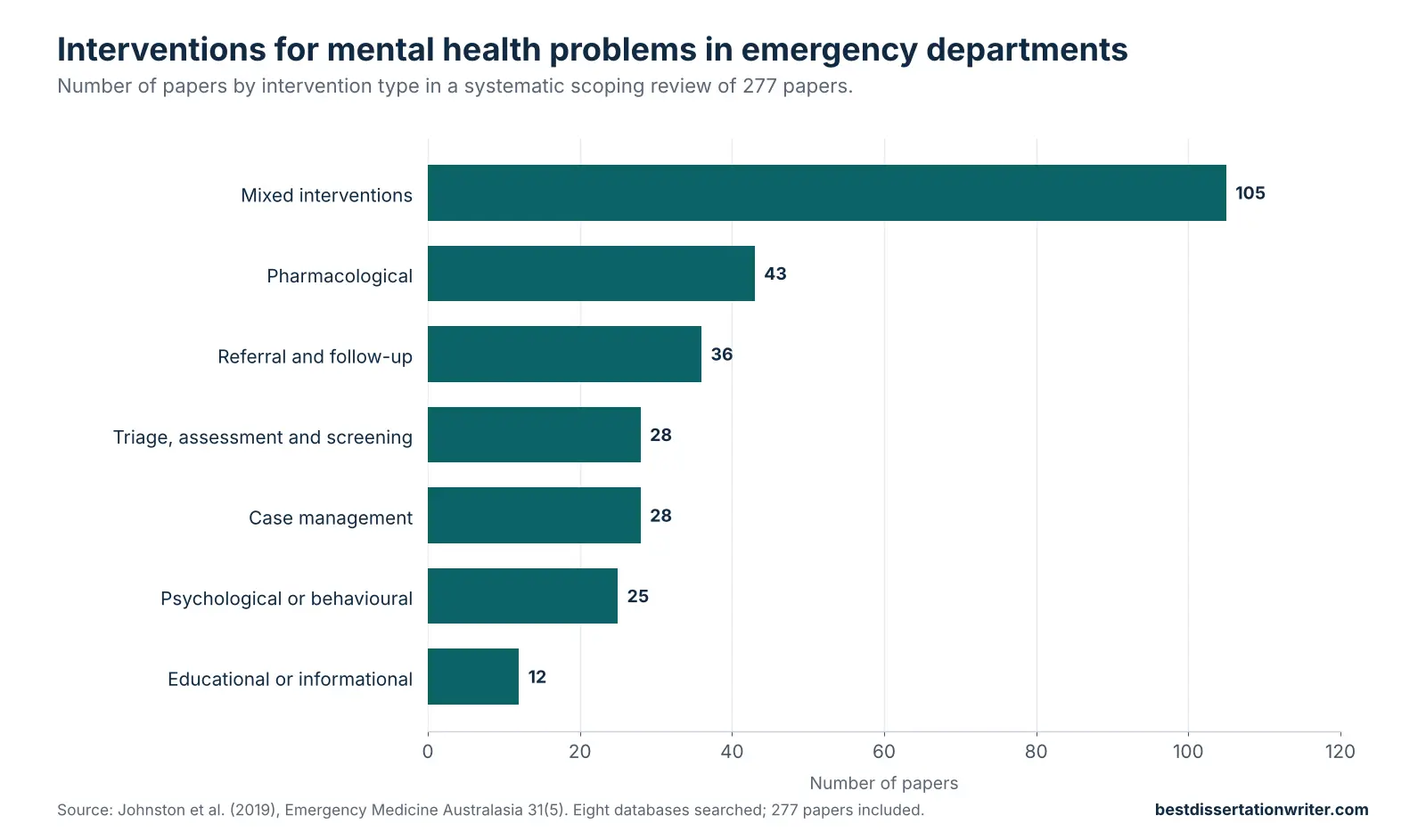
The large number of mixed interventions suggests that real services combine several elements, such as triage, assessment, medication and referral, and are not easily separated into single components. It also shows how difficult it is to compare studies. A nurse reading this literature may find examples of promising practice but little that clearly answers which approach to adopt.
Theme 2: Outcomes and Experience
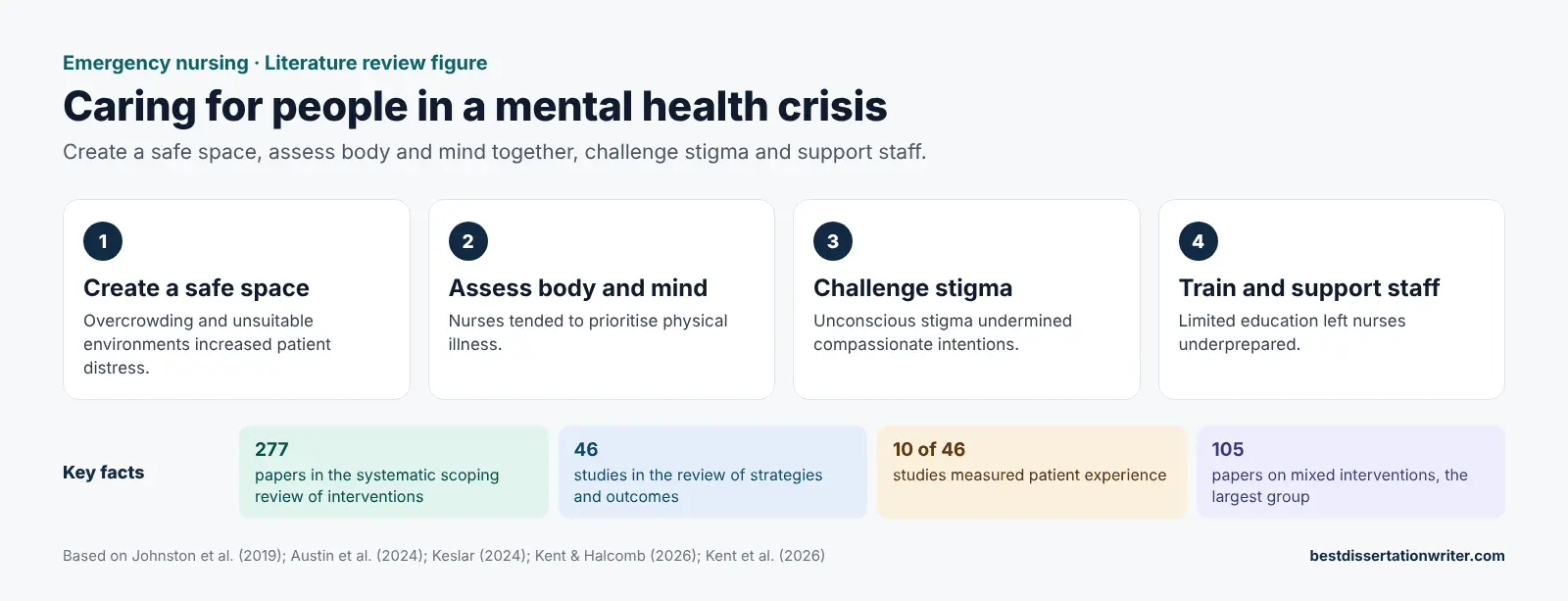
Austin et al. (2024) carried out a systematic review of strategies to improve emergency department care for adults presenting with mental illness and their impact on outcomes, experience and performance. They included 46 studies: 23 pre-post studies, six quasi-experimental, six descriptive, three randomised controlled trials, two cohort, two cross-sectional, two qualitative, one realist evaluation and one time series. Eleven studies concerned substance use, nine concerned suicide or self-harm and 26 concerned general mental illness.
System performance was measured in 33 studies (72%), patient outcomes in 19 (41%), patient experience in 10 (22%) and staff experience in 14 (30%). Few interventions reported outcomes across all four domains. The authors concluded that variation in samples, strategies and outcomes makes it difficult to adopt existing strategies, and that strategies to provide care must align emergency department system goals with patient goals and staff experience.
Only 10 of 46 studies measured patient experience, which means that the views of people in a mental health crisis are under-represented. This matters because the quality of the encounter, including being listened to and treated with respect, is likely to influence whether someone feels safe and accepts help. Nurses are well placed to contribute to research in this area, and services should seek patient feedback routinely.
Theme 3: The Views of Emergency Nurses
Keslar (2024) carried out an integrative review of emergency nurses’ perspectives on mental health boarders, that is, mental health patients who remain in the department while waiting for a place elsewhere. Seven articles were included. Six themes emerged: violence and patient safety, psychiatry and mental health support, attitudes and beliefs, education and training, workflow and environment, and long waits. The author concluded that more research is needed, and noted that no included study focused specifically on mental health boarders.
Kent and Halcomb (2026) reviewed qualitative studies from 2009 to 2024 of how emergency nurses experience caring for people with mental health issues. Nine papers reporting eight studies were included, and quality was appraised with the JBI Critical Appraisal tool. Three themes were identified: attitudes towards mental illness, education gaps affecting confidence and structural barriers affecting the quality of care. Nurses’ compassionate intentions were often undermined by unconscious stigma and a tendency to prioritise physical illness.
Kent et al. (2026) then interviewed ten nurses from a single tertiary emergency department in the Northern Territory of Australia. They identified four themes: systemic factors such as overcrowding, staff shortages and unsuitable environments, which limited therapeutic care and increased distress; the emotional impact of the work and a reactive staff culture, linked to moral distress and burnout; the influence of communication and teamwork; and limited mental health education, which left nurses underprepared and reliant on informal learning.
These accounts also show that nurses carry an emotional load. Caring for people in distress, often without enough time or privacy, can leave nurses feeling that they have not been able to help, and moral distress was linked to burnout in the interview study. This is not only a matter of staff wellbeing. Nurses who feel exhausted or unsupported may find it harder to listen, which is the skill that people in a mental health crisis value most.
The three nursing sources agree closely. Nurses want to help, but they describe a department that gives priority to physical illness, offers little privacy and gives them limited training. Participants called for clear protocols, targeted training and structured support. These accounts are drawn from few studies, from Australia, the United States and elsewhere, and the sample in the last study was small, but their agreement across designs strengthens confidence in the main message.
Discussion
This scoping review shows that a large body of research on emergency care for mental health crisis exists, but it is fragmented, varies in quality and rarely measures the experience of patients. Interventions of many types have been tried, and no single model has emerged as the best. Few studies measure outcomes in more than one domain.
The nursing evidence is consistent. Nurses report that stigma, limited education and the physical environment shape the care they can give, and that these factors contribute to moral distress and burnout. These findings imply that improving care for a mental health crisis depends on supporting staff as well as patients, through training, supervision, clear pathways and a more suitable environment.
There are limitations to this review. The scoping design does not appraise the quality of individual studies or combine their results, so the review cannot say which interventions work. The sources overlap, most of the nursing studies are from Australia and other high-income countries and one is a small qualitative study. The experience of patients and families is under-represented in the sources. This review relied on openly accessible, English-language sources.
A further gap concerns specific groups. The sources say little about children and young people, older adults, people with learning disabilities or people from minority ethnic groups who may experience a mental health crisis differently. They also say little about the effect of nurse-led interventions, such as brief assessment or safety planning, on outcomes. Studies that address these gaps would help emergency nurses to tailor their care.
Involving families and carers, with the patient’s consent, is one aspect of care that the sources do not address well. Only one of the 277 papers in the largest review included the patient’s family. Nurses can ask patients who they would like to be involved, can listen to carers’ concerns and can include them in discharge planning, while respecting confidentiality. Such steps are low in cost and may improve safety after a mental health crisis.
Implications of Mental Health Crisis Evidence for Practice
For practice, the evidence supports treating mental health crisis as a priority in the emergency department, offering a safe and private space when possible, assessing physical and mental needs together, communicating calmly and respectfully, challenging stigma and giving nurses training and supervision. Information is available from Mind and the Royal College of Nursing.
Managers should consider how long patients in a mental health crisis wait, whether dedicated spaces and liaison teams are available and how staff are supported after distressing events. Clear local protocols, agreed with mental health services, can help nurses to know what to do and whom to call.
Future research should test integrated, person-centred models of care in controlled designs, include the views of patients and families and measure outcomes in several domains. Studies in United Kingdom emergency departments, and of nurse-led interventions in particular, would be valuable.
Conclusion
This scoping review found that evidence on care for mental health crisis in the emergency department is considerable but fragmented, and that nurses are constrained by stigma, limited education and environment.
Emergency nurses, educators and managers can use these findings to plan training, protocols and support that help nurses to give compassionate care to people in distress.
References
Austin, E. E., Cheek, C., Richardson, L., Testa, L., Dominello, A., Long, J. C., Carrigan, A., Ellis, L. A., Norman, A., Murphy, M., Smith, K., Gillies, D., & Clay-Williams, R. (2024). Improving emergency department care for adults presenting with mental illness: A systematic review of strategies and their impact on outcomes, experience, and performance. Frontiers in Psychiatry, 15, Article 1368129. https://doi.org/10.3389/fpsyt.2024.1368129
Johnston, A. N. B., Spencer, M., Wallis, M., Kinner, S. A., Broadbent, M., Young, J. T., Heffernan, E., Fitzgerald, G., Bosley, E., Keijzers, G., Scuffham, P., Zhang, P., Martin-Khan, M., & Crilly, J. (2019). Review article: Interventions for people presenting to emergency departments with a mental health problem: A systematic scoping review. Emergency Medicine Australasia, 31(5), 715–729. https://doi.org/10.1111/1742-6723.13335
Kent, C., & Halcomb, E. (2026). Nurses’ experiences of mental health care in the emergency department: An integrative review. Journal of Clinical Nursing, 35(2), 502–512. https://doi.org/10.1111/jocn.70116
Kent, C., Stephen, C., & Halcomb, E. (2026). Nurses’ experiences caring for people presenting to the emergency department with mental health concerns. Journal of Clinical Nursing, 35(9), 3879–3890. https://doi.org/10.1111/jocn.70340
Keslar, R. (2024). Emergency nurses’ perspectives on mental health boarders: An integrative review. International Emergency Nursing, 75, Article 101463. https://doi.org/10.1016/j.ienj.2024.101463
Cite this example
Best Dissertation Writers (2026) Caring for Patients in Mental Health Crisis in Emergency Departments: A Scoping Review. Available at: https://bestdissertationwriter.com/mental-health-crisis-literature-review/
Best Dissertation Writers
Get expert help with your nursing literature review
Share your topic and deadline with Best Dissertation Writers and get support tailored to your module brief.