Patient Positioning and the Prevention of Perioperative Pressure Injuries: A Systematic Review
 By Dr. Robertson Prime, Research Fellow
Updated October 26, 2026
14 min read
About 2,800 words
In this review
Abstract
Background: Pressure injuries are among the most common adverse events in hospital, and perioperative pressure injuries are a particular concern because patients lie immobile on the operating table, often for long periods, under anaesthesia. Perioperative nurses are responsible for patient positioning, skin assessment and the selection of pressure-redistributing equipment.
Aim: This systematic review aimed to examine the frequency of and risk factors for perioperative pressure injuries and the evidence for risk assessment tools, support surfaces and prophylactic dressings.
Methods: Evidence was identified through targeted searches of openly accessible bibliographic records, publisher websites and the reference lists of key reviews. Five systematic reviews published between 2015 and 2025 were included, appraised using CASP checklists and synthesised narratively.
Findings: Pressure injuries affected 12.8% of hospitalised adults, and intraoperative acquired pressure injury occurred in 12.30% of 6,721 surgical patients in studies of risk assessment tools. Cardiovascular disease, respiratory disease, diabetes, low haemoglobin and longer surgery were associated with postoperative pressure injuries. Specialist risk scales such as the ELPO performed better than the Braden Scale in surgical patients. Pressure-relieving overlays on the operating table reduced postoperative pressure ulcers, and silicone dressings may reduce pressure ulcer incidence, although the certainty of evidence was low.
Conclusion: Perioperative pressure injuries are common but largely preventable. Nurses should use surgery-specific risk assessment, careful patient positioning and pressure-redistributing surfaces, and consider prophylactic dressings for high-risk patients.
Keywords: perioperative pressure injuries, patient positioning, perioperative pressure injury, operating table
Introduction
This systematic review critically examines recent evidence on perioperative pressure injuries and its implications for perioperative nursing practice.
A pressure injury is localised damage to the skin and underlying tissue, usually over a bony prominence, caused by sustained pressure or pressure combined with shear. Pressure injuries cause pain, increase the risk of infection, prolong hospital stays and add considerably to the cost of care. They are widely regarded as largely preventable, and their occurrence is used as an indicator of the quality of nursing care.
Surgical patients are especially vulnerable. Under anaesthesia, patients cannot move or feel discomfort, and they may lie in the same position on a firm operating table for several hours. Reduced blood pressure, cooling, vasoactive drugs and the effects of positioning devices may all reduce tissue tolerance. Damage that begins in theatre may not be visible until hours or days later, which means that perioperative pressure injuries are often recognised on the ward and may not be linked back to the operation.
A systematic review approach was chosen to focus on pooled evidence from systematic reviews and meta-analyses, which are the most appropriate sources for estimating frequency, identifying risk factors and judging the effectiveness of prevention.
The question matters for perioperative nurses because they are responsible for patient positioning, for protecting pressure areas and for choosing equipment in the operating theatre. Understanding the evidence helps nurses to target prevention at patients most at risk and to use the strategies most likely to work.
Review question
How common are perioperative pressure injuries, which patients are at greatest risk, and what does the evidence say about risk assessment, support surfaces and prophylactic dressings?
Background to Perioperative Pressure Injuries
Pressure injuries develop when soft tissue is compressed between a bony prominence and an external surface, reducing blood flow and causing tissue deformation. Shear forces, which occur when the skin stays in place while deeper tissues move, add to this damage, particularly when patients are tilted or moved during surgery. Moisture from skin preparation solutions, blood or body fluids can further weaken the skin.
Pressure injuries are classified by stage. Stage 1 involves intact skin with non-blanching redness, and Stage 2 involves partial-thickness skin loss. Stages 3 and 4 involve full-thickness tissue loss, and deep tissue injury describes damage beneath intact skin that may later break down. Perioperative injuries often present as deep tissue injuries or as Stage 1 and 2 damage at sites such as the sacrum, heels, face, chest and knees, depending on patient positioning.
Risk assessment tools are widely used to identify patients at risk. The Braden, Norton and Waterlow scales were developed mainly for general inpatients, while tools such as the ELPO scale and the Munro scale were designed specifically for surgical patients, taking into account factors such as the type and duration of surgery, position, anaesthesia and the use of support surfaces.
Prevention in theatre includes careful positioning with padding of bony prominences, pressure-redistributing mattresses and overlays on the operating table, keeping skin dry, avoiding shear when moving patients and repositioning where possible during long procedures. Prophylactic dressings, such as multilayer silicone foam dressings applied to the sacrum or heels, are increasingly used as an additional measure for high-risk patients.
The burden of perioperative pressure injuries extends beyond the patient’s skin. Injuries acquired in theatre may delay mobilisation and discharge, require dressings and specialist wound care and, in severe cases, lead to further surgery. They are also distressing for patients who came into hospital for an unrelated procedure and may not have expected to leave with a wound. For health services, perioperative pressure injuries add to costs and are often counted as hospital-acquired harm, which makes them a focus for quality improvement.
Responsibility for preventing perioperative pressure injuries is shared across the surgical pathway. Preoperative assessment staff identify risk, anaesthetists manage blood pressure and temperature, surgeons determine position and duration, theatre nurses position and protect the patient, and recovery and ward nurses inspect the skin afterwards. Gaps in communication between these stages can mean that risk is not acted upon or that early damage is missed.
Search Strategy and Methods
Evidence for this example was identified through targeted searches of openly accessible bibliographic records, publisher websites and the reference lists of key reviews. Search terms combined keywords for the problem (“perioperative pressure injuries”, “intraoperative pressure injury”, “pressure ulcer”, “surgical patients”) with terms for risk and prevention (“risk factors”, “risk assessment”, “patient positioning”, “operating table”, “support surfaces”, “prophylactic dressings”), joined with the Boolean operators AND and OR. A full systematic review for assessment would run the same strategy in CINAHL, PubMed/MEDLINE, the Cochrane Library and Embase and report the number of records screened in a PRISMA flow diagram.
Sources were eligible if they were systematic reviews or meta-analyses examining the frequency of, risk factors for or prevention of pressure injuries in hospitalised or surgical adults. Reviews that focused only on the treatment of existing pressure injuries, and reviews of children, were excluded.
Five systematic reviews published between 2015 and 2025 were included: a meta-analysis of pressure injury prevalence and incidence in hospitalised adults, a review of perioperative risk factors, a network meta-analysis of risk assessment tools in surgical patients and two Cochrane reviews of support surfaces and of dressings and topical agents for prevention (Table 1). Each source was appraised using the Critical Appraisal Skills Programme (CASP) checklist for systematic reviews, and findings were synthesised narratively and grouped into themes.
Key Findings on Perioperative Pressure Injuries
Three themes were identified: the frequency of pressure injuries and perioperative risk factors, the accuracy of risk assessment tools in surgical patients, and the effectiveness of support surfaces and prophylactic dressings. Table 1 summarises the included sources, and Figure 1 compares pressure injury rates reported in hospital and surgical populations.
| Author, year | Design | Setting and sample | Key finding |
|---|---|---|---|
| McInnes et al. (2015) | Cochrane systematic review | 59 trials of support surfaces | Operating table overlays reduced postoperative pressure ulcers; foam overlays linked to some skin changes. |
| Moore & Webster (2018) | Cochrane systematic review | 18 trials; 3,629 participants | Silicone dressings may reduce pressure ulcers (RR 0.25); low certainty. |
| Haisley et al. (2020) | Systematic review and meta-analysis | Adults having surgery under general anaesthesia | Cardiovascular and respiratory disease, diabetes, low haemoglobin and longer surgery increased risk. |
| Li et al. (2020) | Systematic review and meta-analysis | 39 studies; over 2.5 million hospitalised adults | Prevalence 12.8%; hospital-acquired rate 8.4%; most injuries Stage 1 or 2. |
| Shang et al. (2025) | Network meta-analysis | 24 studies; 6,721 surgical patients | Intraoperative injury in 12.30%; ELPO ranked highest, Braden lowest. |
Theme 1: Frequency and Risk Factors for Perioperative Pressure Injuries
Li et al. (2020) pooled 39 studies covering more than 2.5 million hospitalised adults. The pooled prevalence of pressure injuries was 12.8% (95% CI 11.8% to 13.9%), and the hospital-acquired rate was 8.4% (95% CI 7.6% to 9.3%). Most injuries were Stage 1 (43.5%) or Stage 2 (28.0%), and the sacrum, heels and hip were the most commonly affected sites. The authors concluded that more than one in ten adult inpatients is affected and that most injuries are superficial and preventable.
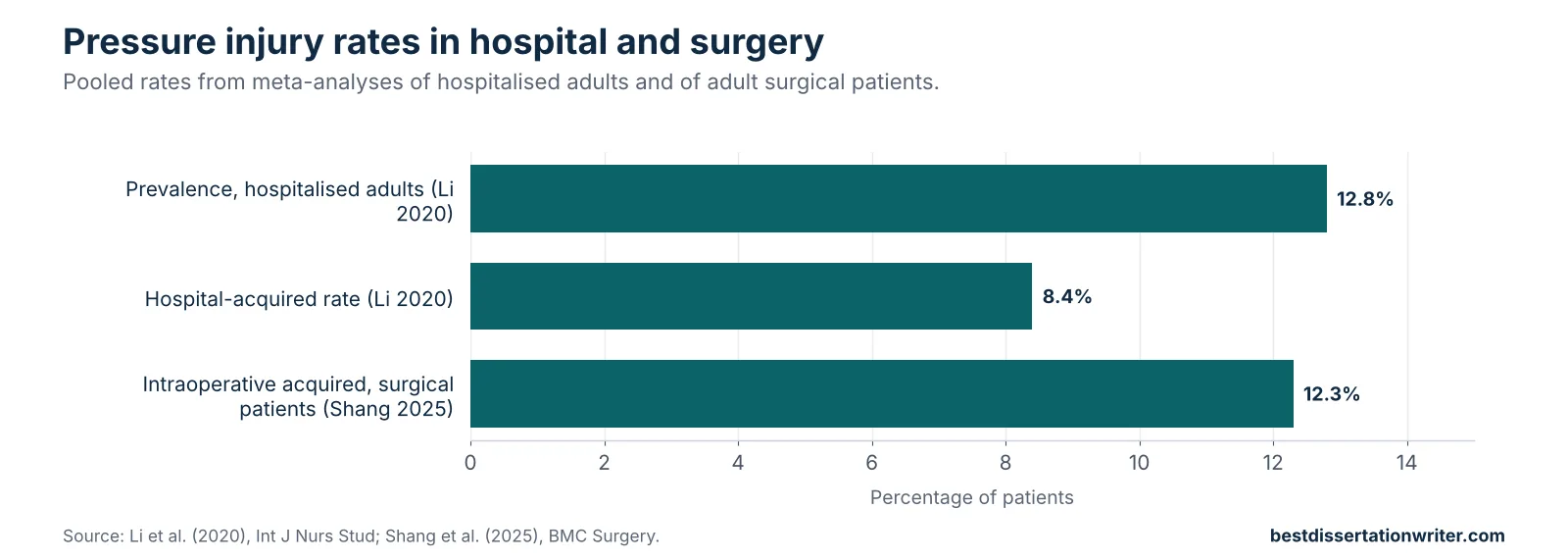
In surgical patients specifically, Shang et al. (2025) reported that 827 of 6,721 patients (12.30%) in 24 studies developed an intraoperative acquired pressure injury. Because these studies were designed to test risk assessment tools, they may have included higher-risk surgical groups, but the figure indicates that perioperative pressure injuries are a substantial problem.
Haisley et al. (2020) systematically reviewed perioperative risk factors for postoperative pressure injuries in adults having surgery under general anaesthesia and performed meta-analyses where at least three studies reported a variable. Cardiovascular disease, respiratory disease, diabetes, low haemoglobin and longer duration of surgery were significantly associated with pressure injuries. Serum albumin, vasopressor use, corticosteroid use, sex and age were not significantly associated in the pooled analyses.
These findings suggest that both patient factors and surgical factors contribute to the risk of perioperative pressure injuries. Conditions that impair circulation and oxygen delivery, such as cardiovascular and respiratory disease, diabetes and anaemia, may reduce tissue tolerance, while longer operations increase the time that tissues are exposed to pressure on the operating table. The finding that age was not significantly associated is notable, because older age is often assumed to be a major risk factor.
Theme 2: Risk Assessment for Perioperative Pressure Injury
Shang et al. (2025) compared the accuracy of six risk assessment tools in 24 studies of adult surgical patients using a network meta-analysis. The ELPO scale ranked highest, followed by the Norton, Waterlow and Munro scales and the Scott Triggers tool, while the Braden Scale ranked lowest. The authors suggested that tools designed for surgical patients may be more appropriate for predicting perioperative pressure injury than general tools.
This finding is important because many hospitals use the Braden Scale for all inpatients, including those undergoing surgery. A general tool may not capture factors such as the length of the operation, the patient’s position and the type of anaesthesia, and it may therefore underestimate risk. Using a surgery-specific tool, or supplementing a general tool with assessment of these factors, may help perioperative nurses to identify patients who need additional protection. Accurate prediction allows resources such as specialist overlays and dressings to be targeted at the patients most likely to develop perioperative pressure injuries.
Theme 3: Support Surfaces, Operating Table Overlays and Dressings
McInnes et al. (2015) reviewed 59 trials of support surfaces for pressure ulcer prevention. Pressure-relieving overlays on the operating table reduced the incidence of postoperative pressure ulcers, although two trials found that foam overlays were associated with adverse skin changes. The authors suggested that organisations could consider some form of pressure relief for high-risk patients in the operating theatre.
Moore and Webster (2018) reviewed 18 trials with 3,629 participants of dressings and topical agents for preventing pressure ulcers. Silicone dressings may reduce pressure ulcer incidence compared with no dressing (risk ratio 0.25, 95% CI 0.16 to 0.41; six trials, 1,247 participants), but the certainty of evidence was low because of serious risk of bias. In contrast, one small trial found that an adhesive foam dressing was associated with more pressure ulcers than no dressing. The review did not focus specifically on surgical patients.
Discussion
This review shows that pressure injuries are common among hospitalised adults and surgical patients, that cardiovascular and respiratory disease, diabetes, low haemoglobin and longer surgery increase risk and that surgery-specific risk assessment tools appear to perform better than general tools. Pressure-relieving overlays on the operating table reduce postoperative pressure ulcers, and silicone dressings may provide additional protection, although the evidence is of low certainty.
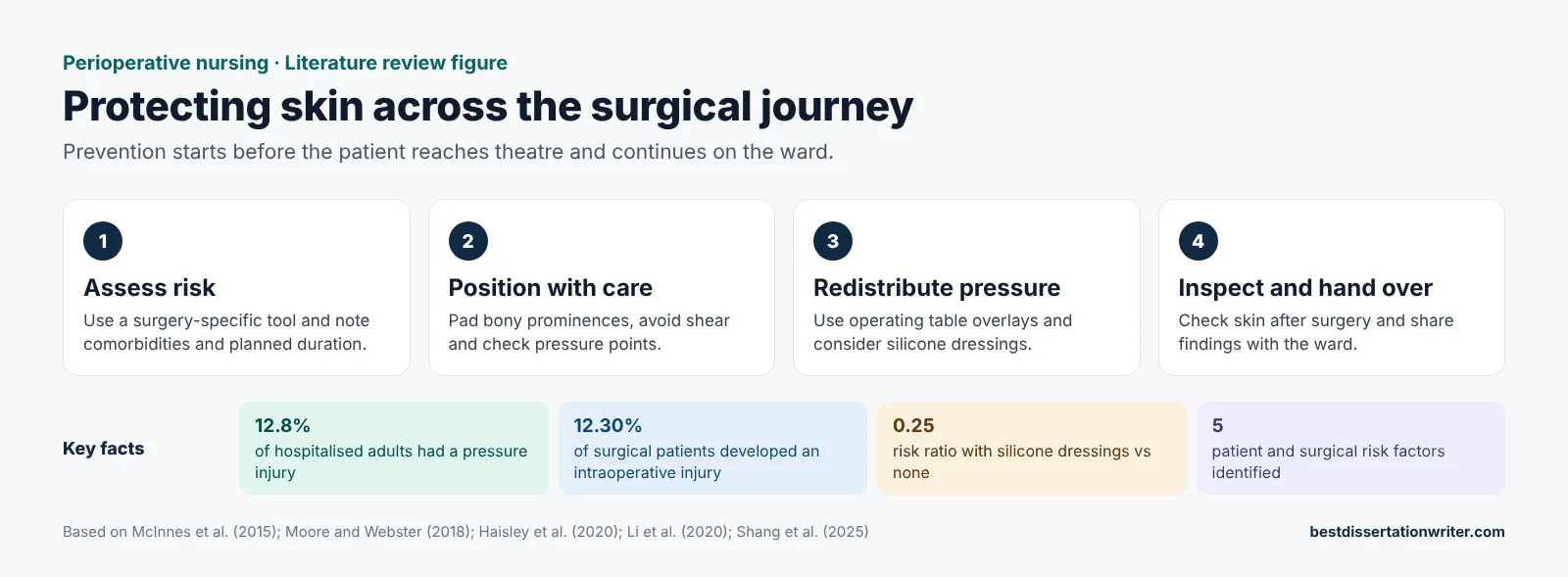
Prevention of perioperative pressure injuries depends on actions across the whole surgical journey. Risk should be assessed before surgery, including consideration of the planned procedure and position. In theatre, careful patient positioning, padding, pressure-redistributing surfaces and avoidance of shear are essential. After surgery, skin should be inspected and findings handed over to ward staff, because damage may not become visible until later.
Patient positioning is a core skill of perioperative nursing. Positions such as prone, lateral and lithotomy create specific pressure points, and devices such as head rings, arm boards and stirrups can concentrate pressure. Nurses must balance surgical access with skin protection, check pressure areas when position changes and advocate for repositioning or pressure relief during long procedures where it is safe to do so.
The timing of damage is a particular challenge. Because perioperative pressure injuries may not become visible for hours or days, ward nurses may record them as ward-acquired, and theatre teams may never learn that harm occurred. Linking ward incident reports back to theatre records, and including the operation in investigations of new pressure injuries in surgical patients, can help theatre teams to recognise the scale of the problem and to learn from it.
Other perioperative factors may also contribute. Cooling during surgery reduces skin perfusion, which links pressure injury prevention to the prevention of perioperative hypothermia. Low blood pressure, fluid shifts and the use of vasoactive drugs may reduce tissue tolerance, highlighting the need for communication between nurses and anaesthetists about patients at high risk.
The evidence base has limitations. The included reviews combined studies with different definitions, populations and follow-up periods, and incidence estimates varied widely. The risk factor review did not report the number of included studies in its abstract, and the dressings review included few surgical patients. Much of the prevention evidence was of low certainty. This review relied on openly accessible, English-language sources and did not involve formal systematic screening. Future research should test prevention bundles specifically in surgical patients and evaluate surgery-specific risk tools in different settings.
Implications of Perioperative Pressure Injuries Evidence for Practice
For perioperative nurses, the evidence supports assessing pressure injury risk before surgery using a surgery-specific tool or additional surgical factors, using pressure-redistributing surfaces on the operating table for high-risk patients and long procedures, positioning patients carefully with padding of bony prominences, considering silicone dressings for patients at high risk and inspecting and handing over skin condition after surgery. Guidance on prevention is available from the NICE guideline on pressure ulcers.
Education is also important. Newer theatre staff may be unfamiliar with the specific pressure points created by each surgical position and with the correct use of positioning devices. Simulation and supervised practice in positioning, together with clear local protocols for high-risk patients and long procedures, can help to make prevention of perioperative pressure injuries a routine part of theatre practice rather than an afterthought.
Theatre managers should ensure that appropriate support surfaces and positioning equipment are available in every operating theatre, provide training in safe positioning and skin assessment and monitor the incidence of perioperative pressure injuries through audit. The team brief and the WHO surgical safety checklist provide opportunities to discuss positioning plans and pressure area risks for each patient.
Conclusion
This systematic review examined the frequency, risk factors and prevention of perioperative pressure injuries. Pressure injuries affect a substantial proportion of hospitalised and surgical patients. Cardiovascular disease, respiratory disease, diabetes, low haemoglobin and longer surgery increase risk, and surgery-specific risk tools appear more accurate than general tools. Operating table overlays reduce postoperative pressure ulcers, and silicone dressings may offer additional protection.
Preventing perioperative pressure injuries requires attention before, during and after surgery. Through careful risk assessment, skilled patient positioning and appropriate use of support surfaces and dressings, perioperative nurses can protect patients from a largely avoidable harm.
References
Haisley, M., Sørensen, J. A., & Sollie, M. (2020). Postoperative pressure injuries in adults having surgery under general anaesthesia: Systematic review of perioperative risk factors. British Journal of Surgery, 107(4), 338–347. https://doi.org/10.1002/bjs.11448
Li, Z., Lin, F., Thalib, L., & Chaboyer, W. (2020). Global prevalence and incidence of pressure injuries in hospitalised adult patients: A systematic review and meta-analysis. International Journal of Nursing Studies, 105, 103546. https://doi.org/10.1016/j.ijnurstu.2020.103546
McInnes, E., Jammali-Blasi, A., Bell-Syer, S. E. M., Dumville, J. C., Middleton, V., & Cullum, N. (2015). Support surfaces for pressure ulcer prevention. Cochrane Database of Systematic Reviews, (9), CD001735. https://doi.org/10.1002/14651858.CD001735.pub5
Moore, Z. E. H., & Webster, J. (2018). Dressings and topical agents for preventing pressure ulcers. Cochrane Database of Systematic Reviews, (12), CD009362. https://doi.org/10.1002/14651858.CD009362.pub3
Shang, Y., Wang, F., Cai, Y., Zhu, Q., Li, X., Wang, R., & Tung, T.-H. (2025). The accuracy of the risk assessment scale for pressure ulcers in adult surgical patients: A network meta-analysis. BMC Surgery, 25, 104. https://doi.org/10.1186/s12893-024-02739-y
Cite this example
Best Dissertation Writers (2026) Patient Positioning and the Prevention of Perioperative Pressure Injuries: A Systematic Review. Available at: https://bestdissertationwriter.com/perioperative-pressure-injuries-review/
Best Dissertation Writers
Get expert help with your nursing literature review
Share your topic and deadline with Best Dissertation Writers and get support tailored to your module brief.