Integration of Palliative Care into Oncology Nursing Practice: A Scoping Review
 By Dr. Robertson Prime, Research Fellow
Updated October 28, 2026
15 min read
About 2,900 words
In this review
Abstract
Background: The integration of palliative care into oncology means offering specialist support for symptoms, communication and decision-making alongside cancer treatment, and not only at the end of life. Oncology nurses are often the first to see unmet needs, yet referral is often late and barriers remain for oncologists and nurses.
Aim: This scoping review aimed to map the evidence on the integration of palliative care into oncology practice, including its effects, guideline recommendations, referral barriers and the nursing role.
Methods: Evidence was identified through targeted searches of openly accessible bibliographic records, publisher websites and professional guidance. Five sources published between 2016 and 2026 were included: a clinical practice guideline, two meta-analyses, a systematic review of referral barriers and a scoping review of nursing roles. Data were charted and summarised descriptively.
Findings: The ASCO guideline recommends referral of patients with advanced cancer to interdisciplinary palliative care teams early in the disease course and alongside active treatment. A Cochrane review of seven trials (1,614 participants) found a small improvement in quality of life and lower symptom intensity with early palliative care, with no clear effect on survival. A meta-analysis of 43 trials found improved quality of life and symptom burden at one to three months. A review of 23 studies found that referral was hindered by presuppositions, power and trust, and stigma. A scoping review of 13 studies described nurses as central to delivery.
Conclusion: The evidence supports integration of palliative care alongside cancer treatment, although certainty is often low. Nurses can support integration by identifying needs, communicating clearly and helping to overcome barriers to referral.
Keywords: integration of palliative care, early integration, supportive care
Introduction
This scoping review critically examines recent evidence on integration of palliative care and its implications for cancer nursing practice.
Palliative care aims to improve quality of life for people with serious illness and for their families by preventing and relieving suffering. In the past it was often seen as care for the last days of life, offered when cancer treatment had stopped. Current thinking, reflected in guidelines, is that palliative care can be given from early in the course of advanced cancer, alongside treatment that aims to control the disease. This approach is described as the integration of palliative care into oncology.
Integration may take different forms. In some services, a specialist palliative care team sees patients in the cancer clinic. In others, oncology teams provide primary palliative care themselves, using skills in symptom control and communication, and refer to specialists for complex needs. Both approaches to the integration of palliative care depend on recognising who might benefit and on teams that are willing to work together.
Nurses have a central place in this work. They often have the closest relationships with patients and families, they are present when symptoms are discussed and when difficult news is given, and they coordinate between services. A scoping review design was chosen because the evidence varies in type, and the aim was to map it.
Review question
What does the evidence show about integration of palliative care in oncology, what makes referral difficult, and what role do nurses play?
Background to Integration of Palliative Care
Several terms are used in this field, and they are not interchangeable. Palliative care is the broad approach. Specialist palliative care refers to care from teams with specific training. Supportive care is a wider term that covers help with the effects of cancer and treatment at any stage. Early palliative care means that it is introduced soon after the diagnosis of advanced disease, often within weeks or months, and alongside active treatment.
Integration of palliative care matters because patients with advanced cancer often have symptoms, emotional distress and difficult decisions to make while still receiving treatment. If palliative care is introduced only when treatment fails, patients may have long periods with unmet needs. Nurses can notice these needs early, including those described in the reviews of psychosocial support needs and cancer pain.
Barriers exist on both sides. Some patients and families associate palliative care with dying and may be reluctant to accept it, and clinicians may worry about removing hope. These barriers are examined in the findings, together with strategies to overcome them.
The evidence on integration of palliative care is also shaped by how trials define the intervention. Some tested visits from a specialist team, some tested nurse-led coordination and some tested a combination, which makes it hard to say which element produces benefit. The Cochrane review itself noted that four of its seven trials tested specialised teams and the others tested coordinated models, and the meta-analysis authors said that future research should identify which components are effective.
Search Strategy and Methods
Evidence for this example was identified through targeted searches of openly accessible bibliographic records, publisher websites and professional guidance. Search terms combined keywords for the intervention (“integration of palliative care”, “early palliative care”, “supportive care”, “palliative care referral”) with terms for the population and provider (“oncology”, “advanced cancer”, “nurses”, “barriers”), joined with the Boolean operators AND and OR. A full scoping review for assessment would follow the PRISMA extension for scoping reviews, search CINAHL, PubMed/MEDLINE, Embase and the Cochrane Library, and report the records screened.
Sources were included if they were guidelines, systematic reviews or meta-analyses on palliative care for adults with cancer, on barriers to referral, or on the role of nurses. Studies of single services and of paediatric palliative care were excluded.
Five sources published between 2016 and 2026 were included (Table 1). In line with scoping review methods, no formal quality appraisal was undertaken. Data were charted and summarised descriptively under themes.
Key Findings on Integration of Palliative Care
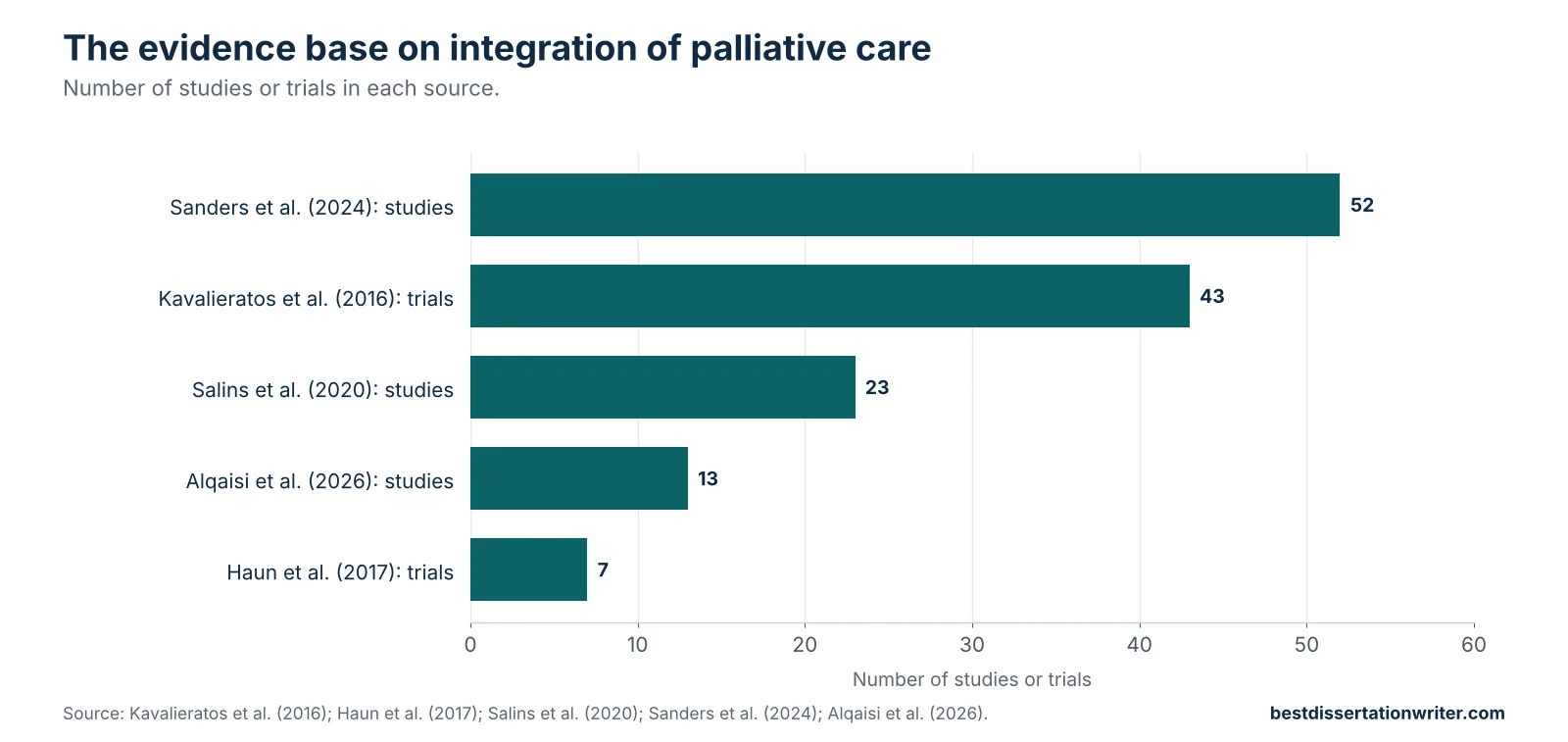
Three themes were identified: what guidelines recommend, what trials and meta-analyses show about effects, and what hinders referral and how nurses contribute. Table 1 summarises the included sources, and Figure 1 shows the size of the evidence base in each source.
| Author, year | Design | Setting and sample | Key finding |
|---|---|---|---|
| Alqaisi et al. (2026) | Scoping review | 13 studies from 920 records | Nurses central to early palliative care; gaps in communication training and role clarity. |
| Haun et al. (2017) | Cochrane review | 7 trials; 1,614 participants | Small improvement in quality of life and symptom intensity; no clear effect on survival. |
| Kavalieratos et al. (2016) | Systematic review and meta-analysis | 43 trials; 12,731 patients | Improved quality of life and symptom burden at 1 to 3 months; no association with survival. |
| Salins et al. (2020) | Systematic review | 23 studies | Referral hindered by presuppositions, power and trust, and stigma. |
| Sanders et al. (2024) | Clinical practice guideline | 52 relevant studies | Refer patients with advanced cancer early to interdisciplinary palliative care alongside treatment. |
Theme 1: What Guidelines Recommend
The American Society of Clinical Oncology (ASCO) guideline update by Sanders et al. (2024) updates the 2016 guidance on integrating palliative care into routine oncology care. An expert panel reviewed literature published from 2015 to 2023, including systematic reviews, meta-analyses and randomised trials, and assessed outcomes including quality of life, patient satisfaction, physical and psychological symptoms, survival and caregiver burden. Fifty-two relevant studies informed the evidence base, and the panel combined this with informal consensus.
The recommendations are clear. Patients with advanced solid tumours or haematological malignancies should be referred to specialised interdisciplinary palliative care teams, with care starting early in the disease course and alongside active cancer treatment. Dedicated specialist palliative care should be provided in cancer programmes for patients with unaddressed physical, psychosocial or spiritual distress. Family and other caregivers should be referred for additional support, and clinicians may consider early involvement, particularly for patients with uncontrolled symptoms or concerns about quality of life, and specialist referral for patients with solid tumours enrolled in phase I trials.
Theme 2: Effects of Early and Integrated Palliative Care
Kavalieratos et al. (2016) carried out a systematic review and meta-analysis of 43 randomised trials of palliative care in adults with life-limiting illness, with 12,731 patients and 2,479 caregivers. Palliative care was associated with statistically and clinically significant improvements in quality of life and symptom burden at one to three months, with no association with survival. It was also associated with improved advance care planning, higher patient and caregiver satisfaction and lower use of health care. Results for caregivers and for several other outcomes were mixed, and when the analysis was restricted to five trials at low risk of bias, the association with quality of life was weaker and that with symptom burden was no longer statistically significant.
Haun et al. (2017) focused on advanced cancer in a Cochrane review of early palliative care. It included seven randomised and cluster randomised trials with 1,614 participants, of which four tested care from specialised palliative care teams and the others tested coordinated care models. Early palliative care produced a small improvement in quality of life (standardised mean difference 0.27, 95% confidence interval 0.15 to 0.38; low certainty) and lower symptom intensity (−0.23, −0.35 to −0.10; low certainty), with no clear difference in survival (hazard ratio 0.85, 0.56 to 1.28; very low certainty) or depression (very low certainty).
The Cochrane authors concluded that early palliative care may benefit quality of life and symptom intensity in advanced cancer, that the effects are small but may matter clinically, and that the evidence is of low to very low certainty. One trial reported more severe pain and poor appetite in the intervention group, and the others did not report adverse events in their publications. Taken together with the meta-analysis, the evidence suggests a modest benefit for patients, but not a survival advantage.
Theme 3: Barriers to Referral and the Role of Nurses
Salins et al. (2020) carried out a systematic review of how the views of oncologists and haematologists affect palliative care referral. Searching seven databases from 1990 to 2019, they included 23 studies from 9,336 citations and synthesised them narratively into five themes. Presuppositions such as role conflict, abandonment and loss of hope hindered referral, as did low confidence in managing palliative needs. Oncologists often preferred to control referrals and had limited trust in the competence of palliative care providers, and stigma, organisational barriers, lack of referral criteria and limited resources made referral difficult. Suggested strategies included an integrated model of care, renaming palliative care and expanding resources.
Alqaisi et al. (2026) carried out a scoping review of nursing roles in the early integration of palliative and supportive care for adults with advanced cancer. They followed the Arksey and O’Malley framework and PRISMA for scoping reviews, and included 13 studies from 920 records, searched from January 2016 to November 2025. Early palliative care generally improved quality of life and reduced symptom burden, nurse-led primary palliative care increased end-of-life conversations and completion of advance directives in a secondary analysis of a cluster trial, and nurse-led telephone symptom management was feasible.
The same scoping review reported gaps in competence and support. In a survey of 1,198 nurses in China, communication was the lowest-scoring palliative care domain, and in a qualitative study of 19 Canadian oncology nurses, participants reported role uncertainty, training gaps, and limited time and privacy. The authors described nurses as central to delivering early palliative care, called for structured nurse-led models, communication training and organisational reform, and noted that the evidence is heterogeneous and mostly from high-income countries.
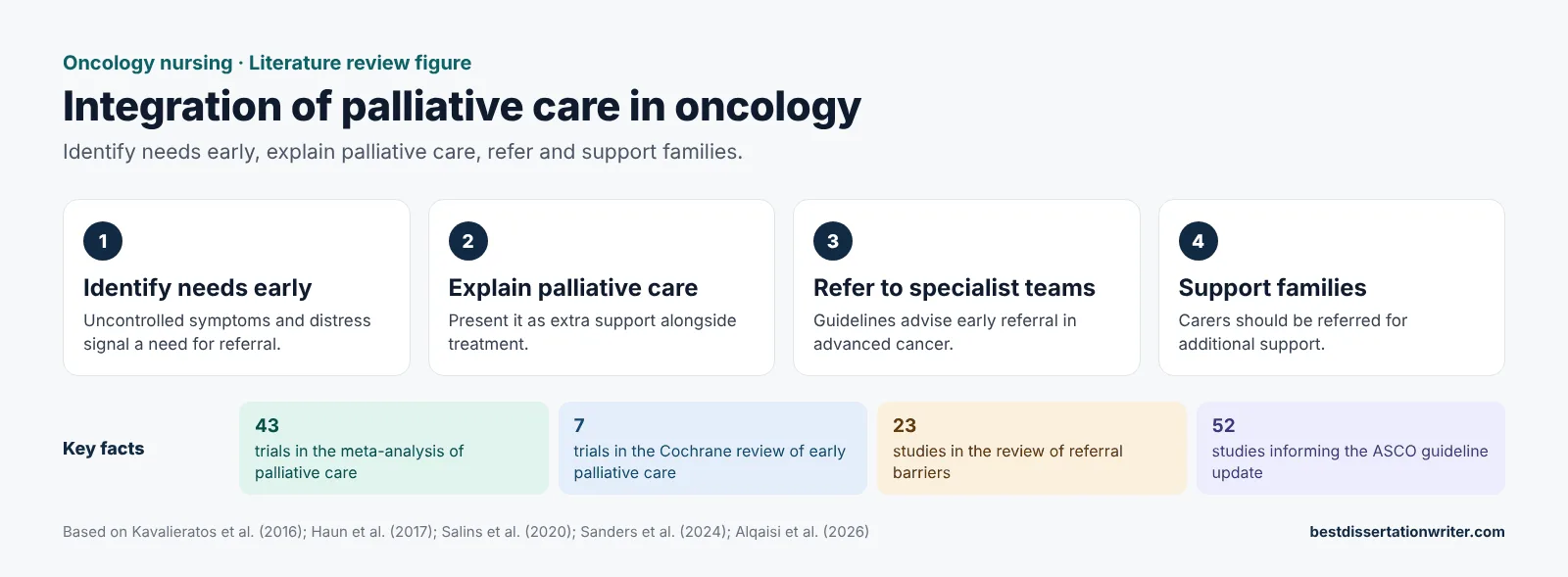
Taken together, the three themes show a progression from recommendation to evidence to practice. The guideline sets a standard, the trials show that following it is associated with modest benefit, and the studies of referral and nursing describe why the standard is not always met. The gap between the first and last of these is where nurses can make a difference, since they can prompt discussion, explain options and keep the conversation going over time.
Several practical questions remain unanswered by the sources. When is the best time to introduce palliative care, and does this differ for patients with different cancers? Which patients benefit most from specialist referral and which can be supported by primary palliative care from the oncology team? How can services avoid overloading specialist teams as demand grows? The guideline suggests that early involvement is particularly useful for uncontrolled symptoms or quality-of-life concerns, but the trials were not designed to identify optimal timing.
Communication is a recurring thread. Patients and families may find the word palliative frightening, and clinicians may avoid it. Suggested strategies in the review of referral included renaming the service. Nurses can explain palliative care in plain terms, such as an extra layer of support that helps with symptoms and decisions while treatment continues, and can ask patients what they understand and what matters most to them. These conversations take time and skill, so training and protected time are important.
Discussion
This scoping review maps a consistent message. Guidelines recommend integration of palliative care early and alongside treatment, and trials and meta-analyses show modest improvements in quality of life and symptoms without evidence of harm to survival. The certainty of the evidence is often low, so recommendations are based partly on consensus, and services should be open about this when they discuss palliative care with patients.
The barriers to the integration of palliative care are largely attitudinal and organisational. Clinicians’ concerns about hope and loss of control, uncertain trust in palliative care providers and the stigma attached to the term all appear in the review of referral. These suggest that integration of palliative care depends on relationships and communication as well as on referral criteria. Nurses, who work across teams and know patients well, may help by explaining what palliative care offers and by talking openly with oncology colleagues.
For nurses the practical implications are clear. They can identify patients with uncontrolled symptoms or distress, raise the possibility of palliative care with the team, explain it to patients as an extra layer of support and not as a sign that treatment is ending, and support advance care planning. They also need training in communication and clarity about their role, as the studies in the scoping review show, and cancer centres need time and space for these conversations. Navigation roles, described in the review of cancer nurse navigators, may help to coordinate.
There are limitations. As a scoping review it did not appraise study quality or pool results. The included sources differ widely, from a guideline to a review of surveys, and one of them is a 2026 scoping review with a small number of studies. Much evidence concerns specialist teams in high-income settings, so it may not apply to services where specialist palliative care is limited. Outcomes were mostly measured at one to three months, so longer-term effects are unclear. This review relied on openly accessible, English-language sources.
Future research should test nurse-led models of palliative care in oncology in well-designed trials, identify which components of integrated care are responsible for benefit, and examine timing and triggers for referral. Studies from the United Kingdom and from low- and middle-income settings are needed, since the scoping review found that most evidence comes from high-income countries, and patient and family views on terminology and acceptability should be included. Outcomes beyond three months would show whether the benefits last.
Implications of Integration of Palliative Care Evidence for Practice
For practice, the evidence supports considering palliative care for every patient with advanced cancer soon after diagnosis, referring early to specialist teams where symptoms or distress are not controlled, involving family members and carers, and discussing goals of care regularly. Information for patients is available from Macmillan Cancer Support and Cancer Research UK.
Managers should create clear referral criteria, provide training in palliative care communication and ensure that nurses have time to hold these conversations. Services should audit when referrals happen and whether patients receive support alongside treatment.
Conclusion
This scoping review mapped the evidence on integration of palliative care in oncology. Guidelines recommend early referral alongside treatment, trials suggest modest benefits for quality of life and symptoms, and barriers of attitude, trust and organisation hinder referral.
Nurses are well placed to help by identifying needs, explaining palliative care and supporting patients and families. With training and organisational support, they can make integration of palliative care a routine part of cancer care, and help to close the gap between guidance and practice.
References
Alqaisi, O., Al-Ghabeesh, S., Masalha, H., Jones Thachuthara, A., Joseph, K., Tai, P., Yu, E., & Koul, R. (2026). Nursing roles in early integration of palliative and supportive care for adults with advanced cancer: A scoping review. Current Oncology, 33(6), Article 312. https://doi.org/10.3390/curroncol33060312
Haun, M. W., Estel, S., Rücker, G., Friederich, H.-C., Villalobos, M., Thomas, M., & Hartmann, M. (2017). Early palliative care for adults with advanced cancer. Cochrane Database of Systematic Reviews, 2017(6), Article CD011129. https://doi.org/10.1002/14651858.CD011129.pub2
Kavalieratos, D., Corbelli, J., Zhang, D., Dionne-Odom, J. N., Ernecoff, N. C., Hanmer, J., Hoydich, Z. P., Ikejiani, D. Z., Klein-Fedyshin, M., Zimmermann, C., Morton, S. C., Arnold, R. M., Heller, L., & Schenker, Y. (2016). Association between palliative care and patient and caregiver outcomes: A systematic review and meta-analysis. JAMA, 316(20), 2104. https://doi.org/10.1001/jama.2016.16840
Salins, N., Ghoshal, A., Hughes, S., & Preston, N. (2020). How views of oncologists and haematologists impacts palliative care referral: A systematic review. BMC Palliative Care, 19, Article 175. https://doi.org/10.1186/s12904-020-00671-5
Sanders, J. J., Temin, S., Ghoshal, A., Alesi, E. R., Ali, Z. V., Chauhan, C., Cleary, J. F., Epstein, A. S., Firn, J. I., Jones, J. A., Litzow, M. R., Lundquist, D., Mardones, M. A., Nipp, R. D., Rabow, M. W., Rosa, W. E., Zimmermann, C., & Ferrell, B. R. (2024). Palliative care for patients with cancer: ASCO guideline update. Journal of Clinical Oncology, 42(19), 2336–2357. https://doi.org/10.1200/JCO.24.00542
Cite this example
Best Dissertation Writers (2026) Integration of Palliative Care into Oncology Nursing Practice: A Scoping Review. Available at: https://bestdissertationwriter.com/integration-of-palliative-care-review/
Best Dissertation Writers
Get expert help with your nursing literature review
Share your topic and deadline with Best Dissertation Writers and get support tailored to your module brief.