Interprofessional Education in Health Professional Programmes: A Systematic Review
 By Dr. Robertson Prime, Research Fellow
Updated October 25, 2026
14 min read
About 2,800 words
In this review
Abstract
Background: Interprofessional education, in which students from two or more professions learn about, from and with each other, is promoted internationally as a way to prepare a workforce that collaborates safely. Failures of communication between professions contribute to harm, yet health professional programmes are still largely taught in separate silos.
Aim: This systematic review aimed to examine the effects of shared learning between health professions on students’ attitudes, knowledge and skills, and on professional practice and patient care.
Methods: Evidence was identified through targeted searches of openly accessible bibliographic records, publisher websites and the reference lists of key reviews. Five sources published between 2010 and 2019 were included: an international framework, a Cochrane review, a Best Evidence Medical Education review, a meta-analysis and a systematic review of student outcomes, appraised with CASP checklists and synthesised narratively.
Findings: Reviews consistently found that learners respond well, with improved attitudes, perceptions of other professions and collaborative knowledge and skills; all seven studies in one review of students reported positive effects, and a meta-analysis of 12 studies reported a pooled effect of 1.37. Evidence for changes in practice and patient care was more limited: of 15 controlled studies in a Cochrane review, seven reported positive outcomes, four mixed outcomes and four no effect, and generalisable conclusions were not possible.
Conclusion: Shared learning reliably improves students’ attitudes and collaborative skills, while its effect on care is promising but uncertain. Nurse educators should embed well-designed, practice-linked activities and evaluate their impact on behaviour.
Keywords: interprofessional education, healthcare students, IPE
Introduction
This systematic review critically examines recent evidence on interprofessional education and its implications for nursing education and leadership.
Modern healthcare depends on teams. A patient admitted to hospital may be cared for by nurses, doctors, pharmacists, physiotherapists, occupational therapists, dietitians and social workers, each with different training, language and priorities. When these professionals communicate well, share information and respect each other’s contributions, care is safer and more coordinated. When they do not, errors, delays and duplication follow, and inquiries into serious incidents frequently identify breakdowns in teamwork and communication as contributing factors.
Despite this, health professionals are still mostly educated separately. Nursing, medical and allied health students often study on different campuses, follow different timetables and meet each other for the first time in practice. Interprofessional education aims to address this by bringing students from different professions together to learn about each other’s roles, from each other’s expertise and with each other in shared activities. The World Health Organization has argued that such learning is essential for collaborative practice and a stronger health workforce.
A systematic approach was chosen because several major reviews have examined this question at different levels of outcome, and bringing them together allows the strength of evidence at each level to be compared.
The question matters for nurse educators who must decide how much curriculum time to devote to shared learning, for programme leaders negotiating timetables with other schools, and for practice partners who host interprofessional placements. Shared learning is resource-intensive to organise, so it is important to know which outcomes it can reliably achieve and which claims remain uncertain.
Review question
What are the effects of interprofessional education on students’ attitudes, knowledge and skills, and on professional practice and patient care?
Background to Interprofessional Education
The World Health Organization (2010) defined interprofessional education as occurring when students from two or more professions learn about, from and with each other to enable effective collaboration and improve health outcomes. This definition distinguishes it from multiprofessional education, in which students from different professions simply attend the same lectures without interaction. Genuine IPE requires interaction, shared problem-solving and reflection on professional roles.
Interprofessional education takes many forms. Classroom activities include shared case discussions, workshops on communication and role clarification and problem-based learning in mixed groups. Simulation brings students together to manage emergencies or discharge planning in realistic scenarios. Practice-based IPE includes interprofessional training wards, shared placements and community projects. Online modules allow students from different institutions to work together despite timetabling constraints.
Several theories underpin IPE. Contact theory suggests that structured contact between groups reduces stereotypes and improves attitudes. Social identity theory explains how strong professional identities can create in-group loyalty and out-group bias, which IPE seeks to soften without undermining professional identity. Theories of team learning emphasise shared mental models, communication and mutual trust as foundations of effective collaborative practice.
Outcomes of IPE are often described using a modified version of Kirkpatrick’s model: learner reactions; changes in attitudes and perceptions; acquisition of knowledge and skills; changes in behaviour; changes in organisational practice; and benefits to patients. Most evaluations measure the lower levels, which are easier to assess, while the higher levels, which matter most for patients, are much harder to measure and attribute to education.
Timing is a recurring debate. Some educators argue that students should learn together from the first year, before stereotypes become fixed, while others suggest that shared learning is most meaningful once students understand their own professional role and have clinical experience to draw on. Many programmes now combine both, starting with introductory activities on roles and values and progressing to complex simulations and shared placements in later years. The evidence does not yet show which sequence works best.
Search Strategy and Methods
Evidence for this example was identified through targeted searches of openly accessible bibliographic records, publisher websites and the reference lists of key reviews. Search terms combined keywords for the intervention (“interprofessional education”, “IPE”, “interprofessional learning”, “shared learning”, “interprofessional simulation”) with terms for the population and outcomes (“healthcare students”, “nursing student*”, “attitudes”, “collaboration”, “professional practice”, “patient outcome*”), joined with the Boolean operators AND and OR. A full systematic review for assessment would run the same strategy in CINAHL, ERIC, PubMed/MEDLINE and Scopus and report the number of records screened in a PRISMA flow diagram.
Sources were eligible if they evaluated interprofessional education involving nursing and at least one other health profession, at pre-registration or post-registration level, and reported outcomes at any Kirkpatrick level, or if they set international policy for IPE. Systematic reviews and meta-analyses were prioritised because of the very large number of single evaluations of interprofessional education. Studies of multiprofessional teaching without interaction between professions were excluded.
Five sources published between 2010 and 2019 were included: one international policy framework, one Cochrane review of effects on practice and patient outcomes, one Best Evidence Medical Education review, one meta-analysis and one systematic review of student outcomes (Table 1). The quality of each review was appraised using the Critical Appraisal Skills Programme (CASP) checklist for systematic reviews, and findings were synthesised narratively according to the level of outcome.
Key Findings on Interprofessional Education
Three themes were identified: the effects of interprofessional education on students’ reactions and attitudes, its effects on knowledge and collaborative skills, and the more limited evidence on professional practice and patient care. Table 1 summarises the included sources, and Figure 1 shows the distribution of outcomes reported in controlled studies of effects on practice and patient care.
| Author, year | Design | Setting and sample | Key finding |
|---|---|---|---|
| World Health Organization (2010) | International policy framework | Health workforce education globally | Defines IPE as learning about, from and with each other to enable collaborative practice. |
| Reeves et al. (2013) | Cochrane systematic review | 15 controlled studies of practice and healthcare outcomes | 7 positive, 4 mixed and 4 no effect; generalisable conclusions not possible. |
| Reeves et al. (2016) | Systematic review (BEME Guide No. 39) | 46 high-quality evaluations | Learners respond well; improved attitudes, knowledge and skills; behaviour and patient evidence limited. |
| Guraya & Barr (2018) | Systematic review and meta-analysis | 12 studies of healthcare students (2000–2016) | Pooled effect 1.37 (95% CI 0.92–1.82) on knowledge, skills and attitudes. |
| Dyess et al. (2019) | Systematic review | 7 studies with students from at least three professions | All seven reported positive effects on attitudes and teamwork. |
Theme 1: Interprofessional Education, Reactions and Attitudes
Reeves et al. (2016) updated a Best Evidence Medical Education review, adding 25 new studies to 21 from a previous review to create a data set of 46 high-quality evaluations. Learners responded well to interprofessional education, and their attitudes and perceptions of one another improved. The review reported far more positive than neutral or mixed outcomes, although most studies relied on self-report and short-term measures.
Dyess et al. (2019) systematically reviewed studies of interprofessional education involving students from at least three health professions within academic coursework. From 870 records, seven studies met the inclusion criteria, and all seven reported a positive effect on students’ education. The authors concluded that IPE improved attitudes toward interdisciplinary teamwork, communication and shared problem-solving. The small number of studies and reliance on attitude scales limit the strength of these conclusions.
Positive changes in attitude are an important starting point. Healthcare students often arrive with stereotypes about other professions, for example that doctors make all the decisions or that nurses simply follow instructions. Structured interaction can challenge these assumptions and help students appreciate the expertise of others. However, attitudes measured immediately after a workshop may not last, and the evidence on durability is limited.
Theme 2: Knowledge and Collaborative Skills
Guraya and Barr (2018) conducted a meta-analysis of 12 studies published between 2000 and 2016 examining the effect of interprofessional education on students’ knowledge, skills and attitudes. The pooled effect size was 1.37 (95% confidence interval 0.92 to 1.82), indicating a statistically significant positive effect. The authors concluded that IPE had a positive impact across healthcare disciplines but called for further trials to assess its effect on clinical competence.
Reeves et al. (2016) similarly found that learners reported increases in collaborative knowledge and skills, such as understanding of roles, communication and teamwork. Interprofessional simulation was a common format, allowing students to practise handovers, escalation and shared decision-making in realistic situations. Most of this evidence was self-reported, however, and objective assessment of team performance was less common.
The size of the pooled effect in the meta-analysis should be interpreted cautiously. The included studies were heterogeneous in design, duration and outcome measures, and many lacked control groups. Large effect sizes in education research often reflect comparisons with no intervention and outcomes measured by the same instruments used to design the teaching. The direction of effect is encouraging, but its magnitude is uncertain.
Collaborative skills are also hard to define and assess. Communication, role clarity, shared decision-making and conflict resolution are complex behaviours that depend on context, and self-assessment of them may be unreliable. Observational tools that rate team performance in simulation, and structured feedback from peers in other professions, offer more objective measures. Programmes that assess these skills directly, rather than relying on questionnaires about attitudes, would provide stronger evidence that interprofessional education is building the capabilities needed for safe teamwork.
Theme 3: Practice and Patient Outcomes
Reeves et al. (2013) conducted a Cochrane review restricted to randomised trials, controlled before-and-after studies and interrupted time series examining effects on professional practice and healthcare outcomes. Fifteen studies were included, covering areas such as diabetes care, emergency departments, operating theatres, domestic violence and mental health. Seven reported positive outcomes, four mixed outcomes and four no effect on practice or patient care.
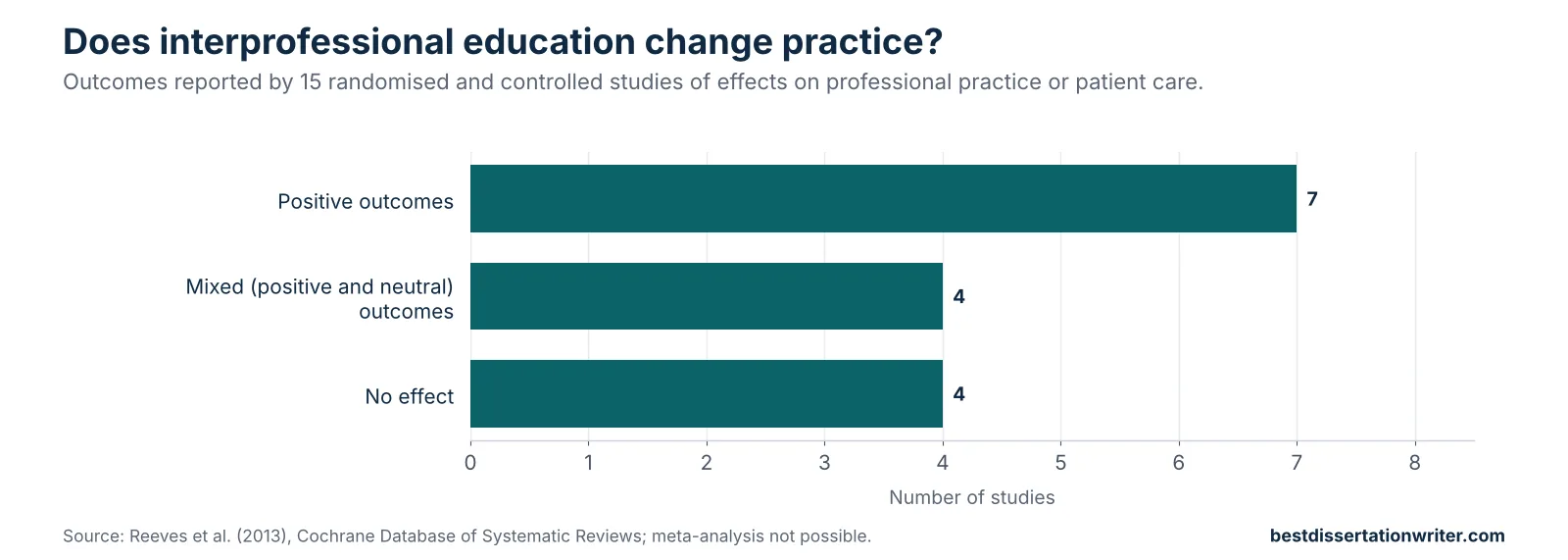
Because the studies varied so much in interventions and outcomes, meta-analysis was not possible, and the authors concluded that it was not possible to draw generalisable inferences about the key elements of IPE or its effectiveness. Most of these studies involved qualified professionals rather than students, and many interventions were embedded in quality improvement initiatives, making it difficult to isolate the contribution of education.
The mixed results at this level are not surprising. Patient outcomes depend on staffing, systems and organisational culture as well as on the skills of individual professionals, and an educational intervention may be necessary but not sufficient to improve them. Positive studies often combined interprofessional education with changes to protocols, team structures or communication tools, suggesting that education works best as part of a broader improvement strategy. For leaders, this means pairing shared learning with changes that allow staff to apply what they have learned.
Discussion
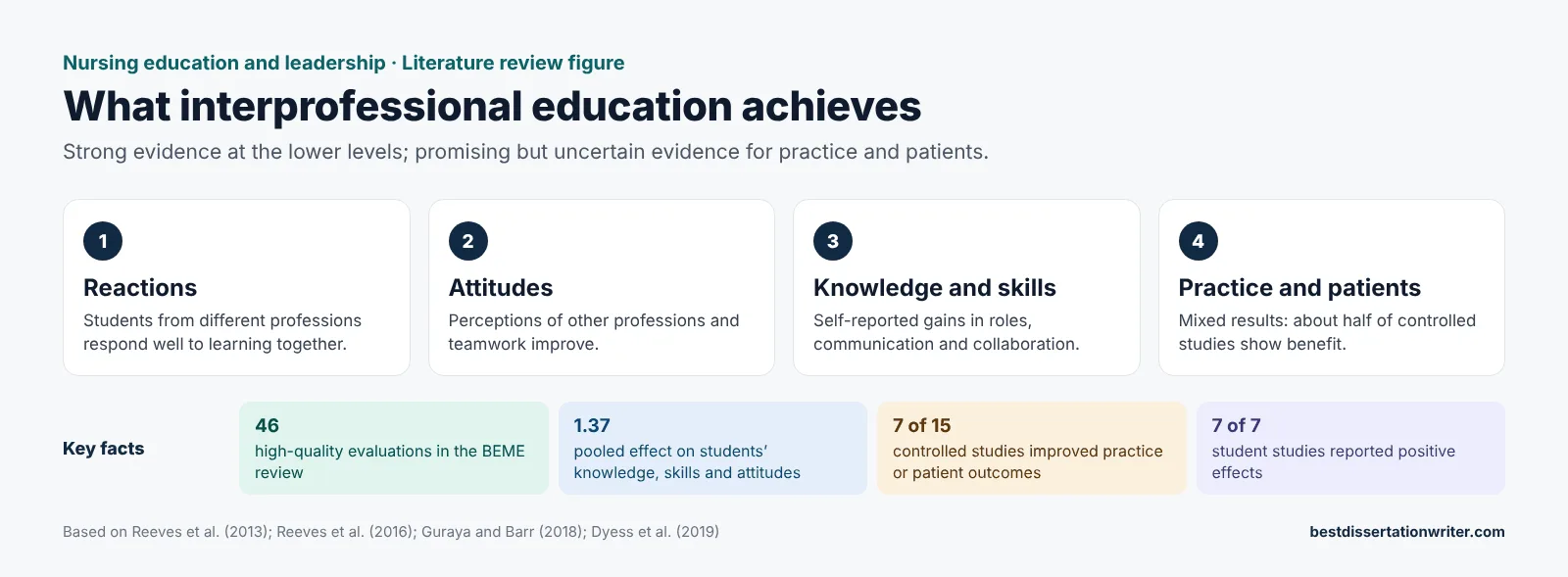
This review suggests that interprofessional education reliably produces positive reactions, improved attitudes toward other professions and self-reported gains in collaborative knowledge and skills. Evidence for changes in professional behaviour, organisational practice and patient outcomes is more limited and mixed, with about half of controlled studies reporting positive effects. The pattern is typical of educational research, where lower-level outcomes are easier to measure than effects on care.
The gap between attitude change and practice change has several possible explanations. Short, one-off activities may be insufficient to change behaviour established through years of uniprofessional training and reinforced by workplace cultures. Students may return to clinical environments where hierarchies and siloed working persist, limiting their opportunity to apply collaborative skills. Practice change may also take time to emerge, beyond the follow-up periods of most studies.
These findings have implications for how interprofessional education is designed. Activities linked to real clinical tasks, such as joint discharge planning, interprofessional simulation of deterioration and shared placements on training wards, may have greater impact than classroom discussions alone. Repeated, progressive exposure across programmes is likely to be more effective than single events. Faculty development matters too, because educators from different professions need to model collaborative behaviour themselves.
Organisational barriers remain significant. Different timetables, assessment requirements, student numbers and professional regulators make it difficult to schedule shared learning, and IPE may be seen as an addition rather than an integral part of the curriculum. Leadership at programme and institutional level is needed to protect time, align assessments and resource the coordination that interprofessional education requires.
Nursing has a particular stake in this agenda. Nurses coordinate much of the care that patients receive and act as a bridge between professions, yet they may feel that their contribution is undervalued in hierarchical teams. Interprofessional education can give nursing students the confidence to share their assessments and challenge decisions, and it can help students from other professions understand the scope of nursing practice. Ensuring that nursing students participate as equal partners, rather than as observers in medically led activities, is therefore an important design principle.
The evidence base has limitations. Most studies used self-report and short follow-up, many lacked control groups, and terminology and outcome measures varied widely. Some included reviews combined qualified professionals and students. This review relied on openly accessible, English-language sources and did not involve independent double screening. Future research should use controlled designs, objective measures of team performance and longer follow-up, and should examine which features of IPE produce lasting changes in practice and patient care.
Implications of Interprofessional Education Evidence for Practice
For nurse educators, the evidence supports embedding interactive, practice-linked IPE throughout programmes rather than relying on isolated events, using simulation and shared placements, and assessing collaborative behaviour as well as attitudes. Programme leaders should work with partner schools to align timetables and assessments. For nurse leaders in practice, supporting interprofessional training wards, joint learning and team debriefing helps to sustain collaborative skills after qualification. The Cochrane review of interprofessional education summarises what is known about effects in practice.
Interprofessional simulation builds on the evidence for simulation-based learning, and shared placements extend the learning available on clinical placements. Collaborative work environments are a feature of organisations with Magnet hospital recognition, and better teamwork may help to reduce the stress that contributes to nurse burnout.
Conclusion
This systematic review examined the effects of interprofessional education on healthcare students and practice. IPE consistently improves reactions, attitudes and self-reported collaborative knowledge and skills, while its effects on professional practice and patient care are promising but uncertain, with mixed results across controlled studies.
For nursing education and leadership, interprofessional education is best seen as a long-term investment in collaborative practice rather than a single curriculum event. Designing activities around real clinical tasks, repeating them across programmes and supporting collaboration in the workplace are the most promising ways to turn positive attitudes into safer, better-coordinated care.
References
Dyess, A. L., Brown, J. S., Brown, N. D., Flautt, K. M., & Barnes, L. J. (2019). Impact of interprofessional education on students of the health professions: A systematic review. Journal of Educational Evaluation for Health Professions, 16, 33. https://doi.org/10.3352/jeehp.2019.16.33
Guraya, S. Y., & Barr, H. (2018). The effectiveness of interprofessional education in healthcare: A systematic review and meta-analysis. The Kaohsiung Journal of Medical Sciences, 34(3), 160–165. https://doi.org/10.1016/j.kjms.2017.12.009
Reeves, S., Fletcher, S., Barr, H., Birch, I., Boet, S., Davies, N., McFadyen, A., Rivera, J., & Kitto, S. (2016). A BEME systematic review of the effects of interprofessional education: BEME Guide No. 39. Medical Teacher, 38(7), 656–668. https://doi.org/10.3109/0142159X.2016.1173663
Reeves, S., Perrier, L., Goldman, J., Freeth, D., & Zwarenstein, M. (2013). Interprofessional education: Effects on professional practice and healthcare outcomes (update). Cochrane Database of Systematic Reviews, (3), CD002213. https://doi.org/10.1002/14651858.CD002213.pub3
World Health Organization. (2010). Framework for action on interprofessional education and collaborative practice. World Health Organization.
Cite this example
Best Dissertation Writers (2026) Interprofessional Education in Health Professional Programmes: A Systematic Review. Available at: https://bestdissertationwriter.com/interprofessional-education-review/
Best Dissertation Writers
Get expert help with your nursing literature review
Share your topic and deadline with Best Dissertation Writers and get support tailored to your module brief.