Magnet Hospital Recognition and Its Effect on Nursing and Patient Outcomes: A Systematic Review
 By Dr. Robertson Prime, Research Fellow
Updated October 25, 2026
14 min read
About 2,900 words
In this review
Abstract
Background: Magnet hospital recognition, awarded by the American Nurses Credentialing Center, identifies organisations with excellent nursing work environments and is increasingly used as a model outside the United States. Leaders considering the model need to know whether recognition is associated with better outcomes for nurses and patients, and whether any benefits reflect the designation itself or underlying features of good organisations.
Aim: This systematic review aimed to examine the relationship between Magnet recognition and nurse and patient outcomes.
Methods: Evidence was identified through targeted searches of openly accessible bibliographic records, publisher websites and the reference lists of key reviews. Five sources published between 2011 and 2022 were included: two cross-sectional studies, one longitudinal study, one systematic review and one trial protocol, appraised with CASP checklists and synthesised narratively.
Findings: Nurses in recognised hospitals were 18% less likely to be dissatisfied and 13% less likely to report high burnout. Surgical patients had 14% lower odds of death within 30 days and 12% lower odds of failure to rescue, partly explained by better staffing, education and work environments. Hospitals that achieved recognition improved faster than others, with 2.4 fewer surgical deaths per 1,000 patients. However, a systematic review of 10 studies judged the evidence too weak to conclude that accreditation itself causes these effects.
Conclusion: The organisational features associated with the model are consistently linked to better outcomes, but evidence that the designation itself causes improvement is limited. A European trial is testing whether the model can be transferred to other health systems.
Keywords: Magnet hospital, Magnet recognition, nursing outcomes, work environment
Introduction
This systematic review critically examines recent evidence on Magnet hospital and its implications for nursing education and leadership.
In the early 1980s, researchers in the United States noticed that some hospitals were able to attract and keep nurses despite national shortages. These hospitals, described as magnets, shared features such as supportive nurse leaders, nurse involvement in decisions, professional autonomy and good relationships between nurses and doctors. The American Nurses Credentialing Center later developed a formal recognition programme based on these features, and Magnet hospital status has since become one of the most widely recognised marks of nursing excellence.
The model has attracted international interest. In Europe, the Magnet4Europe project has worked with more than 60 hospitals in six countries, including England, to test whether an organisational redesign based on the Magnet model can improve the wellbeing of nurses and doctors. For nurse leaders in the United Kingdom, where staff shortages, burnout and retention are pressing concerns, the question is whether the model offers a route to better outcomes or whether its benefits are confined to a particular health system.
A systematic approach was chosen because the evidence includes large cross-sectional studies, a longitudinal analysis, a systematic review and an ongoing trial, and appraising these together helps to distinguish associations from causal effects. The distinction matters because pursuing recognition requires considerable investment of time and money.
The question is relevant to nurse executives deciding whether to pursue recognition or adopt its principles, to educators preparing future nurse leaders and to staff who want to understand what an excellent nursing work environment looks like. Understanding which features of the model are associated with better outcomes allows organisations to invest in those features, whether or not they seek formal designation.
Review question
What is the relationship between Magnet hospital recognition and outcomes for nurses and patients?
Background to Magnet Hospital Recognition
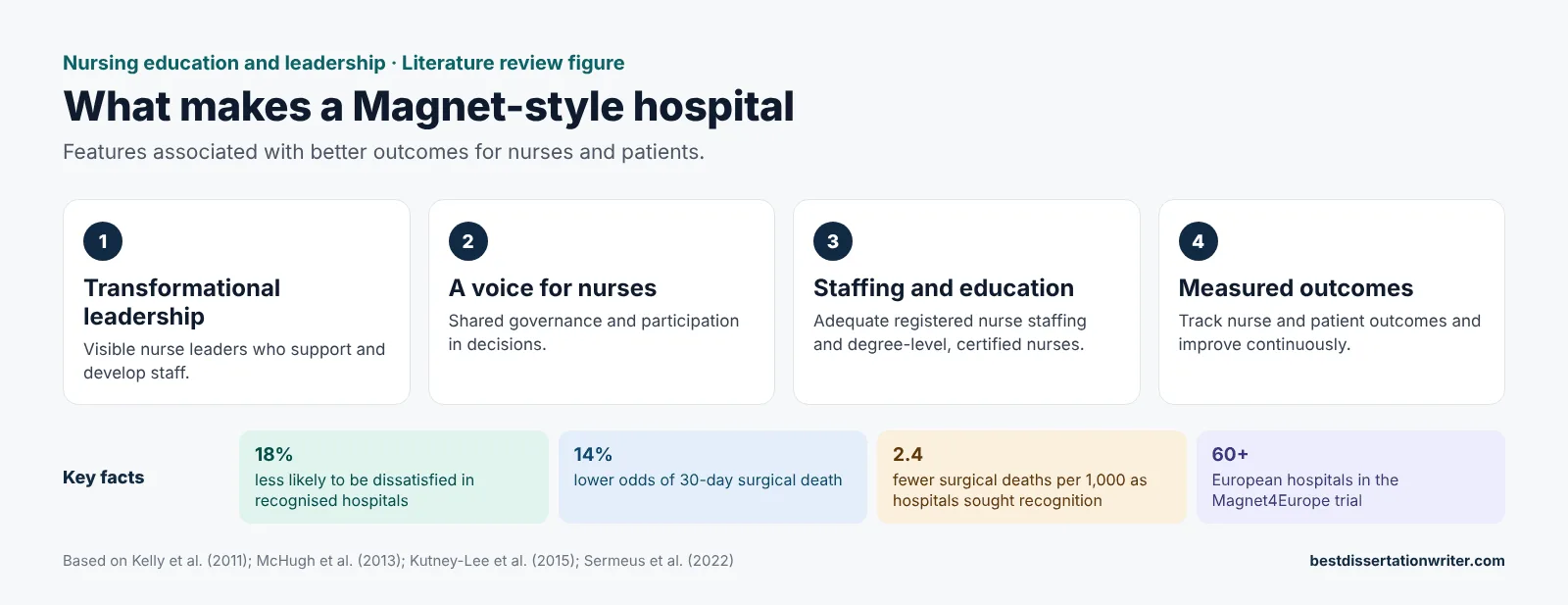
The current model is organised around five components: transformational leadership; structural empowerment, which includes shared governance and professional development; exemplary professional practice, covering care delivery, autonomy and interprofessional relationships; new knowledge, innovations and improvements, emphasising research and evidence-based practice; and empirical outcomes, requiring organisations to demonstrate measurable results. Applicants must submit extensive documentation and undergo a site visit, and recognition must be renewed periodically.
The original magnet studies identified 14 so-called forces of magnetism, including quality of nursing leadership, organisational structure, management style, personnel policies, professional models of care, quality of care, autonomy, community relationships, nurses as teachers, the image of nursing, interdisciplinary relationships and professional development. These forces describe a positive nursing work environment and have been used to develop measurement tools such as the Practice Environment Scale of the Nursing Work Index.
A central question in research on the model is whether the designation itself makes a difference or simply identifies hospitals that were already good. Organisations that apply may differ from others in resources, size, teaching status and leadership, and these factors could explain better outcomes. Studies therefore try to adjust for such characteristics or examine changes over time as hospitals move through the recognition process.
Outside the United States, interest has focused on the principles of the model rather than formal designation. The work environment features associated with a Magnet hospital, such as good leadership, adequate staffing and nurse participation in decisions, are relevant to any health system, and research has examined whether these features can be developed through organisational change rather than accreditation.
Magnet recognition also has implications for nursing education. Recognised organisations are expected to support continuing professional development, specialty certification and higher degrees, and to promote research and evidence-based practice. A Magnet hospital therefore often functions as a learning organisation for nurses, with clinical educators, nurse researchers and structured career pathways. For universities and practice partners, this raises questions about how the educational features of the model contribute to its outcomes and whether they can be strengthened in hospitals without formal recognition.
Search Strategy and Methods
Evidence for this example was identified through targeted searches of openly accessible bibliographic records, publisher websites and the reference lists of key reviews. Search terms combined keywords for the exposure (“Magnet hospital”, “Magnet recognition”, “Magnet status”, “Magnet4Europe”) with terms for outcomes (“nursing outcomes”, “burnout”, “job satisfaction”, “mortality”, “failure to rescue”, “work environment”), joined with the Boolean operators AND and OR. A full systematic review for assessment would run the same strategy in CINAHL, ERIC, PubMed/MEDLINE and Scopus and report the number of records screened in a PRISMA flow diagram.
Sources were eligible if they compared outcomes between hospitals with and without Magnet hospital recognition, examined changes associated with the recognition process, reviewed this evidence systematically or described trials of the model outside the United States. Studies of individual forces of magnetism without reference to recognition or the model were excluded, as were descriptive accounts of a single Magnet hospital journey without outcome data.
Five sources published between 2011 and 2022 were included: two large cross-sectional studies of nurse and patient outcomes, one longitudinal study of hospitals moving through the recognition process, one systematic review and one trial protocol from Europe (Table 1). The quality of each source was appraised using the Critical Appraisal Skills Programme (CASP) checklist appropriate to its design, and findings were synthesised narratively and grouped into themes.
Key Findings on Magnet Hospital Recognition
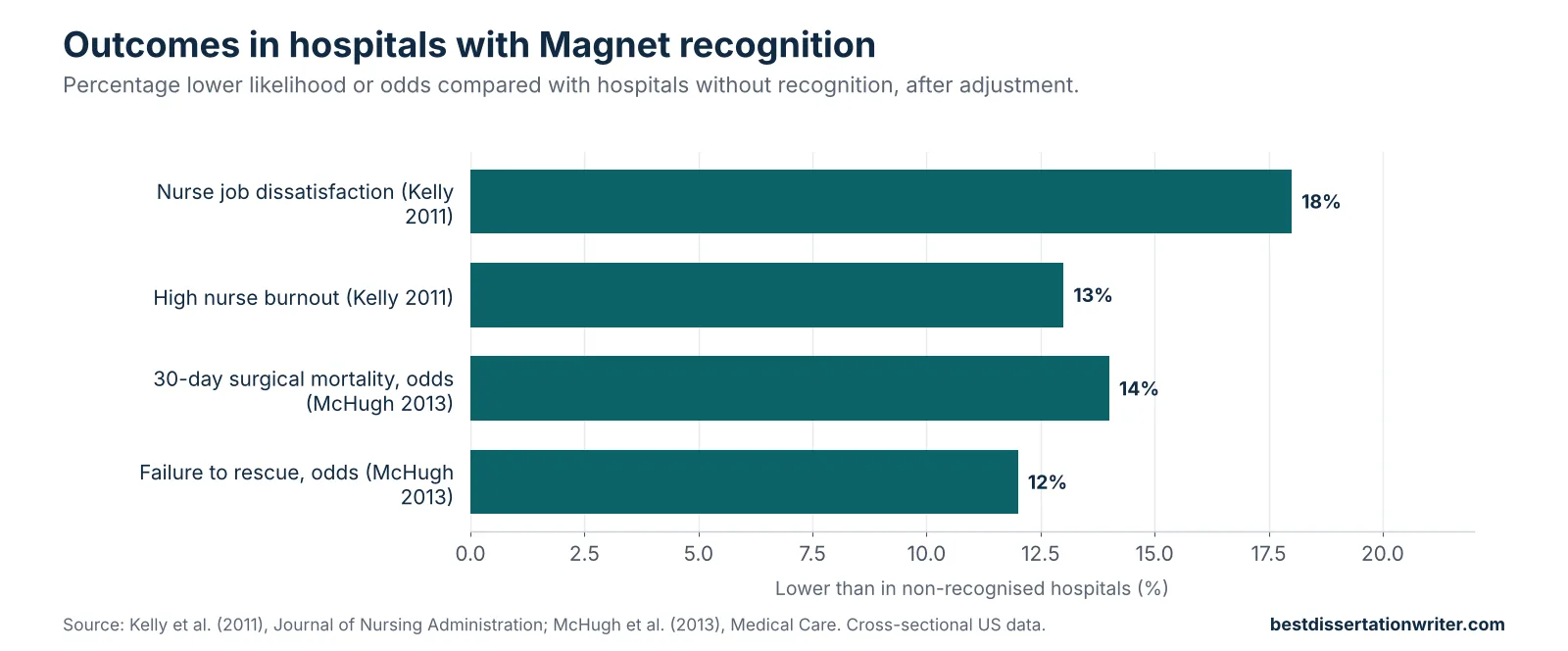
Three themes were identified: nurse outcomes, patient outcomes and the question of whether Magnet hospital recognition causes improvement or reflects existing strengths. Table 1 summarises the included sources, and Figure 1 summarises the differences in nurse and patient outcomes reported by two large studies.
| Author, year | Design | Setting and sample | Key finding |
|---|---|---|---|
| Kelly et al. (2011) | Cross-sectional survey | More than 26,000 nurses, 567 hospitals, four US states | Nurses in recognised hospitals 18% less likely dissatisfied and 13% less likely highly burned out. |
| McHugh et al. (2013) | Cross-sectional observational study | 56 recognised and 508 other hospitals; more than 600,000 surgical patients | 14% lower odds of 30-day death and 12% lower odds of failure to rescue. |
| Kutney-Lee et al. (2015) | Longitudinal study | 136 hospitals in Pennsylvania, 11 seeking recognition | Emerging recognised hospitals: 2.4 fewer surgical deaths per 1,000; lower burnout. |
| Petit dit Dariel & Regnaux (2015) | Systematic review | 10 studies comparing recognised and other hospitals | Some improvements reported, but poor-quality designs; causation not established. |
| Sermeus et al. (2022) | Cluster randomised trial protocol | More than 60 hospitals in six European countries | Tests a Magnet-based redesign; primary outcome nurse and physician burnout. |
Theme 1: Nurse Outcomes in a Magnet Hospital
Kelly et al. (2011) surveyed more than 26,000 registered nurses in 567 hospitals in four American states and compared those working in recognised and non-recognised organisations. Nurses working in a Magnet hospital were 18% less likely to be dissatisfied with their jobs and 13% less likely to report high levels of burnout, and they were less likely to report an intention to leave their current position. Better work environments appeared to account for much of the difference.
Kutney-Lee et al. (2015) examined 136 hospitals in Pennsylvania, of which 11 were going through the recognition process. These emerging Magnet hospitals showed lower adjusted rates of burnout, job dissatisfaction and intention to leave than non-Magnet hospitals. Because this study tracked changes over time, it provides stronger evidence than cross-sectional comparisons that improvements in the work environment accompany the process of seeking recognition.
These nurse outcomes matter for workforce sustainability. Burnout and dissatisfaction are among the strongest predictors of intention to leave, so organisations with better work environments may be better able to retain staff. The findings are consistent with the original observation that magnet hospitals attracted and kept nurses during shortages, although self-selection of nurses into recognised hospitals may contribute to the differences. Nurses who value professional development and shared governance may actively seek out such employers, which would make differences in satisfaction partly a matter of who works there rather than how they are treated.
Theme 2: Patient Outcomes
McHugh et al. (2013) compared 56 recognised hospitals with 508 non-recognised hospitals in four states, analysing outcomes for more than 600,000 surgical patients. After adjusting for nursing, hospital and patient characteristics, patients in a Magnet hospital had 14% lower odds of death within 30 days and 12% lower odds of failure to rescue. Recognised hospitals had better work environments, more nurses with bachelor’s degrees and specialty certification and better staffing, which explained much, but not all, of the advantage.
Kutney-Lee et al. (2015) found that emerging Magnet hospitals outpaced non-Magnet hospitals in several outcomes, with 2.4 fewer surgical deaths per 1,000 patients within 30 days and 6.1 fewer deaths per 1,000 among patients with complications. These improvements occurred as each emerging Magnet hospital moved through the recognition process, suggesting that the organisational changes required for recognition may themselves improve care.
Petit dit Dariel and Regnaux (2015) systematically reviewed 10 studies comparing recognised and non-recognised hospitals. Of seven studies examining patient outcomes, three found statistically significant improvements in recognised hospitals for outcomes including pressure ulcers, falls, failure to rescue and 30-day mortality, and three studies found improvements in nurse job satisfaction, intention to leave and turnover. However, nine studies were retrospective analyses of existing databases, designs were of poor quality and results could not be pooled.
Theme 3: Association or Causation?
The systematic review concluded that it was not possible to say that Magnet hospital accreditation itself has effects on nurse and patient outcomes, and called for more robust designs. This conclusion does not contradict the large studies; rather, it highlights that associations may reflect differences between hospitals that seek recognition and those that do not. McHugh et al. (2013) found that staffing, education and work environment explained much of the mortality advantage, supporting the view that these features, rather than the badge, drive outcomes.
The Magnet4Europe trial addresses this question directly. Sermeus et al. (2022) described a wait-list cluster randomised controlled trial in more than 60 general acute hospitals in Belgium, England, Germany, Ireland, Norway and Sweden, testing an organisational redesign based on the model, supported by twinning with recognised American hospitals. The primary outcome is burnout among nurses and doctors, with secondary outcomes including work environment, patient safety, quality of care and risk-adjusted mortality. Randomisation should provide much stronger evidence on whether the model can cause improvement.
Discussion
This review suggests that hospitals with Magnet hospital recognition have better outcomes for nurses and patients than comparable hospitals without it, including lower burnout and dissatisfaction and lower surgical mortality. Longitudinal evidence suggests that hospitals moving through the recognition process improve faster than others. However, the evidence is largely observational, and a systematic review judged it insufficient to conclude that accreditation itself causes improvement.
The most robust interpretation is that the features emphasised by the model, namely supportive leadership, adequate staffing, a highly educated workforce, nurse autonomy and participation in decisions, are associated with better outcomes. These findings align with wider research on nurse work environments and staffing. Whether formal recognition adds value beyond these features is less certain, although the longitudinal findings suggest that the process of seeking recognition may act as a catalyst for organisational change.
The costs and transferability of the model deserve consideration. Pursuing recognition requires substantial investment in documentation, data collection and organisational development, and hospitals with fewer resources may be unable to apply. Outside the United States, differences in health systems, professional cultures, pay structures and regulation may limit transferability. The Magnet4Europe trial will help to show whether the principles can be adapted to European hospitals, including those in the NHS.
There is also a risk of focusing on the badge rather than the substance. Recognition may become a marketing tool or an end in itself, and staff may experience the preparation as an administrative burden. Nurse leaders should therefore focus on the underlying features of good work environments, which can be developed with or without formal designation, and should involve frontline nurses in shaping the changes that matter most to them.
Measurement of nursing outcomes is central to this debate. Recognition requires organisations to collect and report data on nurse satisfaction, falls, pressure injuries and other indicators, and this emphasis on measurement may itself drive improvement. Hospitals without recognition may not collect comparable data, which makes fair comparison difficult. For nurse leaders in the NHS, adopting systematic measurement of nursing outcomes, whether or not they pursue Magnet hospital designation, would allow them to track the effects of changes to staffing, leadership and the work environment and to learn from the Magnet hospital approach without its full costs.
The evidence base has limitations. Most studies were cross-sectional or retrospective, conducted in a few American states and dependent on administrative data. Selection bias, unmeasured confounding and the age of some data limit conclusions. This review relied on openly accessible, English-language sources and did not involve independent double screening. Future research, including the results of the Magnet4Europe trial, should test the model using randomised or quasi-experimental designs in diverse health systems and examine its costs.
Implications of Magnet Hospital Evidence for Practice
For nurse leaders, the evidence supports investing in the features associated with the model: transformational leadership, shared governance, adequate registered nurse staffing, support for degree-level education and specialty development, and strong interprofessional relationships. Organisations can use validated work environment measures and routine data on nursing outcomes to identify priorities and track progress, as a Magnet hospital would. Those considering formal recognition should weigh its costs against the benefits of pursuing the same organisational changes directly. The Magnet4Europe trial protocol offers a European perspective on adapting the model, and its results should help leaders judge whether a structured redesign is worth the investment in their own organisations.
The model’s emphasis on staffing aligns with evidence on safe staffing, and its work environment features are strongly linked to nurse retention and the prevention of nurse burnout. Its focus on professional development supports educational innovations such as simulation-based learning for staff.
Conclusion
This systematic review examined the relationship between Magnet hospital recognition and outcomes for nurses and patients. Recognised hospitals report lower nurse burnout and dissatisfaction and lower surgical mortality, and hospitals moving through recognition improve faster than others, but the evidence is mainly observational and cannot show that the designation itself causes improvement.
For nursing education and leadership, the key message is that the features of a Magnet hospital, including strong leadership, adequate staffing, an educated workforce and a voice for nurses, are worth pursuing for their own sake. Whether through formal recognition or organisational redesign, building these features offers a promising route to better outcomes for nurses and patients.
References
Kelly, L. A., McHugh, M. D., & Aiken, L. H. (2011). Nurse outcomes in Magnet® and non-Magnet hospitals. Journal of Nursing Administration, 41(10), 428–433. https://doi.org/10.1097/NNA.0b013e31822eddbc
Kutney-Lee, A., Stimpfel, A. W., Sloane, D. M., Cimiotti, J. P., Quinn, L. W., & Aiken, L. H. (2015). Changes in patient and nurse outcomes associated with Magnet hospital recognition. Medical Care, 53(6), 550–557. https://doi.org/10.1097/MLR.0000000000000355
McHugh, M. D., Kelly, L. A., Smith, H. L., Wu, E. S., Vanak, J. M., & Aiken, L. H. (2013). Lower mortality in Magnet hospitals. Medical Care, 51(5), 382–388. https://doi.org/10.1097/MLR.0b013e3182726cc5
Petit dit Dariel, O., & Regnaux, J.-P. (2015). Do Magnet®-accredited hospitals show improvements in nurse and patient outcomes compared to non-Magnet hospitals: A systematic review. JBI Database of Systematic Reviews and Implementation Reports, 13(6), 168–219. https://doi.org/10.11124/jbisrir-2015-2262
Sermeus, W., Aiken, L. H., Ball, J., Bridges, J., Bruyneel, L., Busse, R., De Witte, H., Dello, S., Drennan, J., Eriksson, L. E., Griffiths, P., Kohnen, D., Köppen, J., Lindqvist, R., Maier, C. B., McHugh, M. D., McKee, M., Rafferty, A. M., Schaufeli, W. B., … Smith, H. L. (2022). A workplace organisational intervention to improve hospital nurses’ and physicians’ mental health: Study protocol for the Magnet4Europe wait list cluster randomised controlled trial. BMJ Open, 12(7), e059159. https://doi.org/10.1136/bmjopen-2021-059159
Cite this example
Best Dissertation Writers (2026) Magnet Hospital Recognition and Its Effect on Nursing and Patient Outcomes: A Systematic Review. Available at: https://bestdissertationwriter.com/magnet-hospital-literature-review/
Best Dissertation Writers
Get expert help with your nursing literature review
Share your topic and deadline with Best Dissertation Writers and get support tailored to your module brief.