Supported Living and Quality of Life Among Adults with Learning Disabilities: A Systematic Review
 By Dr. Robertson Prime, Research Fellow
Updated October 12, 2026
16 min read
About 3,200 words
In this review
Abstract
Background: Supported living, in which people with learning disabilities hold their own tenancy and receive separately arranged support, has become a central part of community living policy in the United Kingdom and elsewhere. National policy in England aims to close 35% to 50% of inpatient provision and give people a home in their community, but the quality of life it achieves depends heavily on the support provided.
Aim: This systematic review aimed to examine the evidence on quality of life outcomes for adults with learning disabilities in supported living and other community settings, and the factors that make a difference to those outcomes.
Methods: Targeted searches of openly accessible bibliographic records, publisher websites and the reference lists of key reviews identified seven sources published between 2009 and 2018: two systematic reviews, three observational studies, one qualitative study and one national policy plan. Sources were appraised with CASP checklists and synthesised narratively.
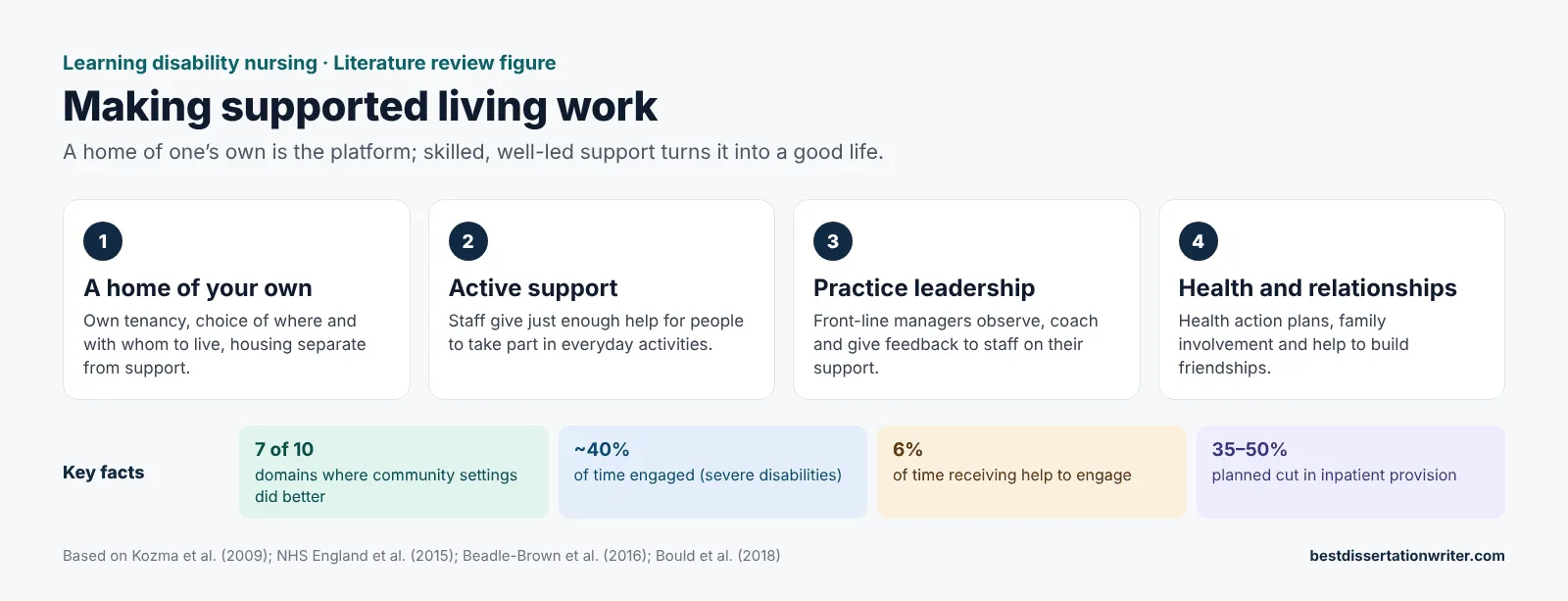
Findings: Community-based services were superior to congregate settings in seven of ten quality of life domains, and dispersed housing outperformed clustered housing in most domains. People who moved to personalised arrangements had more choice, community engagement and relationships than those in group homes, yet many tenants reported loneliness, low income and little say over their support. Observed engagement was low, at about 40% of time, with only 6% of time spent receiving assistance to engage, and active support and practice leadership were the strongest predictors of good outcomes.
Conclusion: This model offers a better platform for quality of life, but nurses and managers must ensure skilled, well-led support, and learning disability nurses can contribute through health facilitation, training and practice leadership.
Keywords: supported living, quality of life, community living
Introduction
This systematic review critically examines recent evidence on supported living and its implications for learning disability nursing practice.
For much of the twentieth century, many adults with learning disabilities lived in long-stay hospitals and other large institutions, often far from their families and communities. The closure of these institutions led first to group homes and then, increasingly, to arrangements in which people have their own home, hold a tenancy and receive support that is arranged separately from their housing. This model, known as supported living, aims to give people the same control over where and with whom they live as other citizens.
Moving to the community does not guarantee a good life, however. Research has shown that people can be physically present in the community yet socially isolated, and that small, ordinary-looking homes can still provide poor support. At the same time, some people with learning disabilities, particularly those whose behaviour challenges services, continue to live in inpatient units rather than homes of their own. The quality of supported living therefore matters both for people already in the community and for those who are waiting to leave hospital.
Learning disability nurses work with people living in their own homes as health facilitators, community team members, trainers and, increasingly, managers and practice leaders. They are well placed to influence the health, safety and quality of life of tenants and to support staff teams. A systematic review design was chosen so that comparative reviews, observational studies, qualitative research and policy could be identified and appraised transparently.
Review question
What quality of life outcomes do adults with learning disabilities experience in supported living compared with other residential settings, and what factors make a difference?
Background to Supported Living
Supported living separates the provision of housing from the provision of support. The person, or someone on their behalf, holds a tenancy or owns their home, and support is commissioned from a provider that can, in principle, be changed without the person losing their home. This contrasts with residential care, where housing and support are provided together by one organisation, and with clustered settings such as campuses and village communities, where several homes are grouped together on one site.
Quality of life is usually understood in this field through a framework of eight domains: interpersonal relations, social inclusion, personal development, physical well-being, self-determination, material well-being, emotional well-being and rights. Studies of these and other forms of community living compare settings across these domains using measures such as choice-making, community participation, social networks and observed engagement in meaningful activity.
In England, national policy has explicitly promoted this model. Building the Right Support, published in 2015 by NHS England, the Local Government Association and the Association of Directors of Adult Social Services, set out a plan to close 35% to 50% of inpatient provision for people with a learning disability or autism who display behaviour that challenges (NHS England et al., 2015). Its service model states that people should have a home within their community and a choice about where and with whom they live, including small-scale supported living.
The success of this model depends on the support people receive within their homes. Active support is an approach in which staff provide just enough assistance for people to take part in everyday activities, such as cooking, cleaning and leisure, rather than doing things for them. Practice leadership refers to front-line managers who observe, coach and give feedback to staff so that skilled support is maintained over time. Both have become central to debates about why outcomes vary between apparently similar services.
Search Strategy and Methods
Evidence for this example was identified through targeted searches of openly accessible bibliographic records, publisher websites and the reference lists of key reviews. Search terms combined keywords for the population (“learning disab*”, “intellectual disab*”) with terms for the setting and outcomes (“supported living”, “community living”, “group home*”, “deinstitutionali*”, “dispersed housing”, “quality of life”, “active support”, “practice leadership”), joined with the Boolean operators AND and OR. A full systematic review for assessment would run the same strategy in CINAHL, PubMed/MEDLINE, PsycINFO and the Cochrane Library and report the number of records screened in a PRISMA flow diagram.
Sources were eligible if they examined quality of life or related outcomes for adults with learning or intellectual disabilities in supported living, group homes or other community settings, compared residential models, or set out national policy for community services. Systematic reviews, comparative and observational studies, qualitative research with people with learning disabilities and national policy documents were included. Studies of children, family homes only and specialist inpatient treatment were excluded, as were opinion pieces on supported living without empirical data.
Seven sources published between 2009 and 2018 were included: two systematic reviews, one comparative cohort study of relocation, two observational studies of support quality, one qualitative study and one national policy plan (Table 1). The quality of each source was appraised using the Critical Appraisal Skills Programme (CASP) checklist appropriate to its design, and findings were synthesised narratively and grouped into themes.
Key Findings on Supported Living
Three themes were identified: quality of life outcomes in community and congregate settings; the experiences of tenants, including choice, relationships and loneliness; and the quality of support, particularly active support and practice leadership, as the main driver of outcomes. Table 1 summarises the included sources, and Figure 1 shows how people with severe and profound learning disabilities in residential care and supported living spent their observed time.
| Author, year | Design | Setting and sample | Key finding |
|---|---|---|---|
| Kozma et al. (2009) | Systematic review | 68 articles, 1997–2007; adults with intellectual disability in different residential settings | Community-based services superior to congregate settings in 7 of 10 domains; results varied within models. |
| Mansell and Beadle-Brown (2009) | Systematic review | 19 papers from 10 studies; nearly 2,500 people in four countries | Dispersed housing superior on most quality of life indicators; clustered housing cheaper mainly through lower staffing. |
| NHS England et al. (2015) | National policy plan | England; around 2,600 people in inpatient settings | Plan to close 35% to 50% of inpatient provision; people should choose where and with whom they live. |
| McConkey et al. (2016) | Comparative cohort study | Ireland; personalised arrangements (n = 29), group homes (n = 31), congregated settings (n = 29) | Personalised arrangements gave more choice, community engagement and relationships; congregated settings fared worst. |
| Beadle-Brown et al. (2016) | Observational study | 110 people with severe or profound intellectual disabilities and complex needs; residential and supported housing services | About 40% of time engaged; 6% of time receiving assistance to engage; good active support strongest predictor. |
| Bigby et al. (2017) | Qualitative study (grounded theory) | 40 people with intellectual disability in supported living | More choice and control over daily life, but little say over support, low income and loneliness. |
| Bould et al. (2018) | Observational study | 189 service users in 58 shared supported accommodation services | Engagement and active support higher when a practice leader was present. |
Theme 1: Community Settings and Quality of Life
In a systematic review of 68 articles published between 1997 and 2007, Kozma et al. (2009) compared outcomes for adults with intellectual disability across residential arrangements. In seven of ten domains, the majority of studies showed that community-based services were superior to congregate arrangements. However, results varied between studies, which the authors interpreted as evidence that factors other than the basic model of care also shape outcomes. Community living is therefore a necessary but not sufficient condition for a good quality of life.
Mansell and Beadle-Brown (2009) reviewed 19 papers from 10 studies, covering nearly 2,500 people in four countries, that compared dispersed housing in ordinary streets with clustered housing. In five of eight quality of life domains, no study showed an advantage for clustered settings. Clustered settings performed better on some aspects of interpersonal relations, emotional and physical well-being, but mainly in village communities rather than campuses. Clustered housing was usually cheaper, apparently because of lower staffing levels, and there was no evidence that it achieved the same quality of life at lower cost.
McConkey et al. (2016) studied people in Ireland who moved from congregated settings either to personalised arrangements with their own rented accommodation and individual support (n = 29) or to community group homes (n = 31), compared with people still awaiting relocation (n = 29). Those in personalised arrangements, a model close to supported living, had greater control and choice, more community engagement and more personal relationships than group home residents, while people who remained in congregated settings fared worst of all. However, people in personalised arrangements were younger and had fewer support needs, which limits direct comparison.
Theme 2: Choice, Relationships and Loneliness in Supported Living
The views of tenants themselves add an important perspective. Bigby et al. (2017) interviewed 34 people with intellectual disability in seven focus groups and six people individually about their experiences of living in their own homes with support. Participants valued having more choice and control over their daily lives, used community places and had a range of social ties with family, friends and acquaintances. Yet they felt they had little say over how their support was delivered, low income restricted their lifestyles and most reported feeling lonely.
These findings echo the mixed picture in comparative research. Supported living appears to deliver greater choice, but this does not automatically translate into friendship or a sense of belonging. Bigby et al. (2017) recommended more consistent support worker skills, greater control by tenants over the recruitment and scheduling of staff, and more skilled help to build friendships and manage difficult relationships. Their sample consisted of people able to take part in interviews, so the experiences of tenants with more severe learning disabilities were not captured.
The policy context in England reinforces these themes. Building the Right Support estimated that around 2,600 people were in inpatient settings and that a further group were at risk of admission, and it called for local housing options, personal budgets and a named care navigator or key worker for each person (NHS England et al., 2015). The plan envisaged homes in the community as one route out of hospital, but it set targets for bed closures rather than for quality of life outcomes, leaving the quality of the support that replaces hospital care largely to local commissioning.
Theme 3: Quality of Support Drives Outcomes in Supported Living
Several studies suggest that what happens inside the home matters more than the type of setting. Beadle-Brown et al. (2016) observed 110 people with severe and profound intellectual disabilities and complex needs in services providing residential care or supported living. On average, people were engaged in meaningful activity for approximately 40% of their time and received staff contact 25% of the time, with only 6% in the form of assistance to be engaged. Just over a third received consistently good active support, which was the strongest predictor of outcomes.
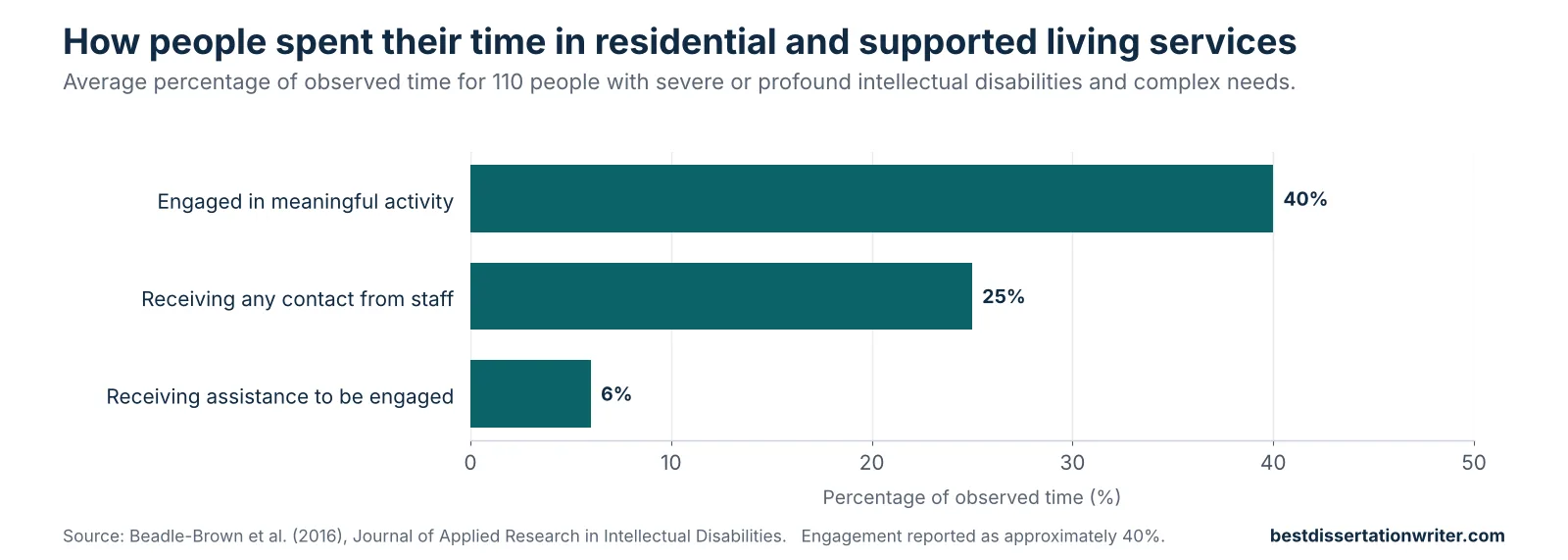
These findings show that, even in small community services, people with the most complex needs may spend most of their day disengaged, with staff present but rarely helping them to take part. Beadle-Brown et al. (2016) concluded that quality of life and quality of support were relatively poor, although about a third of people received skilled support. Good support for this group therefore depends on staff having the skills and organisational backing to provide active support consistently.
Practice leadership appears to be one of the keys to maintaining good support. Bould et al. (2018) observed 189 service users across 58 shared supported accommodation services. Engagement and active support were significantly higher in services where a practice leader was present during the observation (19 services) than where one was absent (39 services). The authors concluded that systems for supporting, monitoring, modelling and improving staff practice are essential if active support is to be implemented, although the observational design cannot prove that practice leadership caused the better outcomes.
Discussion
This review finds consistent evidence that community-based and dispersed settings, including supported living, generally offer a better quality of life than congregate or clustered settings, particularly in choice, community participation and personal relationships. The evidence from systematic reviews and from the Irish relocation study points in the same direction, which supports national policy to move people out of institutional and inpatient settings into homes of their own.
At the same time, the evidence shows that supported living is a platform rather than a guarantee. Kozma et al. (2009) found variation in outcomes within models, tenants interviewed by Bigby et al. (2017) reported loneliness and little control over support, and observational studies found low engagement for people with severe disabilities. The key tension is between the structural features of supported living, such as tenancy and separation of housing and support, and the everyday quality of support, which determines whether those structural advantages lead to a good life.
The evidence also raises questions about who benefits. In the Irish study, people who moved to personalised arrangements were younger and had fewer support needs than those who moved to group homes (McConkey et al., 2016), and qualitative research on this model has mainly involved people who can speak for themselves. People with severe and profound learning disabilities, complex health needs or behaviour that challenges may be offered supported living less often, or may receive it with insufficiently skilled support. Ensuring equal access to good, well-supported homes of their own is therefore an important equity issue.
Cost is a recurring concern for commissioners. Mansell and Beadle-Brown (2009) found that clustered housing was cheaper mainly because of lower staffing, while McConkey et al. (2016) found that staff costs were highest in congregated settings. These findings suggest that cost differences largely reflect staffing levels rather than inherent efficiency, and that cutting staffing to reduce costs in these services is likely to undermine quality of life. Investment in training and practice leadership may be a better use of resources.
This review has limitations. This review relied on openly accessible, English-language sources, did not involve independent double screening and included a small number of sources, several from the same research groups and from different national service systems, including Ireland. Most studies were cross-sectional or observational, and people in different settings often differed in age and support needs. Future research should use longitudinal designs, include people with severe and profound learning disabilities and evaluate the health outcomes of these arrangements, including access to healthcare and mortality.
Implications of Supported Living Evidence for Practice
For learning disability nurses, the evidence highlights the importance of the support within people’s homes rather than the setting alone. Nurses can contribute by training staff in active support, modelling skilled interaction, supporting front-line managers to act as practice leaders and helping services to measure engagement and quality of life. Health facilitation remains essential: tenants depend on staff to recognise illness, attend appointments and manage long-term conditions, so nurses should ensure that health action plans, annual health checks and communication passports are in place and used.
Good support also depends on relationships. Nurses can help staff to use therapeutic communication skills and alternative communication approaches with non-verbal patients, so that tenants can express preferences about their support. Working in partnership with family carers, who often remain closely involved after a move, can strengthen social networks, reduce loneliness and provide valuable knowledge of the person’s history and health.
Conclusion
This systematic review examined evidence on supported living and quality of life for adults with learning disabilities. Community-based and dispersed settings generally offer better quality of life than congregate or clustered settings, with greater choice, community participation and relationships, but many tenants remain lonely and people with severe disabilities are often disengaged.
The quality of support, especially active support and practice leadership, appears to be the main driver of good outcomes. Learning disability nurses can help to realise the promise of supported living by developing skilled staff teams, supporting practice leaders and ensuring that tenants’ health needs are met.
References
Beadle-Brown, J., Leigh, J., Whelton, B., Richardson, L., Beecham, J., Baumker, T., & Bradshaw, J. (2016). Quality of life and quality of support for people with severe intellectual disability and complex needs. Journal of Applied Research in Intellectual Disabilities, 29(5), 409–421. https://doi.org/10.1111/jar.12200
Bigby, C., Bould, E., & Beadle-Brown, J. (2017). Conundrums of supported living: The experiences of people with intellectual disability. Journal of Intellectual and Developmental Disability, 42(4), 309–319. https://doi.org/10.3109/13668250.2016.1253051
Bould, E., Beadle-Brown, J., Bigby, C., & Iacono, T. (2018). The role of practice leadership in active support: Impact of practice leaders’ presence in supported accommodation services. International Journal of Developmental Disabilities, 64(2), 75–80. https://doi.org/10.1080/20473869.2016.1229524
Kozma, A., Mansell, J., & Beadle-Brown, J. (2009). Outcomes in different residential settings for people with intellectual disability: A systematic review. American Journal on Intellectual and Developmental Disabilities, 114(3), 193–222. https://doi.org/10.1352/1944-7558-114.3.193
Mansell, J., & Beadle-Brown, J. (2009). Dispersed or clustered housing for adults with intellectual disability: A systematic review. Journal of Intellectual and Developmental Disability, 34(4), 313–323. https://doi.org/10.3109/13668250903310701
McConkey, R., Keogh, F., Bunting, B., Garcia Iriarte, E., & Flatman Watson, S. (2016). Relocating people with intellectual disability to new accommodation and support settings: Contrasts between personalized arrangements and group home placements. Journal of Intellectual Disabilities, 20(2), 109–120. https://doi.org/10.1177/1744629515624639
NHS England, Local Government Association, & Association of Directors of Adult Social Services. (2015). Building the right support: A national plan to develop community services and close inpatient facilities for people with a learning disability and/or autism who display behaviour that challenges, including those with a mental health condition. NHS England. https://www.england.nhs.uk/wp-content/uploads/2015/10/ld-nat-imp-plan-oct15.pdf
Cite this example
Best Dissertation Writers (2026) Supported Living and Quality of Life Among Adults with Learning Disabilities: A Systematic Review. Available at: https://bestdissertationwriter.com/supported-living-literature-review/
Best Dissertation Writers
Get expert help with your nursing literature review
Share your topic and deadline with Best Dissertation Writers and get support tailored to your module brief.