
Early Recognition and Management of Sepsis in the Emergency Department: A Literature Review of Nursing Practice
 By Dr. Robertson Prime, Research Fellow
Updated November 2, 2026
16 min read
About 3,200 words
In this review
Abstract
Background: Sepsis in the emergency department is a time-critical emergency in which a dysregulated response to infection causes life-threatening organ dysfunction. Emergency nurses are often the first to see the early signs, so their recognition, screening and prompt action are central to survival.
Aim: This narrative review aimed to discuss the evidence on sepsis in the emergency department, including definitions, the timing of antibiotics and bundles, international guidance and the contribution of nurse-led screening and protocols.
Methods: Evidence was identified through targeted searches of openly accessible bibliographic records, publisher websites and professional guidance. Five sources published between 2016 and 2021 were included: a consensus definition, two large cohort studies, a commentary on nurse-led protocols and an international guideline. The relevance and quality of each source was considered critically, and findings were synthesised narratively.
Findings: The Sepsis-3 consensus defined sepsis as life-threatening organ dysfunction caused by a dysregulated host response to infection and introduced the qSOFA bedside screen. A study of 49,331 patients at 149 hospitals found that each hour of delay in completing the three-hour bundle or giving antibiotics was associated with higher in-hospital mortality (odds ratio 1.04 for each). A study of 35,000 patients at 21 emergency departments found an adjusted odds ratio of 1.09 for each hour of antibiotic delay, with the largest absolute increase in septic shock (1.8%). A commentary described nurse-led screening and protocols that raised bundle completion and, in a Norwegian ward study, improved 30-day survival. The 2021 Surviving Sepsis Campaign guideline recommends screening programmes and antimicrobials ideally within one hour for septic shock or high likelihood of sepsis.
Conclusion: Early recognition and rapid antibiotics are associated with better outcomes, and nurses can contribute through screening, escalation and protocol-led treatment. Most evidence is observational, so services should combine guidance with local audit.
Keywords: sepsis in the emergency department, screening tool, time to antibiotics
Introduction
This narrative review critically examines recent evidence on sepsis in the emergency department and its implications for emergency nursing practice.
Sepsis occurs when the body’s response to an infection injures its own tissues and organs. It can follow a chest infection, a urinary infection, a wound or an abdominal problem, and it can progress from feeling unwell to septic shock within hours. Many patients with sepsis first present to the emergency department, where the key task is to recognise it quickly and start treatment.
Recognition is not easy. Early signs, such as a raised heart rate, a raised breathing rate, confusion or a change in temperature, are also found in many patients who do not have sepsis, and they may be mistaken for other problems. In a crowded department, subtle signs can be missed. Emergency nurses carry out triage, take observations, give the first treatments and monitor patients, so they have a central part in sepsis in the emergency department.
A narrative review was chosen because the evidence includes consensus definitions, large observational studies, a commentary and a guideline, which cannot be combined in a pooled analysis.
Review question
What does the evidence show about the recognition and treatment of sepsis in the emergency department, and how can nurses contribute?
Background to Sepsis in the Emergency Department
Definitions of sepsis have changed over time. For many years, sepsis was identified using criteria for a systemic inflammatory response, which many patients with minor infections also met. The most recent consensus defines sepsis in terms of organ dysfunction. This change matters because the definition determines who is screened, who is treated and how outcomes are measured.
Treatment of sepsis rests on early recognition, cultures, antibiotics, fluids and monitoring, often grouped in a bundle of care to be completed within a set time. Bundles aim to make sure that all the key steps happen promptly. Nurses help to carry them out by measuring observations, obtaining intravenous access, taking blood tests, preparing and giving antibiotics and fluids and escalating to senior colleagues.
Sepsis in the emergency department overlaps with other topics in emergency nursing. Delays in the department, described in the review of triage tools, can reduce the chance that sepsis is identified early, and the systematic assessment of a seriously ill patient, such as the primary survey considered in primary survey, provides a structure for finding signs of deterioration. Confusion and agitation, which are features of sepsis, may also be mistaken for a mental health crisis.
The nurse’s contribution to sepsis in the emergency department begins before any diagnosis is made. A nurse who notices that a patient who is usually well looks drowsy, who sees that the breathing rate has crept up or who senses that something is wrong may be the first to raise the alarm. This kind of early, intuitive recognition is difficult to measure, but it is the foundation of every screening tool and bundle discussed in this review.
Search Strategy and Methods
Evidence for this example was identified through targeted searches of openly accessible bibliographic records, publisher websites and professional guidance. Search terms combined keywords for the condition (“sepsis”, “septic shock”, “severe sepsis”) with terms for the setting and care (“emergency department”, “nurses”, “screening”, “bundle”, “antibiotics”, “time to treatment”), joined with the Boolean operators AND and OR. A full review for assessment would run the same strategy in CINAHL, PubMed/MEDLINE and Embase and report how sources were selected.
Sources were eligible if they addressed definitions, recognition or time-critical treatment of sepsis in adults, or the role of nurses in screening and protocols. Single-centre studies, studies of children and studies of sepsis treated only in intensive care were excluded.
Five sources published between 2016 and 2021 were included (Table 1). The relevance and quality of each source was considered critically, with attention to the design, size, adjustment for confounding and the extent to which findings apply to emergency nursing, and findings were synthesised narratively under themes.
In a narrative review the aim is to interpret the evidence in context, not to produce a pooled estimate. The findings on sepsis in the emergency department are therefore presented in sequence: first how sepsis is defined and screened for, then what is known about the timing of treatment and finally what nurse-led approaches and guidance add. Differences in design and setting are noted where they affect how far a finding can be applied.
Key Findings on Sepsis in the Emergency Department
Three themes were identified: definition and screening, the timing of treatment, and nurse-led approaches and guidance. Table 1 summarises the included sources, and Figure 1 shows how the absolute increase in mortality per hour of antibiotic delay varied with severity.
| Author, year | Design | Setting and sample | Key finding |
|---|---|---|---|
| Evans et al. (2021) | International guideline | Surviving Sepsis Campaign 2021 | Recommends sepsis performance improvement programmes with screening; against qSOFA alone; antimicrobials ideally within one hour for shock or high likelihood. |
| Kleinpell (2017) | Commentary | Nurse-led sepsis protocols in several studies | Nurse-led screening and protocols associated with faster treatment; more studies needed. |
| Liu et al. (2017) | Retrospective cohort study | 35,000 patients; 21 emergency departments | Each hour of antibiotic delay: adjusted odds ratio 1.09 for hospital mortality. |
| Seymour et al. (2017) | Cohort study of mandated protocols | 49,331 patients; 149 hospitals | Each hour of delay in bundle or antibiotics associated with higher mortality (odds ratio 1.04). |
| Singer et al. (2016) | Consensus definitions | Sepsis-3 task force | Sepsis defined as life-threatening organ dysfunction; qSOFA introduced as a bedside prompt. |
Theme 1: Definition and Screening
The Third International Consensus Definitions for Sepsis and Septic Shock (Sepsis-3), published by Singer et al. (2016), revised the earlier definitions in light of advances in understanding of sepsis. The task force defined sepsis as life-threatening organ dysfunction caused by a dysregulated host response to infection. Organ dysfunction is identified by an acute change in the Sequential Organ Failure Assessment (SOFA) score of two points or more.
Septic shock was defined as a subset of sepsis in which circulatory and metabolic abnormalities are severe enough to substantially increase mortality, identified by a need for vasopressors to maintain a mean arterial pressure of at least 65 mm Hg and a serum lactate above 2 mmol/L despite adequate fluid resuscitation. The task force also introduced the quick SOFA, or qSOFA, as a bedside prompt: two or more of a respiratory rate of 22 per minute or more, altered mentation and a systolic blood pressure of 100 mm Hg or less.
Importantly, the consensus stated that qSOFA is not a stand-alone definition and that failing to meet its criteria should not delay investigation or treatment of infection. The 2021 Surviving Sepsis Campaign guideline (Evans et al., 2021) went further, making a strong recommendation against using qSOFA as a single screening tool compared with other tools such as the systemic inflammatory response criteria or early warning scores. It also made a strong recommendation that hospitals and health systems use a sepsis performance improvement programme that includes screening of acutely ill, high-risk patients.
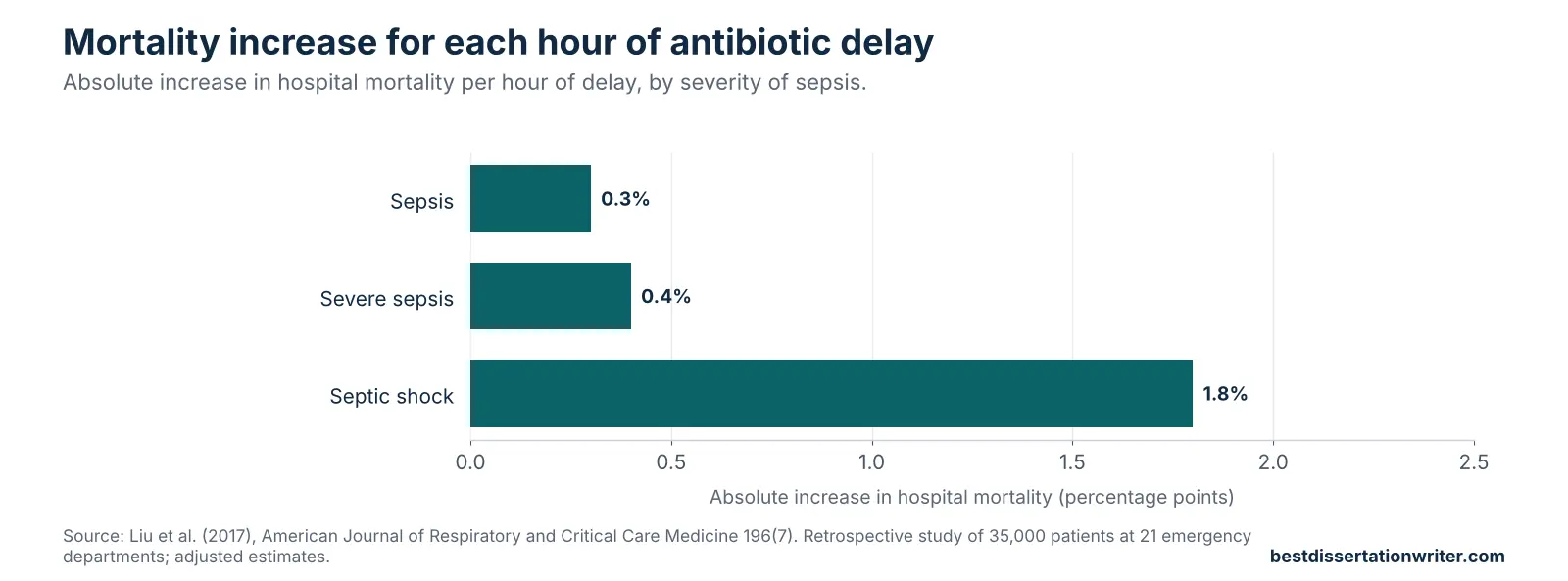
For emergency nurses, these statements are practical. Screening is recommended, no single tool should be relied upon on its own, and a patient who appears unwell should be escalated even if they do not meet a score threshold. Services should therefore ensure that nurses are trained in the screening tool in use, and that they know that the tool supports clinical concern and does not replace it.
Theme 2: The Timing of Treatment
Seymour et al. (2017) analysed data reported to the New York State Department of Health on patients with sepsis or septic shock, after state regulations required hospitals to start sepsis protocols. The cohort comprised 49,331 patients at 149 hospitals, in whom a protocol was started within six hours of arrival and the three-hour bundle was completed within 12 hours. In 40,696 patients (82.5%), the bundle was completed within three hours.
Faster completion of the three-hour bundle was associated with lower risk-adjusted in-hospital mortality, with an odds ratio of 1.04 for each hour of delay (95% confidence interval 1.02 to 1.05). Faster antibiotic administration was also associated with lower mortality (odds ratio 1.04, 1.03 to 1.06), whereas faster completion of the initial fluid bolus was not (1.01, 0.99 to 1.02). Median time to antibiotics was 0.95 hours. The finding suggests that the speed of antibiotics is an important component of the bundle.
Liu et al. (2017) examined the timing of early antibiotics in a retrospective study of 35,000 patients with sepsis treated at 21 emergency departments in Northern California between 2010 and 2013. The median time to antibiotics was 2.1 hours. Each hour of delay within the first six hours of emergency department registration was associated with an adjusted odds ratio for hospital mortality of 1.09 (95% confidence interval 1.05 to 1.13).
The absolute increase in mortality per hour of delay was 0.3% for sepsis, 0.4% for severe sepsis and 1.8% for septic shock. These effects are modest for each hour but they add up over several hours of delay, and the largest effect was seen in septic shock. Both studies are observational, and delays may be longer in patients whose illness was harder to recognise, so the associations may be influenced by factors that the analyses could not fully remove.
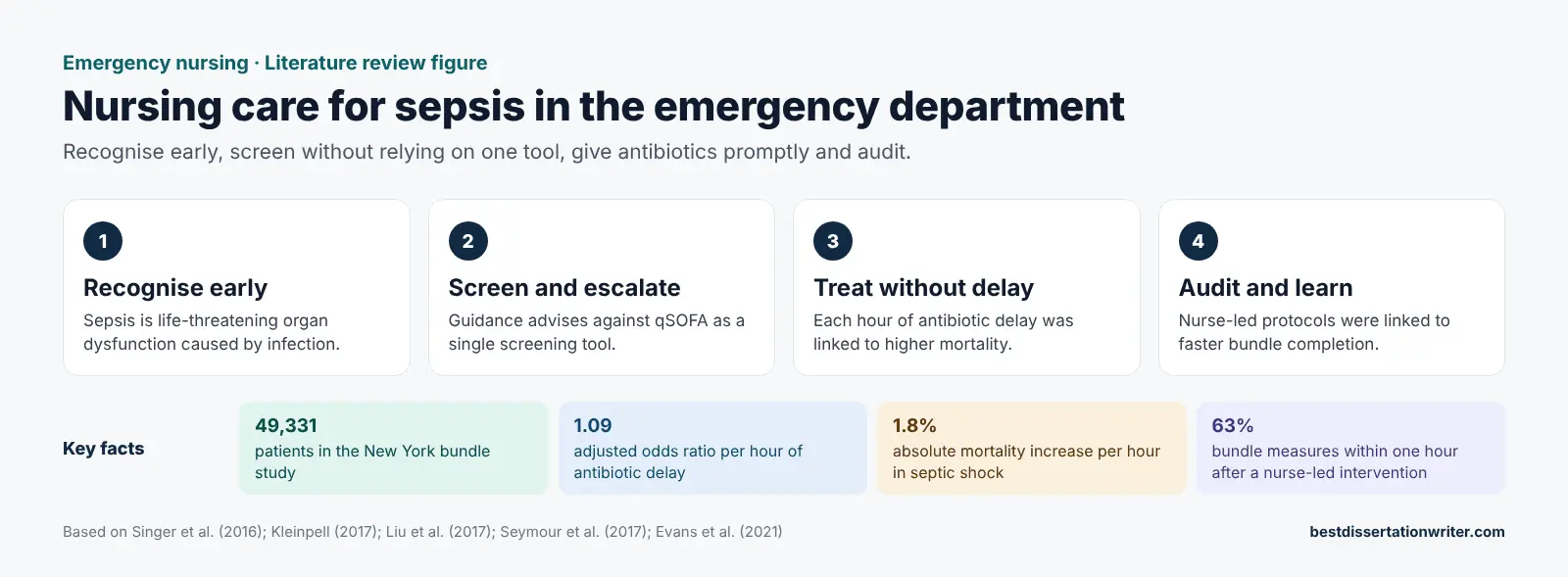
Taken together, the two studies suggest that time matters, and that delays of even one hour are associated with a measurable rise in mortality. They support the recommendation of the 2021 guideline that antimicrobials should ideally be given within one hour of recognition for adults with septic shock or a high likelihood of sepsis. The guideline rated the quality of evidence for this as low for septic shock and very low for sepsis without shock, which reflects the lack of randomised trials, but the recommendation was nevertheless strong.
Theme 3: Nurse-Led Approaches and Guidance
Kleinpell (2017) wrote a commentary on promoting early identification of sepsis in hospitalised patients with nurse-led protocols. It argues that nurses are well placed to identify sepsis early because of their constant contact with patients, so that screening can be built into routine assessments. The commentary describes several nurse-led studies, including a New Zealand project in which bundle measures started within one hour rose from 29% to 63% after an intervention using the Sepsis Six.
It also reports an English oncology hospital in which 96.4% of patients with suspected sepsis after chemotherapy received their first intravenous antibiotic dose within 60 minutes. The review of neutropenic sepsis discusses this group in more detail. The commentary accompanied a Norwegian study in which ward nurses used a sepsis identification flowchart, a triage tool and a four-hour training course, and in which patients after the intervention had higher odds of surviving 30 days (odds ratio 2.7) and a shorter stay.
This source is a commentary, and its examples come from different settings and designs, many of them before-and-after studies without controls. It cannot show that nurse-led screening causes better outcomes, but it provides a consistent picture in which structured screening, clear protocols and training are associated with faster treatment. It also notes that more studies are needed to determine the most effective way to meet bundle targets.
The guideline’s recommendation on performance improvement programmes is a reminder that sepsis in the emergency department is partly a systems problem. Screening tools, order sets, audit and feedback are all organisational measures, and nurses are central to each of them. A nurse who helps to design a screening prompt or who reviews cases in which treatment was delayed is contributing to safer care in the same way as one who treats a patient at the bedside.
The sources also agree on one point of practice: sepsis care is a team effort. Nurses recognise and escalate, doctors prescribe and review, pharmacists and laboratory staff support rapid treatment and managers provide the systems that allow this. A department that relies on a single person to remember each step is more likely to miss patients than one that has an agreed pathway that every member of the team understands.
Discussion
This narrative review suggests that sepsis in the emergency department is best approached as a time-critical emergency in which recognition, screening and prompt antibiotics are all important. Definitions have moved from inflammation to organ dysfunction, and guidance now advises against relying on a single screening score, favouring performance improvement programmes that combine screening, training and audit.
The evidence on timing is consistent in direction. Both large studies found that delays in antibiotics were associated with higher mortality, and the guideline recommends giving them ideally within an hour for patients with shock or a high likelihood of sepsis. However, the studies are observational and from the United States, and the effects per hour of delay were modest, so the findings should be applied with clinical judgement. For example, a one-hour target should not lead to antibiotics being given to patients in whom the diagnosis is doubtful.
There are limitations to this review. It included only five sources, and one is a short commentary. Several of the findings come from studies in the United States and Norway, and the effects of local protocols and staffing may differ in United Kingdom departments. The sources were published between 2016 and 2021, so newer evidence on screening tools or on treatment is not included. This review relied on openly accessible, English-language sources.
A further point is that none of the sources examined the experience of emergency nurses directly, for instance how they balance sepsis screening against other demands or how they feel about escalating concerns. These questions are important because the best protocol is of little use if staff cannot apply it in a busy department. Studies that include nurses’ views, as well as patient outcomes, would be useful.
Implications of Sepsis in the Emergency Department Evidence for Practice
For practice, the evidence supports training emergency nurses to recognise the signs of sepsis and to use the department’s screening tool without relying on it alone, escalating concerns promptly, working to a bundle that includes early antibiotics, and auditing the time to treatment. Guidance and patient information are available from the UK Sepsis Trust and NICE.
Managers should provide protocols that nurses can follow without delay, including the authority to start parts of the bundle, and should feed back audit results to staff. Sepsis in the emergency department is also an issue for patient safety, and incidents in which treatment was delayed should be reviewed as learning opportunities.
For individual nurses, the practical message is to act on concern. A patient who is deteriorating, who has a suspected infection and who looks unwell should be escalated promptly, whatever the score says, and the reasons for concern should be recorded. Staff who work in settings where sepsis in the emergency department is frequent should have access to refresher training, and new staff should be shown the local pathway early in their induction.
Future research should evaluate nurse-led sepsis screening and treatment pathways in controlled designs, compare screening tools in emergency departments, examine outcomes for patients whose sepsis is recognised late and explore nurses’ experiences. Studies in United Kingdom emergency departments would be especially relevant.
Sepsis in the emergency department will continue to challenge emergency nurses, because its early signs are common and its course is rapid. The evidence suggests that vigilance, structured screening and prompt treatment together offer the best chance of recognising it in time.
Conclusion
This narrative review found that early recognition and rapid treatment are central to sepsis in the emergency department, that delays in antibiotics are associated with higher mortality and that guidance supports screening programmes while advising against reliance on a single tool.
Emergency nurses can contribute through vigilant assessment, screening, escalation and protocol-led care, and services should support them with training, clear pathways and audit.
References
Evans, L., Rhodes, A., Alhazzani, W., Antonelli, M., Coopersmith, C. M., French, C., Machado, F. R., Mcintyre, L., Ostermann, M., Prescott, H. C., Schorr, C., Simpson, S., Wiersinga, W. J., Alshamsi, F., Angus, D. C., Arabi, Y., Azevedo, L., Beale, R., Beilman, G., … Levy, M. (2021). Surviving Sepsis Campaign: International guidelines for management of sepsis and septic shock 2021. Critical Care Medicine, 49(11), e1063–e1143. https://doi.org/10.1097/CCM.0000000000005337
Kleinpell, R. (2017). Promoting early identification of sepsis in hospitalized patients with nurse-led protocols. Critical Care, 21, Article 10. https://doi.org/10.1186/s13054-016-1590-0
Liu, V. X., Fielding-Singh, V., Greene, J. D., Baker, J. M., Iwashyna, T. J., Bhattacharya, J., & Escobar, G. J. (2017). The timing of early antibiotics and hospital mortality in sepsis. American Journal of Respiratory and Critical Care Medicine, 196(7), 856–863. https://doi.org/10.1164/rccm.201609-1848OC
Seymour, C. W., Gesten, F., Prescott, H. C., Friedrich, M. E., Iwashyna, T. J., Phillips, G. S., Lemeshow, S., Osborn, T., Terry, K. M., & Levy, M. M. (2017). Time to treatment and mortality during mandated emergency care for sepsis. New England Journal of Medicine, 376(23), 2235–2244. https://doi.org/10.1056/NEJMoa1703058
Singer, M., Deutschman, C. S., Seymour, C. W., Shankar-Hari, M., Annane, D., Bauer, M., Bellomo, R., Bernard, G. R., Chiche, J.-D., Coopersmith, C. M., Hotchkiss, R. S., Levy, M. M., Marshall, J. C., Martin, G. S., Opal, S. M., Rubenfeld, G. D., van der Poll, T., Vincent, J.-L., & Angus, D. C. (2016). The third international consensus definitions for sepsis and septic shock (Sepsis-3). JAMA, 315(8), 801. https://doi.org/10.1001/jama.2016.0287
Cite this example
Best Dissertation Writers (2026) Early Recognition and Management of Sepsis in the Emergency Department: A Literature Review of Nursing Practice. Available at: https://bestdissertationwriter.com/sepsis-in-the-emergency-department/
Best Dissertation Writers
Get expert help with your nursing literature review
Share your topic and deadline with Best Dissertation Writers and get support tailored to your module brief.