Nutrition for Preterm Infants and the Use of Human Breast Milk in Neonatal Units: A Systematic Review
 By Dr. Robertson Prime, Research Fellow
Updated October 25, 2026
14 min read
About 2,900 words
In this review
Abstract
Background: Nutrition for preterm infants shapes their growth, their risk of serious illness and their longer-term development. Human milk, whether from the baby’s own mother or a donor, is widely recommended, but preterm babies also have high nutrient needs that unfortified milk may not meet, and neonatal nurses play a central role in supporting mothers to provide milk.
Aim: This systematic review aimed to examine the evidence on human milk, donor milk, fortification and feeding strategies for preterm infants, and on interventions that support breastfeeding in neonatal units.
Methods: Evidence was identified through targeted searches of openly accessible bibliographic records, publisher websites and the reference lists of key reviews. Five sources published between 2009 and 2024 were included: a systematic review with economic analysis, a meta-analysis of human milk feeding and three Cochrane reviews, appraised with CASP checklists and synthesised narratively.
Findings: Any human milk compared with exclusive preterm formula was associated with about half the risk of necrotising enterocolitis (risk ratio 0.51), and exclusive human milk with a larger reduction (0.22). In randomised trials, donor milk instead of formula roughly halved this risk (0.53) without affecting mortality. Multi-nutrient fortification modestly increased in-hospital weight gain (1.76 g/kg/day). Kangaroo care, peer support and staff training helped mothers to provide milk, but evidence on early full enteral feeding was uncertain.
Conclusion: Human milk is the foundation of preterm feeding, and fortification can improve growth. Neonatal nurses should prioritise early expressing, skin-to-skin contact and practical support for mothers, with donor milk when mother’s own milk is unavailable.
Keywords: nutrition for preterm infants, preterm nutrition, breast milk, donor milk
Introduction
This systematic review critically examines recent evidence on nutrition for preterm infants and its implications for neonatal nursing practice.
Babies born preterm miss the period of rapid growth that normally takes place in the last weeks of pregnancy, when nutrients are delivered through the placenta. After birth, they must receive nutrition through intravenous fluids and then through milk given by tube, often before they can suck, swallow and breathe in a coordinated way. Their gut is immature, their nutrient needs per kilogram are high and they are vulnerable to serious complications, including necrotising enterocolitis and infection.
Decisions about what to feed preterm babies, how quickly to increase feeds and how to support mothers to provide milk are made every day in neonatal units. Nurses prepare and give feeds, monitor tolerance, support mothers to express milk, encourage skin-to-skin contact and help babies move from tube feeding to breastfeeding or bottle feeding. Nutrition for preterm infants is therefore a central part of neonatal nursing, not only a medical or dietetic responsibility.
A systematic approach was chosen because several Cochrane reviews and meta-analyses address these questions, and bringing them together allows the strength of evidence for each element of nutrition for preterm infants to be compared.
The question matters for neonatal nurses, infant feeding specialists and unit leaders who decide how to organise lactation support, whether to use donor milk and how to implement feeding protocols. It also matters for parents, for whom providing milk is often one of the few ways they can actively care for their baby during a stressful admission.
Review question
What does the evidence show about human milk, donor milk, fortification and feeding strategies in preterm nutrition, and which interventions help mothers to provide breast milk in neonatal units?
Background to Nutrition for Preterm Infants
Mother’s own milk is generally considered the first choice for feeding preterm babies. It contains antibodies, growth factors, oligosaccharides and live cells that support the immature immune system and gut, and it is tailored to the baby’s needs. However, many mothers of preterm babies find it difficult to establish and maintain a milk supply, because of separation, stress, illness and the need to express milk with a pump rather than feeding directly.
When mother’s own milk is unavailable or insufficient, the alternatives are donor milk from screened donors, processed by a milk bank, or preterm formula. Donor milk retains many protective components, although pasteurisation reduces some of them and its nutrient content is often lower than that of the milk of mothers who have given birth preterm. Preterm formula is designed to provide higher levels of protein, energy and minerals but lacks the protective components of human milk.
Because human milk alone may not meet the high protein, energy and mineral needs of very preterm babies, it is commonly fortified with additional nutrients. Feeding strategies also vary: units differ in when they start milk feeds, how quickly they increase volumes and how they use trophic feeds and parenteral nutrition. These decisions balance the need for growth against concerns about feed intolerance and necrotising enterocolitis, and they make nutrition for preterm infants one of the most debated areas of neonatal care.
Supporting breast milk provision is largely a nursing task. Early initiation of expressing, frequent expressing, access to good pumps, skin-to-skin contact, privacy and encouragement all influence whether mothers can produce enough milk. Accreditation schemes for breastfeeding-friendly care have extended their attention to neonatal units, and specialist infant feeding staff can support both nurses and families. These organisational arrangements shape nutrition for preterm infants as much as decisions about any individual feed.
Search Strategy and Methods
Evidence for this example was identified through targeted searches of openly accessible bibliographic records, publisher websites and the reference lists of key reviews. Search terms combined keywords for the population (“preterm”, “low birth weight”, “very low birth weight”, “neonatal unit”) with terms for nutrition and feeding (“nutrition for preterm infants”, “preterm nutrition”, “breast milk”, “donor milk”, “fortification”, “enteral feeding”, “breastfeeding support”), joined with the Boolean operators AND and OR. A full systematic review for assessment would run the same strategy in CINAHL, PubMed/MEDLINE, the Cochrane Library and Embase and report the number of records screened in a PRISMA flow diagram.
Sources were eligible if they evaluated the type of milk, fortification or feeding strategy for preterm or low birth weight infants, or interventions to support breastfeeding and breast milk provision in neonatal units, and reported growth, morbidity or feeding outcomes. Systematic reviews were prioritised because of the large number of trials and cohort studies in this field. Studies of term babies were excluded, because nutrition for preterm infants raises distinct physiological and practical questions.
Five sources published between 2009 and 2024 were included: one systematic review and economic analysis of breastfeeding promotion in neonatal units, one systematic review and meta-analysis of human milk feeding and morbidity, and three Cochrane reviews of fortification, early full enteral feeding and donor milk (Table 1). The quality of each source was appraised using the Critical Appraisal Skills Programme (CASP) checklist for systematic reviews, and findings were synthesised narratively.
Key Findings on Nutrition for Preterm Infants
Three themes were identified: human milk and protection against serious illness, fortification and feeding strategies for growth, and supporting mothers to provide breast milk. Table 1 summarises the included sources, and Figure 1 presents pooled risk ratios for necrotising enterocolitis associated with different feeding approaches.
| Author, year | Design | Setting and sample | Key finding |
|---|---|---|---|
| Renfrew et al. (2009) | Systematic review and economic analysis | 48 studies of breastfeeding promotion in neonatal units | Kangaroo care, peer support, effective expressing and staff training helped; interventions work together. |
| Miller et al. (2018) | Systematic review and meta-analysis | 49 studies of very low birth weight infants | Any human milk vs formula: NEC RR 0.51; exclusive human milk RR 0.22. |
| Brown et al. (2020) | Cochrane systematic review | 18 trials, 1,456 preterm infants | Fortification increased weight gain by 1.76 g/kg/day; NEC effect uncertain. |
| Walsh et al. (2020) | Cochrane systematic review | 6 trials, 526 infants, India | Early full enteral feeding: no clear effect on NEC (RR 0.98); very low certainty. |
| Quigley et al. (2024) | Cochrane systematic review | 12 trials, 2,296 very preterm infants | Donor milk vs formula: NEC RR 0.53 (high certainty); no effect on mortality. |
Theme 1: Human Milk, Donor Milk and Protection
Miller et al. (2018) systematically reviewed 49 studies of human milk feeding and morbidity in very low birth weight infants, most of them observational. Any human milk compared with exclusive preterm formula was associated with about half the risk of necrotising enterocolitis (risk ratio 0.51, 95% confidence interval 0.35 to 0.76), and exclusive human milk with a larger reduction (0.22, 0.09 to 0.54). Evidence for effects on late-onset sepsis, retinopathy of prematurity and bronchopulmonary dysplasia was weak or inconclusive.
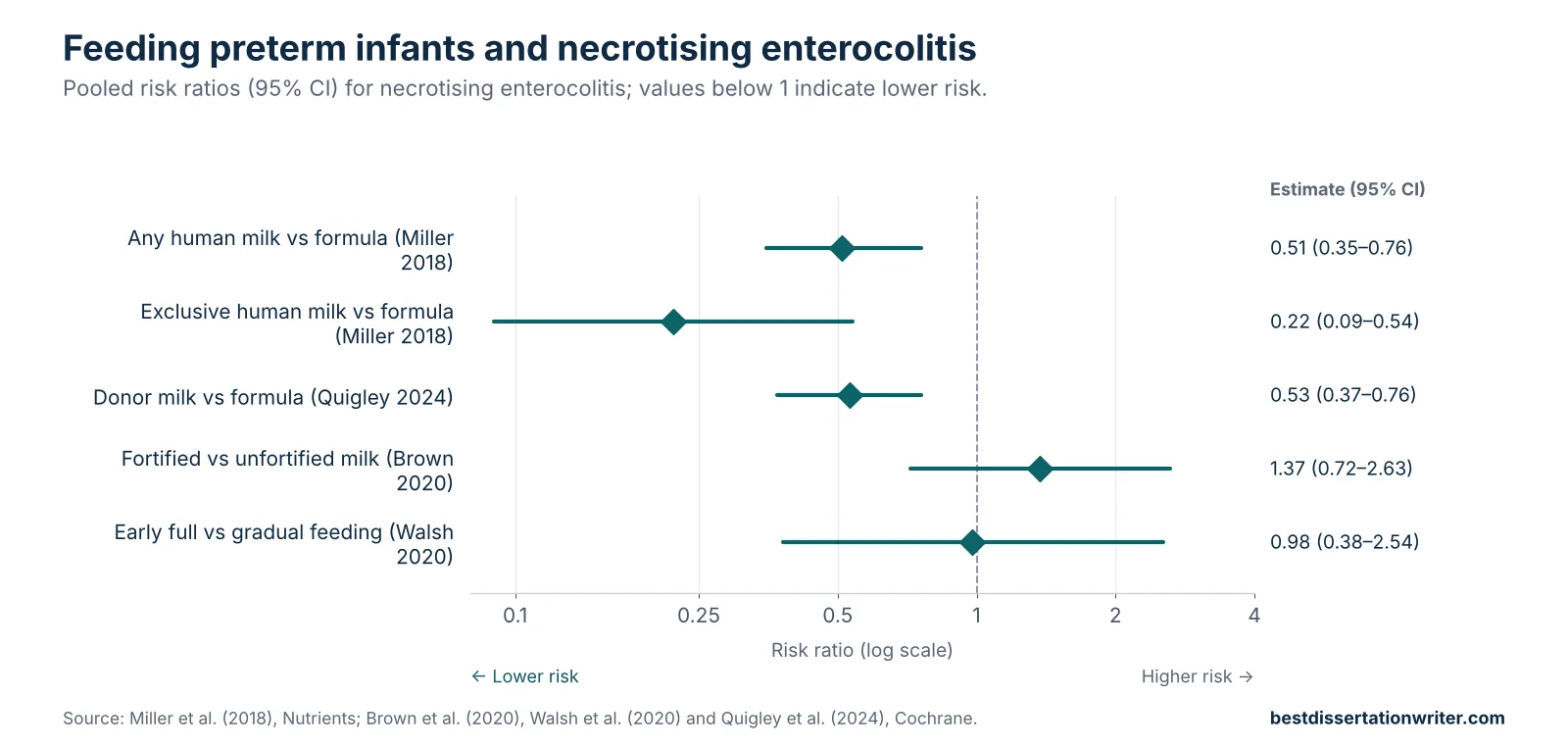
Quigley et al. (2024) reviewed 12 randomised trials involving 2,296 very preterm or very low birth weight infants that compared donor milk with formula. Donor milk reduced the risk of necrotising enterocolitis by about half (risk ratio 0.53, 0.37 to 0.76), and the authors rated this evidence as high certainty. There was probably little or no effect on late-onset invasive infection or on mortality before discharge.
Together, these findings provide strong support for human milk as the foundation of nutrition for preterm infants, and for donor milk when mother’s own milk is not available. The observational evidence for mother’s own milk is consistent with the randomised evidence for donor milk, although observational studies may be confounded by differences between families who do and do not provide breast milk.
Theme 2: Fortification and Feeding Strategies in Nutrition for Preterm Infants
Brown et al. (2020) reviewed 18 trials involving 1,456 preterm infants that compared fortified with unfortified human milk. Multi-nutrient fortification increased in-hospital weight gain by 1.76 g/kg/day, length by 0.11 cm/week and head circumference by 0.06 cm/week. The effect on necrotising enterocolitis was uncertain (risk ratio 1.37, 0.72 to 2.63), and there were few data on growth or development beyond infancy, so it is not known whether the faster early growth persists or improves later outcomes such as development at school age. The certainty of evidence was low to moderate.
Walsh et al. (2020) reviewed six trials of early full enteral feeding, in which preterm babies received full milk feeds from the first day rather than gradually increasing volumes with parenteral nutrition. All trials took place in India and involved 526 infants, mostly weighing between 1,000 and 1,500 g. The evidence was too uncertain to determine benefits, and there was no clear effect on necrotising enterocolitis (risk ratio 0.98, 0.38 to 2.54), with low or very low certainty.
These findings suggest that fortification improves short-term growth, which matters because poor growth in hospital is common among very preterm babies. However, the long-term benefits of faster in-hospital growth are not yet clear. For feeding strategies, the evidence remains limited, and units must rely on protocols that balance growth with safety, adapted to the population of babies they care for.
Nurses translate these protocols into daily care. They calculate and prepare feed volumes, add fortifier accurately, check tube position, observe for abdominal distension or vomiting and report concerns promptly. Errors in preparation or inconsistent application of protocols can undermine nutrition for preterm infants as much as the choice of feeding strategy itself. Clear guidelines, double-checking of fortified feeds and good communication between nurses, dietitians and doctors are therefore important parts of safe preterm nutrition.
Theme 3: Supporting Mothers to Provide Breast Milk
Renfrew et al. (2009) systematically reviewed 48 studies of interventions to promote breastfeeding or breast milk feeding for infants in neonatal units. Kangaroo skin-to-skin contact was associated with longer breastfeeding after discharge, peer support increased the number of mothers providing breast milk, simultaneous expressing with an electric pump had early advantages, and staff training and Baby Friendly accreditation of the associated maternity hospital improved several outcomes. Additional skilled professional support was estimated to be more effective and less costly than usual care.
The review also concluded that interventions interact and that single interventions are unlikely to be effective on their own. This finding is important for nursing practice, because supporting mothers to provide milk requires a combination of early expressing, practical help, emotional support, skin-to-skin contact and a unit culture that values breast milk. Nurses at the cot side are often the people who make these elements happen.
It is easy to see why support matters. Expressing milk for a baby who cannot yet feed directly can feel mechanical and isolating, and low volumes can cause anxiety and guilt. Encouragement from nurses, expressing close to the cot or after skin-to-skin contact, and recognition that every amount of milk is valuable can help mothers persist. Seen this way, supporting nutrition for preterm infants is also a form of family-centred emotional care, not simply a technical feeding task.
Discussion
This review shows that human milk is the cornerstone of nutrition for preterm infants. Observational evidence links any human milk, and especially exclusive human milk, with a lower risk of necrotising enterocolitis, and high-certainty randomised evidence shows that donor milk roughly halves this risk compared with formula. Fortification improves short-term growth, while the evidence on early full enteral feeding is too uncertain to guide practice.
The findings place breast milk provision at the centre of neonatal nursing. If mother’s own milk is the first choice and donor milk the second, then supporting mothers to establish and maintain a supply is one of the most effective things a unit can do. Renfrew et al. (2009) showed that this requires several interventions working together, from skin-to-skin contact and early expressing to peer support and staff training.
Donor milk raises practical and equity questions. Milk banks must screen donors, pasteurise milk and maintain supply, and access may vary between regions and countries. In planning nutrition for preterm infants, donor milk should support, not replace, efforts to help mothers provide their own milk, and families need clear information about why it is offered and how it is processed. Because its nutrient content is variable, babies receiving donor milk may need careful fortification and growth monitoring.
The evidence on fortification and feeding advancement shows the tension between growth and safety. Faster growth in hospital is desirable, but the long-term consequences of different growth patterns remain uncertain. Nurses contribute by measuring growth accurately, monitoring feed tolerance and communicating concerns, and by ensuring that feeding protocols are followed consistently so that their effects can be evaluated.
The evidence base has limitations. Much of the evidence on mother’s own milk is observational, many trials were small and some, such as those of early full feeding, came from a single country. Long-term outcomes are rarely reported. This review relied on openly accessible, English-language sources and did not involve independent double screening. Future research should evaluate combined lactation support programmes, the long-term effects of fortification and feeding strategies, and equitable access to donor milk.
Implications of Nutrition for Preterm Infants Evidence for Practice
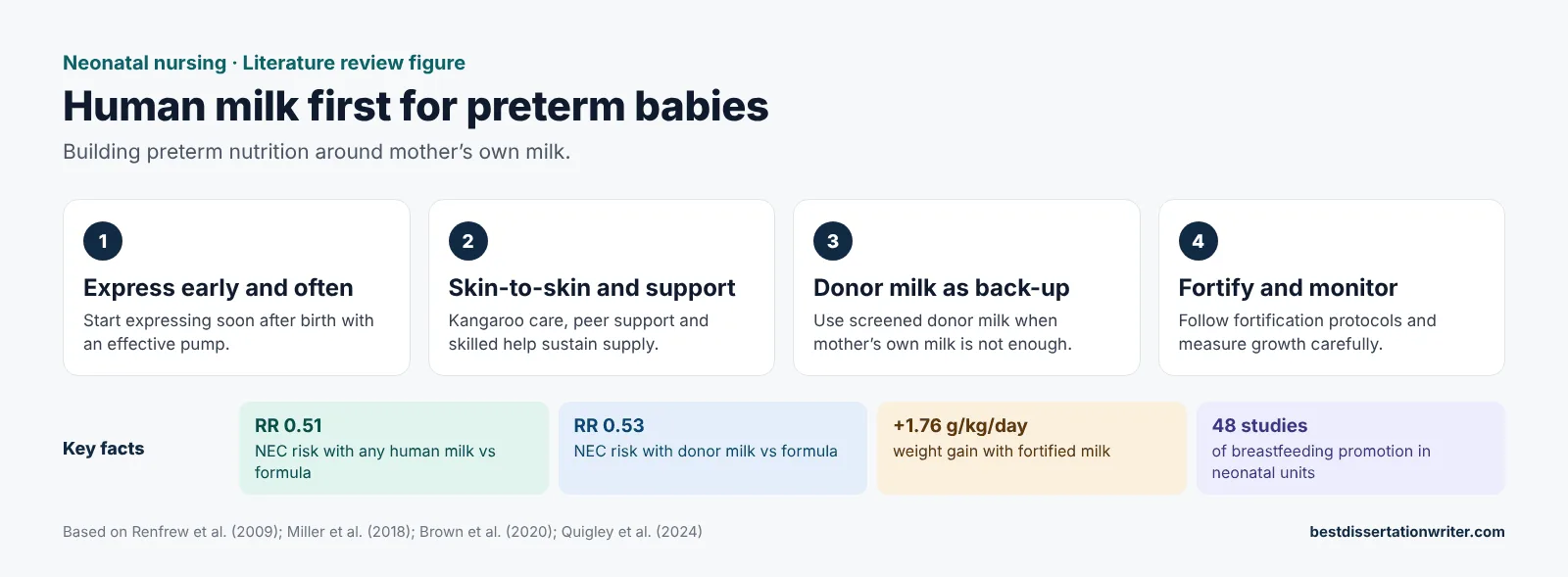
For neonatal nurses, the evidence on nutrition for preterm infants supports helping mothers to start expressing as soon as possible after birth, providing access to effective pumps, encouraging frequent expressing and skin-to-skin contact, and offering practical and emotional support throughout the admission. Units should use donor milk when mother’s own milk is unavailable, follow agreed fortification and feeding protocols, monitor growth carefully and train staff in breastfeeding support. The Cochrane review of donor milk summarises the strongest randomised evidence.
Supporting milk supply is closely linked to kangaroo mother care and to reducing parental stress, because mothers who feel supported are better able to express. Human milk is the most important protective factor against necrotising enterocolitis, and feeding plans should continue into discharge preparation so that families leave confident about feeding at home.
Conclusion
This systematic review examined nutrition for preterm infants, including human milk, donor milk, fortification, feeding strategies and breastfeeding support. Human milk is associated with a substantially lower risk of necrotising enterocolitis, donor milk halves this risk compared with formula, and fortification modestly improves short-term growth, while evidence on early full feeding remains uncertain.
Neonatal nurses are central to improving nutrition for preterm infants and making human milk the norm for preterm babies. By supporting mothers to express and breastfeed, using donor milk when needed and following evidence-based feeding protocols, nurses can make a direct contribution to the health and growth of the smallest and most vulnerable babies.
References
Brown, J. V. E., Lin, L., Embleton, N. D., Harding, J. E., & McGuire, W. (2020). Multi-nutrient fortification of human milk for preterm infants. Cochrane Database of Systematic Reviews, (6), CD000343. https://doi.org/10.1002/14651858.CD000343.pub4
Miller, J., Tonkin, E., Damarell, R. A., McPhee, A. J., Suganuma, M., Suganuma, H., Middleton, P. F., Makrides, M., & Collins, C. T. (2018). A systematic review and meta-analysis of human milk feeding and morbidity in very low birth weight infants. Nutrients, 10(6), 707. https://doi.org/10.3390/nu10060707
Quigley, M., Embleton, N. D., Meader, N., & McGuire, W. (2024). Donor human milk for preventing necrotising enterocolitis in very preterm or very low-birthweight infants. Cochrane Database of Systematic Reviews, (9), CD002971. https://doi.org/10.1002/14651858.CD002971.pub6
Renfrew, M. J., Craig, D., Dyson, L., McCormick, F., Rice, S., King, S. E., Misso, K., Stenhouse, E., & Williams, A. F. (2009). Breastfeeding promotion for infants in neonatal units: A systematic review and economic analysis. Health Technology Assessment, 13(40). https://doi.org/10.3310/hta13400
Walsh, V., Brown, J. V. E., Copperthwaite, B. R., Oddie, S. J., & McGuire, W. (2020). Early full enteral feeding for preterm or low birth weight infants. Cochrane Database of Systematic Reviews, (12), CD013542. https://doi.org/10.1002/14651858.CD013542.pub2
Cite this example
Best Dissertation Writers (2026) Nutrition for Preterm Infants and the Use of Human Breast Milk in Neonatal Units: A Systematic Review. Available at: https://bestdissertationwriter.com/nutrition-for-preterm-infants-review/
Best Dissertation Writers
Get expert help with your nursing literature review
Share your topic and deadline with Best Dissertation Writers and get support tailored to your module brief.