Screening and Nursing Management of Retinopathy of Prematurity: A Narrative Review
 By Dr. Robertson Prime, Research Fellow
Updated October 25, 2026
14 min read
About 2,800 words
In this review
Abstract
Background: Retinopathy of prematurity is a disorder of developing retinal blood vessels in babies born preterm and remains an important cause of preventable childhood blindness worldwide. Screening, careful oxygen management and timely treatment can prevent most severe visual loss, and neonatal nurses contribute to each of these.
Aim: This narrative review aimed to examine the evidence on the burden, screening, prevention and treatment of the condition and the implications for neonatal nursing.
Methods: Evidence was identified through targeted searches of openly accessible bibliographic records, publisher websites and the reference lists of key reviews. Five sources published between 2011 and 2022 were included: a global burden study, a Cochrane review, an individual participant data meta-analysis, a randomised trial and a national screening guideline, appraised with CASP checklists where applicable and synthesised narratively.
Findings: An estimated 184,700 preterm babies developed the condition in 2010, of whom 20,000 became blind or severely visually impaired. In 4,965 infants born before 28 weeks, a lower oxygen saturation target reduced treatment for the condition (10.9% versus 14.9%) but increased death (19.9% versus 17.1%) and severe necrotising enterocolitis. Treatment success was 80% with ranibizumab 0.2 mg and 66% with laser. Screening examinations are painful, and local anaesthetic drops reduced but did not remove pain.
Conclusion: Preventing visual loss depends on reliable screening, balanced oxygen targeting and timely treatment. Nurses should ensure that eligible babies are screened on time, manage oxygen within agreed targets and provide comfort during examinations.
Keywords: retinopathy of prematurity, preterm infants, ROP screening
Introduction
This narrative review critically examines recent evidence on retinopathy of prematurity and its implications for neonatal nursing practice.
The blood vessels of the retina normally develop throughout pregnancy, reaching the edge of the retina around the time of full-term birth. When babies are born very preterm, this process is interrupted. Exposure to relatively high oxygen levels after birth, together with immaturity and illness, can disrupt vessel growth, and abnormal new vessels may later develop at the boundary between vascular and avascular retina. In severe cases, these vessels can lead to scarring and retinal detachment, causing permanent visual impairment or blindness.
Retinopathy of prematurity is largely preventable or treatable if it is detected in time. Babies at risk are screened by ophthalmologists using indirect ophthalmoscopy or retinal imaging, and those who develop severe disease can be treated with laser therapy or injections of drugs that block vascular endothelial growth factor. However, screening must be performed at the right time and repeated until the risk has passed, and treatment must be given within a narrow window. Delays at any step can have lifelong consequences.
A narrative review was chosen because the relevant evidence spans epidemiology, a prospective individual participant data meta-analysis of oxygen targeting, a treatment trial, a Cochrane review of pain relief during screening and national guidance, and a narrative approach allows these to be integrated.
The question matters for nurses because they manage oxygen therapy minute by minute, coordinate screening examinations, prepare and comfort babies during examinations and support parents through anxiety about their baby’s sight. Nurses also play an important part in ensuring that screening continues after transfer between units or discharge home, when follow-up appointments can be missed.
Because diagnosis and treatment are carried out by ophthalmologists, retinopathy of prematurity can easily be seen as outside the nursing role, and it may receive less attention in nursing education and unit training than conditions such as sepsis or respiratory distress that nurses manage directly every day. Yet many of the factors that determine whether a baby develops severe disease, and whether it is detected in time, lie within everyday nursing practice. Bringing together the evidence relevant to nurses is therefore a useful starting point for education and quality improvement on neonatal units.
Review question
What does the evidence show about the burden, screening, prevention and treatment of retinopathy of prematurity, and what are the implications for neonatal nursing?
Background to Retinopathy of Prematurity
The condition is classified by the zone of the retina affected, the stage of abnormal vessel growth and the presence of plus disease, in which the vessels at the back of the eye become dilated and tortuous. Mild disease usually resolves on its own, while severe disease meeting treatment criteria requires prompt intervention. The main risk factors are lower gestational age and birth weight, exposure to high or fluctuating oxygen levels, poor postnatal growth and illness such as sepsis.
Oxygen is central to the story of retinopathy of prematurity. Historical accounts describe how unrestricted oxygen use in the mid-twentieth century was followed by an epidemic of blindness among preterm infants, and how later strict restrictions reduced retinopathy of prematurity but were thought to increase deaths. Modern practice uses pulse oximetry to keep oxygen saturation within a target range, but the optimal range has been debated. Because nurses adjust oxygen and respond to alarms, their practice has a direct influence on the exposure that babies receive.
Screening programmes identify babies at risk based on gestational age and birth weight. In the United Kingdom, a guideline from the Royal College of Paediatrics and Child Health, developed with the Royal College of Ophthalmologists and the British Association of Perinatal Medicine, sets out who should be screened, when examinations should begin and how they should be conducted, including comfort and pain relief. Screening examinations involve eye drops to dilate the pupils, an eyelid speculum and pressure on the eye, which are stressful and painful for babies.
Treatment has changed considerably. Laser therapy, which destroys the avascular peripheral retina, has been the standard for many years, but anti-VEGF injections are increasingly used, particularly for disease close to the centre of the retina. These newer treatments raise questions about recurrence and long-term safety, which affect how long babies need follow-up after treatment.
Search Strategy and Methods
Evidence for this example was identified through targeted searches of openly accessible bibliographic records, publisher websites and the reference lists of key reviews. Search terms combined keywords for the condition (“retinopathy of prematurity”, “ROP”, “ROP screening”) with terms for population and care (“preterm infants”, “oxygen saturation”, “pain”, “laser”, “anti-VEGF”, “ranibizumab”, “nursing”), joined with the Boolean operators AND and OR. A full narrative review for assessment would run the same strategy in CINAHL, PubMed/MEDLINE, the Cochrane Library and Embase and report the number of records screened in a PRISMA flow diagram.
Sources were eligible if they reported the burden of retinopathy of prematurity, the effect of oxygen targeting on the condition, interventions to reduce pain during screening, treatment outcomes or national screening criteria relevant to the United Kingdom. Systematic reviews, meta-analyses, large trials and guidelines were prioritised. Studies of older children and adults with retinal disease were excluded.
Five sources published between 2011 and 2022 were included: one global burden study, one Cochrane review of local anaesthetic eye drops, one prospective individual participant data meta-analysis of oxygen saturation targeting, one randomised controlled trial of treatment and one national screening guideline (Table 1). The quality of research sources was appraised using the Critical Appraisal Skills Programme (CASP) checklist appropriate to their design, and findings were synthesised narratively.
Key Findings on Retinopathy of Prematurity
Three themes were identified: the global burden of retinopathy of prematurity, oxygen targeting and prevention, and screening and treatment. Table 1 summarises the included sources, and Figure 1 shows the outcomes of lower and higher oxygen saturation targets in extremely preterm infants.
| Author, year | Design | Setting and sample | Key finding |
|---|---|---|---|
| Dempsey & McCreery (2011) | Cochrane systematic review | 2 randomised crossover trials of preterm infants | Topical anaesthetic reduced high pain scores at 1 minute (RR 0.56); screening still painful. |
| Blencowe et al. (2013) | Global burden modelling study | Preterm births worldwide, 2010 | 184,700 babies developed ROP; 20,000 blind or severely visually impaired. |
| Askie et al. (2018) | Prospective individual participant data meta-analysis | 5 RCTs, 4,965 infants born before 28 weeks | Lower oxygen target: less ROP treatment (RR 0.74) but more death (RR 1.17) and severe NEC. |
| Stahl et al. (2019) | Randomised controlled trial (RAINBOW) | 225 very low birth weight infants needing treatment | Treatment success 80% with ranibizumab 0.2 mg vs 66% with laser. |
| Royal College of Paediatrics and Child Health (2022) | National clinical guideline | Preterm infants in the United Kingdom | Screen if born before 31 weeks or under 1,501 g; includes comfort and pain relief. |
Theme 1: The Global Burden of Retinopathy of Prematurity
Blencowe et al. (2013) estimated that in 2010, 184,700 preterm babies worldwide developed any stage of retinopathy of prematurity. Of these, 20,000 became blind or severely visually impaired and a further 12,300 developed mild or moderate visual impairment. Sixty-five per cent of those visually impaired were born in middle-income regions, where improving survival of preterm babies has not always been matched by safe oxygen management and screening programmes.
The estimates relied on modelling with wide uncertainty ranges, but they demonstrate that visual loss from the condition remains a significant global problem. They also show that the disease affects not only the most immature babies: in some settings, larger and more mature babies are affected because of unmonitored oxygen use, which has implications for screening criteria in different countries.
Theme 2: Oxygen Targeting and Prevention
Askie et al. (2018) combined individual data from five randomised trials involving 4,965 infants born before 28 weeks’ gestation, comparing a lower oxygen saturation target of 85% to 89% with a higher target of 91% to 95%. There was no significant difference in death or major disability. However, the lower target reduced treatment for retinopathy of prematurity (10.9% versus 14.9%; risk ratio 0.74) but increased death (19.9% versus 17.1%; risk ratio 1.17) and severe necrotising enterocolitis (9.2% versus 6.9%).
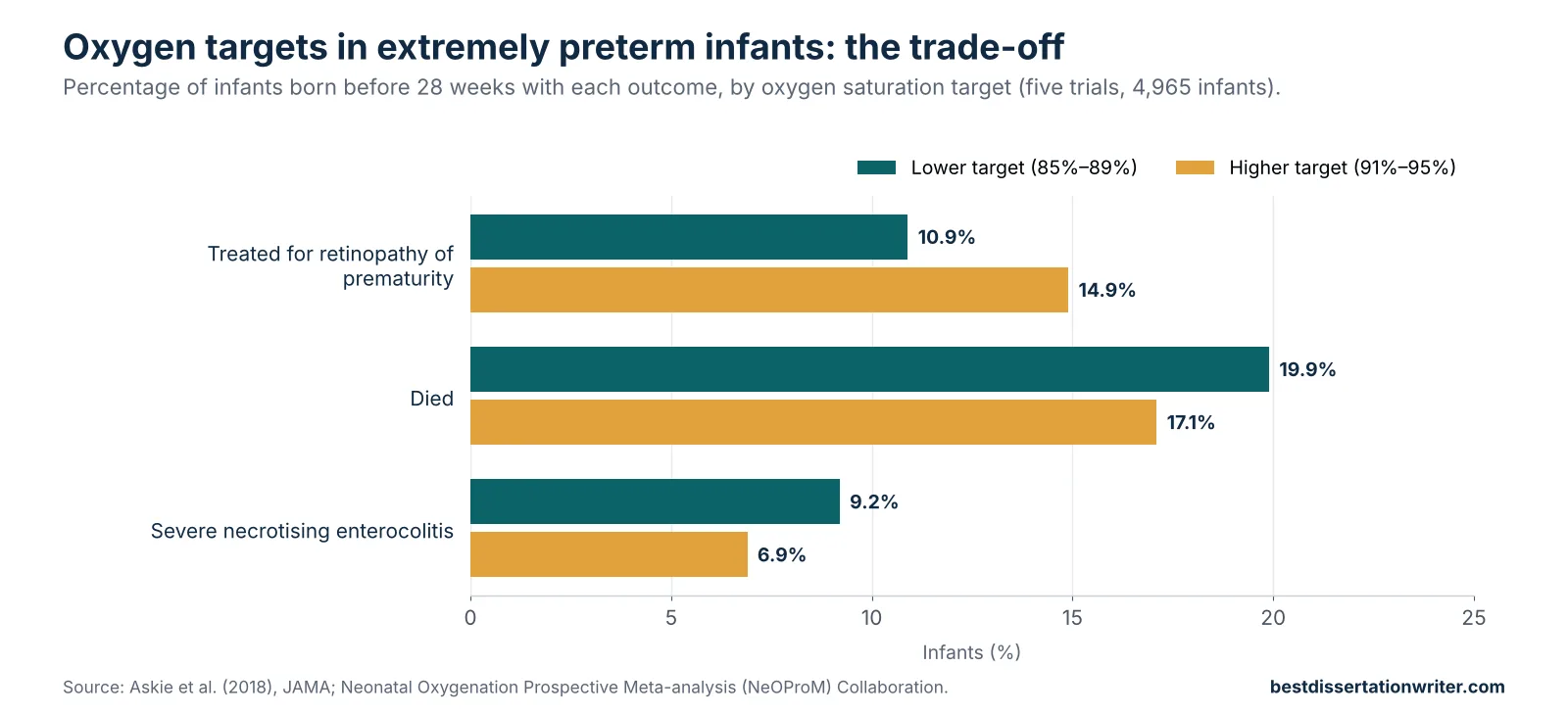
These findings illustrate a difficult trade-off. Lower oxygen targets protect the developing retina but at the cost of higher mortality, which is why most units now target the higher range. For nurses, the implication is that keeping saturations within the agreed target range, avoiding both prolonged high saturations and repeated fluctuations, is an important part of preventing retinopathy of prematurity without increasing other risks. Alarm limits, prompt responses and careful weaning of oxygen all contribute, as does avoiding unnecessary increases in oxygen during handling and procedures.
Theme 3: ROP Screening and Treatment
The Royal College of Paediatrics and Child Health (2022) guideline recommends ROP screening for infants born at less than 31 weeks’ gestation or weighing less than 1,501 g, and a 2024 review recommended considering screening for babies born between 31+0 and 31+6 weeks. The guideline also addresses the timing of the first examination, comfort care and pain relief during examinations, and when to refer for treatment.
Dempsey and McCreery (2011) reviewed two randomised crossover trials of local anaesthetic eye drops before screening. Topical proparacaine given 30 seconds before the examination reduced the proportion of babies with high pain scores at one minute (risk ratio 0.56), especially at speculum insertion, but the authors noted that screening remained a painful procedure despite treatment. This suggests that anaesthetic drops should be combined with other comfort measures.
Stahl et al. (2019) randomised 225 infants with retinopathy needing treatment to ranibizumab 0.2 mg, ranibizumab 0.1 mg or laser therapy. Treatment success was 80% with ranibizumab 0.2 mg, 75% with 0.1 mg and 66% with laser; the comparison of the higher dose with laser narrowly missed statistical significance (odds ratio 2.19, 95% confidence interval 0.99 to 4.82). Anti-VEGF treatment offers a less invasive option, but longer follow-up is needed to understand recurrence and long-term effects.
Discussion
This review shows that retinopathy of prematurity remains a significant cause of visual impairment worldwide, but that most severe visual loss can be prevented through careful oxygen management, reliable screening and timely treatment. The evidence on oxygen targeting reveals a trade-off between retinal protection and survival, while newer treatments offer alternatives to laser but require long-term follow-up.
Nursing practice is central at each stage. Oxygen saturation targeting depends on nurses setting alarm limits, responding promptly and adjusting oxygen carefully, often many times a day. Small differences in practice across shifts can influence how much time babies spend above or below target. Education about why targets matter, and audit of the time babies spend within range, are therefore important parts of prevention.
ROP screening is a clear example of a necessary but painful procedure. The Cochrane review showed that local anaesthetic drops reduce but do not eliminate pain, and the national guideline highlights comfort care and pain relief. Nurses can combine anaesthetic drops with sucrose, swaddling, non-nutritive sucking and calm handling, time examinations to avoid feeds and monitor babies afterwards for any apnoea or instability that may follow the stress of screening.
Parents also need attention during screening. Many parents find it distressing to know that their baby is undergoing a painful eye examination, and some wish to be present to comfort their baby while others prefer not to watch. Offering a choice, explaining what will happen and why, and sharing the results promptly can reduce anxiety. Where retinopathy of prematurity is found, parents need clear information about what the stage means, whether treatment is likely and how often examinations will be repeated, delivered in language they can understand.
Screening also depends on organisation. Babies must be identified as eligible, examined at the right postmenstrual age and followed until the retina is mature, even if they are transferred or discharged home. Missed or delayed examinations can lead to preventable blindness. Nurses often coordinate screening lists, communicate with ophthalmologists and explain the importance of follow-up appointments to parents, making them key to the reliability of screening programmes.
The newer anti-VEGF treatments change these responsibilities. Because retinopathy of prematurity can recur weeks or months after injection, babies may need eye examinations long after they have left the neonatal unit, sometimes until well after their original due date. This places greater weight on discharge planning and community follow-up. Nurses preparing families for discharge need to ensure that appointments are booked, that parents understand why they matter and that community teams know which babies remain under ophthalmology review.
The evidence base has limitations. The burden estimates relied on modelling, the oxygen targeting trials were conducted mainly in high-income countries, the pain review included only two small trials and the treatment trial reported short-term outcomes. This review relied on openly accessible, English-language sources and, as a narrative review, did not use formal systematic screening. Future research should evaluate comfort bundles during screening, long-term outcomes of anti-VEGF treatment and the effectiveness of nurse-led systems to ensure that no eligible baby misses screening.
Implications of Retinopathy of Prematurity Evidence for Practice
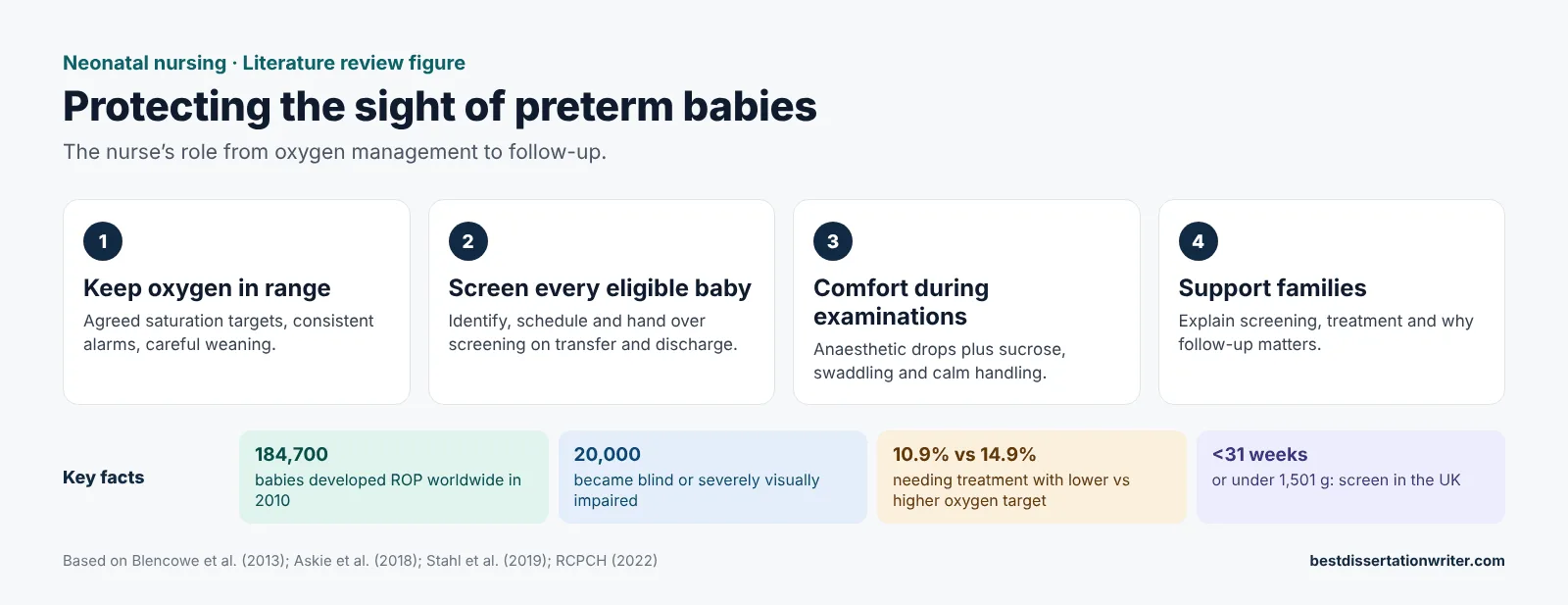
For neonatal nurses, the evidence supports keeping oxygen saturation within agreed target ranges, setting and responding to alarms consistently and avoiding unnecessary fluctuations. Nurses should ensure that every eligible baby is identified and screened on time, prepare babies with dilating drops and local anaesthetic, provide comfort measures during examinations and monitor afterwards. Clear handover of screening schedules at transfer and discharge, and information for parents, help to prevent missed follow-up. The RCPCH screening guideline sets out national standards.
Comfort during screening draws on the evidence for managing procedural pain in neonates, and arrangements for ongoing eye examinations should be part of discharge preparation. Oxygen management skills are reinforced through neonatal resuscitation training, and families coping with the possibility of visual impairment, like those facing neonatal loss, need sensitive emotional support.
Conclusion
This narrative review examined the burden, screening, prevention and treatment of retinopathy of prematurity, drawing on epidemiological, trial and guideline evidence. The condition causes thousands of cases of blindness each year, lower oxygen targets reduce it but increase mortality, screening is necessary but painful and anti-VEGF treatment offers an effective alternative to laser.
Neonatal nurses are central to preventing visual loss from retinopathy of prematurity in preterm infants. By managing oxygen carefully, ensuring reliable and comfortable screening and supporting families through treatment and follow-up, nurses help to ensure that preterm babies leave hospital with the best possible chance of healthy vision.
References
Askie, L. M., Darlow, B. A., Finer, N., Schmidt, B., Stenson, B., Tarnow-Mordi, W., Davis, P. G., Carlo, W. A., Brocklehurst, P., Davies, L. C., Das, A., Rich, W., Gantz, M. G., Roberts, R. S., Whyte, R. K., Costantini, L., Poets, C., Asztalos, E., Battin, M., … Simes, R. J. (2018). Association between oxygen saturation targeting and death or disability in extremely preterm infants in the Neonatal Oxygenation Prospective Meta-analysis Collaboration. JAMA, 319(21), 2190–2201. https://doi.org/10.1001/jama.2018.5725
Blencowe, H., Lawn, J. E., Vazquez, T., Fielder, A., & Gilbert, C. (2013). Preterm-associated visual impairment and estimates of retinopathy of prematurity at regional and global levels for 2010. Pediatric Research, 74(Suppl. 1), 35–49. https://doi.org/10.1038/pr.2013.205
Dempsey, E., & McCreery, K. (2011). Local anaesthetic eye drops for prevention of pain in preterm infants undergoing screening for retinopathy of prematurity. Cochrane Database of Systematic Reviews, (9), CD007645. https://doi.org/10.1002/14651858.CD007645.pub2
Royal College of Paediatrics and Child Health. (2022). Screening of retinopathy of prematurity (ROP): Clinical guideline. https://www.rcpch.ac.uk/resources/screening-treatment-retinopathy-prematurity-guidance
Stahl, A., Lepore, D., Fielder, A., Fleck, B., Reynolds, J. D., Chiang, M. F., Li, J., Liew, M., Maier, R., Zhu, Q., & Marlow, N. (2019). Ranibizumab versus laser therapy for the treatment of very low birthweight infants with retinopathy of prematurity (RAINBOW): An open-label randomised controlled trial. The Lancet, 394(10208), 1551–1559. https://doi.org/10.1016/S0140-6736(19)31344-3
Cite this example
Best Dissertation Writers (2026) Screening and Nursing Management of Retinopathy of Prematurity: A Narrative Review. Available at: https://bestdissertationwriter.com/retinopathy-of-prematurity-review/
Best Dissertation Writers
Get expert help with your nursing literature review
Share your topic and deadline with Best Dissertation Writers and get support tailored to your module brief.