
What Is a Dissertation Introduction Chapter?
- The introduction chapter is the opening section of your dissertation or thesis, and it’s the very first thing your reader engages with after the contents page. Before we get into dissertation introduction examples, it’s worth understanding exactly what this chapter needs to do.
- In simple terms, the introduction chapter sets the stage for your entire dissertation. It’s where you introduce your research topic, explain the context of the study, and clearly state the specific research problem your research project addresses.
- A well-written introduction chapter typically covers:
- Background information — the broader context surrounding your topic and research.
- Research problem — the gap in the literature or real-world issue your dissertation addresses.
- Research question(s) and research objectives — what you intend to find out and why it matters.
- Aims and objectives — the specific outcomes your research study is working toward.
- Significance of the study — why your research topic matters to existing research and practice.
- Structure of your dissertation — a brief roadmap outlining what each of the following chapters will cover.
- The introduction chapter isn’t just an academic formality — it’s your chance to hook the reader, demonstrate a clear understanding of your field, and provide an overview of your research that flows logically into the rest of the dissertation.
- Many students, particularly postgraduate and international students, underestimate how much weight this chapter carries. Examiners often form their first impression of your academic writing quality right here, which is exactly why looking at solid dissertation introduction examples before you start writing can make such a big difference.
- Throughout your dissertation, chapter one acts as the anchor that every other chapter — the literature review chapter, the research methodology, the results section, and the conclusion chapter — refers back to. If your introduction is vague or poorly structured, the rest of the dissertation can feel disconnected.
- In the sections below, we’ll walk through real dissertation introduction examples, explain how they’re structured, and show you how to write a dissertation introduction chapter that sets a strong, clear tone from page one.
- If you’ve searched for dissertation introduction examples before, you’ve probably noticed that the best ones share a common thread: they’re specific, they’re concise, and they never leave the reader guessing about the research topic and research at hand.
- Before diving into a full breakdown, it’s worth noting that dissertation introduction examples differ slightly depending on discipline, university guidelines, and whether your research study is qualitative or quantitative — but the underlying structure remains remarkably consistent across the board.
Dissertation Introduction Examples: Chapter One Breakdown
- To really understand how to write a dissertation introduction chapter, it helps to see how the theory translates into practice. Below, we break down chapter one into its core components, with dissertation introduction examples for each part.
- These dissertation introduction examples are drawn from real academic writing conventions used across UK universities and beyond, so you can see exactly how each element should read once it’s on the page.
1. Opening Hook and Context of the Study
- A strong opening line draws the reader into your research topic immediately, and this is one area where dissertation introduction examples really earn their keep. Rather than a dry, generic statement, aim for something that establishes real-world relevance.
- Example: “Despite decades of policy intervention, youth unemployment in urban South Africa remains stubbornly high, with recent statistics indicating that nearly one in three young adults is without work.”
- This type of opening immediately establishes the context of the study and hints at the specific research problem to come. Notice how it doesn’t waste words — it gets straight to why the research topic matters.
2. Background Information
- After your hook, you’ll need a few paragraphs of background information that gently guide the reader from the broad context of the study to the narrower focus of your research project.
- Example: “Over the past decade, several government-led initiatives have attempted to address this issue, yet unemployment among graduates continues to rise. While existing research has explored macroeconomic causes, comparatively little attention has been paid to the role of soft-skills training in graduate employability.”
- This is a classic move seen across dissertation examples — start broad, then narrow the focus until you arrive at the specific gap in the literature your dissertation will fill. Almost every set of dissertation introduction examples you’ll find follows this same funnel shape.
3. Problem Statement
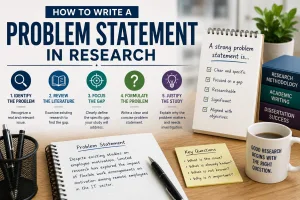
- This is where you clearly state the specific research problem. Among all the dissertation introduction examples we could look at, this section is often the trickiest for students to get right because it must be narrow, specific, and justified.
- Example: “Although soft-skills training programmes have been introduced in several universities, there is limited empirical evidence evaluating their effectiveness in improving graduate employability outcomes in the South African context.”
- Notice the precision here — it doesn’t just say “there’s a problem,” it identifies exactly what’s missing from existing research. This kind of precision is what separates memorable dissertation introduction examples from forgettable ones.
4. Research Aims, Objectives and Research Questions
- Your research question and research objectives should flow directly from your problem statement. This is a section where dissertation introduction examples vary depending on whether the research study is qualitative, quantitative, or mixed-methods.
- Example (quantitative):
- Research Question: “What is the relationship between participation in soft-skills training and graduate employment outcomes?”
- Research Objectives: “To measure the correlation between soft-skills training attendance and time-to-employment among recent graduates.”
- Example (qualitative):
- Research Question: “How do recent graduates perceive the value of soft-skills training in securing employment?”
- Research Objectives: “To explore graduate perceptions and experiences of soft-skills training through in-depth interviews.”
- These dissertation introduction examples show how the same broad research topic can be approached differently depending on your chosen research methodology.
- Whichever approach you take, the aim of these dissertation introduction examples is the same: to show the reader, in plain terms, exactly what your research sets out to answer and how you intend to analyse the data you collect.
5. Significance of the Study
- Here, you explain why your research project matters — to academia, to policy, or to practice.
- Example: “This study contributes to existing literature by providing empirical evidence on an under-researched aspect of graduate employability, offering practical recommendations for universities and policymakers.”
- Good dissertation introduction examples always tie this significance statement back to the specific research problem raised earlier, rather than making broad, unsupported claims about impact.
6. Structure of Your Dissertation
- Finally, most introduction chapters end with a short roadmap of the rest of the dissertation, previewing chapter two (literature review), chapter three (methodology), and beyond, through to chapter five (conclusion and recommendations).
- Example: “Chapter Two reviews existing literature on graduate employability and soft-skills training. Chapter Three outlines the research methodology. Chapter Four presents the findings, and Chapter Five discusses the results and offers recommendations for future research.”
- As these dissertation introduction examples show, chapter one is a carefully engineered sequence — hook, context, problem, questions, significance, and roadmap — each part building logically on the last. Once you see this pattern across enough dissertation introduction examples, writing your own introduction chapter becomes far less intimidating.
How to Write a Dissertation Introduction That Grabs Attention
- Now that you’ve seen dissertation introduction examples broken down piece by piece, let’s talk about how to write a dissertation introduction that genuinely grabs attention — not just satisfies a checklist.
- The techniques below apply whether you’re writing your dissertation for the first time or refining a draft, and they’re the same techniques you’ll spot if you go back and reread the dissertation introduction examples above with fresh eyes.
- Start with a compelling fact, statistic, or observation. Readers (and examiners) are human. A striking statistic or an unexpected observation about your research topic draws them in far more effectively than “This dissertation aims to explore…”
- Avoid overly broad, vague openings. Sentences like “Throughout history, communication has been important to society” tell the reader nothing specific. Instead, ground your opening in your actual research topic from the very first line.
- Clearly identify the gap in the literature early. Within the first page, the reader should understand what existing research has and hasn’t addressed. This is a hallmark of a high-quality dissertation or thesis introduction.
- Use plain, confident academic writing. You don’t need overly complex language to sound academic — clarity is more persuasive than jargon. A clear introduction, written in accessible language, is far easier to follow than one stuffed with unnecessary terminology.
- Signal your research methodology briefly. You don’t need full detail here (that’s for chapter three), but a sentence noting whether your research study is qualitative, quantitative, or mixed-methods helps orient the reader early.
- Make the “so what?” obvious. After reading your introduction, the reader should be able to answer: why does this research project matter? If they can’t, revisit your significance section.
- Keep paragraphs short and purposeful. Long, meandering paragraphs bury your key points. Each paragraph in your introduction chapter should do one clear job — introduce the context, state the problem, outline objectives, and so on.
- Preview your structure without over-explaining. A brief, well-organised roadmap of the rest of the dissertation shows organisation and gives the reader confidence that you know exactly where the research is headed.
- Study loads of examples before you write. One of the best ways to learn how to write a dissertation introduction chapter is to read loads of examples from your field — including examples of undergraduate dissertations if you’re at that level — and note how experienced writers combine these techniques. The more dissertation introduction examples you read, the easier it becomes to spot what separates an average opening from a genuinely strong dissertation introduction.
- Revise your opening after finishing the rest of the chapter. Many students, and even seasoned researchers at outlets like Grad Coach, recommend writing your grabbing opening line last, once you know exactly what your introduction chapter argues.
- Get a second opinion. Ask a supervisor, peer, or a dissertation help service to read your opening cold. If they can’t tell you your research topic and research question after one read, it’s a sign your introduction needs sharpening.
- Don’t be afraid to dig deep into your topic early. Readers respond well when a writer clearly understands the nuance of the research topic and research context from the very first paragraph, rather than skimming the surface.
- Ultimately, if you’re wondering how to write a dissertation introduction chapter that stands out, the answer lies in specificity, clarity, and confidence — qualities you’ll notice repeatedly if you study dissertation introduction examples from strong, well-structured dissertations. Students who take the time to compare several dissertation introduction examples side by side tend to produce far more polished, actionable opening chapters than those who start writing from a blank page.
Dissertation Examples: Introduction and Conclusion Compared
- A question many students ask is how the introduction and conclusion of a dissertation or thesis relate to one another. Looking at dissertation examples side by side — introduction and conclusion together — makes the relationship much clearer, and it’s a useful companion exercise to studying dissertation introduction examples on their own.
- They mirror each other in structure, but serve opposite purposes. The introduction chapter opens with background information and narrows down to a specific research problem and research question. The conclusion chapter does the reverse — it starts with specific research findings and broadens back out to implications for existing research and practice.
- Example (Introduction excerpt): “This study investigates the impact of remote learning on student engagement in UK universities, addressing a gap in the literature regarding long-term engagement post-pandemic.”
- Example (Conclusion excerpt): “This study has demonstrated that remote learning significantly affects long-term student engagement, contributing new insight to existing literature and offering recommendations for future research into hybrid learning models.”
- Notice how the conclusion chapter directly answers the research question first posed in the introduction chapter — this is what examiners look for as they read your entire dissertation from front to back.
- The introduction previews; the conclusion delivers. Where your introduction chapter states aims and objectives, your conclusion chapter should explicitly confirm whether those aims and objectives were achieved, based on your research findings.
- Both chapters reference the same core elements — but at different points in the story. The research question, research objectives, and gap in the literature appear in both chapters. In the introduction, they’re framed as open questions; in the conclusion, they’re framed as answered (or partially answered) outcomes.
- The conclusion chapter often includes recommendations for future research — something the introduction chapter usually doesn’t touch on, since at that stage, findings don’t exist yet.
- Consistency matters. If your introduction states that your research study is qualitative and exploratory, your conclusion should reflect that same framing rather than introducing quantitative claims out of nowhere.
- A well-structured dissertation reads as a closed loop. When you compare strong dissertation examples, introduction and conclusion sections should feel like they’re in direct conversation — the conclusion should never introduce any new information the reader hasn’t been prepared for.
- Avoid a common mistake: Some students treat the conclusion chapter as a place to include any new information about the topic. It shouldn’t be — anything substantial should already have appeared in your literature review chapter, results section, or discussion.
- By studying dissertation examples where the introduction and conclusion are tightly aligned, you’ll get a much clearer understanding of how examiners expect your entire dissertation to hang together, from chapter one through to chapter five. This is exactly why comparing dissertation introduction examples against their matching conclusion chapters is such a valuable exercise before you submit.
How to Write the Introduction Chapter of a Dissertation or Thesis
A strong introduction chapter sets the foundation for the entire dissertation. Below is a summary of our guides from Best Dissertation Writers covering every section you need to write a clear, well-structured introduction.
More Guides and Examples to Explore
Dissertation Introduction Chapter
A complete overview of what the introduction chapter should include and how each section fits together.
How to frame the context of your research, explain why the topic matters, and lead the reader toward your problem statement.
A step-by-step guide to identifying the research gap and articulating the problem your study addresses, with examples.
How to state the overall aim of your research in one clear, concise statement tied to the problem identified.
How to explain the theoretical and practical contributions of your research to your field and future studies.
How to craft a clear, focused research question that aligns with your purpose and guides your entire study.
Guidance on turning your purpose into specific, measurable objectives that guide methodology and analysis.
A practical walkthrough of running hypothesis tests in SPSS and interpreting the results for your study.
How to select and explain the theory or model that underpins your research and connects it to existing literature.
How to define the boundaries of your study — what it covers and what it excludes — and why this matters.
How to acknowledge the constraints of your research design, data, or methodology honestly.
Real sample introductions to see how all the sections above come together in a finished chapter.
Need Expert Help With Your Introduction Chapter?
Our writers at Best Dissertation Writers can help you craft a compelling, well-structured introduction from scratch.
Get Started NowReference: https://www.iup.edu/scholarlycommunication/our-writing-resources/dissertation-overview.html
How to Write a Strong Dissertation Introduction (With Examples)
- If your goal is to write a strong dissertation introduction, it helps to combine everything covered so far into a practical, step-by-step process. Below is a guide on how to write a strong, high-quality dissertation or thesis introduction, illustrated with dissertation introduction examples throughout.
Step 1: Nail Down Your Research Topic and Research Question First
- Before writing a single word of your introduction chapter, make sure your research topic and research question are clearly identified. A strong dissertation introduction can’t be written on shaky foundations.
- Example: Instead of a vague topic like “social media and mental health,” a clearly identified research question might be: “How does daily Instagram use affect self-esteem among female university students aged 18–24?”
- This is one of those dissertation introduction examples that shows how narrowing a broad topic into a specific, answerable research question instantly makes the rest of the introduction chapter easier to write.
Step 2: Draft Your Background and Context of the Study
- Write a few paragraphs of background information that move from the general research topic down to your specific angle. This section should provide an overview of your research area without going into excessive detail — that’s what your literature review chapter is for.
- Example: “Social media use among university students has risen sharply over the past five years, with research increasingly linking platform use to shifts in self-perception and mental wellbeing.”
- This kind of measured, evidence-backed background is a hallmark of the strongest dissertation introduction examples available online.
Step 3: State the Gap in the Literature Clearly
- This is arguably the single most important part of learning how to write a dissertation introduction. A strong dissertation introduction always identifies precisely what existing research has missed.
- Example: “While prior studies have examined general social media use and mental health, few have isolated the specific effects of Instagram usage patterns on self-esteem within university-aged populations.”
- Across the strongest dissertation introduction examples we’ve reviewed, this gap statement is almost always just one or two sentences — precise and unmistakable, never vague or padded out.
Step 4: Write Clear Aims, Objectives and Research Questions
- Clearly state what your dissertation sets out to achieve. Keep the language direct and easy to follow.
- Example: “This dissertation aims to examine the relationship between Instagram usage frequency and self-esteem levels among female university students, using a quantitative survey-based research methodology.”
Step 5: Justify the Significance of Your Research Project
- Explain why your research study matters — to academic literature, to practitioners, or to policy.
- Example: “Findings from this research project could inform university counselling services and social media literacy programmes aimed at supporting student mental health.”
Step 6: Provide a Brief Overview of Your Dissertation Structure
- Close your introduction chapter with a short, clear roadmap of the rest of the dissertation, so the reader knows exactly what’s coming.
- Example: “Chapter Two reviews existing literature on social media and self-esteem. Chapter Three details the research methodology, including sampling and analysis techniques used to analyse survey data. Chapter Four presents the results, and Chapter Five discusses findings and recommendations for future research.”
Step 7: Compare Your Draft Against Strong Dissertation Introduction Examples
- Once you have a full draft, compare it against dissertation introduction examples from well-structured, successful dissertations in your field — including examples of undergraduate dissertations if that’s your level of study. Check that your version is just as clear, focused, and specific.
- It’s worth setting aside dedicated time to read through several dissertation introduction examples back to back, rather than just one, since patterns only become obvious once you’ve seen how different writers handle the same structural requirements.
- Look out for tables and figures used effectively elsewhere in similarly strong dissertations, and consider whether a simple diagram summarising your research design might help orient your reader (these often appear in chapter three rather than chapter one, but it’s worth noting early).
- Before moving on, it’s worth pausing here to reread a few dissertation introduction examples one final time, checking that your own draft matches their tone, precision, and pacing.
Quick Checklist for a Strong Dissertation Introduction
- Does it open with something engaging, not generic?
- Does it clearly state the research problem and gap in the literature?
- Are the research question, research objectives, and aims and objectives clearly identified?
- Does it briefly signal the research methodology (qualitative, quantitative, or mixed)?
- Does it end with a clear, easy-to-follow overview of your research and dissertation structure?
- Would a reader unfamiliar with your topic and research understand, within two pages, exactly what your dissertation investigates and why it matters?
- If you can confidently tick off each item above, you’re well on your way to producing a high-quality dissertation or thesis introduction. And if you ever get stuck, revisiting a handful of strong dissertation introduction examples — alongside dissertation help resources from your university or supervisor — is one of the fastest ways to get back on track and craft a top-notch dissertation from chapter one onward.
- At the end of the day, learning how to write a dissertation introduction chapter isn’t about memorising a formula — it’s about internalising the pattern behind great dissertation introduction examples until writing your own feels natural rather than forced.
More Dissertation Introduction Examples on Different Subject Areas
Filter by focus area, or browse the full set.
- Dissertation introduction examples: a complete writing guide
- The effect of minimum wage increases on small business hiring decisions
- Social media use and body image concerns among adolescents
- Procedural justice and public trust in law enforcement
- The role of community health workers in chronic disease care
- Culturally responsive pedagogy and student engagement outcomes
- Neighborhood cohesion and civic engagement in urban communities
- Barriers to accessing child welfare services among low-income families
- Balancing patient autonomy and paternalism in end-of-life care
- Leadership styles and psychological safety in the workplace
- Therapeutic communication techniques in mental health nursing
- Consumer trust in AI-generated marketing content
- Remote work flexibility and its effect on employee retention
- Attachment style and its influence on adult romantic relationships
- Emotion regulation strategies and their link to teacher burnout
Dissertation support
Best Dissertation Writers helps you write and edit publication-ready research
From literature reviews to full dissertations, our editors help students and researchers write clearly, meet academic standards, and submit with confidence.
Get StartedSee Source