The Experiences of Family Carers of People with Learning Disabilities: A Qualitative Evidence Synthesis
 By Dr. Robertson Prime, Research Fellow
Updated October 12, 2026
15 min read
About 3,100 words
By Dr. Robertson Prime, Research Fellow
Updated October 12, 2026
15 min read
About 3,100 words
In this review
Abstract
Background: Most people with learning disabilities are supported for much or all of their lives by family carers, whose own health, wellbeing and future plans shape the care the person receives. Understanding the caregiver experience is therefore essential for learning disability nurses who work with whole families.
Aim: This integrative review aimed to examine the experiences, health and support needs of family carers of people with learning disabilities, and the implications for learning disability nursing.
Methods: Evidence was identified through targeted searches of openly accessible bibliographic records, publisher websites and the reference lists of key reviews. Six sources published between 2014 and 2020 were included: a qualitative meta-synthesis, a narrative systematic review, a meta-analysis, a carer survey, a qualitative study and a national guideline, appraised with CASP checklists and integrated thematically.
Findings: A qualitative synthesis of 17 studies found that carers of relatives with challenging behaviour described deep love alongside chronic strain, and often experienced services as adding stress. A meta-analysis of 14 studies found poorer health among mothers of young children with developmental disabilities (standardised mean difference 0.87), most marked for stress, and a UK survey of 110 carers of adults reported more health problems than population norms. A review of 22 studies identified positive change and personal growth, while older carers in Ireland had made few future care plans.
Conclusion: Carers need to be recognised as partners and as people with their own needs. Nurses should offer carer assessments, reliable support and early future planning, and build on the strengths families describe.
Keywords: family carers, caregiver experience, qualitative synthesis
Introduction
This integrative review critically examines recent evidence on family carers and its implications for learning disability nursing practice.
Families provide much of the day-to-day support for people with learning disabilities. Parents, siblings and other relatives often care for their family member from birth into adulthood and, increasingly, into older age. Caring can bring great meaning and satisfaction, but it can also involve long hours, sleep disruption, managing complex health needs and behaviour that challenges, and repeated negotiation with education, health and social care services.
The wellbeing of family carers matters in its own right, and it also affects the person they support. When carers become ill, exhausted or unable to continue, people with learning disabilities may face crisis moves, unfamiliar placements or hospital admission. Many older parents worry about what will happen when they can no longer care. Understanding the caregiver experience is therefore central to person-centred and family-centred learning disability services.
Learning disability nurses work with family carers in community teams, specialist health services, hospitals and residential settings. They assess needs, provide information and training, support health care and help families plan for the future. Nurses who understand what caring involves, what harms carers’ health and what helps them are better placed to work in genuine partnership with families rather than relying on them without support.
An integrative design was chosen because the evidence includes qualitative syntheses, quantitative meta-analysis, surveys and guidance. Bringing these together allows the lived caregiver experience to be considered alongside measured health outcomes and recommended practice.
Review question
What are the experiences, health outcomes and support needs of family carers of people with learning disabilities, and what are the implications for nursing?
Background to Family Carers
Family caregiving for a person with a learning disability differs from many other caring roles because it often begins at birth and continues for decades. Parents of children with learning disabilities may combine caring with work and other children, and many continue to provide significant support after their child reaches adulthood. As the life expectancy of people with learning disabilities has increased, more family carers are themselves becoming older and may have health problems of their own.
Research on family carers has historically focused on stress, burden and negative outcomes. More recent work has also examined positive experiences, adaptation and resilience. A balanced understanding recognises that caring can be both rewarding and demanding, and that the same carer may describe love, pride, exhaustion and frustration at different times. The caregiver experience is also shaped by the support available, including short breaks, information, financial help and the attitudes of professionals.
In England, the Care Act 2014 gives carers the right to an assessment of their own needs, and the National Institute for Health and Care Excellence (NICE, 2020) guideline on supporting adult carers recommends that practitioners actively identify carers, offer carers’ assessments that reflect what matters most to them, provide information in accessible formats and discuss the value of reliable breaks. The guideline applies to all adult carers, including parents and other relatives of people with learning disabilities, but does not focus specifically on this group.
Caring families are diverse. Mothers have been the focus of most research, but fathers, siblings, grandparents and other relatives also provide substantial support, and their experiences may differ. Cultural expectations about family responsibility, language barriers and experiences of discrimination can shape how families from minority ethnic communities use services. Some carers are themselves disabled or have long-term conditions. Recognising this diversity helps nurses avoid assuming that one model of support will suit every household.
Search Strategy and Methods
Evidence for this example was identified through targeted searches of openly accessible bibliographic records, publisher websites and the reference lists of key reviews. Search terms combined keywords for the population (“learning disab*”, “intellectual disab*”, “developmental disab*”) with terms for carers and their experiences (“family carers”, “parent*”, “caregiver”, “caregiver experience”, “wellbeing”, “stress”, “future planning”, “qualitative synthesis”), joined with the Boolean operators AND and OR. A full integrative review for assessment would run the same strategy in CINAHL, PubMed/MEDLINE, PsycINFO, the Cochrane Library and Embase and report the number of records screened in a PRISMA flow diagram.
Sources were eligible if they examined the experiences, health, wellbeing or support needs of family carers of children or adults with learning or intellectual disabilities, or provided national guidance on supporting carers. Qualitative syntheses, systematic reviews, meta-analyses, surveys and qualitative studies were included, reflecting the integrative design. Studies of paid support staff, and of carers of people with dementia or mental illness alone, were excluded.
Six sources published between 2014 and 2020 were included: one qualitative synthesis using meta-synthesis, one systematic review with narrative synthesis, one meta-analysis, one cross-sectional survey of family carers, one qualitative interview and focus group study and one national guideline (Table 1). The quality of each source was appraised using the Critical Appraisal Skills Programme (CASP) checklist appropriate to its design, and findings were integrated thematically so that carers’ experiences could be compared across designs.
Key Findings on Family Carers
Three themes were identified: the lived experience of caring, including love and strain; the physical and psychological health of family carers; and positive adaptation, future planning and support. Table 1 summarises the included sources, and Figure 1 presents pooled differences in health between mothers of young children with developmental disabilities and other mothers.
| Author, year | Design | Setting and sample | Key finding |
|---|---|---|---|
| Griffith and Hastings (2014) | Qualitative meta-synthesis | 17 studies of family members caring for relatives with intellectual disabilities and challenging behaviour | Five themes: affection, changed sense of self, crises, support beyond services, low expectations with hope; services often added stress. |
| Brennan et al. (2018) | Qualitative study (focus groups and interviews) | Older families of people with intellectual disability from an Irish longitudinal ageing study | Declining family caregiving capacity, limited service support and few future care plans. |
| Grey et al. (2018) | Cross-sectional survey | 110 UK carers co-residing with an adult relative with intellectual disability | More health problems than population norms; adaptation and helpful support buffered negative outcomes. |
| Beighton and Wills (2019) | Systematic review with narrative synthesis | 22 studies of parents of children with intellectual disabilities | Positive change, personal strength, growth and development; growth did not mean absence of distress. |
| Masefield et al. (2020) | Systematic review and meta-analysis | 14 studies comparing mothers of preschool children with and without developmental disabilities | Poorer maternal health (SMD 0.87); largest for stress (1.11), smaller for depressive symptoms (0.36). |
| NICE (2020) | National guideline | Adult carers in England, including relatives of disabled people | Identify carers, joint carers’ assessments, accessible information, training, reliable breaks and planning for change. |
Theme 1: The Caregiver Experience of Love and Strain
Griffith and Hastings (2014) carried out a qualitative synthesis of 17 studies of family members caring for a relative with intellectual disabilities and behaviour that challenges. Five themes emerged: strong affection for the family member, a changed sense of self, managing crises, support that extends beyond specialist behaviour services, and low expectations for the future alongside hope. Carers described deep love for their relative together with chronic strain arising from the demands of caring.
A striking finding of this synthesis was that support services often added to carers’ problems and stress rather than relieving them, although examples of good practice were also reported. Carers described having to fight for services, repeat their story to different professionals and manage crises with little help. This suggests that the caregiver experience is shaped not only by the person’s needs but also by how services respond to families.
The synthesis focused on carers of people with behaviour that challenges, a group likely to experience particularly high demands, so its findings may not apply equally to every caring family. However, the combination of love and strain it describes recurs throughout the wider literature and offers an important corrective to accounts that portray caring only as a burden.
Theme 2: The Health of Family Carers
Masefield et al. (2020) meta-analysed 14 studies comparing mothers of preschool children with developmental disabilities with mothers of typically developing children. Caregiving was associated with greater ill health, with a pooled standardised mean difference of 0.87. The difference was largest for stress (1.11) and smaller but still present for depressive symptoms (0.36). The association was greatest for mixed developmental disabilities and smallest for Down syndrome. All studies were retrospective, heterogeneity was high and socioeconomic data were too limited for subgroup analysis.
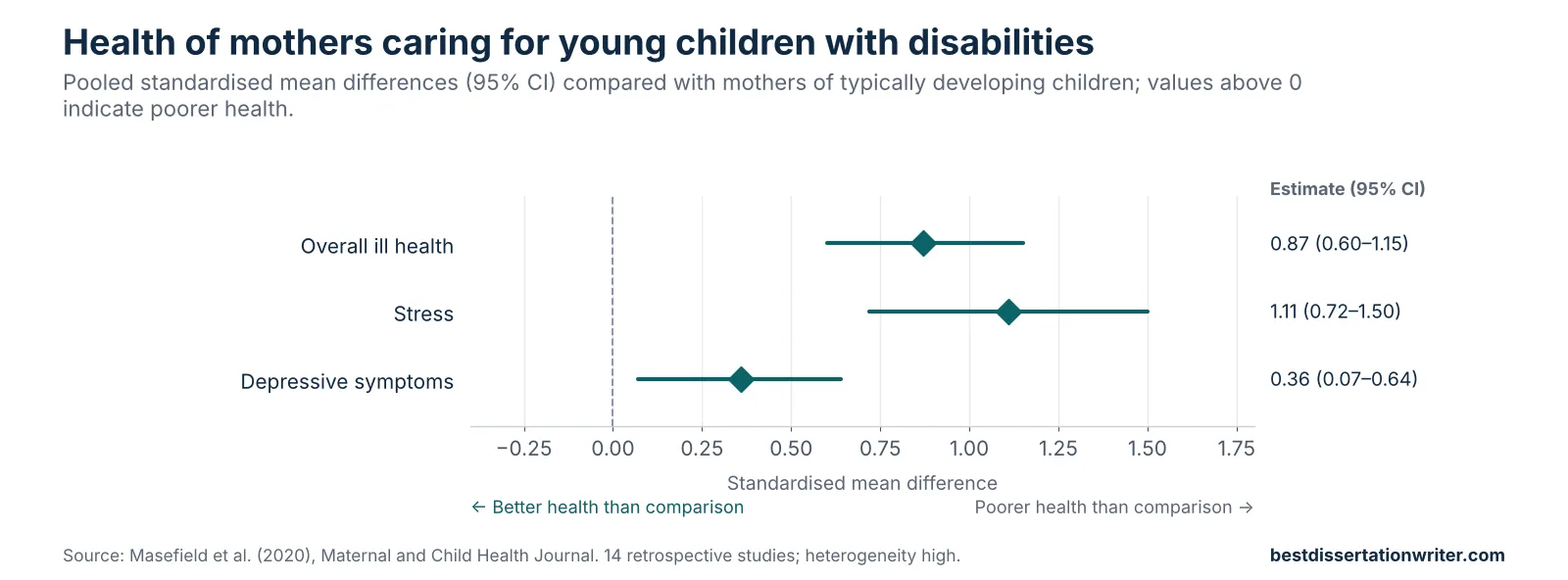
These findings relate to mothers of young children and to developmental disabilities more broadly, not only learning disabilities. Fathers, siblings and carers of adults were not represented. Because the studies were cross-sectional comparisons, they cannot show whether caring causes poorer health or whether other factors, such as financial hardship, contribute. Nevertheless, the size of the difference in stress is large enough to be clinically important for nurses supporting parents in the early years.
Grey et al. (2018) surveyed 110 family carers in the UK who lived with an adult relative with an intellectual disability. Participants reported more health problems than general population norms. Higher support needs of the relative were associated with greater family stress, while older carers and those with a better socioeconomic position reported better psychological outcomes. Adaptation to the caring role and perceiving support as helpful appeared to buffer negative effects and to foster positive gains. The sample was small and self-selected, so findings should be treated with caution.
Taken together, the two quantitative sources suggest that poorer health can appear early, when children are young, and may persist when carers continue to support adult relatives at home. However, they also point to factors that are open to change. Grey et al. (2018) found that carers who had adapted to the caring role and who experienced support as helpful reported better outcomes, which implies that the way services work with carers may influence their wellbeing as much as the level of the relative’s needs.
Theme 3: Positive Adaptation, Future Planning and Support for Family Carers
Beighton and Wills (2019) reviewed 22 studies in which parents described positive aspects of parenting a child with intellectual disabilities. Consistent themes included positive change, increased personal strength, growth and development. Several studies noted that growth did not mean the absence of distress. The review found that positive aspects were defined and measured inconsistently and that no single theoretical framework explained them, but it showed that many parents identify real benefits alongside difficulties.
Planning for the future is a persistent concern for older family carers. Brennan et al. (2018) used focus groups and interviews with families drawn from an Irish longitudinal study of ageing in people with intellectual disability. They found that the traditional sociodemographic supports for family caregiving were declining, that families reported limited service support and few future care options, and that few future care plans had been made. The authors called for proactive work with families to develop long-term care plans early.
NICE (2020) recommends that carers’ assessments should be produced jointly with the carer, that information should be discussed rather than only given in writing, that training should be offered to help carers provide care safely, and that breaks should be reliable and avoid last-minute changes. It also advises planning for emergency replacement care and helping carers prepare for changes in the caring situation. These recommendations respond directly to the stresses and future worries described by carers in the qualitative literature.
Discussion
This integrative review shows that family carers of people with learning disabilities experience both deep attachment and significant strain, that their physical and psychological health is often poorer than that of other parents or the general population, and that many also describe positive change and personal growth. The qualitative and quantitative evidence are broadly consistent, which strengthens confidence in these conclusions about family carers.
A key tension concerns the role of services. Griffith and Hastings (2014) found that services often added to carers’ stress, while Grey et al. (2018) found that support perceived as helpful buffered negative outcomes. This suggests that the quality and reliability of support may matter as much as its quantity. Support that is fragmented, unpredictable or requires carers to fight for it may undermine wellbeing, whereas support that is consistent and respectful may strengthen it.
The evidence on positive experiences challenges a purely deficit-based view of caring. Beighton and Wills (2019) showed that many parents describe growth and strength, and Grey et al. (2018) found that adaptation to caring was linked to positive gains. Nurses who recognise both strain and strength can avoid treating carers simply as at risk, and can instead build on their expertise and resilience while still responding to their needs.
Future planning emerged as an urgent and neglected issue. Brennan et al. (2018) found that few families had made plans, and the meta-synthesis by Griffith and Hastings (2014) described low expectations for the future. Without planning, people with learning disabilities may face sudden moves when an older carer becomes ill or dies. Nurses can help family carers to begin these conversations early, involving the person with a learning disability as fully as possible.
The findings also raise questions about professional relationships. Carers in the qualitative synthesis described repeating their story and fighting for help, which suggests that continuity of contact with a known professional may be valuable in itself. Learning disability nurses who stay involved over time can build trust, notice early signs of carer strain and coordinate support before a crisis develops. This relational role is rarely measured in research but appears central to how carers judge services.
This review has limitations. This review relied on openly accessible, English-language sources, did not involve independent double screening and included only six sources. The meta-analysis concerned mothers of young children with developmental disabilities, the survey sample was small, and fathers, siblings and carers from minority ethnic communities were under-represented. Future research should use longitudinal and population-based designs, include diverse family carers and evaluate interventions such as carer assessments, short breaks and future planning support.
Implications of Family Carers Evidence for Practice
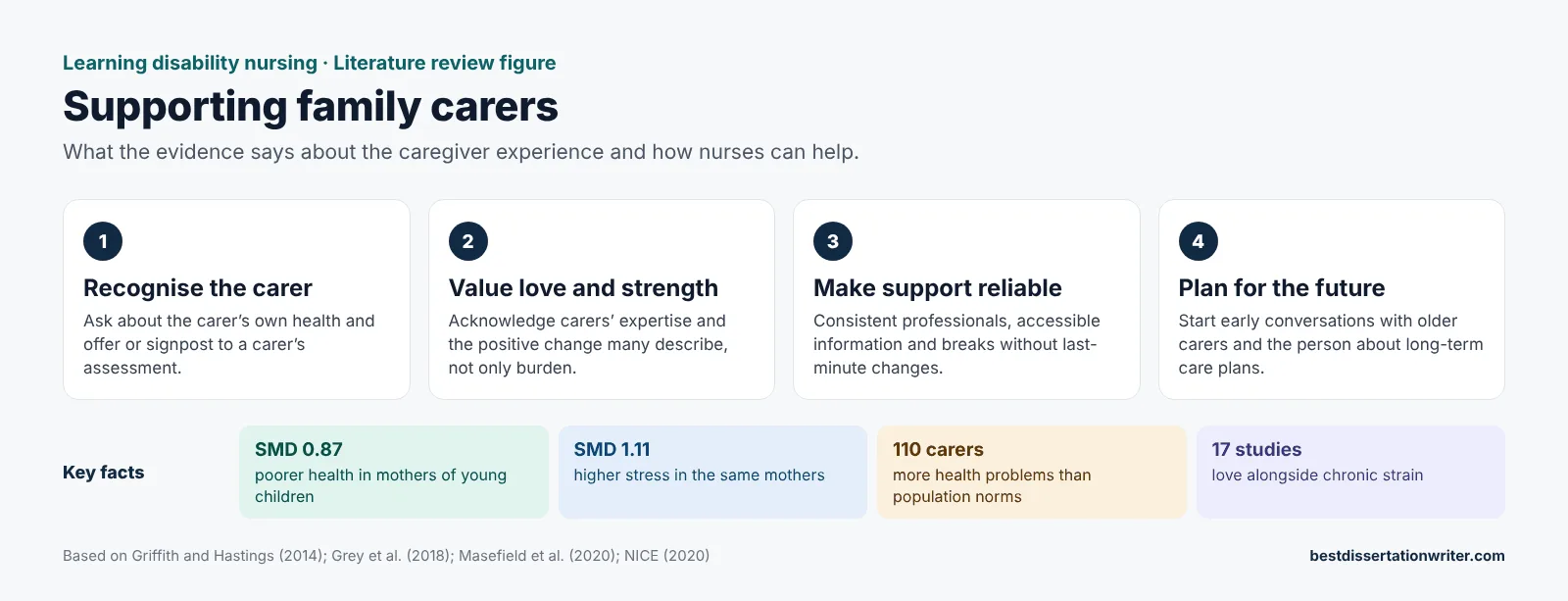
For learning disability nurses, the evidence supports routinely asking about the carer’s own health and wellbeing, offering or signposting to a carer’s assessment and providing information in a form that suits each family. Nurses should recognise carers’ expertise, involve them in care planning and ensure that support is consistent and reliable. Starting conversations about future planning early, particularly with older carers, can prevent crises and give the person with a learning disability a voice in decisions about where and how they will live.
Carers often hold key knowledge about health, such as how their relative communicates pain as one of the non-verbal patients nurses may meet, and their involvement can help to reduce health inequalities. Carers may also want guidance on sensitive topics such as sexual health education, and planning a move into supported living is often a central part of future planning for families.
Conclusion
This integrative review examined the experiences of family carers of people with learning disabilities. Caring involves love and strain, carers’ health is often poorer than that of others, and many carers describe positive change and growth. Services can either relieve or add to stress, and future planning is often neglected.
Learning disability nurses can support family carers by recognising them as partners with expertise, attending to their own needs, ensuring reliable support and helping families to plan for the future. Such an approach benefits both carers and the people with learning disabilities they support.
References
Beighton, C., & Wills, J. (2019). How parents describe the positive aspects of parenting their child who has intellectual disabilities: A systematic review and narrative synthesis. Journal of Applied Research in Intellectual Disabilities, 32(5), 1255–1279. https://doi.org/10.1111/jar.12617
Brennan, D., Murphy, R., McCallion, P., & McCarron, M. (2018). “What’s going to happen when we’re gone?” Family caregiving capacity for older people with an intellectual disability in Ireland. Journal of Applied Research in Intellectual Disabilities, 31(2), 226–235. https://doi.org/10.1111/jar.12379
Grey, J. M., Totsika, V., & Hastings, R. P. (2018). Physical and psychological health of family carers co-residing with an adult relative with an intellectual disability. Journal of Applied Research in Intellectual Disabilities, 31(S2), 191–202. https://doi.org/10.1111/jar.12353
Griffith, G. M., & Hastings, R. P. (2014). “He’s hard work, but he’s worth it”. The experience of caregivers of individuals with intellectual disabilities and challenging behaviour: A meta-synthesis of qualitative research. Journal of Applied Research in Intellectual Disabilities, 27(5), 401–419. https://doi.org/10.1111/jar.12073
Masefield, S. C., Prady, S. L., Sheldon, T. A., Small, N., Jarvis, S., & Pickett, K. E. (2020). The caregiver health effects of caring for young children with developmental disabilities: A meta-analysis. Maternal and Child Health Journal, 24(5), 561–574. https://doi.org/10.1007/s10995-020-02896-5
National Institute for Health and Care Excellence. (2020). Supporting adult carers (NICE guideline NG150). https://www.nice.org.uk/guidance/ng150
Cite this example
Best Dissertation Writers (2026) The Experiences of Family Carers of People with Learning Disabilities: A Qualitative Evidence Synthesis. Available at: https://bestdissertationwriter.com/family-carers-literature-review/
Best Dissertation Writers
Get expert help with your nursing literature review
Share your topic and deadline with Best Dissertation Writers and get support tailored to your module brief.