Prevention and Management of Oral Mucositis in Patients Receiving Cancer Treatment: A Systematic Review
 By Dr. Robertson Prime, Research Fellow
Updated October 28, 2026
14 min read
About 2,900 words
In this review
Abstract
Background: Oral mucositis is a painful inflammation and ulceration of the mouth that affects many people receiving chemotherapy, radiotherapy or stem cell transplantation. It interferes with eating, speaking and sleeping and can lead to treatment delays, so prevention and early management are central to cancer nursing.
Aim: This systematic review aimed to examine the evidence on the prevention and management of oral mucositis, including oral cryotherapy and basic oral care, and the knowledge and practice of oncology nurses.
Methods: Evidence was identified through targeted searches of openly accessible bibliographic records, publisher websites and professional guidance. Five sources published between 2010 and 2024 were included: three Cochrane or systematic reviews of interventions, an international clinical practice guideline and a mixed methods systematic review of nurses. The research sources were appraised using CASP checklists and synthesised narratively.
Findings: A Cochrane review of 14 trials found that oral cryotherapy reduced mucositis of any severity (risk ratio 0.61) and severe mucositis (0.40) in adults receiving 5-fluorouracil, and reduced severe mucositis in those given high-dose melphalan (0.38). A Cochrane review of 131 studies identified nine interventions with some benefit. Guidelines suggest multi-agent oral care protocols and advise against chlorhexidine in head and neck radiotherapy. A review of 15 studies found that nurses had limited knowledge of oral mucositis, positive attitudes to oral care and barriers of time and staffing.
Conclusion: Oral cryotherapy and structured oral care protocols are supported by the evidence for prevention of oral mucositis, while other interventions depend on the treatment setting. Nurses need education, written protocols and time to deliver oral care reliably.
Keywords: oral mucositis, oral care, cryotherapy
Introduction
This systematic review critically examines recent evidence on oral mucositis and its implications for cancer nursing practice.
Oral mucositis is inflammation and ulceration of the lining of the mouth caused by cancer treatment. It is a common effect of some chemotherapy drugs, of radiotherapy to the head and neck and of the conditioning regimens given before stem cell transplantation. People with oral mucositis describe pain, difficulty swallowing, changes in taste and a dry or sore mouth. The damaged mucosa can become infected, and eating and drinking may be so difficult that nutrition is compromised and treatment has to be delayed or reduced.
Nurses assess the mouth, teach oral hygiene, give mouthwashes and analgesia, help with nutrition and watch for infection. Because the condition often starts within days of treatment and can worsen quickly, nurses have a particular chance to act early. Many hospitals have oral care protocols, but they vary, and nurses report that practice is not always based on evidence.
A large number of interventions have been proposed, from ice chips to laser therapy, mouthwashes, growth factors and honey. The focus is on adults, although some sources include children. The review is presented as a systematic review of five key sources, including a clinical practice guideline.
Review question
What does the evidence show about the prevention and management of oral mucositis, and what do we know about the knowledge and practice of oncology nurses?
Background to Oral Mucositis
Oral mucositis develops when cancer treatment damages the rapidly dividing cells of the oral mucosa. Inflammation, redness and soreness are followed in more severe cases by ulceration. It is graded on scales such as those of the World Health Organization, which range from soreness through to an inability to eat. Severe oral mucositis is a reason for treatment breaks and hospital admission, which makes prevention a priority.
The Multinational Association of Supportive Care in Cancer and the International Society of Oral Oncology (MASCC/ISOO) published its first guidelines on mucositis in 2003, with updates in 2007 and 2014. The 2020 update was prepared by the Mucositis Study Group, which involved about 250 experts from 33 countries, and covers intervention categories including anti-inflammatory agents, photobiomodulation, basic oral care, growth factors, antimicrobials, cryotherapy, nutritional supplements and natural agents.
For nurses, the practical questions are which interventions to offer to which patients, how to deliver them consistently and how to teach patients to look after their own mouths. The answers depend on the type of treatment, so evidence is reported separately for chemotherapy, head and neck radiotherapy and stem cell transplantation wherever possible.
Nurses also meet oral mucositis in different settings. In day units, patients may go home within hours of treatment and must recognise symptoms themselves, whereas in transplant wards nurses can assess the mouth several times a day. Teaching patients to check their mouths, to report soreness early and to keep up gentle cleaning at home is therefore an important part of care, even though the guideline could not issue a statement on patient education because of limited evidence.
Search Strategy and Methods
Evidence for this example was identified through targeted searches of openly accessible bibliographic records, publisher websites and professional guidance. Search terms combined keywords for the condition (“oral mucositis”, “stomatitis”, “mucositis”) with terms for the intervention and provider (“oral care”, “cryotherapy”, “nurses”, “prevention”, “guideline”), joined with the Boolean operators AND and OR. A full systematic review for assessment would run the same strategy in CINAHL, PubMed/MEDLINE, Embase and the Cochrane Library and report the records screened in a PRISMA flow diagram.
Sources were eligible if they were systematic reviews, Cochrane reviews or clinical practice guidelines on the prevention or management of oral mucositis in people receiving cancer treatment, or systematic reviews of nurses’ knowledge and practice. Single trials and reviews of mucositis of the gastrointestinal tract were excluded.
Five sources published between 2010 and 2024 were included (Table 1). The quality of each research source was considered using the Critical Appraisal Skills Programme (CASP) checklists, and findings were synthesised narratively.
Key Findings on Oral Mucositis
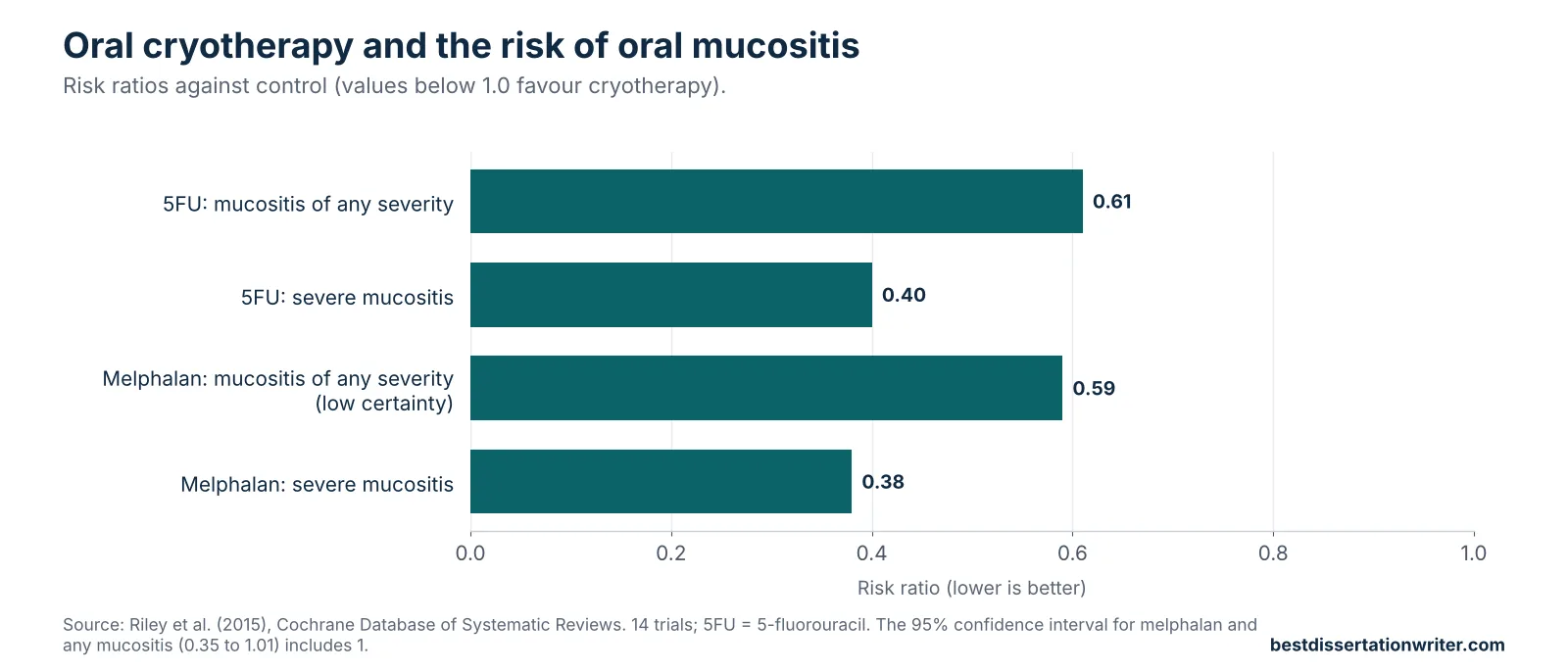
Three themes were identified: the evidence for oral cryotherapy and other interventions, the evidence for oral care protocols and guidelines, and the knowledge and practice of nurses. Table 1 summarises the included sources, and Figure 1 shows the effect of oral cryotherapy on the risk of oral mucositis.
| Author, year | Design | Setting and sample | Key finding |
|---|---|---|---|
| Elad et al. (2020) | Clinical practice guideline | 1,197 publications | New statements for photobiomodulation and benzydamine; stronger statement for cryotherapy. |
| Hong et al. (2019) | Systematic review and guideline | 17 new papers; six interventions | Multi-agent oral care protocols suggested; chlorhexidine not suggested in head and neck radiotherapy. |
| Riley et al. (2015) | Cochrane review | 14 trials; 1,316 participants | Cryotherapy reduced mucositis with 5FU and severe mucositis with melphalan. |
| Worthington et al. (2010) | Cochrane review | 131 studies; 10,514 participants | Nine interventions showed some benefit; strength of evidence varied. |
| Zuo et al. (2024) | Mixed methods systematic review | 15 studies of oncology nurses | Limited knowledge; barriers of time, knowledge and staffing. |
Theme 1: Oral Cryotherapy and Other Interventions
Riley et al. (2015) carried out a Cochrane review of oral cryotherapy, in which the patient holds ice chips or cold water in the mouth during chemotherapy. The review included 14 randomised controlled trials, with 1,316 participants randomised and 1,280 analysed, and searched the main databases in June 2015. Nearly all participants were adults, and most did not receive head and neck radiotherapy.
In adults receiving 5-fluorouracil (5FU) chemotherapy for solid cancers, cryotherapy reduced the risk of mucositis of any severity (risk ratio 0.61, 95% confidence interval 0.52 to 0.72; 5 studies, 444 participants analysed), with a number needed to treat of 4, and reduced severe mucositis (risk ratio 0.40, 0.27 to 0.61; number needed to treat 6). Both findings were of moderate certainty. In adults given high-dose melphalan before stem cell transplantation, severe mucositis was also reduced (risk ratio 0.38, 0.20 to 0.72; 5 studies, 270 participants), but the effect on mucositis of any severity was uncertain (0.59, 0.35 to 1.01) and of low certainty.
Only minor adverse effects were reported, such as headache, chills and taste disturbance. The authors concluded that evidence was insufficient for other chemotherapies, radiotherapy, targeted therapy and children, so cryotherapy cannot yet be recommended in those settings on the basis of this review alone. The 2020 guideline described its statement on cryotherapy as stronger than before.
Worthington et al. (2010) reviewed the broader field in a Cochrane review of 131 studies with 10,514 randomised participants, searched to June 2010. Nine interventions showed some statistically significant benefit in preventing or reducing the severity of oral mucositis compared with placebo or no treatment: allopurinol, aloe vera, amifostine, cryotherapy, intravenous glutamine, honey, keratinocyte growth factor, laser therapy and an antibiotic pastille or paste. The strength of evidence varied, and benefit may depend on the type of cancer and treatment, so the authors called for more well-designed trials.
Theme 2: Oral Care Protocols and Guidelines
Hong et al. (2019), for the MASCC/ISOO Mucositis Study Group, updated the systematic review of basic oral care for the management of oral mucositis. They added 17 new papers covering six interventions to the earlier database. Multi-agent combination oral care protocols were suggested as beneficial for preventing oral mucositis in chemotherapy, head and neck radiotherapy and stem cell transplantation (level of evidence III). Chlorhexidine was suggested not to be used to prevent mucositis in head and neck radiotherapy. No guideline was possible for professional oral care, patient education, saline or sodium bicarbonate, because the evidence was not sufficient, so expert opinion was used for these.
The 2020 summary of the MASCC/ISOO guidelines (Elad et al., 2020) brings these findings together. The update drew on 1,197 publications on oral and gastrointestinal mucositis, with 13 new guideline statements developed, 11 previous statements confirmed and 13 previous statements carried over without new evidence. It added recommendations for photobiomodulation and benzydamine, each tied to a specific setting and population, and suggested that topical honey, then swallowed, may prevent mucositis in head and neck cancer patients receiving radiotherapy or chemoradiotherapy, although the long-term effect is unclear.
These sources show how evidence for nursing care is graded. The finding that a multi-agent oral care protocol is beneficial rests on suggestions rather than strong recommendations, and several staples of nursing practice, such as patient education and saline rinses, are not backed by enough studies to support a guideline. This does not show that they are ineffective. It shows that good studies are lacking.
Theme 3: The Knowledge and Practice of Nurses
Zuo et al. (2024) carried out a mixed methods systematic review of oncology nurses’ knowledge, attitudes, barriers and practices concerning oral mucositis. Following PRISMA guidelines, they searched six databases for English-language studies published between January 2000 and December 2023 and assessed quality with the Mixed Methods Appraisal Tool. They included 15 studies: 10 cross-sectional studies, 4 non-randomised controlled trials and 1 qualitative study.
Nurses showed limited knowledge of oral mucositis, generally positive attitudes to oral care and some variation in practice. The main barriers were lack of time, lack of knowledge and insufficient staffing. The authors concluded that training is important and recommended ongoing oral care education, evidence-based practice and evaluation systems, written oral care protocols specific to each institution and stronger multidisciplinary collaboration.
This finding matters because protocols and interventions cannot work unless they are carried out. A nurse who is not confident in grading mucositis may under-recognise it, and a ward without time for oral care rounds may not deliver the schedule that trials used. The effectiveness reported in trials therefore depends partly on whether nursing teams have the knowledge and capacity to repeat the intervention in everyday care.
Taken together, the sources show a pattern that is common in supportive care research. Interventions that are simple, cheap and delivered by nurses, such as ice chips and structured mouth care, have reasonable evidence, whereas more complex interventions are supported by trials in specific groups. The guideline process is helpful because it assigns each intervention a level of evidence for each treatment setting, and so avoids a single statement that something works or does not work.
Readers should note the difference between evidence of effect and evidence of practice. The Cochrane reviews and the guideline describe what happens in trials, in which protocols are followed closely. The review of nurses describes what happens in wards and clinics, where time and staffing limit what can be done. A full appraisal of oral mucositis care needs both kinds of evidence, and the gap between them is a reasonable target for quality improvement projects led by nurses.
Patient experience is a further gap. None of the five sources reports in detail how patients felt about holding ice in the mouth for long periods, using several mouthwashes a day or being asked to change eating habits. Adherence is likely to affect results, and services should ask patients what helps. Written information and a named contact, which are standard in cancer care, can make it easier for people to continue their routine at home.
Discussion
This review shows that nurses can use some evidence-based interventions now. Oral cryotherapy is supported by moderate-certainty evidence for adults receiving 5FU and for severe mucositis in those given high-dose melphalan, with only minor adverse effects. A structured, multi-agent oral care protocol is suggested by the guidelines, and a chlorhexidine mouthwash is suggested not to be used during head and neck radiotherapy.
For many other interventions the answer is less clear. Laser therapy, honey, glutamine and growth factors showed some benefit in the earlier Cochrane review, but the strength of evidence varied, and benefit depended on the treatment setting. The 2020 guideline added recommendations for photobiomodulation and benzydamine tied to particular settings, which suggests that nurses should check the guideline for their own patient group and not assume that an intervention is suitable for everyone.
Pain control and nutrition also need attention when oral mucositis develops. Analgesia, softer foods and, when needed, referral to a dietitian are part of the nursing response, although the sources reviewed here do not address them in detail. Other reviews in this series, such as the review of cancer pain, discuss analgesia, and the review of chemotherapy-induced side effects places mucositis among the wider effects of treatment.
There are limitations. The Cochrane review of the broader field was searched to 2010, and the cryotherapy review to 2015, so newer trials are not included. The mixed methods review of nurses was not limited to randomised evidence, and most of its studies were cross-sectional. The evidence for children was not covered by the main sources. Photobiomodulation was not examined in depth because only the protocol for a Cochrane review of it had been published at the time of searching. This review relied on openly accessible, English-language sources.
Implications of Oral Mucositis Evidence for Practice
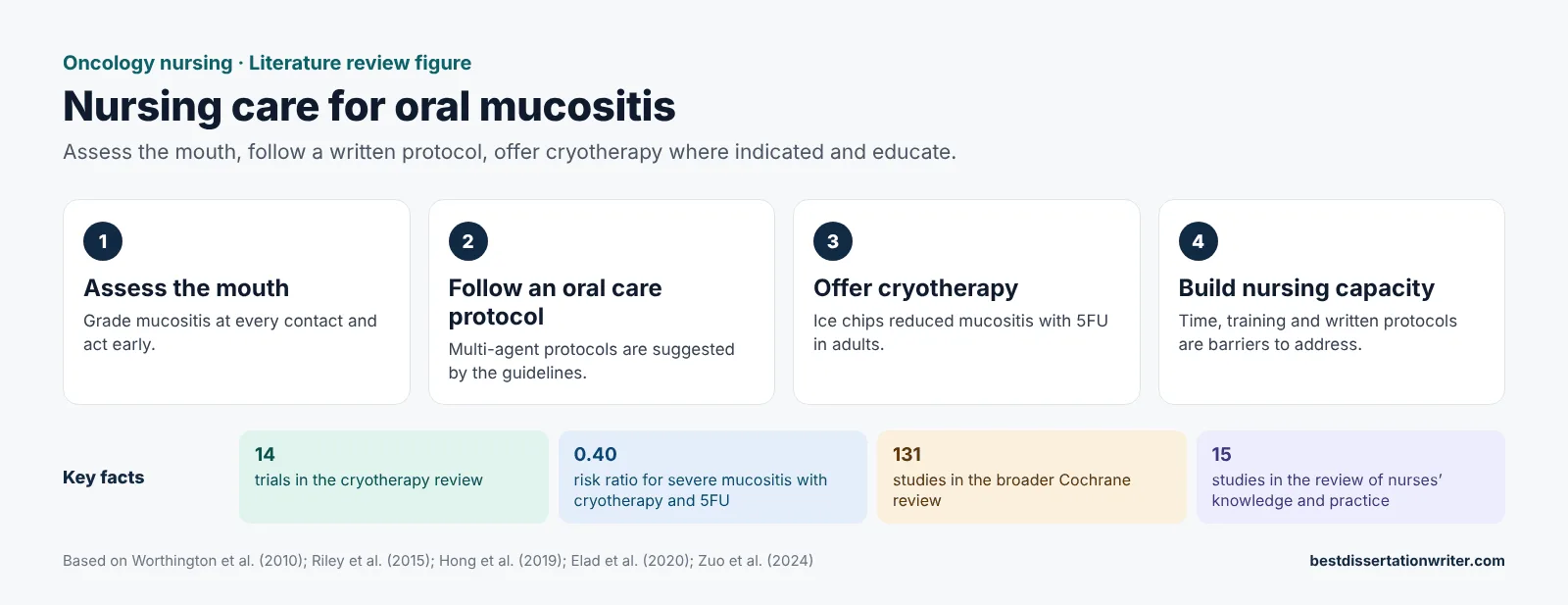
For practice, the evidence supports offering oral cryotherapy to eligible adults during 5FU infusions, using a written multi-agent oral care protocol, assessing the mouth with a validated scale at every contact, and avoiding chlorhexidine for prevention in head and neck radiotherapy. Nurses should also ask patients about eating, drinking and pain. Guidance and patient information are available from Macmillan Cancer Support and Cancer Research UK.
Patients and families also have a role, and the experiences described in the review of cancer carers show how much support at home influences the success of oral care routines. Managers should provide training, written protocols and enough staff time for oral assessment and care.
Future research should evaluate oral care protocols delivered by nurses in randomised or well-controlled studies, test cryotherapy in settings where evidence is currently insufficient, and examine children, for whom evidence from the main sources is limited. Studies that include patient-reported symptoms, adherence and cost would help services to decide which interventions to adopt, and implementation studies could show how to close the gap between guideline and everyday practice.
Conclusion
This systematic review found that oral cryotherapy and structured oral care protocols are the best-supported nursing interventions for the prevention of oral mucositis, although the evidence is strongest for particular treatments and certainty varies.
Nurses need knowledge, time and clear protocols to put the evidence into practice. With these, they can reduce the severity of a condition that affects comfort, nutrition and the ability to complete cancer treatment.
References
Elad, S., Cheng, K. K. F., Lalla, R. V., Yarom, N., Hong, C., Logan, R. M., Bowen, J., Gibson, R., Saunders, D. P., Zadik, Y., Ariyawardana, A., Correa, M. E., Ranna, V., Bossi, P., & Mucositis Guidelines Leadership Group of MASCC/ISOO. (2020). MASCC/ISOO clinical practice guidelines for the management of mucositis secondary to cancer therapy. Cancer, 126(19), 4423–4431. https://doi.org/10.1002/cncr.33100
Hong, C. H. L., Gueiros, L. A., Fulton, J. S., Cheng, K. K. F., Kandwal, A., Galiti, D., Fall-Dickson, J. M., Johansen, J., Ameringer, S., Kataoka, T., Weikel, D., Eilers, J., Ranna, V., Vaddi, A., Lalla, R. V., Bossi, P., & Elad, S. (2019). Systematic review of basic oral care for the management of oral mucositis in cancer patients and clinical practice guidelines. Supportive Care in Cancer, 27(10), 3949–3967. https://doi.org/10.1007/s00520-019-04848-4
Riley, P., Glenny, A.-M., Worthington, H. V., Littlewood, A., Clarkson, J. E., & McCabe, M. G. (2015). Interventions for preventing oral mucositis in patients with cancer receiving treatment: Oral cryotherapy. Cochrane Database of Systematic Reviews, 2016(1), Article CD011552. https://doi.org/10.1002/14651858.CD011552.pub2
Worthington, H. V., Clarkson, J. E., Bryan, G., Furness, S., Glenny, A.-M., Littlewood, A., McCabe, M. G., Meyer, S., & Khalid, T. (2010). Interventions for preventing oral mucositis for patients with cancer receiving treatment. Cochrane Database of Systematic Reviews, (12), Article CD000978. https://doi.org/10.1002/14651858.CD000978.pub4
Zuo, F., Li, T., Chen, Y., Wen, M., & Cao, H. (2024). Knowledge, attitudes, barriers and practices concerning cancer therapy-associated oral mucositis amongst oncology nurses: A mixed methods systematic review. Asia-Pacific Journal of Oncology Nursing, 11(8), Article 100542. https://doi.org/10.1016/j.apjon.2024.100542
Cite this example
Best Dissertation Writers (2026) Prevention and Management of Oral Mucositis in Patients Receiving Cancer Treatment: A Systematic Review. Available at: https://bestdissertationwriter.com/oral-mucositis-literature-review/
Best Dissertation Writers
Get expert help with your nursing literature review
Share your topic and deadline with Best Dissertation Writers and get support tailored to your module brief.