

Transformational Leadership and Its Impact on Nurse Job Satisfaction and Patient Outcomes: A Systematic Review
 By Dr. Robertson Prime, Research Fellow
Updated October 25, 2026
14 min read
About 2,800 words
In this review
Abstract
Background: Transformational leadership, in which leaders inspire a shared vision, support individual staff and encourage new thinking, is the most widely studied leadership style in nursing. Health systems facing shortages and burnout need to know whether the way nurse managers lead makes a measurable difference to nurses and patients.
Aim: This systematic review aimed to examine the relationship between this leadership style and nurses’ job satisfaction, wellbeing and patient outcomes.
Methods: Evidence was identified through targeted searches of openly accessible bibliographic records, publisher websites and the reference lists of key reviews. Five sources published between 2018 and 2023 were included: three systematic reviews, one review of reviews and one commissioned policy report, appraised with CASP checklists and synthesised narratively.
Findings: A review of 129 studies found that relational leadership was associated with higher nurse job satisfaction in 52 studies, while task-focused leadership was linked to lower satisfaction in 16. In a review of 12 studies, the transformational style was positively correlated with job satisfaction in 9 of 9 cases, compared with 4 of 8 for transactional leadership, and passive styles were negatively correlated. Effects on patient outcomes were less often studied and more mixed, with links to safety mainly operating through the work environment.
Conclusion: Relational, transformational styles of leadership consistently support nurses’ satisfaction and wellbeing. Organisations should develop these skills in nurse managers, while recognising that evidence for direct effects on patients remains limited.
Keywords: transformational leadership, job satisfaction, nurse managers
Introduction
This systematic review critically examines recent evidence on transformational leadership and its implications for nursing education and leadership.
Leadership is often described as one of the most important influences on the nursing workforce. Nurse managers shape the culture of their wards and units, decide how work is organised and determine whether staff feel heard, supported and valued. When leadership is poor, nurses may feel isolated, overloaded and powerless; when it is good, they may feel motivated, trusted and able to give high-quality care. Inquiries into failures of care in the United Kingdom have repeatedly identified leadership and culture as underlying causes.
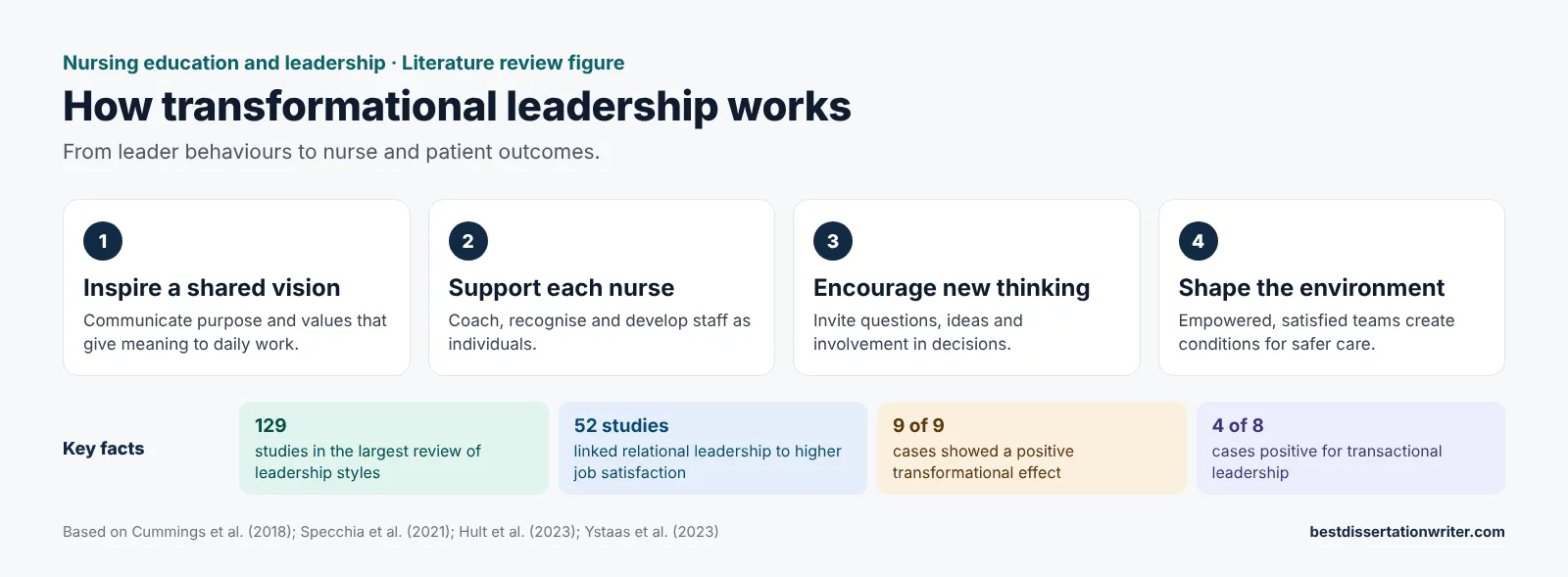
Among the many leadership theories applied to nursing, transformational leadership has received the most attention. Transformational leaders inspire staff with a shared vision, act as role models, encourage new ideas and pay attention to the needs and development of each individual. The style is often contrasted with transactional leadership, which relies on rewards and corrective action, and with passive or laissez-faire leadership, in which managers avoid decisions and responsibility.
A systematic approach was chosen because the field contains hundreds of primary studies and several systematic reviews, and bringing the most comprehensive reviews together gives a clearer picture than any single study. The review also considers what the evidence means for developing nurse managers in the United Kingdom, where leadership has been a recurring theme in national inquiries and workforce plans, and where many ward managers receive little formal preparation for the role.
Review question
What is the relationship between transformational leadership and nurses’ job satisfaction, wellbeing and patient outcomes?
Background to Transformational Leadership
The idea of transformational leadership originated in political and organisational studies and was developed into a measurable model with four components: idealised influence, in which leaders act as trusted role models; inspirational motivation, in which they communicate a compelling vision; intellectual stimulation, in which they encourage staff to question assumptions; and individualised consideration, in which they coach and support each person. These components are usually measured with questionnaires completed by staff about their manager.
In nursing research, transformational leadership is often grouped with other relational styles, such as authentic, resonant, servant and compassionate leadership, that emphasise relationships, values and staff wellbeing. These styles overlap, and critics argue that the boundaries between them are unclear. Task-focused styles, by contrast, concentrate on completing work, monitoring performance and meeting targets. Most nurse managers use a mix of behaviours, and effective leaders may adapt their style to the situation.
Leadership is thought to influence outcomes through several pathways. Leaders shape the work environment, including staffing, autonomy and teamwork; they affect nurses’ psychological experience of work, such as empowerment, engagement and burnout; and through these, they may influence the quality and safety of care. Understanding these pathways matters because it indicates where leadership development should focus and which outcomes can reasonably be expected to change.
Most studies measure leadership through questionnaires such as the Multifactor Leadership Questionnaire, in which staff rate how often their manager shows particular behaviours. This approach captures nurses’ perceptions, which matter in their own right, but it does not record what managers actually do. Ratings may also be coloured by nurses’ general feelings about their workplace. When interpreting research on transformational leadership, it is therefore important to remember that the evidence largely concerns perceived leadership rather than directly observed behaviour.
In the United Kingdom, a report for the King’s Fund (West et al., 2020) argued that compassionate leadership, which shares many features with transformational leadership, is essential for nurses’ wellbeing and for high-quality care. National leadership programmes for nurses draw on similar ideas. For organisations investing in these programmes, it is important to know how strong the evidence is and which outcomes it supports.
Search Strategy and Methods
Evidence for this example was identified through targeted searches of openly accessible bibliographic records, publisher websites and the reference lists of key reviews. Search terms combined keywords for the exposure (“transformational leadership”, “relational leadership”, “leadership style”, “nurse manager*”) with terms for outcomes (“job satisfaction”, “wellbeing”, “burnout”, “patient outcome*”, “patient safety”), joined with the Boolean operators AND and OR. A full systematic review for assessment would run the same strategy in CINAHL, ERIC, PubMed/MEDLINE and Scopus and report the number of records screened in a PRISMA flow diagram.
Sources were eligible if they examined the leadership style of nurse managers or nurse leaders in healthcare settings and reported nurse or patient outcomes. Because many primary studies already exist, systematic reviews and reviews of reviews were prioritised, together with a policy report relevant to the United Kingdom. Studies of leadership in other professions, and opinion pieces without evidence, were excluded. Where reviews grouped transformational leadership with other relational styles, their findings were included but interpreted with this overlap in mind.
Five sources published between 2018 and 2023 were included: three systematic reviews, one systematic review of reviews and one commissioned policy report (Table 1). Together the reviews drew on more than 160 primary studies. The quality of each source was appraised using the Critical Appraisal Skills Programme (CASP) checklist appropriate to its design, and findings were synthesised narratively and grouped into themes.
Key Findings on Transformational Leadership
Three themes were identified: the association between transformational leadership and nurses’ job satisfaction, the wider effects of relational leadership on wellbeing and the work environment, and the less certain evidence on patient outcomes. Table 1 summarises the included sources, and Figure 1 compares how often transformational and transactional styles were correlated with job satisfaction in one systematic review.
| Author, year | Design | Setting and sample | Key finding |
|---|---|---|---|
| Cummings et al. (2018) | Systematic review | 129 quantitative studies, 121 outcomes | Relational leadership linked to higher job satisfaction in 52 studies; task-focused to lower satisfaction in 16. |
| West et al. (2020) | Commissioned policy report | Nurses and midwives in the United Kingdom | Compassionate leadership and meeting needs for autonomy, belonging and contribution support wellbeing and care. |
| Specchia et al. (2021) | Systematic review | 12 studies of leadership style and nurse job satisfaction | Transformational style positive in 9 of 9 cases; transactional mixed; passive styles negative. |
| Hult et al. (2023) | Systematic review of reviews | 12 reviews, 85 outcomes | Transformational leadership most studied; relational styles beneficial; patient outcomes less reported. |
| Ystaas et al. (2023) | Systematic review | 23 studies of transformational leadership and work environment | Positive direct and mediated effects on work environment; patient outcome evidence weaker. |
Theme 1: Transformational Leadership and Job Satisfaction
Specchia et al. (2021) systematically reviewed 12 studies of leadership styles and nurses’ job satisfaction, selected from more than 11,000 titles. Most studies showed a significant correlation between leadership style and satisfaction. The transformational style showed a positive correlation in 9 of 9 cases. Authentic, resonant and servant styles were each positively correlated in the single study that examined them, while passive-avoidant and laissez-faire styles were negatively correlated in all cases.
Transactional leadership showed a more mixed picture. It was positively associated with satisfaction in 4 of 8 cases, showed no significant association in 3 and was negatively associated in 1. This suggests that clear expectations and recognition of good work, which are features of transactional leadership, can support nurses, but that they are less consistently beneficial than the relational and developmental behaviours of transformational leaders.
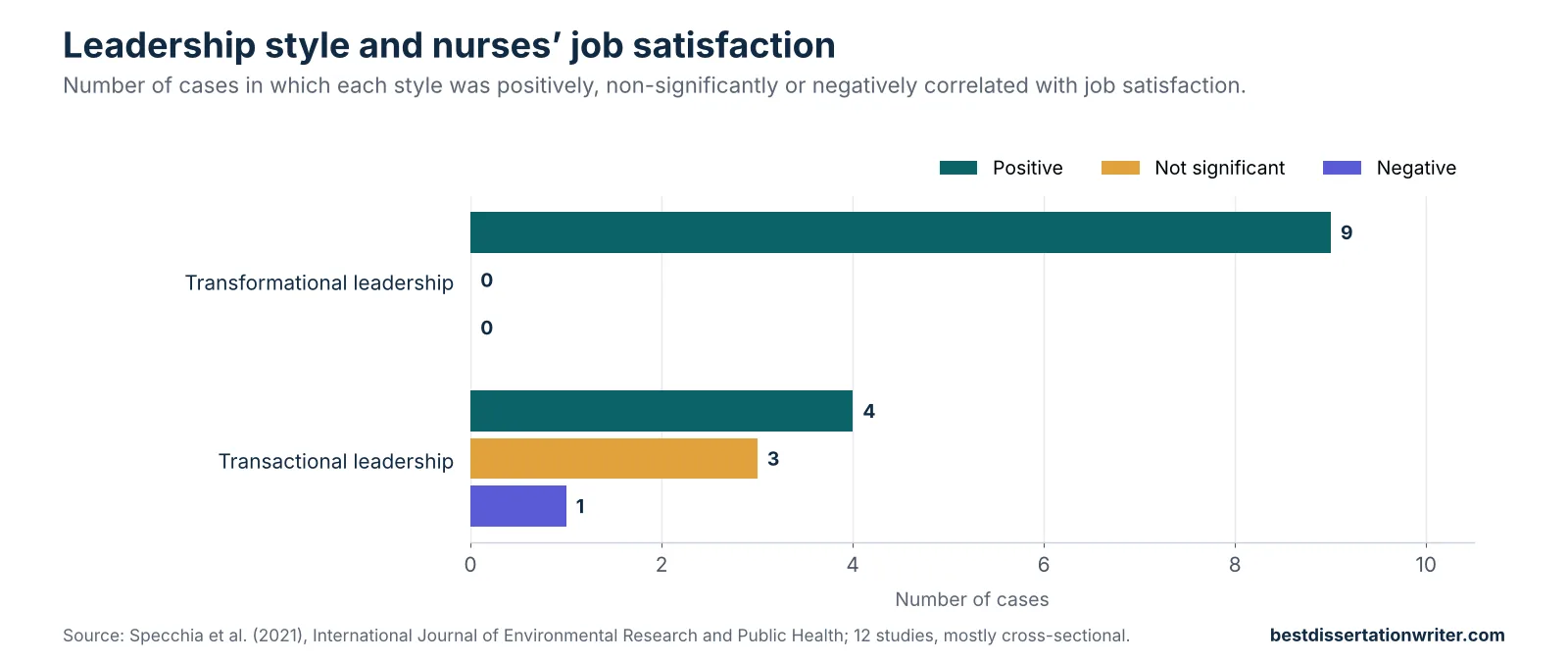
The review was relatively small, and almost all included studies were cross-sectional, so the direction of the relationship cannot be established. Satisfied nurses may rate their managers more positively, and both satisfaction and leadership ratings may reflect the wider culture of the organisation. Nevertheless, the consistency of the association across countries and settings supports the view that transformational leadership and job satisfaction are closely linked.
Theme 2: Relational Leadership, Wellbeing and the Work Environment
Cummings et al. (2018) conducted the most comprehensive review, including 129 quantitative studies and grouping 121 outcomes into six categories, from staff satisfaction and wellbeing to organisational environment and productivity. Relational leadership styles were associated with higher nurse job satisfaction in 52 studies, while task-focused leadership was associated with lower job satisfaction in 16 studies. Similar patterns were found in each outcome category, including staff health and wellbeing and relationships with work.
The authors concluded that leadership focused solely on completing tasks is insufficient to achieve optimal outcomes for the nursing workforce. Hult et al. (2023), in a review of 12 systematic reviews covering 85 outcomes, similarly found that transformational leadership was the most studied style and that extensive research supported the benefits of relational leadership for staff. They noted, however, that relational styles need clearer conceptual definitions and that destructive leadership was under-researched.
Ystaas et al. (2023) focused specifically on transformational leadership and the nursing work environment, including 23 studies. Transformational leadership influenced the work environment positively, both directly and through mediators such as structural empowerment, organisational commitment and job satisfaction, and several included studies linked it to reduced burnout. These mediating pathways help to explain how nurse managers’ behaviour translates into nurses’ day-to-day experience of work.
Theme 3: Patient Outcomes
Evidence linking this style of leadership directly to patient outcomes was weaker. Hult et al. (2023) found that staff outcomes were reported far more often than patient outcomes, and called for more research on how nurse leadership affects patients. Ystaas et al. (2023) reported that nurses in the included studies perceived their managers’ transformational behaviours as falling short of excellence, and highlighted weak reporting of adverse events and a culture of blame in some settings.
Where effects on patients were found, they appeared to operate through the work environment, for example by improving teamwork, safety climate and nurses’ willingness to report errors. This indirect pathway is plausible but harder to demonstrate, because patient outcomes are influenced by many factors beyond leadership. The evidence therefore supports a cautious claim: this style of leadership creates conditions in which safe care is more likely, rather than directly causing better patient outcomes.
Discussion
This review suggests that transformational and other relational leadership styles are consistently associated with higher job satisfaction and better wellbeing among nurses, while passive and task-focused styles are associated with poorer outcomes. The consistency of this pattern across a large number of studies, several systematic reviews and a review of reviews strengthens confidence that leadership style genuinely matters for the nursing workforce.
The strength of the evidence is limited by study design. Nearly all primary studies were cross-sectional surveys in which nurses rated both their manager and their own satisfaction, creating a risk of common-method bias. Few studies used longitudinal or intervention designs that could show whether developing transformational leadership skills changes outcomes over time. The overlap between relational styles also makes it difficult to identify which specific behaviours are responsible for the benefits observed.
The weaker evidence on patient outcomes deserves attention. Leadership programmes are often justified by claims that they improve patient safety, but the reviews found that patient outcomes were studied less often and with mixed results. This does not mean that leadership is unimportant for patients, since the pathways through staff wellbeing, retention and safety culture are well supported. It does mean that organisations should evaluate leadership development against nurse outcomes as well as patient outcomes, and avoid overstating direct effects.
There are also practical tensions. Nurse managers often have large spans of control, heavy administrative workloads and limited authority over staffing and budgets, which constrain their ability to act transformationally. Developing individual leaders without addressing these organisational conditions may have limited effect. Leadership development should therefore be accompanied by realistic management roles, supportive senior leadership and time for managers to be visible and available to their teams.
Education has a part to play. Leadership is often taught late in nursing careers, after nurses have already been promoted into management roles. Introducing the principles of transformational leadership in pre-registration and early career education, through reflection, coaching and supervised leadership of small teams, could prepare nurses to lead before they take formal posts. Postgraduate programmes for nurse managers could also give more attention to the evidence on relational leadership, helping managers to understand why their behaviour affects staff and how transformational leadership can be developed rather than assumed to be a fixed personal trait.
The evidence base has limitations. Most studies came from North America, Europe and Asia, and few examined leadership in community or social care settings. This review relied on openly accessible, English-language sources, drew mainly on systematic reviews rather than primary studies and did not involve independent double screening. Future research should use longitudinal and intervention designs, measure observed leadership behaviours, and test whether developing transformational leadership among nurse managers improves both staff and patient outcomes.
Implications of Transformational Leadership Evidence for Practice
For nursing organisations, the evidence supports selecting and developing nurse managers for relational skills such as listening, coaching, recognising staff and involving them in decisions, alongside management competence. Leadership programmes should include feedback from staff, coaching and opportunities to practise, and should be evaluated using measures of staff satisfaction, wellbeing and retention. Senior leaders should also model the behaviours they expect and give ward managers the time and authority to lead.
Practical steps for individual nurse managers include holding regular one-to-one conversations with staff, recognising good practice publicly, explaining the reasons behind decisions and inviting suggestions for improvement. Seeking anonymous feedback from the team can show how leadership is experienced, and acting visibly on that feedback builds trust. These behaviours are modest in cost but, according to the evidence reviewed here, closely linked to how satisfied and supported nurses feel at work.
Transformational leaders can support teams to adopt evidence-based practice by encouraging questioning and innovation, and their coaching approach is central to effective preceptorship for new staff. Because satisfaction and wellbeing influence whether nurses stay, leadership is closely linked to nurse retention, and the self-awareness and empathy described in research on emotional intelligence underpin many transformational behaviours.
Conclusion
This systematic review examined the relationship between transformational leadership and outcomes for nurses and patients. Transformational and other relational styles were consistently associated with higher job satisfaction and better wellbeing, while passive and task-focused styles were linked to poorer outcomes. Evidence for direct effects on patients was weaker and mainly indirect.
For nursing education and leadership, the message is that how nurse managers lead matters. Developing transformational leadership skills, supported by realistic roles and organisational backing, is a sound investment in the workforce, but its effects on patient care should be evaluated carefully rather than assumed.
References
Cummings, G. G., Tate, K., Lee, S., Wong, C. A., Paananen, T., Micaroni, S. P. M., & Chatterjee, G. E. (2018). Leadership styles and outcome patterns for the nursing workforce and work environment: A systematic review. International Journal of Nursing Studies, 85, 19–60. https://doi.org/10.1016/j.ijnurstu.2018.04.016
Hult, M., Terkamo-Moisio, A., Kaakinen, P., Karki, S., Nurmeksela, A., Palonen, M., Peltonen, L.-M., & Häggman-Laitila, A. (2023). Relationships between nursing leadership and organizational, staff and patient outcomes: A systematic review of reviews. Nursing Open, 10(9), 5920–5936. https://doi.org/10.1002/nop2.1876
Specchia, M. L., Cozzolino, M. R., Carini, E., Di Pilla, A., Galletti, C., Ricciardi, W., & Damiani, G. (2021). Leadership styles and nurses’ job satisfaction. Results of a systematic review. International Journal of Environmental Research and Public Health, 18(4), 1552. https://doi.org/10.3390/ijerph18041552
West, M., Bailey, S., & Williams, E. (2020). The courage of compassion: Supporting nurses and midwives to deliver high-quality care. The King’s Fund. https://www.kingsfund.org.uk/publications/courage-compassion-supporting-nurses-midwives
Ystaas, L. M. K., Nikitara, M., Ghobrial, S., Latzourakis, E., Polychronis, G., & Constantinou, C. S. (2023). The impact of transformational leadership in the nursing work environment and patients’ outcomes: A systematic review. Nursing Reports, 13(3), 1271–1290. https://doi.org/10.3390/nursrep13030108
Cite this example
Best Dissertation Writers (2026) Transformational Leadership and Its Impact on Nurse Job Satisfaction and Patient Outcomes: A Systematic Review. Available at: https://bestdissertationwriter.com/transformational-leadership-review/
Best Dissertation Writers
Get expert help with your nursing literature review
Share your topic and deadline with Best Dissertation Writers and get support tailored to your module brief.