Recognition and Assessment of Pain in Non-Verbal Patients with Learning Disabilities: A Systematic Review
 By Dr. Robertson Prime, Research Fellow
Updated October 12, 2026
16 min read
About 3,200 words
In this review
Abstract
Background: Pain is common among people with learning disabilities, yet non-verbal patients who cannot self-report are at particular risk of having pain missed, misread as behaviour or left untreated. Caregiver surveys suggest that around one in seven adults with learning disabilities lives with chronic pain, often for years.
Aim: This systematic review aimed to examine how pain is recognised and assessed in people with learning disabilities who cannot self-report, and what this means for learning disability nursing practice.
Methods: Evidence was identified through targeted searches of openly accessible bibliographic records, publisher websites and the reference lists of key reviews. Seven sources published between 2002 and 2025 were included: two instrument development studies, two caregiver-report or cross-sectional prevalence studies, a systematic review, a qualitative systematic review and a practice discussion paper, appraised with CASP checklists and synthesised thematically.
Findings: Caregivers reported chronic pain in 15.4% of 753 community-dwelling adults, and in a Dutch facility 85% of residents rated as being in pain had no analgesic prescription. A systematic review of 27 studies found that motor activity, facial activity, social-emotional indicators and non-verbal vocal expression were the most frequently reported pain behaviours, but no pain-specific pattern emerged. Observational pain tools such as the NCCPC-R (84% sensitivity at a cut-off of 7) and DisDAT help carers to document each person’s individual cues, although validation in adults remains limited.
Conclusion: Pain recognition for non-verbal patients depends on knowing the person’s baseline, using a validated observational tool and involving family carers. Nurses should treat behaviour change as a possible sign of pain and act on what they observe.
Keywords: non-verbal patients, pain recognition, observational pain tools
Introduction
This systematic review critically examines recent evidence on non-verbal patients and its implications for learning disability nursing practice.
Pain is one of the most common reasons people seek healthcare, and most patients can simply say that something hurts, where it hurts and how much. Many people with severe or profound learning disabilities cannot do this. They may have little or no speech, limited understanding of numbers or pictures, and physical conditions that change how they move and express themselves. For these non-verbal patients, pain may show only as a change in behaviour, sleep, eating or mood, which carers and professionals can easily miss or misinterpret.
The consequences of missed pain are serious. Untreated pain reduces quality of life, may lead to distress and behaviour that challenges, and can delay the diagnosis of conditions such as dental disease, constipation, fractures, reflux and cancer. When behaviour changes are attributed to the learning disability itself rather than to an underlying cause, the result is diagnostic overshadowing, a recognised contributor to poor outcomes. Pain recognition is therefore central to safe and equitable care for non-verbal patients.
Learning disability nurses work closely with people, their families and paid support staff, and they are often asked to help other professionals interpret behaviour. A systematic design was chosen so that prevalence studies, tool development research, systematic reviews and qualitative evidence could be identified, appraised and compared transparently.
Review question
How is pain recognised and assessed in non-verbal patients with learning disabilities who cannot self-report, how well do observational pain tools perform, and what are the implications for nursing?
Background to Non-Verbal Patients
Self-report is generally regarded as the gold standard for pain assessment, because pain is a subjective experience. Doody and Bailey (2017) noted that people with intellectual disability have the same chronic conditions as the general population but more physical and psychological comorbidities, which places them at higher risk of frequent or severe pain. Yet those with limited communication or cognitive ability may be unable to describe pain, so assessment must combine clinical knowledge, physical examination and careful observation of behaviour.
Non-verbal patients are not a single group. Some people use signs, symbols or gestures, some can indicate yes or no, and others communicate only through facial expression, sounds, posture and activity. Pain may also be expressed in unusual ways: a person may laugh, become withdrawn, self-injure or stop eating. Because these signs are individual and can have many causes, recognising pain requires knowledge of the person’s usual behaviour as well as general knowledge of pain.
Several structured observational pain tools have been developed to support this process. Some, such as the Non-communicating Children’s Pain Checklist-Revised (NCCPC-R), list behaviours that are scored to produce a total that indicates likely pain. Others, such as the Disability Distress Assessment Tool (DisDAT), help carers to record a person’s individual signs of contentment and distress so that changes can be recognised. Doody and Bailey (2017) observed that many tools exist but are often not well validated or widely used in practice.
Barney et al. (2020), writing for the International Association for the Study of Pain, concluded that although standardised tools for people with severe intellectual and developmental disabilities have been developed over the past decade, there is little evidence that clinical assessment or management has improved. This gap between the availability of tools and their routine use is an important context for understanding the care of non-verbal patients.
Search Strategy and Methods
Evidence for this example was identified through targeted searches of openly accessible bibliographic records, publisher websites and the reference lists of key reviews. Search terms combined keywords for the population (“learning disab*”, “intellectual disab*”, “non-verbal patients”, “communication difficulties”, “non-communicating”) with terms for pain and assessment (“pain”, “pain recognition”, “pain assessment”, “observational tool”, “distress”, “behavioural indicators”), joined with the Boolean operators AND and OR. A full systematic review for assessment would run the same strategy in CINAHL, PubMed/MEDLINE, PsycINFO, the Cochrane Library and Embase and report the number of records screened in a PRISMA flow diagram.
Sources were eligible if they reported the prevalence, recognition or assessment of pain in children or adults with learning or intellectual disabilities who have limited verbal communication, or the development and testing of observational pain or distress tools for this group. Systematic reviews, validation studies, large caregiver surveys, cross-sectional studies and qualitative syntheses were prioritised. Studies of people with dementia without a learning disability, and of self-report scales alone, were excluded, because the review focused on non-verbal patients. Studies that included both verbal and non-verbal patients were eligible where results for people with limited communication were discussed.
Seven sources published between 2002 and 2025 were included: two tool development and validation studies, one caregiver survey, one cross-sectional prevalence study, one systematic review of behavioural pain indicators, one qualitative systematic review and one practice discussion paper (Table 1). The quality of each source was appraised using the Critical Appraisal Skills Programme (CASP) checklist appropriate to its design, and findings were synthesised narratively into three themes.
Key Findings on Non-Verbal Patients
Three themes were identified: the extent of unrecognised and undertreated pain; the behavioural signs through which non-verbal patients express pain; and the performance and use of observational pain tools. Table 1 summarises the included sources, and Figure 1 brings together key percentages on pain prevalence, treatment and tool accuracy reported in the included studies.
| Author, year | Design | Setting and sample | Key finding |
|---|---|---|---|
| Breau et al. (2002) | Psychometric validation study | 71 caregivers of children aged 3–18 with severe cognitive impairment; Canada | NCCPC-R internally consistent and stable; score of 7 or more gave 84% sensitivity and up to 77% specificity. |
| Regnard et al. (2007) | Tool development and assessment study | Pilot with 16 carers and 8 patients; 56 carers used DisDAT with 25 patients; UK | Each person had a distinct pattern of distress cues; no cue was specific to pain; carers found DisDAT simple and useful. |
| Walsh et al. (2011) | Caregiver postal survey | 753 caregivers of community-dwelling adults with intellectual disability; Ireland | Chronic pain in 15.4%, lasting on average 6.3 years; more than 78% of those in pain upset or distressed by it. |
| Boerlage et al. (2013) | Cross-sectional study | 255 residents of a special care facility; the Netherlands | 18% rated as in pain; 85% of those in pain had no analgesic prescription. |
| de Knegt et al. (2013) | Systematic review | 27 studies (1992–2012) linking behaviour to pain in intellectual disability | Motor, facial, social-emotional and vocal indicators most reported; no pain-specific pattern identified. |
| Doody and Bailey (2017) | Practice discussion paper | Pain and pain assessment in people with intellectual disability | Higher risk of pain; many tools exist but are poorly validated and used; combine knowledge, assessment and observation. |
| Trainer et al. (2025) | Qualitative systematic review (meta-ethnography) | 7 qualitative studies of pain in adults with intellectual disability | Multiple causes of pain, individual expression and shared decision-making; few qualitative studies exist. |
Theme 1: Unrecognised and Undertreated Pain
Walsh et al. (2011) surveyed caregivers of community-dwelling adults with an intellectual disability in Ireland. Of 2,378 questionnaires sent, 753 were returned, a response rate of 31.6%. Caregivers reported chronic pain in 15.4% of service users, lasting on average 6.3 years. Pain was associated with cerebral palsy, physical disability and challenging behaviour, and more than 78% of caregivers said the person had become upset or distressed by pain. Most people with chronic pain saw a family doctor, and analgesics were the main treatment.
Interestingly, Walsh et al. (2011) found that communication ability and level of intellectual disability were not associated with reported pain. Because the data came from caregivers, this finding may reflect real equality of prevalence or, more worryingly, that pain in non-verbal patients is simply less often noticed. The low response rate also means that caregivers who were more aware of pain may have been more likely to reply, so the true prevalence remains uncertain.
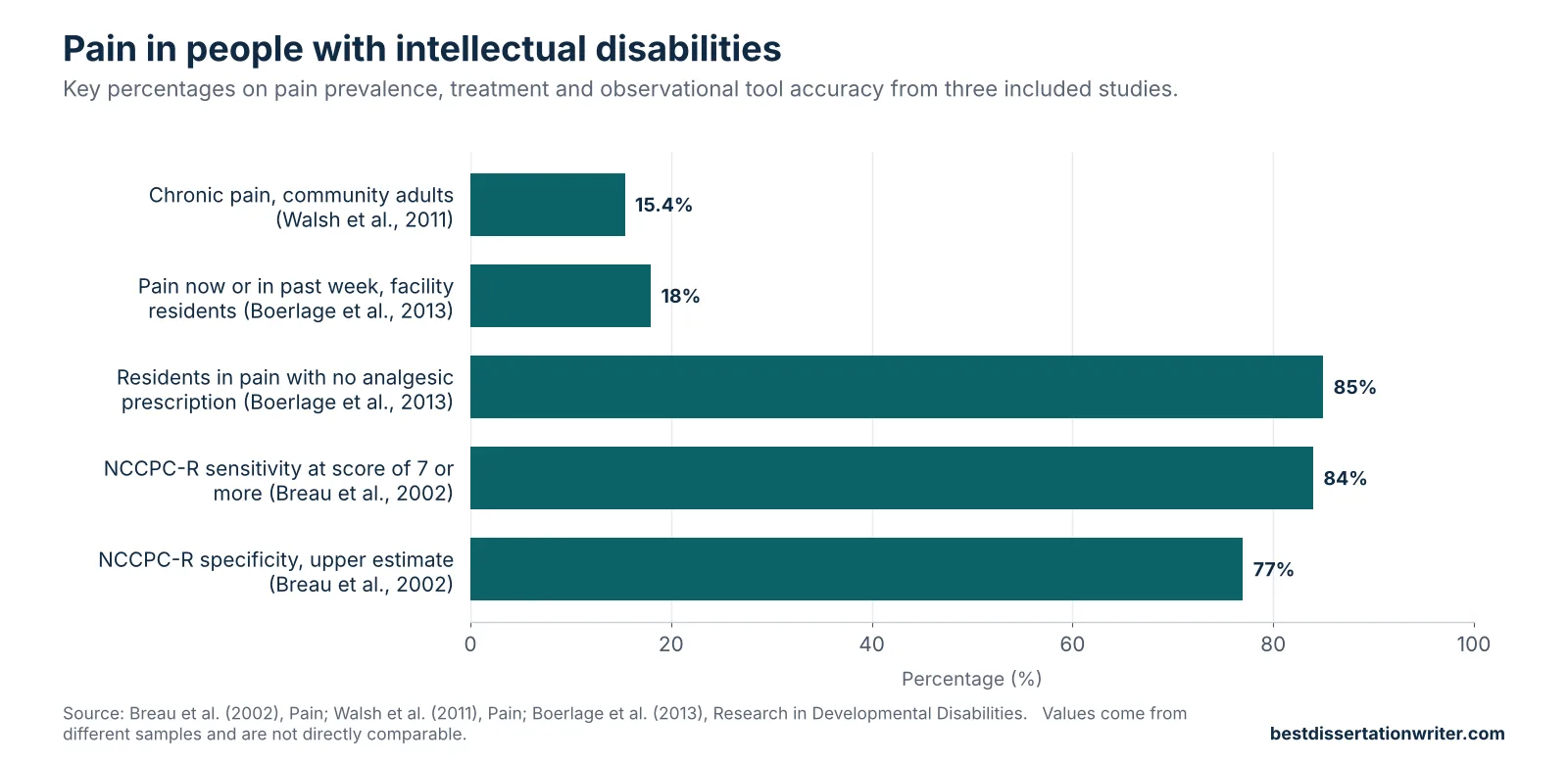
Boerlage et al. (2013) studied 255 residents of a Dutch special care facility. Caregivers rated 47 residents (18%) as having pain either at the time of assessment or during the previous week, and 14 of these 47 (30%) had pain on both occasions. Most strikingly, 85% of residents rated as being in pain had no analgesic prescription, including some with severe pain. The authors suggested that the prevalence of about one in five was lower than in other studies, possibly because caregivers underestimate pain, and they recommended a pain protocol with a validated measurement instrument.
Theme 2: How Non-Verbal Patients Express Pain
De Knegt et al. (2013) systematically reviewed 27 studies, published between 1992 and 2012, that linked observable behaviour to pain in people with intellectual disabilities. Of 14 categories of behavioural pain indicator, motor activity, facial activity, social-emotional indicators and non-verbal vocal expression were reported most often, and most indicators appeared in more than one study. However, a pain-specific behavioural pattern could not be identified. Most studies concerned acute pain, with only a few on chronic pain, which limits what is known about long-standing pain in non-verbal patients. The indicators nonetheless offer a useful starting list of behaviours for clinicians to observe.
The development of DisDAT provides complementary evidence. Regnard et al. (2007) piloted the tool with 16 carers and eight patients, and then 56 carers used it in routine practice with 25 patients, most with severe communication difficulties. Each person had a distinct pattern of distress cues, although some cues were shared, and there was no evidence that any cue pointed to a specific cause. Distress was understood to cover more than physical pain. The authors concluded that pain has no specific signs and that DisDAT gave carers evidence for their intuitive observations.
Trainer et al. (2025) used meta-ethnography to synthesise seven qualitative studies of pain in adults with intellectual disability. The findings described differing views on recognising the many causes of pain, individual differences in how pain is expressed and the decision-making involved in assessment and treatment. The small number of qualitative studies is itself a finding, showing that the voices of people with intellectual disabilities and their carers are still under-represented in pain research.
Theme 3: Observational Pain Tools and Pain Recognition in Practice
The NCCPC-R is one of the most thoroughly tested observational pain tools. Breau et al. (2002) asked 71 caregivers to observe children aged 3 to 18 years with severe cognitive impairments during a time of pain and a time without pain, and 55 completed a second set of observations. The checklist was internally consistent, related to caregivers’ ratings of pain intensity and stable over time. A score of 7 or more identified pain with 84% sensitivity and up to 77% specificity, meaning that most episodes of pain were detected, although some false positives occurred.
Tools of this kind have important limitations. The NCCPC-R was developed for children, and its use with adults relies on further validation. DisDAT does not produce a pain score; instead it documents the person’s individual cues, so it supports recognition of change rather than measurement of intensity. Doody and Bailey (2017) noted that many tools are not well validated or widely used, and Barney et al. (2020) reported little evidence that their introduction has improved clinical practice. For non-verbal patients, a tool is only as useful as the observation, knowledge and action that accompany it.
Both tools depend on people who know the individual well. DisDAT is built around carers’ knowledge of the person’s usual signs, and the NCCPC-R was validated with caregivers as observers. Regnard et al. (2007) found that different carers identified different cues, but the length of the carer’s relationship with the person did not affect how many cues were identified. This suggests that structured observation can help newer staff to recognise pain, provided that baseline information is recorded and shared.
Discussion
This review shows that pain is common among people with learning disabilities, including non-verbal patients, that it often goes unrecognised or untreated, and that recognising pain in non-verbal patients depends on observing individual changes in behaviour. The consistency between the caregiver survey, the facility study and the systematic review strengthens confidence that undertreatment is real and not an artefact of one setting.
A central tension concerns the role of observational pain tools. Generic behaviour checklists offer a structured, scorable approach with reported sensitivity and specificity, but the evidence from de Knegt et al. (2013) and Regnard et al. (2007) suggests that no single behaviour is specific to pain. Person-centred tools capture individual signs but do not produce a measure of severity. In practice, the two approaches may be complementary: a personal profile identifies a change, and a structured checklist helps to judge whether that change is likely to reflect pain.
The finding that 85% of residents rated as being in pain had no analgesic prescription (Boerlage et al., 2013) suggests that recognition alone is not enough. Pain must be documented, communicated to prescribers and reassessed after treatment. Barriers may include uncertainty about whether behaviour reflects pain, concern about side effects and the absence of clear pain protocols. For non-verbal patients who cannot confirm whether treatment has helped, a trial of analgesia with structured reassessment may itself be a useful diagnostic step.
Family carers and long-term support staff hold much of the knowledge needed for pain recognition, but their knowledge is often informal and may be lost when staff change or a person is admitted to hospital. Recording each person’s usual behaviour and known pain cues in a health passport or care plan can make this knowledge available to everyone involved. The qualitative synthesis by Trainer et al. (2025) also highlights that decision-making about pain is shared and sometimes contested, which reinforces the need for clear communication between carers and professionals.
This review has limitations. This review relied on openly accessible, English-language sources, did not involve independent double screening and included a small number of studies, several of them from single countries or settings. Tool validation evidence comes largely from children and from small samples, and prevalence estimates rely on caregiver report, which may underestimate pain. Future research should validate observational pain tools in adults across hospital and community settings, test whether their routine use improves analgesic treatment and outcomes, and involve people with learning disabilities and their families in design.
Implications of Non-Verbal Patients Evidence for Practice
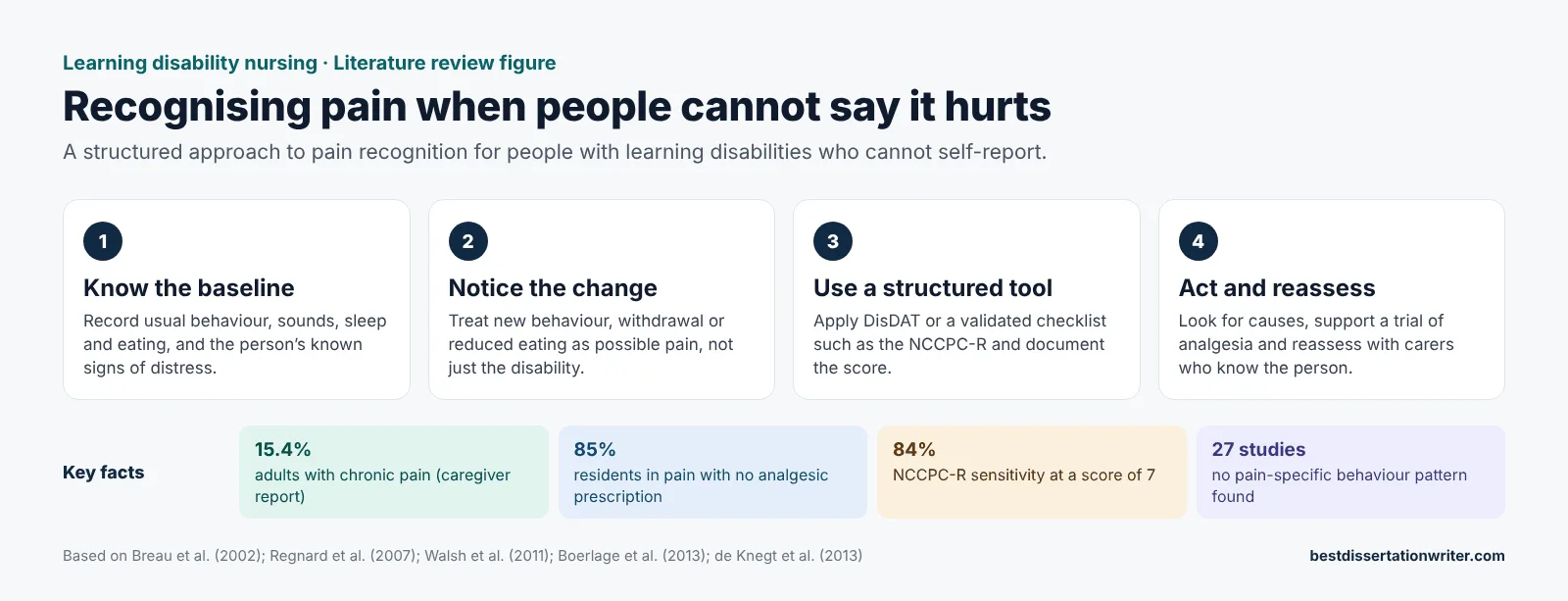
For learning disability nurses, the evidence supports a proactive, structured approach to pain. Each person who cannot self-report should have a baseline profile of their usual behaviour and known signs of distress, ideally using a tool such as DisDAT, and this should travel with them between services. When behaviour changes, nurses should consider pain first, use a validated observational checklist, examine for common causes and support a trial of analgesia with reassessment. Pain scores and responses to treatment should be documented so that patterns can be recognised over time.
Working in partnership with family carers is essential, because they often notice subtle changes before professionals do. Nurses can use the communication strategies that suit each person, and should challenge diagnostic overshadowing when distress is too readily attributed to the learning disability. Explaining bodily changes and comfort in accessible ways can also connect with wider health teaching, including sexual health education, so that people learn to show where they feel discomfort.
Conclusion
This systematic review examined how pain is recognised and assessed in people with learning disabilities who cannot self-report. Pain is common and often undertreated, it is expressed through individual changes in behaviour rather than a single pain-specific pattern, and observational pain tools can support recognition, although their validation in adults remains limited.
Good care for non-verbal patients depends on knowing the person, using structured observation, listening to carers and acting on what is observed. Learning disability nurses are well placed to lead this work and to ensure that pain in non-verbal patients is recognised, treated and reassessed in every setting.
References
Barney, C. C., Andersen, R. D., Defrin, R., Genik, L. M., McGuire, B. E., & Symons, F. J. (2020). Challenges in pain assessment and management among individuals with intellectual and developmental disabilities. Pain Reports, 5(4), e822. https://doi.org/10.1097/PR9.0000000000000822
Boerlage, A. A., Valkenburg, A. J., Scherder, E. J. A., Steenhof, G., Effing, P., Tibboel, D., & van Dijk, M. (2013). Prevalence of pain in institutionalized adults with intellectual disabilities: A cross-sectional approach. Research in Developmental Disabilities, 34(8), 2399–2406. https://doi.org/10.1016/j.ridd.2013.04.011
Breau, L. M., McGrath, P. J., Camfield, C. S., & Finley, G. A. (2002). Psychometric properties of the non-communicating children’s pain checklist-revised. Pain, 99(1–2), 349–357. https://doi.org/10.1016/S0304-3959(02)00179-3
de Knegt, N. C., Pieper, M. J. C., Lobbezoo, F., Schuengel, C., Evenhuis, H. M., Passchier, J., & Scherder, E. J. A. (2013). Behavioral pain indicators in people with intellectual disabilities: A systematic review. The Journal of Pain, 14(9), 885–896. https://doi.org/10.1016/j.jpain.2013.04.016
Doody, O., & Bailey, M. E. (2017). Pain and pain assessment in people with intellectual disability: Issues and challenges in practice. British Journal of Learning Disabilities, 45(3), 157–165. https://doi.org/10.1111/bld.12189
Regnard, C., Reynolds, J., Watson, B., Matthews, D., Gibson, L., & Clarke, C. (2007). Understanding distress in people with severe communication difficulties: Developing and assessing the Disability Distress Assessment Tool (DisDAT). Journal of Intellectual Disability Research, 51(4), 277–292. https://doi.org/10.1111/j.1365-2788.2006.00875.x
Trainer, A., Summers, S. J., & Bowman, A. (2025). The phenomenon of pain in adults with intellectual disability: A qualitative systematic review. Journal of Applied Research in Intellectual Disabilities, 38(4), e70093. https://doi.org/10.1111/jar.70093
Walsh, M., Morrison, T. G., & McGuire, B. E. (2011). Chronic pain in adults with an intellectual disability: Prevalence, impact, and health service use based on caregiver report. Pain, 152(9), 1951–1957. https://doi.org/10.1016/j.pain.2011.02.031
Cite this example
Best Dissertation Writers (2026) Recognition and Assessment of Pain in Non-Verbal Patients with Learning Disabilities: A Systematic Review. Available at: https://bestdissertationwriter.com/non-verbal-patients-literature-review/
Best Dissertation Writers
Get expert help with your nursing literature review
Share your topic and deadline with Best Dissertation Writers and get support tailored to your module brief.