Family-Integrated Care in Neonatal Units: A Systematic Review
 By Dr. Robertson Prime, Research Fellow
Updated October 17, 2026
14 min read
About 2,900 words
In this review
Abstract
Background: Family-integrated care is a model of neonatal care in which parents are supported to become the primary caregivers for their baby in the neonatal unit, with education, peer support and an environment that welcomes them. It extends family-centred care by making parents active partners rather than visitors.
Aim: This systematic review aimed to examine the effects of family-integrated care in neonatal units on infant and parent outcomes.
Methods: Evidence was identified through targeted searches of openly accessible bibliographic records, publisher websites and the reference lists of key reviews. Five sources published between 2018 and 2026 were included: two cluster randomised trials, a scoping review, an integrative review and a non-randomised controlled study, synthesised narratively.
Findings: A multinational cluster trial in 26 units found that family-integrated care improved infant weight gain, increased high-frequency exclusive breast milk feeding at discharge (70% compared with 63%) and reduced parental stress and anxiety. A trial in level II units in Canada shortened adjusted length of stay by 2.55 days. Reviews found positive effects on breastfeeding and parents’ mental health, and a recent study found better discharge readiness and fewer trauma symptoms in parents.
Conclusion: Neonatal nurses should support parents to provide as much of their baby’s care as possible, with structured education, peer support and inclusion in ward rounds.
Keywords: family-integrated care, parent participation, FICare
Introduction
This systematic review critically examines recent evidence on family-integrated care and its implications for neonatal nursing practice.
For many years, neonatal units were designed around technology and professional care. Parents were often treated as visitors, allowed to sit beside the incubator but rarely to touch, feed or care for their baby. As the importance of the parent-infant relationship became clearer, units moved towards family-centred care, which aims to respect families, share information and involve parents in decisions.
Family-integrated care, often abbreviated to FICare, goes further. Developed at Mount Sinai Hospital in Toronto, it is based on the idea that parents can be supported to become the primary caregivers of their baby in the neonatal unit, with nurses acting as teachers and coaches. Parents are expected to be present for much of the day, to provide most of the routine care, such as feeding, changing, temperature checks and comforting, and to take part in ward rounds and decisions.
This shift places neonatal nurses at the centre of the model. Nurses teach parents new skills, support them when they are anxious, adjust their own roles from doing to coaching, and judge when and how parents can safely take on more care. Family-integrated care therefore depends heavily on nursing attitudes, workload and unit culture.
A systematic review approach was chosen to bring together evidence from randomised trials and recent reviews, and to judge the strength and consistency of the findings across countries and types of unit.
Review question
What are the effects of family-integrated care in neonatal units on infant and parent outcomes?
Background to Family-Integrated Care
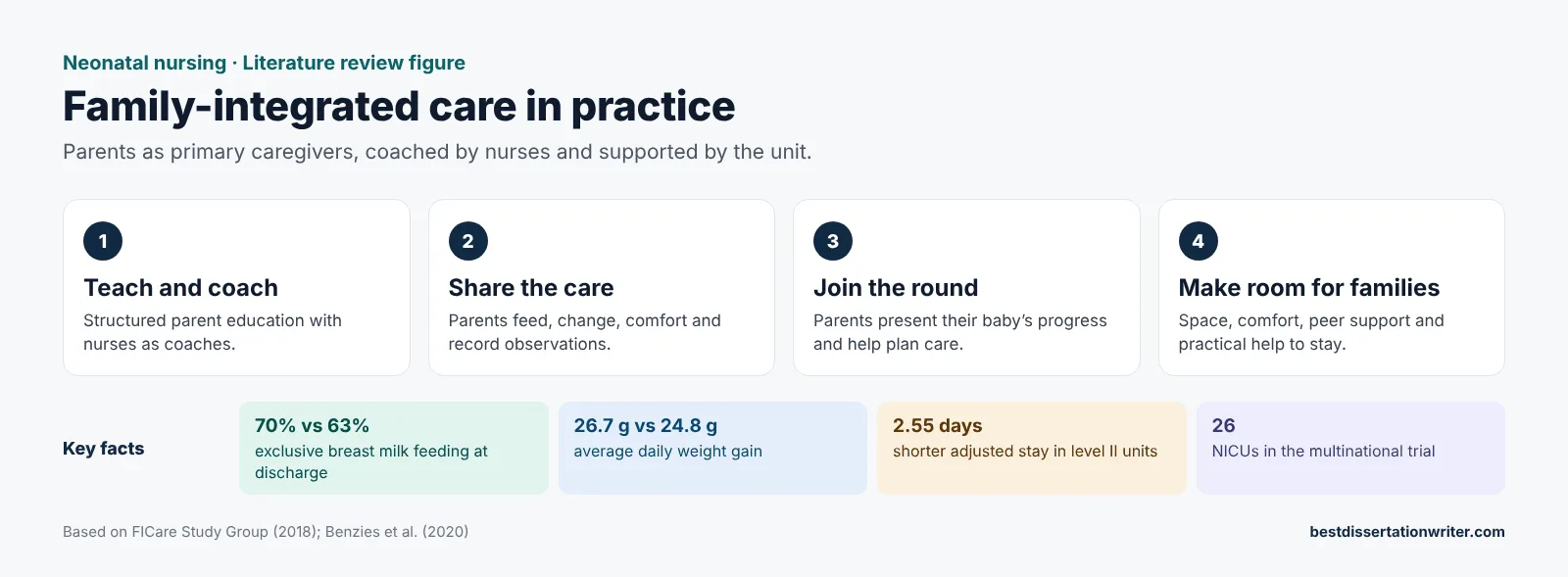
The original model has four main components, often called pillars. Staff education prepares nurses and other professionals to teach and support parents. Parent education provides structured sessions on topics such as feeding, development and preparing for discharge. Peer support brings experienced parents into the unit to share their knowledge and encouragement. Environmental changes, such as comfortable chairs, space for parents and open access, make it possible for parents to stay for long periods.
Parent participation is central to every component. Parents typically commit to being present for several hours a day, record observations about their baby, help to plan care and present their baby’s progress during ward rounds. Nurses remain responsible for clinical care, including medications and complex procedures, but share routine care with parents and coach them to develop confidence.
Variations of the model have been developed for different settings. Some units have adapted it for level II special care nurseries with moderate and late preterm infants, others have added mobile applications to support parent education, and some have integrated it with kangaroo care and breastfeeding support. In countries where parents traditionally have limited access to neonatal units, introducing the model may require major changes to policy and practice.
Several mechanisms may explain how family-integrated care could improve outcomes. Parents who provide care may feed more frequently, provide more breast milk, notice changes in their baby early and feel more confident at discharge. Reduced separation and a stronger sense of parenthood may also lower parental stress and anxiety, which in turn may support the baby’s development.
Parent participation also changes the relationship between families and staff. When parents are present on ward rounds and contribute their observations, decisions can draw on what parents notice about their baby’s behaviour and responses. Many parents value being listened to as experts on their own child, and nurses report that well-supported parents often recognise subtle changes early. Building this partnership takes time, consistency and mutual trust.
Search Strategy and Methods
Evidence for this example was identified through targeted searches of openly accessible bibliographic records, publisher websites and the reference lists of key reviews. Search terms combined keywords for the intervention (“family integrated care”, “FICare”, “family-centred care”, “parent participation”, “parent partnership”) with terms for the setting and outcomes (“neonatal intensive care”, “NICU”, “preterm”, “weight gain”, “breastfeeding”, “length of stay”, “parental stress”), joined with the Boolean operators AND and OR. A full systematic review for assessment would run the same strategy in CINAHL, PubMed/MEDLINE, the Cochrane Library and Embase and report the number of records screened in a PRISMA flow diagram.
Sources were eligible if they evaluated family-integrated care or closely related models in neonatal units and reported infant or parent outcomes. Randomised trials were prioritised, and reviews and a recent controlled study were included to capture evidence from different countries and outcomes such as breastfeeding and discharge readiness. Studies of general family-centred communication without parent caregiving were excluded.
Five sources published between 2018 and 2026 were included: two cluster randomised controlled trials, a scoping review, an integrative review and a non-randomised controlled study (Table 1). The quality of each source was considered using the Critical Appraisal Skills Programme (CASP) checklists, and findings were synthesised narratively.
Key Findings on Family-Integrated Care
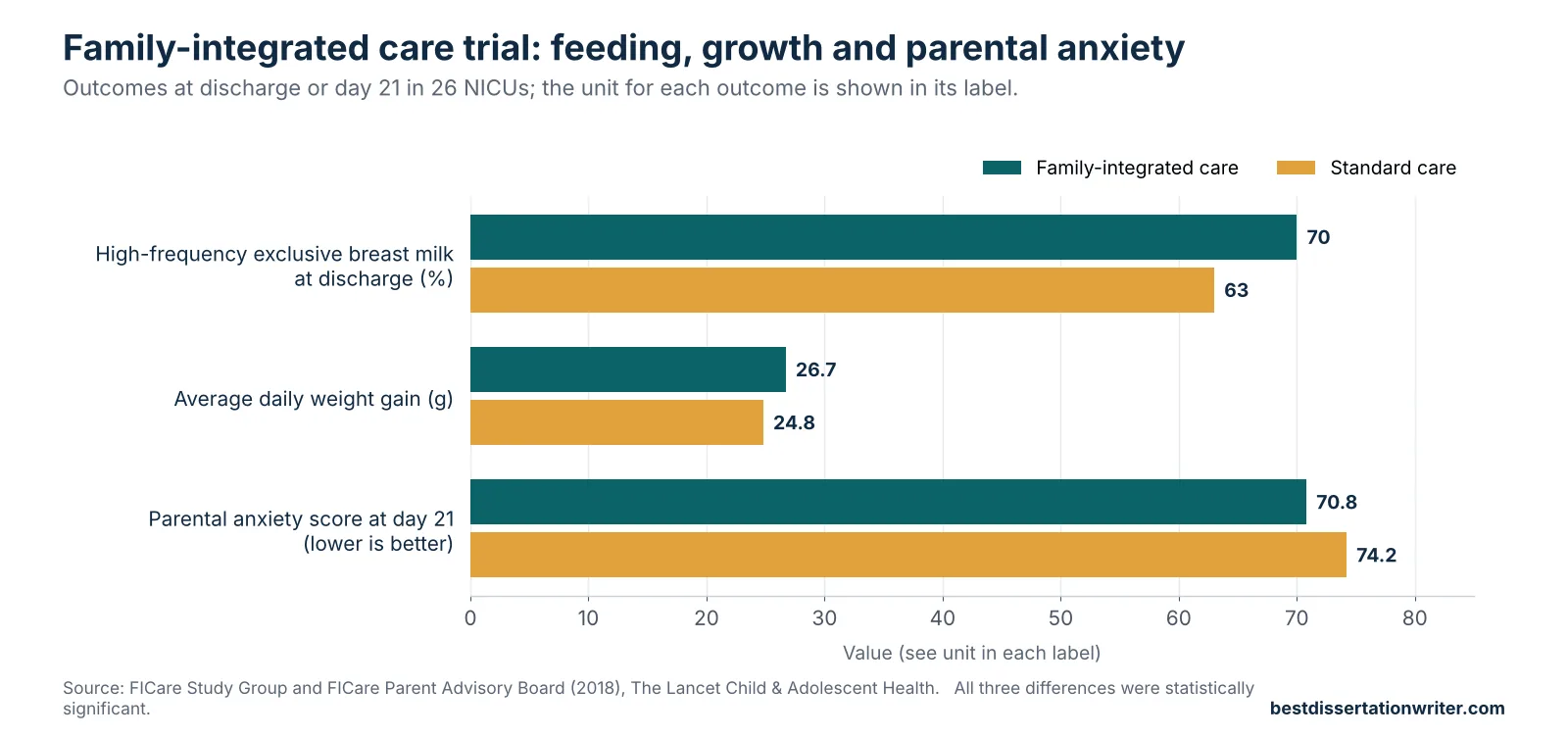
Three themes were identified: the effects of family-integrated care on infant outcomes, its effects on parents’ wellbeing and readiness for discharge, and the conditions needed for implementation. Table 1 summarises the included sources, and Figure 1 compares outcomes in the multinational trial.
| Author, year | Design | Setting and sample | Key finding |
|---|---|---|---|
| FICare Study Group and FICare Parent Advisory Board (2018) | Multinational cluster randomised controlled trial | 26 tertiary NICUs, Canada, Australia and New Zealand; infants ≤33 weeks | Greater weight gain; exclusive breast milk 70% vs 63%; lower parental stress and anxiety. |
| Benzies et al. (2020) | Pragmatic cluster randomised controlled trial | 10 level II NICUs, Alberta, Canada; infants 32–34 weeks | Adjusted length of stay 2.55 days shorter; no increase in readmissions. |
| Ding et al. (2023) | Scoping review | 11 studies of family-integrated care and breastfeeding | Positive effect on breastfeeding at discharge; components identified. |
| Yang and Zhang (2026) | Integrative review | Studies of family-centred and family-integrated care in NICUs | Benefits for growth, breastfeeding, stay and parental mental health; implementation needs training and resources. |
| Zhu et al. (2026) | Non-randomised controlled study | 84 families of infants 28–34 weeks, China | Better discharge readiness; fewer trauma and PTSD screens and lower anxiety and depression at 3 months. |
Theme 1: Family-Integrated Care and Infant Outcomes
A multicentre, multinational cluster randomised trial in 26 tertiary neonatal units in Canada, Australia and New Zealand compared family-integrated care with standard care for infants born at 33 weeks’ gestation or earlier who needed no more than low-level respiratory support (FICare Study Group and FICare Parent Advisory Board, 2018). Around 1,786 eligible infants were included. Infants in FICare units gained more weight, with a greater change in weight z-score at day 21 and an average daily gain of 26.7 g compared with 24.8 g.
High-frequency exclusive breast milk feeding at discharge was more common with FICare (70% compared with 63%). There were no significant differences in mortality, major morbidity, duration of oxygen therapy or length of stay, and no adverse events were reported, although a formal safety assessment was not completed. The authors described the model as an important advance in neonatal care but noted that long-term outcomes need further study.
A pragmatic cluster randomised trial in ten level II neonatal units in Alberta, Canada, tested a psychoeducational version of the model, Alberta FICare, for infants born at 32 to 34 weeks’ gestation (Benzies et al., 2020). After adjustment for site and infant risk factors, infants in the intervention group stayed 2.55 days less in hospital, without more readmissions or emergency visits. Feeding type at discharge and maternal distress did not differ significantly. The unadjusted difference in length of stay was not significant, and the trial was limited to one region.
The two trials therefore suggest that benefits may differ by setting and population. In tertiary units caring for very preterm infants, the main gains were in growth, breast milk feeding and parental wellbeing, while in level II units caring for larger babies, the main gain was a shorter stay. These differences may reflect the different needs of families and the different reasons babies remain in hospital.
Theme 2: Parents’ Wellbeing and Readiness for Discharge
In the multinational trial, parents in FICare units reported lower stress and anxiety at day 21 than parents in standard care units (FICare Study Group and FICare Parent Advisory Board, 2018). These findings support the idea that giving parents an active caregiving role can reduce the distress caused by separation and loss of the parenting role.
A non-randomised controlled study in a single hospital in China compared 42 families receiving family-integrated care with 42 receiving standard care for infants born at 28 to 34 weeks (Zhu et al., 2026). Parents in the intervention group were more ready for discharge and, three months after discharge, had fewer positive screens for trauma and post-traumatic stress and lower anxiety, depression and stress. Infants reached full enteral feeding earlier and had higher discharge weights. The small, non-randomised design means that these results should be interpreted cautiously.
An integrative review of studies of family-centred care and family-integrated care in neonatal units concluded that these models can speed infant growth, shorten hospital stays, improve breastfeeding and reduce parental stress and mental health problems (Yang and Zhang, 2026). The review noted inconsistent findings on early weight gain and highlighted the financial burden on families of spending long periods in hospital.
Theme 3: Breastfeeding and the Conditions for Implementation
A scoping review of 11 studies examined the effect of family-integrated care on breastfeeding among preterm infants (Ding et al., 2023). It found a positive effect on breastfeeding rates at discharge and identified the components used, including training for neonatal staff, parent education, parent participation in infant care and in medical plans, peer support, environmental support and mobile applications for parents. The review did not report pooled effect sizes, and the authors called for further studies.
The integrative review identified the conditions needed for implementation, including staff training, improved care environments and adaptation to regional culture and economic conditions (Yang and Zhang, 2026). Families need space, comfort and practical support, such as help with travel, accommodation and meals, if they are to spend many hours on the unit. Without these, the model may favour families who can afford to be present.
Together, these findings suggest that FICare is not a single intervention but a change in the culture and organisation of neonatal units. Its success depends on nurses’ willingness to share care, managers’ support for environmental changes and policies that make it possible for parents to stay. Where these conditions are met, the model appears to benefit both infants and parents.
Peer support deserves particular attention. Experienced parents who have been through a neonatal admission can offer practical advice and emotional understanding that staff cannot provide, and their presence can show new parents that their situation is survivable. Peer support programmes need training, supervision and clear boundaries, but they are relatively low in cost and are valued by many families.
Discussion
This review found that family-integrated care improves infant weight gain and breast milk feeding, may shorten length of stay in some settings, and reduces parental stress, anxiety and trauma symptoms while improving readiness for discharge. No harms were identified. The evidence includes large cluster trials, which strengthens confidence in the findings, although effects on length of stay and longer-term outcomes are less consistent.
For neonatal nurses, FICare represents a significant change in role. Rather than providing all care directly, nurses teach, coach and supervise parents, and share decisions with them. Some nurses may find this challenging, worrying about safety, losing their own skills or having less control. Staff education, clear guidance on which tasks parents can perform and support from leaders are therefore essential components of the model.
Equity is an important concern. The model assumes that parents can be present for many hours a day, which may be difficult for parents who live far away, have other children, need to return to work or face financial hardship. Units that adopt the model must consider how to support all families, for example through parental leave policies, travel and accommodation support, and flexible ways of participating.
The model also connects with other areas of neonatal care. Parents who provide care can contribute to infection prevention through hand hygiene, to thermal care through skin-to-skin contact and to developmental care by learning to read their baby’s cues. Integrating these elements into parent education may maximise the benefits for infants.
This review has limitations. The trials were conducted mainly in high-income countries and in infants who were relatively stable, the scoping and integrative reviews did not pool data, and the Chinese study was small and non-randomised. This review relied on openly accessible, English-language sources and did not involve independent double screening. Future research should examine long-term neurodevelopmental outcomes and how the model can be adapted for sicker infants and disadvantaged families.
Measuring the model’s implementation is also important. Units can record how many hours parents are present, which care tasks they perform, how often they attend ward rounds and how confident they feel at discharge. These data show whether the model is reaching all families and help nurses and managers to identify where extra support is needed.
Implications of Family-Integrated Care Evidence for Practice
Neonatal nurses should invite parents to provide routine care from early in the admission, teach them skills through structured education, include them in ward rounds and support peer support programmes. Units should provide space, comfort and practical help so that parents can be present. Family-integrated care builds on principles of family-centred care and can reduce parental stress.
Parent education should cover infection prevention, including measures to prevent late-onset sepsis, and thermal care, such as skin-to-skin contact that supports thermoregulation. Nurses should monitor how far parents are able to participate and adapt support for families facing barriers.
Finally, discharge planning should begin early. Parents who have been caring for their baby throughout the stay are usually better prepared to go home, but they still need clear information about feeding, warning signs, follow-up appointments and where to seek help in the first weeks at home, ideally with a named contact on the unit.
Conclusion
This systematic review examined the effects of family-integrated care in neonatal units. It improves infant weight gain and breast milk feeding, may shorten length of stay, and reduces parental stress, anxiety and trauma symptoms while improving discharge readiness, with no evidence of harm.
Family-integrated care recognises parents as their baby’s most important caregivers. Neonatal nurses are central to making it work, by teaching, coaching and supporting parents, and by advocating for the environment and policies that allow every family to take part.
References
Benzies, K. M., Aziz, K., Shah, V., Faris, P., Isaranuwatchai, W., Scotland, J., Larocque, J., Mrklas, K. J., Naugler, C., Stelfox, H. T., Chari, R., Soraisham, A. S., Akierman, A. R., Phillipos, E., Amin, H., Hoch, J. S., Zanoni, P., Kurilova, J., Lodha, A., & Alberta FICare Level II NICU Study Team. (2020). Effectiveness of Alberta Family Integrated Care on infant length of stay in level II neonatal intensive care units: A cluster randomized controlled trial. BMC Pediatrics, 20. https://doi.org/10.1186/s12887-020-02438-6
Ding, L., Chen, Y., Zhang, W., Song, J., Yao, X., Wan, Y., & Huang, R. (2023). Effect of family integrated care on breastfeeding of preterm infants: A scoping review. Nursing Open. https://doaj.org/article/630ed029b72b4de8913d7ddc691e3d33
FICare Study Group and FICare Parent Advisory Board. (2018). Effectiveness of Family Integrated Care in neonatal intensive care units on infant and parent outcomes: A multicentre, multinational, cluster-randomised controlled trial. The Lancet Child & Adolescent Health, 2(4), 245–254. https://doi.org/10.1016/S2352-4642(18)30039-7
Yang, R., & Zhang, X. (2026). Family-centered care in the NICU: An integrative literature review. Frontiers in Pediatrics, 14, 1826607. https://doi.org/10.3389/fped.2026.1826607
Zhu, Y., Jiang, Y., Hong, F., Song, L., & Yang, X. (2026). Psychological outcomes and discharge readiness of parents of preterm infants in China after family integrated care. Frontiers in Pediatrics, 14, 1653759. https://doi.org/10.3389/fped.2026.1653759
Cite this example
Best Dissertation Writers (2026) Family-Integrated Care in Neonatal Units: A Systematic Review. Available at: https://bestdissertationwriter.com/family-integrated-care-review-review/
Best Dissertation Writers
Get expert help with your nursing literature review
Share your topic and deadline with Best Dissertation Writers and get support tailored to your module brief.