Uptake and Effectiveness of Annual Health Checks for People with Learning Disabilities: A Systematic Review
 By Dr. Robertson Prime, Research Fellow
Updated October 12, 2026
15 min read
About 3,000 words
By Dr. Robertson Prime, Research Fellow
Updated October 12, 2026
15 min read
About 3,000 words
In this review
Abstract
Background: Annual health checks in primary care were introduced in England to address the unmet health needs and premature mortality of people with learning disabilities. Their value depends both on what a check achieves and on how many eligible people actually receive one.
Aim: This systematic review aimed to establish the uptake and effectiveness of annual health checks for people with learning disabilities and the factors that influence their implementation.
Methods: Targeted searches of openly accessible bibliographic records, publisher websites and the reference lists of key reviews identified six sources published between 2014 and 2025: two systematic or integrative reviews, a cluster randomised controlled trial, two cohort or natural experiment studies and a national NHS England report. Sources were appraised with CASP checklists and synthesised narratively.
Findings: A systematic review of 48 publications found that health checks consistently detect unmet and sometimes life-threatening health needs. In a national cohort, practices offering incentivised checks were more likely to record hearing assessments (odds ratio 24.0) and to identify obesity and thyroid disorder, and a natural experiment found fewer emergency admissions for ambulatory care sensitive conditions, although a practice nurse trial showed only modest gains in needs being met. NHS England reported that 74% of eligible people received a check in 2020/21, but implementation was hindered by limited time, resources and training and by people with learning disabilities not being identified on practice registers.
Conclusion: Health checks are a worthwhile reasonable adjustment, but their benefit depends on accurate registers, good follow-through on health action plans and well-prepared practice nurses. Learning disability and primary care nurses are central to improving both reach and quality.
Keywords: annual health checks, health screening, health check uptake
Introduction
This systematic review critically examines recent evidence on annual health checks and its implications for learning disability nursing practice.
People with learning disabilities have more long-term conditions, more sensory impairments and higher rates of epilepsy, obesity and mental ill health than the general population, yet many of these problems go unrecognised. A person may not be able to describe symptoms, may rely on carers who do not notice gradual changes, or may find surgeries noisy, rushed and confusing. Undetected illness then contributes to poor quality of life and to the premature deaths described in national mortality reviews. Annual health checks were designed to find these problems earlier, before they become emergencies.
Proactive health screening is one way of overcoming these barriers. Rather than waiting for a person to seek help, general practices in England are paid to invite adults and young people on their learning disability register for an annual review of their physical and mental health. Annual health checks are often carried out by practice nurses, sometimes jointly with a general practitioner, and learning disability nurses in community teams frequently help people and their families to prepare for and attend them.
A systematic approach was chosen so that a randomised trial, large cohort studies and published reviews could be weighed together. This matters because the scheme has expanded rapidly, and nurses need to know whether the effort invested in each check translates into better health or simply into more data being recorded.
Review question
How many eligible people receive annual health checks, how effective are they in detecting and addressing health needs, and what helps or hinders their delivery?
Background to Annual Health Checks
Published evaluations of health checks for people with learning disabilities date back to 1989 and come from several countries (Robertson et al., 2014). In England they became a national priority after Mencap’s report Death by Indifference and the independent inquiry into access to healthcare for people with learning disabilities, both of which described serious failures to recognise and treat illness. From 2008 general practices were offered payment to provide annual health checks to adults on their learning disability register, and the scheme was later extended to young people aged 14 and over.
A typical check includes a review of physical health, weight, blood pressure, vision, hearing, continence, epilepsy, medication, mental health and health promotion, followed by a health action plan agreed with the person and their supporters. The check is also a reasonable adjustment under the Equality Act 2010: longer appointments, easy read invitations, a familiar setting and the involvement of carers are intended to make health screening accessible to people who would otherwise struggle to use routine services.
The NHS Long Term Plan set the ambition that at least 75% of eligible people aged 14 and over should receive a check each year. Health check uptake has therefore become a key performance measure for clinical commissioning and integrated care systems. Yet uptake is only meaningful if the people who need checks are identified on practice registers and if needs found at the check are followed up. Annual health checks thus depend on accurate recording, good communication and coordinated care across primary and specialist services.
Search Strategy and Methods
Evidence for this example was identified through targeted searches of openly accessible bibliographic records, publisher websites and the reference lists of key reviews. Search terms combined keywords for the population (“learning disabilit*”, “intellectual disabilit*”) with terms for the intervention and outcomes (“annual health checks”, “health assessment”, “health screening”, “uptake”, “unmet needs”, “emergency admissions”), joined with the Boolean operators AND and OR. A full systematic review for assessment would run the same strategy in CINAHL, PubMed/MEDLINE, PsycINFO, the Cochrane Library and Embase and report the number of records screened in a PRISMA flow diagram.
Sources were eligible if they evaluated the uptake, outcomes or implementation of annual health checks or comparable structured health assessments for adults with learning disabilities in primary care. Systematic and integrative reviews, randomised trials, cohort studies using routine data and official national reports were prioritised. Studies of one-off screening for a single condition and opinion pieces were excluded.
Six sources published between 2014 and 2025 were included: one systematic review, one integrative review, one cluster randomised controlled trial, one longitudinal cohort study, one natural experiment and one national NHS England report on the uptake of annual health checks (Table 1). The quality of each source was appraised using the Critical Appraisal Skills Programme (CASP) checklist appropriate to its design, and findings were synthesised narratively and grouped into themes.
Key Findings on Annual Health Checks
Three themes were identified: the detection of unmet health needs; the effects of annual health checks on care processes and outcomes; and health check uptake and the barriers to implementation. Table 1 summarises the included sources, and Figure 1 presents the odds of key health actions and new diagnoses in practices that offered incentivised checks compared with practices that did not.
| Author, year | Design | Setting and sample | Key finding |
|---|---|---|---|
| Buszewicz et al. (2014) | Longitudinal cohort study (primary care database) | 8,692 patients in 222 incentivised practices vs 918 in 48 non-incentivised practices; England | More health actions and new diagnoses with checks (e.g. hearing OR 24.0; obesity OR 2.49); 40% with associated syndromes not on registers. |
| Cooper et al. (2014) | Cluster randomised controlled trial | 38 practices recruited in Scotland; 85 intervention and 67 standard care participants | Newly detected needs met 76.4% vs 72.6% (not significant); health monitoring needs met 69.9% vs 56.8% (OR 2.38). |
| Robertson et al. (2014) | Systematic review | 48 publications, 1989–2013, several countries | Health checks consistently detect unmet, sometimes life-threatening, needs and prompt targeted action. |
| Carey et al. (2017) | Natural experiment (cohort comparison) | 126 participating and 68 non-participating practices; 7,487 adults with intellectual disability, 46,408 controls | No change in overall emergency admissions; fewer ambulatory care sensitive admissions (IRR 0.74 practice level; 0.82 individual). |
| NHS England (2021) | National report of routine data | Eligible people aged 14 and over on learning disability registers, England, 2020/21 | 74% received an annual health check; ambition of at least 75% by 2023/24. |
| Breau et al. (2025) | Integrative review | 35 studies, 1996–2023; UK, Australia, Canada, Netherlands, New Zealand | 218 implementation factors (80 barriers, 138 facilitators); main barriers were time, resources and training. |
Theme 1: Detecting Unmet Health Needs
Robertson et al. (2014) updated an earlier systematic review of health checks for people with intellectual disabilities and identified 48 publications from 1989 to 2013, drawn from several countries and covering the full range of intellectual disability. Health checks consistently detected unmet health needs, including some life-threatening conditions, and led to targeted actions to address them. They also exposed gaps in health services and appeared to raise the awareness of health professionals and support staff about the health needs of this population.
The strength of this review lies in the consistency of its findings across countries, settings and decades. Its limitation is that most included studies were uncontrolled before-and-after designs that counted problems detected rather than measuring changes in health. The authors identified the cost-effectiveness and efficiency of checks as priorities for future research. Detection is a necessary first step, but it is not the same as improved health, and the evidence for the later steps is thinner.
Theme 2: Effects of Annual Health Checks on Care and Outcomes
Buszewicz et al. (2014) used a primary care database to compare 8,692 patients with intellectual disabilities in 222 practices that had opted into the incentivised scheme with 918 patients in 48 practices that had not. Incentivised practices carried out more blood tests, general health measurements, specific assessments and medication reviews, and made more health action plans and secondary care referrals. Hearing assessment showed the largest difference, with an odds ratio of 24.0, and medication reviews were more than twice as likely.
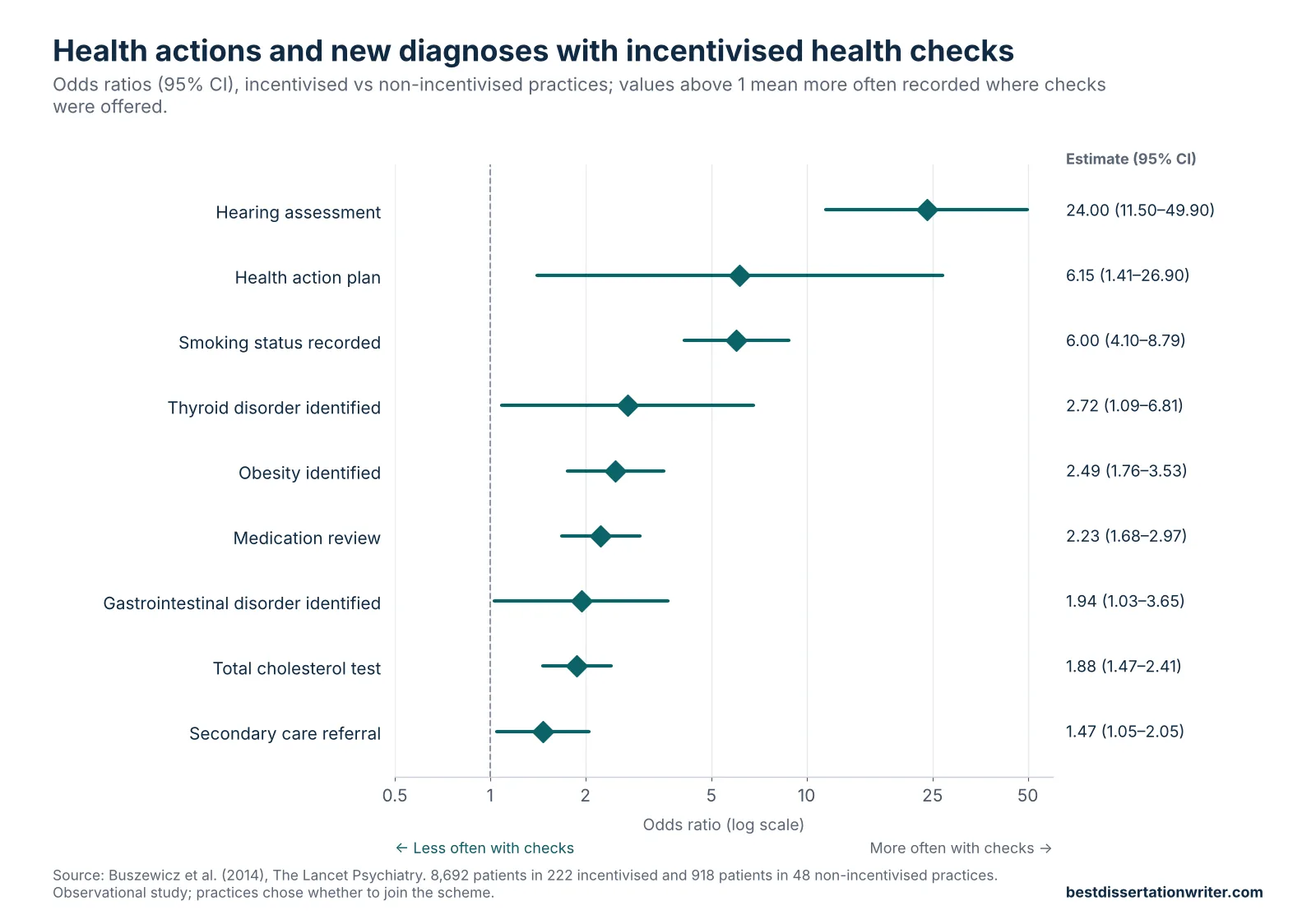
Identification rates were also higher in incentivised practices for thyroid disorder (odds ratio 2.72), gastrointestinal disorders (1.94) and obesity (2.49). However, the study was observational, so practices that chose to join the scheme may have differed in other ways from those that did not, and the wide confidence interval for health action plans (1.41 to 26.9) shows that some estimates were imprecise. The authors also found that 40% of patients with conditions usually associated with intellectual disability had no learning disability code and were therefore never invited.
Cooper et al. (2014) tested practice nurse health checks in a cluster randomised controlled trial that recruited 38 general practices in Scotland. At nine months, the proportion of newly detected health needs that were met was 76.4% in the intervention group and 72.6% with standard care, a difference that was not statistically significant (odds ratio 1.73, 95% confidence interval 0.93 to 3.22). Health monitoring needs were, however, significantly more likely to be met (69.9% versus 56.8%; odds ratio 2.38). This rigorous but small trial suggests that the benefits of checks are real but more modest than uncontrolled studies imply.
Carey et al. (2017) examined whether checks reduce emergency hospital admissions using a natural experiment comparing 126 practices that fully participated in the scheme with 68 that did not, and 7,487 adults with intellectual disability matched to 46,408 controls. Annual health checks did not change overall emergency admissions, but they were associated with fewer emergency admissions for ambulatory care sensitive conditions, with an incidence rate ratio of 0.74 at practice level and 0.82 at individual level. These are conditions such as asthma, diabetes and epilepsy, where timely primary care should prevent crises.
Theme 3: Health Check Uptake and Barriers to Implementation
National data show that uptake rose substantially as the scheme matured. Breau et al. (2025) report that 52% of adults known to their general practitioner as having an intellectual disability received a check in 2017 to 2018. NHS England (2021) reported that 74% of eligible people aged 14 and over on the learning disability register received an annual health check in 2020/21, close to the Long Term Plan ambition of 75%. Health check uptake, however, measures only checks recorded for people already on registers, so it can overstate true coverage.
In an integrative review of 35 primary studies from five high-income countries, Breau et al. (2025) mapped 218 factors influencing the implementation of annual health assessments onto the Consolidated Framework for Implementation Research, of which 80 were barriers and 138 were facilitators. Facilitators included professionals’ belief that checks identify unmet needs and provide more comprehensive care. The most frequent barriers were insufficient time, lack of resources or funding and lack of training. Most factors related to physicians and other health professionals, while relatively few were drawn from carers or people with intellectual disabilities themselves.
Together, these findings suggest that health check uptake is shaped by registers, workforce capacity and professional confidence as much as by individual willingness to attend. The missing register entries identified by Buszewicz et al. (2014) are particularly important, because people who are not recorded as having a learning disability are excluded from both the checks and the uptake statistics. Improving identification is therefore as important as encouraging attendance at annual health checks.

Discussion
This systematic review shows that annual health checks reliably uncover unmet health needs, increase health monitoring and appear to prevent some avoidable emergency admissions. Uptake in England has risen to around three in four eligible people. The evidence therefore supports the scheme as a worthwhile reasonable adjustment, although the size of its benefits varies with study design.
A clear tension runs through the evidence. Observational studies such as Buszewicz et al. (2014) report large differences in health actions, whereas the randomised trial by Cooper et al. (2014) found that the main gain was in health monitoring rather than in meeting newly detected needs. One explanation is selection: practices that volunteer for incentive schemes may already be more organised. Another is that checks detect problems efficiently but follow-up, referral and treatment remain the weak link, which echoes the finding from Robertson et al. (2014) that detection does not automatically lead to better health.
The reduction in emergency admissions for ambulatory care sensitive conditions reported by Carey et al. (2017) is encouraging because it links annual health checks to an outcome that matters to patients and services. However, overall emergency admissions did not change, and natural experiments cannot fully exclude differences between participating and non-participating practices. Long-term outcomes such as mortality, quality of life and the person’s own experience of the check have rarely been measured, so it remains uncertain how far checks narrow health inequalities over the life course.
The implementation evidence highlights an equity problem within the scheme itself. Breau et al. (2025) found that barriers such as lack of time and training cluster within practices, while Buszewicz et al. (2014) showed that many people with syndromes associated with learning disability were not on registers. High headline uptake of annual health checks may therefore conceal groups who are never invited, such as people with mild learning disabilities living independently or people from minority ethnic communities. A narrow focus on targets risks rewarding the number of checks completed rather than their quality.
This review has limitations. This review relied on openly accessible, English-language sources, included a small number of studies and did not involve independent double screening. Most evidence came from the United Kingdom and from routine data with incomplete recording. Future research should use randomised or well-controlled designs to test the quality and follow-up of checks, involve people with learning disabilities and carers in defining outcomes and measure effects on avoidable deaths and health-related quality of life.
Implications of Annual Health Checks Evidence for Practice
For practice nurses and learning disability nurses, the evidence supports a focus on the whole pathway rather than the single appointment. Nurses can help practices to check registers against known diagnoses such as Down syndrome, send easy read invitations, offer longer or quieter appointments and prepare people through pre-check questionnaires and familiarisation visits. Accessible communication strategies help people to report symptoms, while awareness of diagnostic overshadowing prevents new problems being dismissed as part of the learning disability. Good therapeutic communication skills build trust with people and carers, and health action plans should be followed up so that conditions such as type 2 diabetes are monitored and treated.
Learning disability nurses in community teams can provide training and support to primary care staff, address the gaps in time and confidence identified by Breau et al. (2025), and audit whether actions recorded in health action plans are completed. Commissioners and practice leads should measure the quality and follow-through of health screening as well as the number of checks delivered.
Conclusion
This systematic review found that annual health checks for people with learning disabilities detect unmet needs, increase health monitoring and may reduce preventable emergency admissions, and that uptake has risen to around three quarters of those eligible. The strength of the evidence is limited by observational designs, modest trial effects and incomplete registers.
Annual health checks are most effective when people are correctly identified, supported to attend and followed up after the check. Nurses in primary care and learning disability services are well placed to make each check accessible, thorough and connected to ongoing care, so that each check becomes a real route to better health rather than a box to tick.
References
Breau, G., Tiwari, R., Ravindran, S., & Bakker-van Gijssel, E. (2025). Implementation of annual health assessments for adults with intellectual disabilities: An integrative review. Journal of Policy and Practice in Intellectual Disabilities, 22(2), e70010. https://doi.org/10.1111/jppi.70010
Buszewicz, M., Welch, C., Horsfall, L., Nazareth, I., Osborn, D., Hassiotis, A., Glover, G., Chauhan, U., Hoghton, M., Cooper, S.-A., Moulster, G., Hithersay, R., Hunter, R., Heslop, P., Courtenay, K., & Strydom, A. (2014). Assessment of an incentivised scheme to provide annual health checks in primary care for adults with intellectual disability: A longitudinal cohort study. The Lancet Psychiatry, 1(7), 522–530. https://doi.org/10.1016/S2215-0366(14)00079-0
Carey, I. M., Hosking, F. J., Harris, T., DeWilde, S., Beighton, C., Shah, S. M., & Cook, D. G. (2017). Do health checks for adults with intellectual disability reduce emergency hospital admissions? Evaluation of a natural experiment. Journal of Epidemiology and Community Health, 71(1), 52–58. https://doi.org/10.1136/jech-2016-207557
Cooper, S.-A., Morrison, J., Allan, L. M., McConnachie, A., Greenlaw, N., Melville, C. A., Baltzer, M. C., McArthur, L. A., Lammie, C., Martin, G., Grieve, E. A. D., & Fenwick, E. (2014). Practice nurse health checks for adults with intellectual disabilities: A cluster-design, randomised controlled trial. The Lancet Psychiatry, 1(7), 511–521. https://doi.org/10.1016/S2215-0366(14)00078-9
NHS England. (2021, June). Three in four people with a learning disability receive NHS annual health check [News release]. https://www.england.nhs.uk/2021/06/three-in-four-people-with-a-learning-disability-receive-nhs-annual-health-check/
Robertson, J., Hatton, C., Emerson, E., & Baines, S. (2014). The impact of health checks for people with intellectual disabilities: An updated systematic review of evidence. Research in Developmental Disabilities, 35(10), 2450–2462. https://doi.org/10.1016/j.ridd.2014.06.007
Cite this example
Best Dissertation Writers (2026) Uptake and Effectiveness of Annual Health Checks for People with Learning Disabilities: A Systematic Review. Available at: https://bestdissertationwriter.com/annual-health-checks-literature-review/
Best Dissertation Writers
Get expert help with your nursing literature review
Share your topic and deadline with Best Dissertation Writers and get support tailored to your module brief.