Kangaroo Mother Care and Its Effects on Neonatal and Maternal Outcomes: A Systematic Review
 By Dr. Robertson Prime, Research Fellow
Updated October 17, 2026
14 min read
About 2,800 words
In this review
Abstract
Background: Kangaroo mother care combines continuous skin-to-skin contact between a parent and a small or preterm baby with breastfeeding support and early discharge with follow-up. It is one of the most widely recommended interventions for low birthweight and preterm infants, and nurses and midwives are central to its delivery.
Aim: This systematic review aimed to examine the effects of kangaroo mother care on neonatal and maternal outcomes.
Methods: Evidence was identified through targeted searches of openly accessible bibliographic records, publisher websites and the reference lists of key reviews. Five sources published between 2016 and 2025 were included: a Cochrane review, a meta-analysis, a multicountry randomised trial, a meta-analysis of parental outcomes and a Cochrane review of skin-to-skin contact in healthy newborns, synthesised narratively.
Findings: Compared with conventional care, kangaroo mother care reduced mortality at discharge (risk ratio 0.60), severe infection and hypothermia, and increased breastfeeding. Starting it immediately after birth, before stabilisation, reduced 28-day mortality from 15.7% to 12.0% in infants weighing 1.0 to 1.799 kg. Mothers had fewer depressive symptoms (risk ratio 0.76) and lower stress and anxiety. In healthy newborns, early skin-to-skin contact increased breastfeeding at one to four months.
Conclusion: Neonatal nurses should make kangaroo mother care the default for stable small and preterm infants, start it as early as possible and support parents to provide it for as many hours as they can.
Keywords: kangaroo mother care, preterm infants, skin-to-skin, neonatal outcomes
Introduction
This systematic review critically examines recent evidence on kangaroo mother care and its implications for neonatal nursing practice.
Babies born too early or too small face a high risk of death and illness in the first weeks of life. They lose heat quickly, are vulnerable to infection, struggle to feed and often need prolonged care in a neonatal unit. Around the world, prematurity and low birthweight remain leading causes of neonatal death, and many survivors face long-term health and developmental problems.
Kangaroo mother care (KMC) was developed in Bogotá, Colombia, in the late 1970s as a response to overcrowded neonatal units and a shortage of incubators. The baby, wearing only a nappy and a hat, is placed upright on the mother’s bare chest, held in place by a wrap, and kept there for as many hours a day as possible. The approach also promotes exclusive breastfeeding and early discharge with close follow-up. What began as an alternative to incubator care is now recommended for small and preterm babies in all settings.
Nurses and midwives are central to KMC. They decide when babies are stable enough to begin, position babies safely, monitor them during skin-to-skin contact, support breastfeeding, and encourage and reassure parents. Their attitudes and the way neonatal units are organised strongly influence how often and for how long parents provide skin-to-skin care.
A systematic review approach was chosen to bring together the strongest evidence from Cochrane reviews, meta-analyses and a large randomised trial, and to judge how far the findings apply to neonatal nursing practice.
Parents of babies in neonatal units often describe feeling like visitors, separated from their baby by an incubator and unsure how to help. Holding their baby skin-to-skin can transform this experience, allowing parents to comfort, feed and get to know their child. Understanding the evidence helps nurses to explain to parents why their presence and touch matter, and to advocate for unit policies that make prolonged contact possible.
Review question
What are the effects of kangaroo mother care on neonatal and maternal outcomes?
Background to Kangaroo Mother Care
Kangaroo mother care is usually described as having three components. The first is skin-to-skin contact, ideally continuous and prolonged, between the baby and the mother or another caregiver. The second is exclusive or near-exclusive breastfeeding. The third is early discharge from hospital in the kangaroo position with adequate support and follow-up. Units differ in how fully they implement each component.
Several mechanisms may explain the benefits. Skin-to-skin contact keeps the baby warm through the parent’s body heat, stabilises breathing and heart rate, and exposes the baby to the mother’s skin bacteria rather than hospital organisms. Close contact promotes milk production and breastfeeding, and parents become more confident and attuned to their baby’s cues. Reduced stress for both baby and parent may also support growth and development.
Kangaroo mother care can be continuous, lasting for most of the day and night, or intermittent, lasting one or more hours at a time. Traditionally, it was started only once babies were clinically stable, which could take several days. More recent research has tested starting skin-to-skin contact immediately after birth, even before babies are fully stable, with the mother and baby cared for together in a combined unit.
In many high-income neonatal units, the term skin-to-skin care is used for shorter sessions of contact, while kangaroo mother care refers to the fuller model. Both depend on staff support, private and comfortable space, recliner chairs and policies that welcome parents at the bedside around the clock. For preterm infants on respiratory support or with lines and tubes, transfers to and from the parent’s chest require skill and teamwork.
Fathers and other family members can also provide skin-to-skin contact, which allows mothers to rest, recover from birth or attend to other children. Including fathers recognises their role and may support their bonding with the baby, although most research has focused on mothers. Units that encourage both parents to take part can increase the total hours of contact a baby receives each day.
Search Strategy and Methods
Evidence for this example was identified through targeted searches of openly accessible bibliographic records, publisher websites and the reference lists of key reviews. Search terms combined keywords for the intervention (“kangaroo mother care”, “kangaroo care”, “skin-to-skin contact”) with terms for the population and outcomes (“preterm”, “low birthweight”, “newborn”, “mortality”, “sepsis”, “hypothermia”, “breastfeeding”, “maternal depression”), joined with the Boolean operators AND and OR. A full systematic review for assessment would run the same strategy in CINAHL, PubMed/MEDLINE, the Cochrane Library and Embase and report the number of records screened in a PRISMA flow diagram.
Sources were eligible if they examined the effects of KMC or skin-to-skin contact on neonatal or parental outcomes, using randomised trials or systematic reviews. Reviews and large trials were prioritised because they provide the most reliable estimates of effect. A Cochrane review of skin-to-skin contact in healthy term newborns was included to show the wider value of skin-to-skin contact beyond small babies.
Five sources published between 2016 and 2025 were included: two Cochrane systematic reviews, a meta-analysis of neonatal outcomes, a meta-analysis of parental outcomes and a multicountry randomised controlled trial (Table 1). The quality of each source was considered using the Critical Appraisal Skills Programme (CASP) checklists, drawing on the certainty ratings reported by the reviews, and findings were synthesised narratively.
Key Findings on Kangaroo Mother Care
Three themes were identified: the effects of kangaroo mother care on survival and illness, the benefits of starting it immediately after birth, and its effects on breastfeeding and on mothers. Table 1 summarises the included sources, and Figure 1 shows the main effects on neonatal and maternal outcomes.
| Author, year | Design | Setting and sample | Key finding |
|---|---|---|---|
| Boundy et al. (2016) | Systematic review and meta-analysis | 124 studies, including observational studies | KMC associated with 36% lower mortality (RR 0.64), less sepsis (RR 0.53), hypothermia (RR 0.22) and readmission (RR 0.42). |
| Conde-Agudelo and Díaz-Rossello (2016) | Cochrane systematic review | 21 trials, 3,042 low birthweight infants | Mortality at discharge RR 0.60; sepsis RR 0.35; hypothermia RR 0.28; more breastfeeding and growth. |
| WHO Immediate KMC Study Group (2021) | Multicountry randomised controlled trial | 3,211 infants 1.0–1.799 kg, five hospitals in Africa and India | Immediate KMC: 28-day mortality 12.0% vs 15.7% (RR 0.75); trial stopped early. |
| Pathak et al. (2023) | Systematic review and meta-analysis | 30 trials, 7,719 preterm or low birthweight infants | Fewer maternal depressive symptoms (RR 0.76, high certainty); lower stress and anxiety; better bonding. |
| Moore et al. (2025) | Cochrane systematic review | 46 trials, 3,850 healthy mothers and newborns | Early skin-to-skin contact increased breastfeeding at 1–4 months (RR 1.24) and exclusive breastfeeding. |
Theme 1: Kangaroo Mother Care, Survival and Neonatal Outcomes
A Cochrane review of 21 randomised trials involving 3,042 low birthweight infants compared kangaroo mother care with conventional neonatal care, mostly after babies had been stabilised (Conde-Agudelo and Díaz-Rossello, 2016). At discharge or 40 to 41 weeks’ postmenstrual age, KMC reduced mortality (risk ratio 0.60), nosocomial infection or sepsis (risk ratio 0.35) and hypothermia (risk ratio 0.28). At the latest follow-up, mortality (risk ratio 0.67) and severe infection (risk ratio 0.50) remained lower, and babies gained more weight, length and head circumference.
A broader meta-analysis of 124 studies, including observational studies, reached similar conclusions (Boundy et al., 2016). Among low birthweight newborns, KMC was associated with 36% lower mortality (risk ratio 0.64), less neonatal sepsis (risk ratio 0.53), hypothermia (risk ratio 0.22) and hypoglycaemia (risk ratio 0.12), and fewer hospital readmissions (risk ratio 0.42). It was also associated with lower respiratory rates and pain scores and with higher oxygen saturation and temperature.
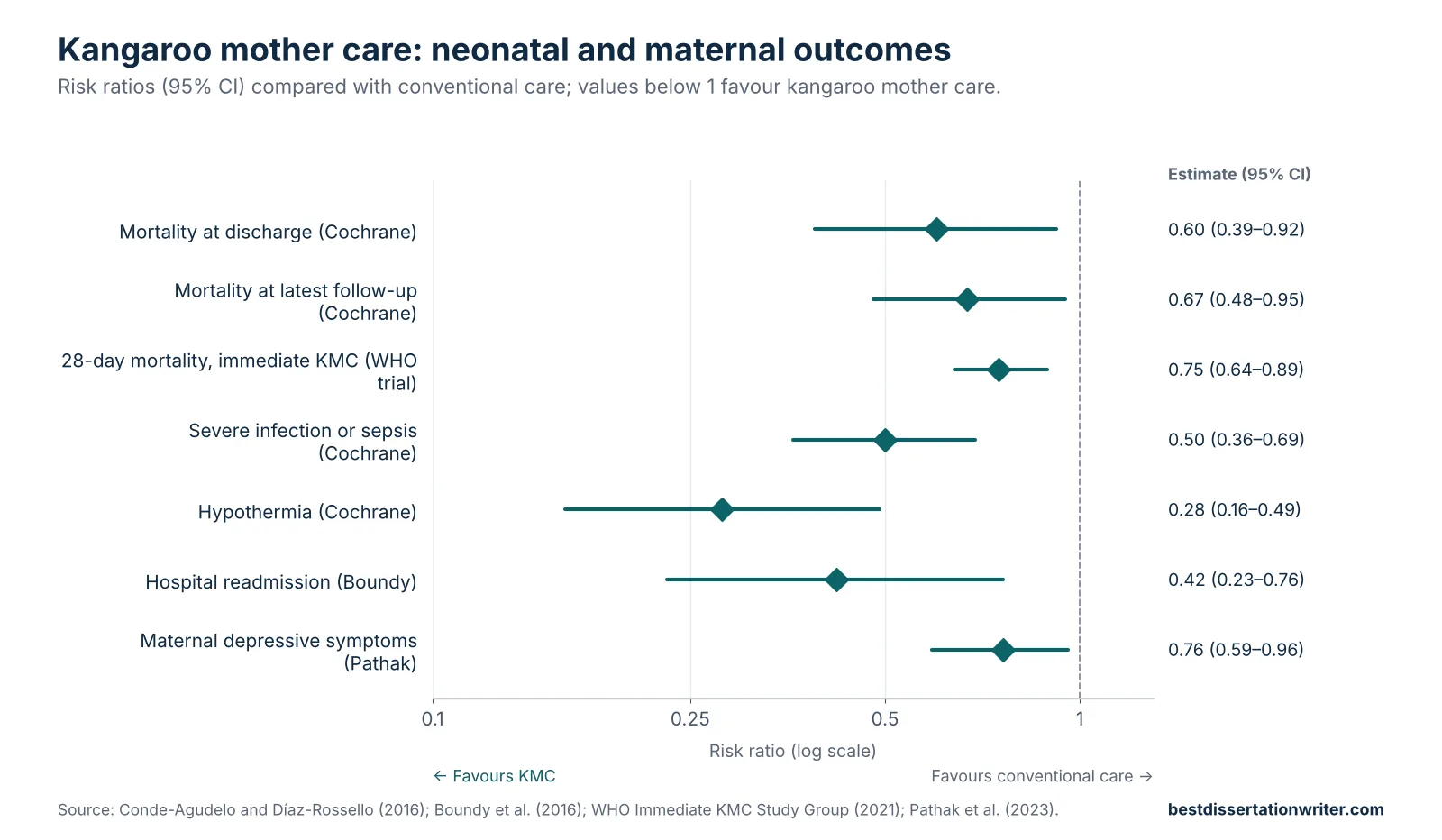
Most trials in the Cochrane review were conducted in low- and middle-income countries, where the alternative was often limited incubator care. The effects may be smaller in well-resourced units with advanced technology, although the physiological benefits of skin-to-skin contact, such as temperature stability and breastfeeding, are likely to apply everywhere. The certainty of evidence for several outcomes was moderate, and many trials could not blind participants.
Theme 2: Starting Skin-to-Skin Contact Immediately After Birth
A multicountry randomised trial in five hospitals in Ghana, India, Malawi, Nigeria and Tanzania enrolled 3,211 infants weighing 1.0 to 1.799 kg (WHO Immediate KMC Study Group, 2021). Infants in the intervention group received continuous skin-to-skin contact immediately after birth, with mother and baby cared for together, while control infants received conventional care in an incubator or under a radiant warmer until they were stable, followed by kangaroo mother care.
Neonatal death in the first 28 days occurred in 12.0% of the immediate group and 15.7% of the control group (risk ratio 0.75), and the trial was stopped early because of the reduction in mortality. The difference in deaths in the first 72 hours was smaller and not statistically significant. The trial challenged the traditional practice of waiting for stabilisation and showed that skin-to-skin contact can be part of the care of unstable small babies.
For neonatal nurses, this trial has significant implications. Caring for mother and baby together, with the baby on the mother’s chest while receiving monitoring and treatment, requires changes to the design of units, staffing models and nursing skills. It also requires mothers to be supported to stay with their babies, which may involve care for the mother’s own recovery after birth in the same space.
Implementing immediate KMC in other settings will require careful evaluation. The trial was conducted in hospitals in sub-Saharan Africa and India, where conventional care for unstable small babies may have been limited. Whether the same reduction in mortality would occur in high-income units is uncertain, but the trial shows that early skin-to-skin contact is feasible and safe when babies are monitored and staff are trained.
Theme 3: Breastfeeding and Benefits for Mothers
KMC increased breastfeeding in the Cochrane review, with more babies exclusively breastfed at discharge (risk ratio 1.16) and at one to three months (risk ratio 1.20) (Conde-Agudelo and Díaz-Rossello, 2016). In healthy term newborns, a Cochrane review of 46 trials found that immediate or early skin-to-skin contact increased breastfeeding at one to four months (risk ratio 1.24) and exclusive breastfeeding up to six months, with moderate-certainty evidence (Moore et al., 2025). Infants also had higher blood glucose.
A meta-analysis of 30 trials involving 7,719 preterm or low birthweight infants examined the effects of KMC on parents (Pathak et al., 2023). Mothers who provided KMC had fewer moderate to severe postpartum depressive symptoms (risk ratio 0.76, high certainty), and lower stress and anxiety and stronger mother-infant attachment, although these outcomes were supported by low-certainty evidence. Limited evidence suggested improved father-infant interaction, but no clear effect on fathers’ depression or stress.
These maternal benefits are important. Mothers of small and preterm babies are at high risk of depression and anxiety, and KMC gives them a central, active role in their baby’s care. For nurses, recognising these benefits strengthens the case for supporting parents to spend long periods in skin-to-skin contact, even in units where technology appears to make it less necessary.
Discussion
This review found consistent evidence that kangaroo mother care reduces mortality, infection and hypothermia in low birthweight infants, improves growth and breastfeeding, and benefits mothers’ mental health. Starting skin-to-skin contact immediately after birth further reduced deaths in small babies in low- and middle-income settings. These findings support KMC as standard care rather than an optional extra.
The evidence also highlights a gap between knowledge and practice. Despite strong recommendations, many babies receive little skin-to-skin contact, often because of staff concerns about safety, lack of space and chairs, restrictive visiting, or parents’ need to return home to other children or work. Nurses’ confidence in transferring babies with tubes and lines, and unit cultures that see parents as visitors rather than partners, also limit uptake.
Applying the findings in high-income neonatal units requires care. The trials compared KMC with limited conventional care in many cases, and the absolute benefits may be smaller where incubators and intensive care are readily available. However, outcomes such as breastfeeding, maternal depression and parental confidence are relevant in every setting, and there is no evidence that skin-to-skin contact is harmful when babies are monitored and positioned safely.
Safety remains an important consideration. Babies should be positioned with the airway clear, monitored as their condition requires and observed by staff, particularly if the parent is tired or sedated after a caesarean birth. Clear guidance on positioning, transfers and monitoring, together with training for nurses, can help to ensure that KMC is both safe and frequent.
This review has limitations. Many of the included trials were conducted in low- and middle-income countries, several outcomes were supported by low-certainty evidence, and the review of healthy term newborns addressed skin-to-skin contact rather than full kangaroo mother care. This review relied on openly accessible, English-language sources and did not involve independent double screening. Future research should examine how to scale up KMC in high-income units and its long-term effects on development.
Measuring practice is a useful starting point for improvement. Units can record how many hours of skin-to-skin contact each baby receives, how soon after birth it begins and what barriers parents report. Sharing these data with staff and parents, alongside training in safe transfers and positioning, can help to increase the amount of contact babies receive.
Implications of Kangaroo Mother Care Evidence for Practice
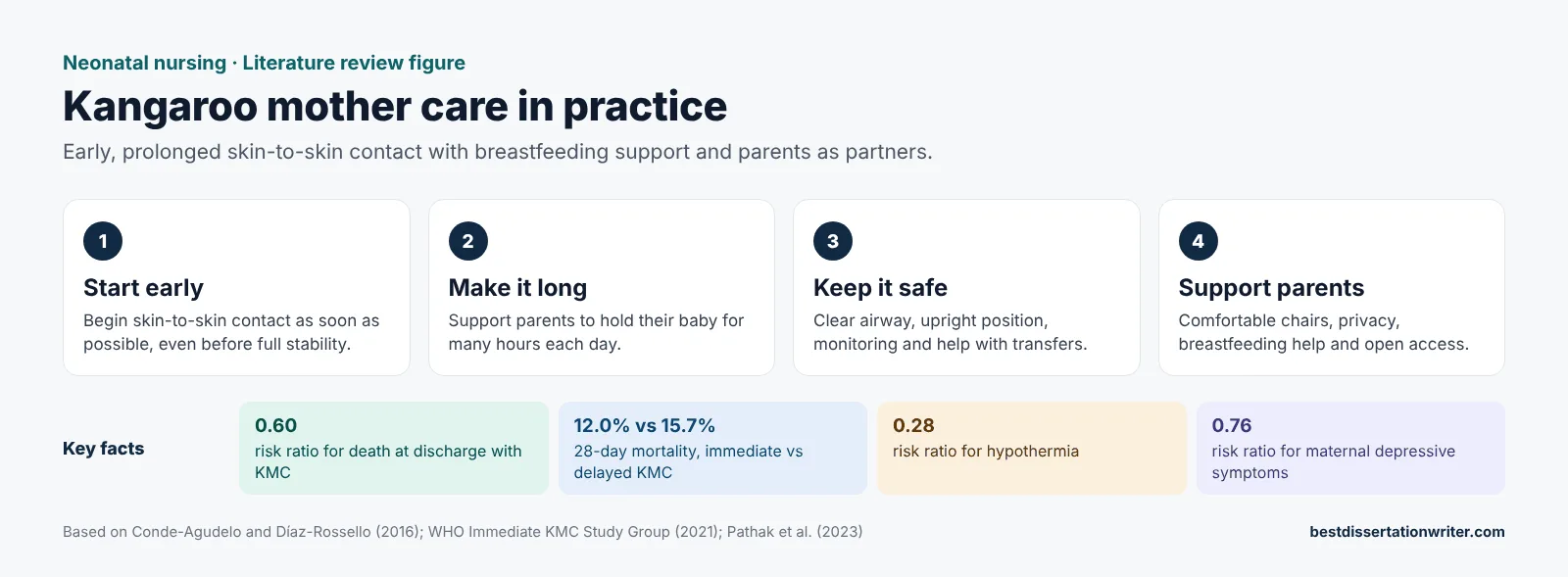
Neonatal nurses should offer kangaroo mother care to all stable small and preterm infants, start it as early as possible, support parents to provide skin-to-skin contact for many hours each day, and provide comfortable chairs, privacy and help with transfers. Kangaroo mother care builds on the benefits of skin-to-skin contact after birth and supports breastfeeding initiation.
Skin-to-skin contact can also reduce distress during painful procedures, linking it with procedural pain in neonates, and it supports milk supply, which is central to nutrition for preterm infants.
Neonatal outcomes such as growth, temperature stability and breastfeeding should be monitored alongside parents’ experiences, so that units can see the difference that more skin-to-skin contact makes for preterm infants and their families.
Conclusion
This systematic review examined the effects of kangaroo mother care on neonatal and maternal outcomes. It reduces mortality, infection and hypothermia, improves growth and breastfeeding, and reduces maternal depression, stress and anxiety. Starting it immediately after birth can further reduce deaths in small babies.
Kangaroo mother care is a simple, low-cost intervention with wide-ranging benefits. Neonatal nurses are central to making it routine, by supporting parents, adapting unit practices and ensuring that every eligible baby spends as much time as possible in skin-to-skin contact.
References
Boundy, E. O., Dastjerdi, R., Spiegelman, D., Fawzi, W. W., Missmer, S. A., Lieberman, E., Kajeepeta, S., Wall, S., & Chan, G. J. (2016). Kangaroo mother care and neonatal outcomes: A meta-analysis. Pediatrics, 137(1), e20152238. https://doi.org/10.1542/peds.2015-2238
Conde-Agudelo, A., & Díaz-Rossello, J. L. (2016). Kangaroo mother care to reduce morbidity and mortality in low birthweight infants. Cochrane Database of Systematic Reviews, (8), CD002771. https://doi.org/10.1002/14651858.CD002771.pub4
Moore, E. R., et al. (2025). Immediate or early skin-to-skin contact for mothers and their healthy newborn infants. Cochrane Database of Systematic Reviews, (10), CD003519. https://doi.org/10.1002/14651858.CD003519.pub5
Pathak, B. G., Sinha, B., Sharma, N., Mazumder, S., & Bhandari, N. (2023). Effects of kangaroo mother care on maternal and paternal health: Systematic review and meta-analysis. Bulletin of the World Health Organization, 101, 391–402. https://doi.org/10.2471/BLT.22.288977
WHO Immediate KMC Study Group. (2021). Immediate “kangaroo mother care” and survival of infants with low birth weight. New England Journal of Medicine, 384(21), 2028–2038. https://doi.org/10.1056/NEJMoa2026486
Cite this example
Best Dissertation Writers (2026) Kangaroo Mother Care and Its Effects on Neonatal and Maternal Outcomes: A Systematic Review. Available at: https://bestdissertationwriter.com/kangaroo-mother-care-literature-review/
Best Dissertation Writers
Get expert help with your nursing literature review
Share your topic and deadline with Best Dissertation Writers and get support tailored to your module brief.